KNOWLEDGE ARTICLE
What Is HTTP Status Codes?
200, 301, 302, 404, 503
Describes how a server handled an HTTP request.
At a glance
2xx usually indicates success, 3xx further action or redirection, 4xx a request-side problem and 5xx server failure. Search engines interpret codes alongside redirect targets and how long a condition lasts.
How three digits summarize a request
HTTP status codes have three digits. The first identifies the class: 1xx informational, 2xx successful handling, 3xx further action or redirection, 4xx inability to fulfill the request under its client-side semantics and 5xx server processing failure. Headers and the body complete the response.
One URL can respond differently by method, authentication, region, device and time. HEAD versus GET, browsers versus crawlers and signed-in versus anonymous users may follow different paths. A single 200 or 404 is not a statement about permanent availability.
Common codes and their consequences
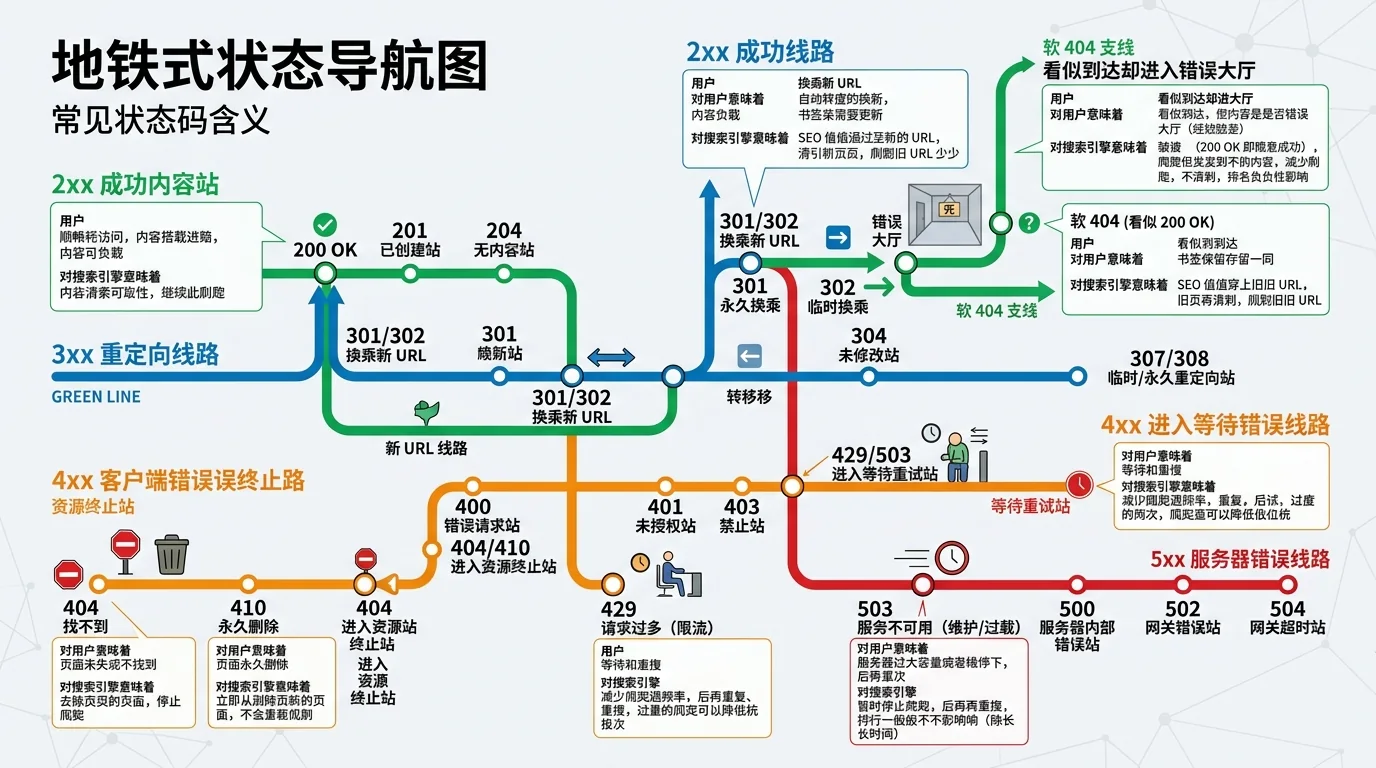
- 200 indicates a successful response, but its body could still be a soft 404, error message or challenge page. Inspect content too.
- 301 and 308 express more permanent redirection; 302 and 307 usually temporary redirection. Long chains and loops increase browsing and crawling overhead.
- 404 means the resource is not currently found; 410 more explicitly indicates permanent removal. 401 requires authentication, while 403 means the server understands but refuses the request.
- 429 signals too many requests. 500, 502, 503 and 504 can point to application failure, upstream errors, unavailability or gateway timeout. Retry-After may supply retry guidance.
Why soft 404s and errors returning 200 cause trouble
Some sites return 200 for missing content and put 'not found' only in the body. A page appears in the browser, but caches, monitors and search engines cannot rely on the status to understand it. APIs that wrap every failure in 200 similarly weaken standard error classification and retry behavior.
Conversely, prolonged 404 responses during temporary maintenance may look like deletion to search engines. A suitable 503 with Retry-After communicates temporary unavailability more clearly. Codes should match resource lifecycle and response content.
Practical use and interpretation
The initial code, redirects and final code can be reported directly, with content checks for challenges or soft errors. Lasting availability requires observations over time: one 503 describes an incident, not necessarily a permanently broken site.
Regional or User-Agent differences can arise from CDNs, access controls or targeted redirects. When only one request viewpoint is available, keep conclusions limited to that access attempt.
Points to consider
One response is a snapshot. Long-term availability and SEO effects require repeated observations and the complete redirect chain.
Frequently asked questions
Does 200 mean a page works normally?
Not always. The body could be an error, login, challenge or soft 404. Check content and the final URL.
Is 301 or 302 better for SEO?
Use the code that matches the plan: usually 301/308 for permanent moves and 302/307 for temporary redirection.
What should a maintenance page return?
Temporary unavailability commonly calls for 503, with Retry-After when appropriate. Avoid prolonged maintenance pages returning 200.