KNOWLEDGE ARTICLE
What Is PTR Records?
Reverse DNS
Maps an IP address back to a domain name.
At a glance
PTR lives in reverse-DNS zones controlled by address-space administrators. Mail systems often check sender reverse names; ordinary website browsing generally does not depend on PTR.
Looking up a name from an address
PTR maps an IP address to a reverse name. IPv4 uses in-addr.arpa and IPv6 uses ip6.arpa. Address-space administrators control these zones; the domain's usual DNS host does not automatically control them. Cloud users often request or configure reverse names through their provider.
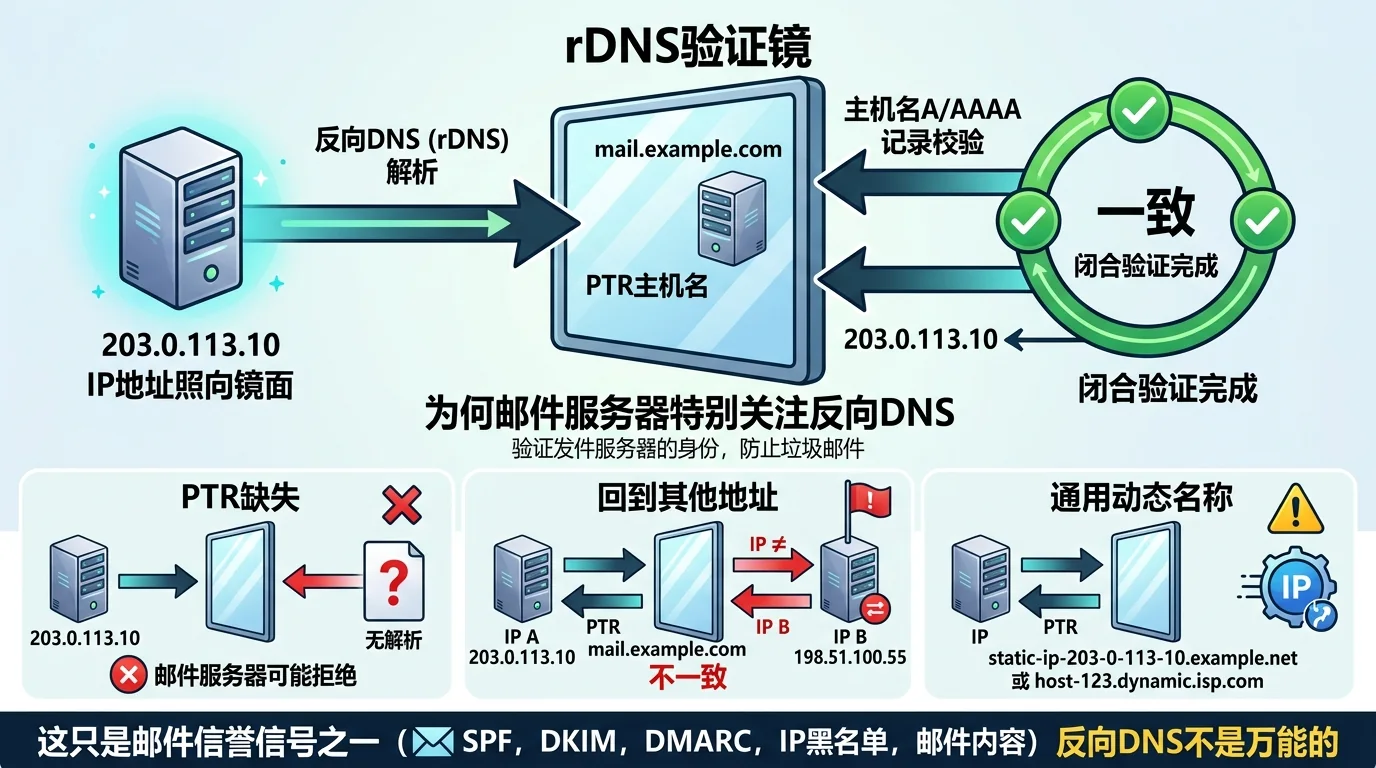
Forward DNS asks which addresses a name points to. PTR asks which reverse name an address declares. They can differ. Forward-confirmed reverse DNS adds a check: resolve the PTR name and see whether the original address is included.
Why reverse DNS matters to mail servers
- Receivers often check whether a sending IP has a plausible PTR, comparing SMTP HELO, certificates and forward resolution to detect obvious configuration problems.
- Missing PTR, generic dynamic names or inconsistent forward and reverse records may damage delivery reputation. Receiver policies vary; PTR is not an admission pass by itself.
- A shared mail platform's reverse name commonly identifies the provider rather than the customer's brand. This can be normal for hosted email.
- Ordinary web browsing usually does not require reverse DNS. A website lacking PTR does not necessarily fail to serve HTTP.
Logs, attribution and migration
Logs and diagnostic tools may resolve PTR to turn opaque addresses into readable hostnames and suggest network roles. Address holders choose those names, which can be stale or conventional. Security attribution still requires ASN, certificates and behavior.
For a mail server, choose a stable fully qualified name and ensure it resolves forward to the same IP. When addresses change, update PTR, forward records and HELO together to avoid migration-time identity inconsistencies.
Practical use and interpretation
A returned PTR name is observable and can be checked against forward DNS. Brand or geographic fragments in the name are clues, not definitive proof of ownership or physical location.
Missing PTR can be a relevant gap for a self-managed sending mail server but has limited implications for an ordinary site. Infer delivery effects only when the IP is known to send mail; otherwise remain neutral.
Points to consider
A missing PTR may have little effect on page access but can matter more to the reputation of a self-managed sending mail server.
Frequently asked questions
Can a domain owner set PTR directly?
Usually the IP provider or network operator must configure it because that organization controls the reverse zone.
Does a missing PTR make a website inaccessible?
Ordinary page access generally does not depend on PTR. Reverse DNS matters more to mail identity and some diagnostics.
Does a PTR hostname prove ownership by that brand?
Not alone. Compare ASN, forward DNS, certificates and the actual service.