KNOWLEDGE ARTICLE
What Is IP Address?
IPv4, IPv6
A numeric address used by a network host or interface for communication.
At a glance
DNS commonly maps names to IPv4 or IPv6. ASN and prefix information can identify operators, clouds or CDNs, while proxies and edge networks may conceal origins.
What an IP address identifies during a visit
An IP address identifies a routable network-interface location. IPv4 uses 32 bits and IPv6 uses 128. DNS supplies addresses and routing uses network prefixes to deliver packets. A website can have several addresses, and many websites can share one.
Modern sites often expose a CDN, reverse proxy or cloud load balancer. Browsers connect to that entry point while application servers may be elsewhere. Resolving a domain to an IP does not establish that the company owns that machine or stores data in the associated city.
Network clues available from an address
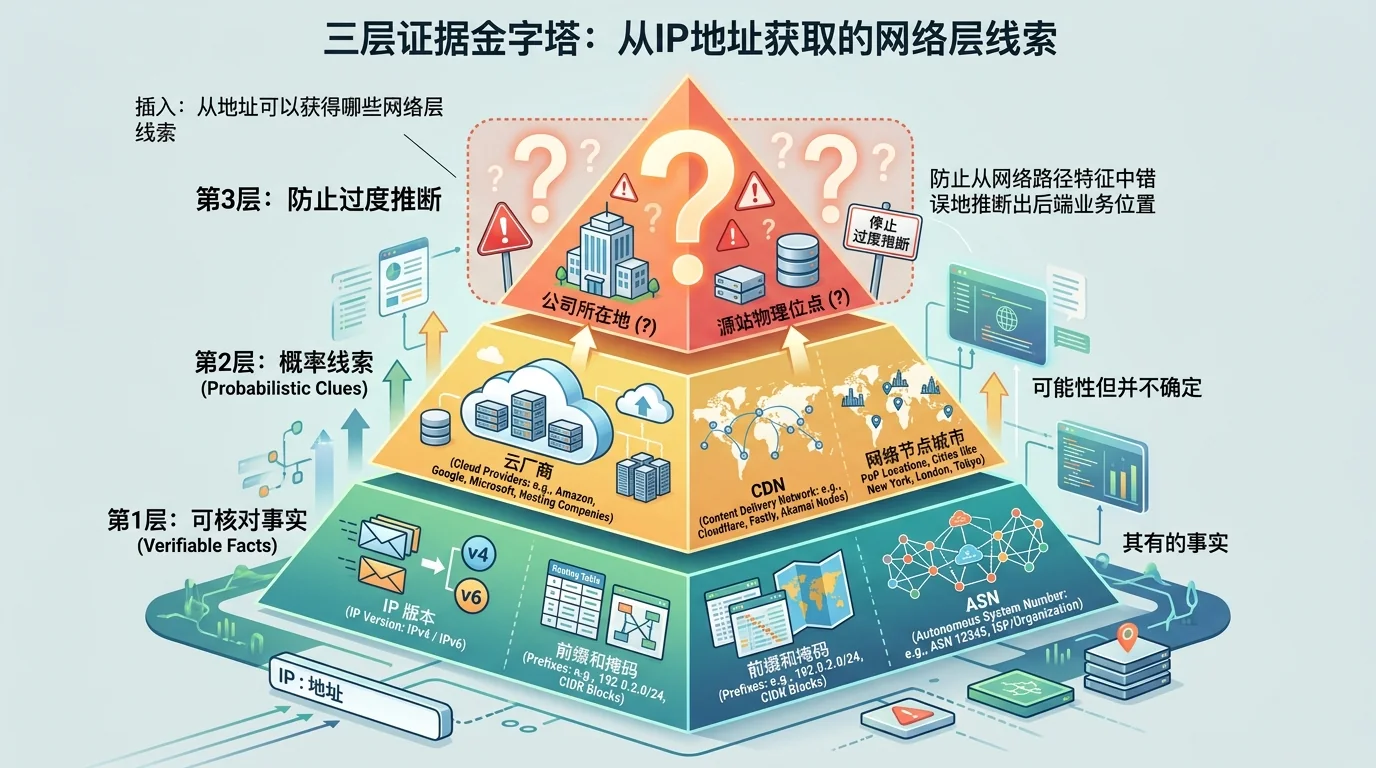
- RIR and ASN data identify organizations registering or announcing an address range, providing clues about operators, clouds and CDNs.
- Geolocation combines registration, measurements and commercial data. Precision varies; Anycast and mobile networks are especially unsuitable for pinpointing a physical server.
- PTR may expose a provider or hostname convention, but the address administrator controls it. The name is not proof of ownership.
- Shared hosting, NAT, proxies and load balancing put independent services on common addresses. A shared IP is not proof of a shared business operator.
Why an address change need not mean a migration
CDN routing, autoscaling, failover and multi-region deployments can change answers over time or location. Cloud resources may also receive new addresses after replacement while domains and content stay the same. Comparing ASN, certificates, responses and DNS chains over time gives better context than one IP comparison.
Distinguish entry-point IPs, origin addresses and third-party APIs. Scanning a shared or CDN address can touch unrelated tenants and does not represent application behavior under the correct Host and TLS name. Keep investigation tied to the intended domain context.
Practical use and interpretation
Addresses, IP versions and ASN can be direct or high-confidence network facts. Provider and node-city labels often derive from ownership or geolocation estimates. Without independent evidence, company, team and storage locations remain unknown.
Failure to resolve may result from a different service hostname, single-stack deployment, DNS errors or retirement. Compare A, AAAA, CNAME and actual connection results before describing availability.
Points to consider
IP geolocation usually describes a network node, not a company's address, team location or data-storage location.
Frequently asked questions
Do websites sharing an IP belong to one company?
Not necessarily. Shared hosting, CDNs, reverse proxies and cloud balancers routinely share addresses across unrelated sites.
Can IP geolocation identify the exact data center?
Usually not reliably. It may reflect registration or an estimated node location; Anycast, proxies and mobile networks add uncertainty.
Is frequent IP change normal?
It is common with CDNs, clouds and regional routing. Assess accompanying ASN, DNS, certificate, content and availability changes.