KNOWLEDGE ARTICLE
What Is DNS?
Domain Name System
Translates domains into server addresses and carries records for email, verification and security policies.
At a glance
DNS determines where a client connects when accessing a domain. A, AAAA, CNAME, MX, TXT and CAA records have different roles in website resolution, mail delivery, service verification and certificate issuance restrictions.
What is DNS?
DNS, the Domain Name System, is the Internet's distributed naming system. Its most familiar job is translating a memorable domain such as notion.com into an IP address that a device can connect to. Websites, email, certificate authorization, service discovery and platform verification also use DNS. It is therefore more like a directory of addresses and rules for Internet services.
DNS is managed hierarchically. The root, top-level domains and individual authoritative zones each manage a different scope; no single server holds every record in the world. This structure supports independent administration, while caching and multiple servers help keep resolution available.
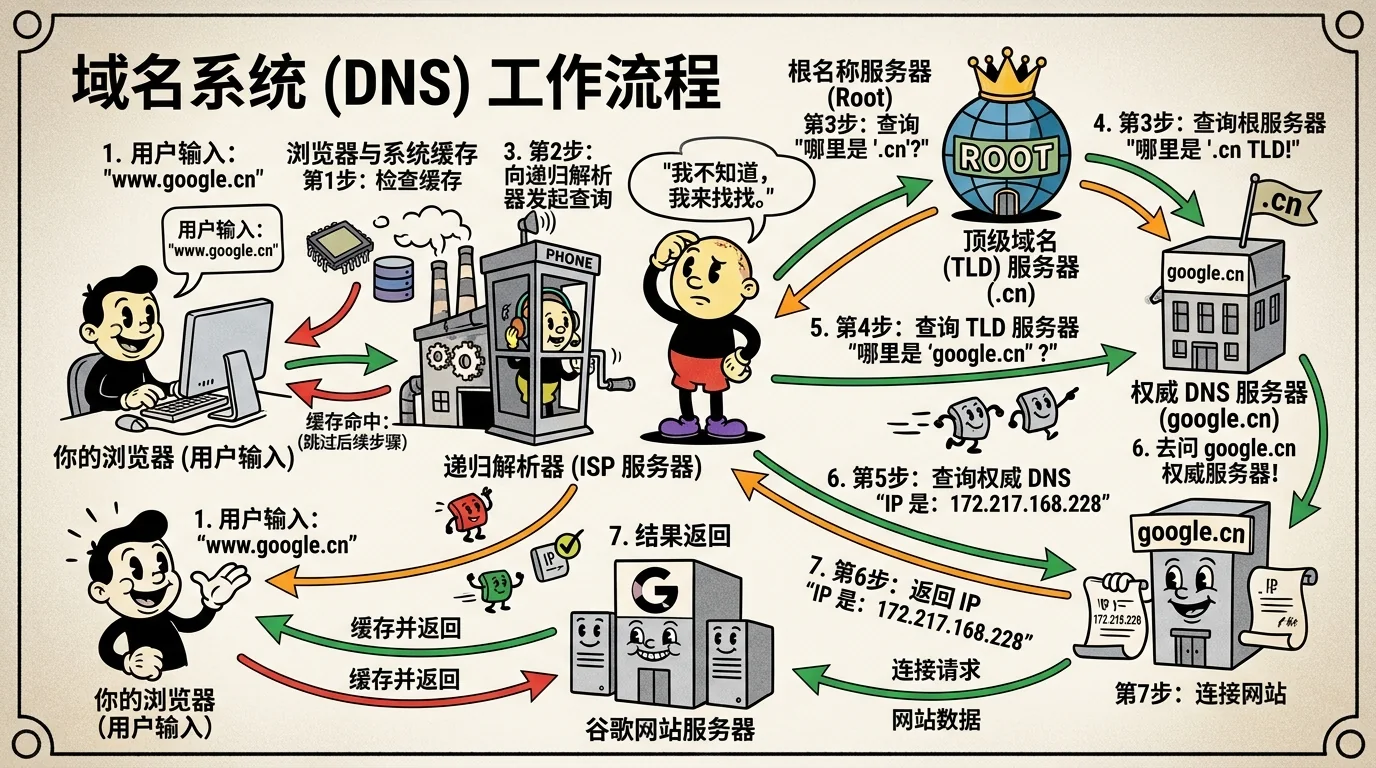
The complete DNS resolution process
- After a user enters a domain, the browser, operating system and local network check their caches. An answer whose cache lifetime has not expired can be reused.
- Without a cached answer, the request goes to a recursive resolver. The resolver asks a root name server where to find the relevant top-level domain, then asks that domain's name servers for the target domain's authoritative DNS servers.
- The authoritative server returns A, AAAA, CNAME or other records. The recursive resolver passes the answer and TTL to the client and caches the data for the permitted period.
- Only after obtaining an address does the browser establish a TCP or QUIC connection, negotiate TLS and request the page. DNS begins the access process; it does not transfer the page content.
Authoritative DNS versus recursive resolvers
Authoritative DNS holds the official records for a zone and provides definitive answers about it. A recursive resolver searches on a user's behalf, follows CNAME chains and caches results. Think of authoritative DNS as the keeper of the original address book, and the recursive resolver as the service that looks up an address for you.
Website operators usually manage an authoritative zone themselves or delegate it to a DNS provider. A user's recursive resolver may be supplied by an Internet provider, a corporate network or a public DNS service. These roles differ, and failures at each layer have different effects.
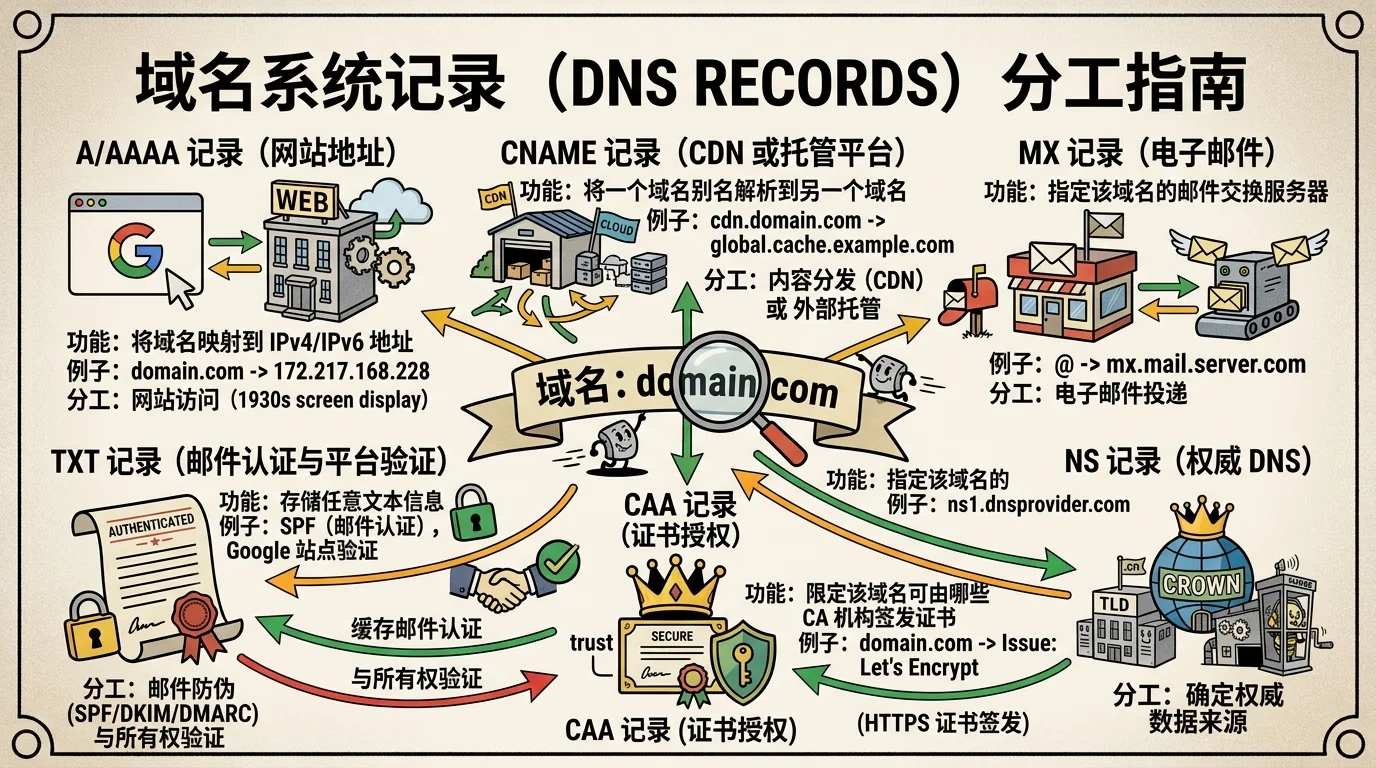
What common DNS records describe
- A and AAAA records provide IPv4 and IPv6 addresses respectively. They may point to an origin server or a CDN edge node.
- CNAME records make one name an alias of another and continue resolution through that target. SaaS products, hosting platforms and CDNs commonly use them.
- MX records define the receiving path for email. TXT records often carry SPF, DKIM, DMARC or third-party ownership verification information.
- NS records identify authoritative DNS servers. CAA records restrict which certificate authorities may issue certificates for the domain. DNSSEC adds verifiable signatures to DNS data.
How DNS caching and TTL affect access
TTL sets how long a DNS record may be cached. A longer TTL reduces repeated queries and improves cache reuse, but old answers can remain in use longer after a change. A shorter TTL supports failover and migration at the cost of more queries to authoritative DNS.
What is commonly called DNS propagation is usually not a record being copied from server to server across the Internet. It is older cached answers expiring at different clients and recursive resolvers. Before a planned migration, operators often lower TTL in advance, then restore a suitable routine value after the service stabilizes.
DNS security and common failures
- DNSSEC uses digital signatures to help resolvers verify that an answer comes from the correct zone and has not been modified. It does not encrypt queries or replace HTTPS.
- Cache poisoning or DNS spoofing can cause a resolver to store an incorrect address and direct users to an unintended server. Correctly configured and validated DNSSEC can reduce this risk.
- A DNS timeout can originate in the local network, recursive resolver, authoritative DNS or zone configuration. Identifying the failing layer comes before choosing a different resolver, correcting records or contacting the provider.
- SERVFAIL, NXDOMAIN and a timeout mean different things. SERVFAIL generally indicates a resolution failure; NXDOMAIN means the name does not exist; a timeout means no response arrived within the allotted time.
Practical interpretation: what DNS can reveal
DNS provides clues about website addresses, IPv6 support, DNS hosting, email providers, platform integrations and security settings. Combining signals can clarify the infrastructure. For example, a CNAME pointing to a known platform is more persuasive when the HTTP response headers also match that platform.
IP geolocation normally describes the current network node. With a CDN such as Cloudflare, the address is more likely to belong to an edge node, leaving the company's location, origin server and data storage location unknown. Platform attribution should also be supported by several signals, such as CNAME records, name servers and response characteristics.
Points to consider
DNS configuration directly affects website availability, email reliability and some layers of security.
Frequently asked questions
Does DNS directly affect website speed?
It affects the lookup time before a connection starts. Overall page speed also depends on network distance, TLS, server response times, CDN caching and frontend resources. Reliable DNS hosting and suitable TTL values can reduce lookup delays and the chance of failures.
Why do DNS changes not take effect everywhere immediately?
Recursive resolvers and clients may still use old cached answers. The delay mainly depends on the previous record's TTL, caches at different layers and providers' refresh policies.
How does DNS differ from RDAP or WHOIS?
DNS tells clients how to locate websites and email services. RDAP and WHOIS provide registration data such as domain events, registrars and status.
Does a missing DNS record mean a feature is not used?
Not necessarily. A feature may use another hostname, a different zone or a method outside DNS. Incomplete public information leaves the state unknown. A statement that a record was not found is appropriate only after a complete response confirms its absence.
Can DNSSEC and HTTPS replace each other?
No. DNSSEC mainly authenticates DNS responses. HTTPS protects data in transit and verifies domain identity at the connection endpoint. They protect different parts of the access path.