KNOWLEDGE ARTICLE
What Is Certificate Chain?
TLS chain of trust
A validation path from a website certificate through intermediates to a trusted root.
At a glance
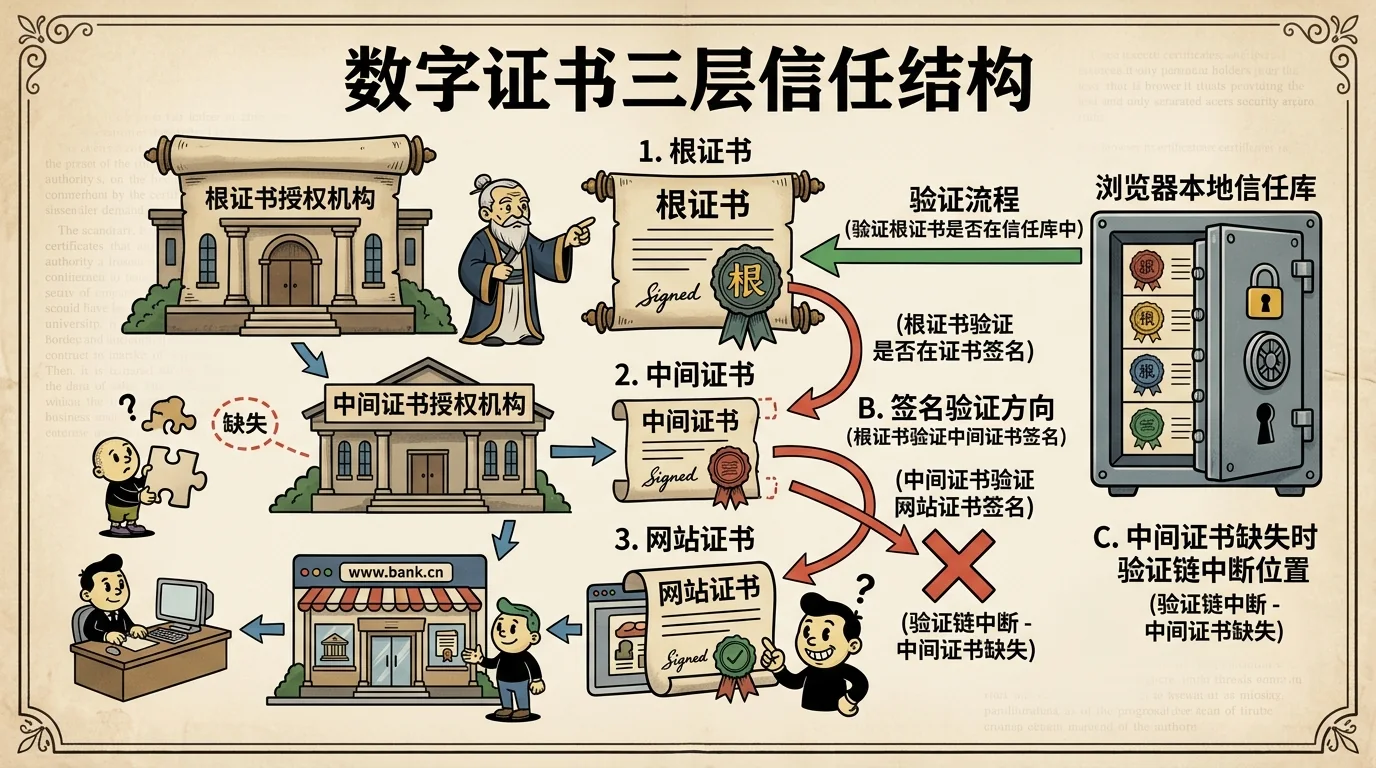
Servers normally send the leaf and necessary intermediate certificates. Clients connect them to a locally trusted root. Missing intermediates, mismatched names or invalid signatures can break validation.
Connecting a website certificate to a trust anchor
Website certificates are normally issued through intermediate CAs rather than directly by a root. Clients validate each signature, purpose, lifetime and constraint until reaching a locally trusted root. Servers generally need not send the root because the client already decides whether to trust it.
Servers should supply the leaf and intermediates needed to build the path. Cached intermediates can make a browser appear fine while new devices, command-line clients or restricted networks fail, concealing a deployment defect.
What clients check along the path
- A certificate's issuer should correspond to the next intermediate's subject, with signature validation establishing integrity.
- Basic Constraints, Key Usage, name constraints and policy extensions govern CA capability, issuance scope and permitted purposes.
- Certificates along the path must be within their validity periods and use algorithms and keys accepted by the client's current policy.
- Cross-signing may create alternative paths. Client trust stores and path-building algorithms can choose differently, especially on older devices.
Diagnosing missing or misordered intermediates
Retrieve the actual server-supplied list, then inspect the leaf hostname, issuer and intermediates. Common mistakes include deploying only the leaf, adding unrelated roots, misordering certificates, using expired cross-signatures or deploying different chains at CDN and origin.
After repair, test clean clients, multiple TLS libraries and different networks so local caches do not mask faults. Automated renewal should deploy the full chain, not merely replace the leaf each time.
Practical use and interpretation
A complete server-chain capture identifies which intermediates were sent and permits validation against a particular trust store. Success in one environment does not guarantee compatibility with every old or embedded client.
Unknown chain data does not justify declaring a complete configuration. A confirmed missing intermediate may cause warnings for some clients, depending on caches and trust stores. A deployment report should identify the tested client and trust environment.
Points to consider
A complete chain supports access across devices, but authenticates a connection rather than guaranteeing safe content.
Frequently asked questions
Must a server send the root certificate?
Usually not. The client trust store supplies roots; servers mainly send the leaf and necessary intermediates.
Why does my browser work while a checker reports an incomplete chain?
The browser may cache or download an intermediate that a clean client cannot obtain. Inspect the certificates actually sent by the server.
Is a longer chain more secure?
No. Length reflects issuance structure. Security depends on algorithms, constraints, key protection and trust policy; unnecessary certificates also enlarge the handshake.