KNOWLEDGE ARTICLE
What Is Certificate Authority?
CA
An organization that validates applications and issues digitally signed certificates.
At a glance
Browsers and operating systems trust selected roots and validate a website's chain to one of them. DV, OV and EV describe validation levels, not guarantees about content or transactions.
From domain control to a verifiable certificate
A CA checks an applicant against relevant requirements, then signs a certificate with its private key. Browser and operating-system trust stores contain selected roots; intermediates connect a website certificate to those roots. Public CAs are governed by root programs, audits and industry rules.
DV mainly verifies domain control; OV and EV add organization checks. All can use modern encryption. Browsers no longer prominently distinguish EV in the address bar, so validation types should not be presented as grades guaranteeing content or transactions.
Validation and issuance steps
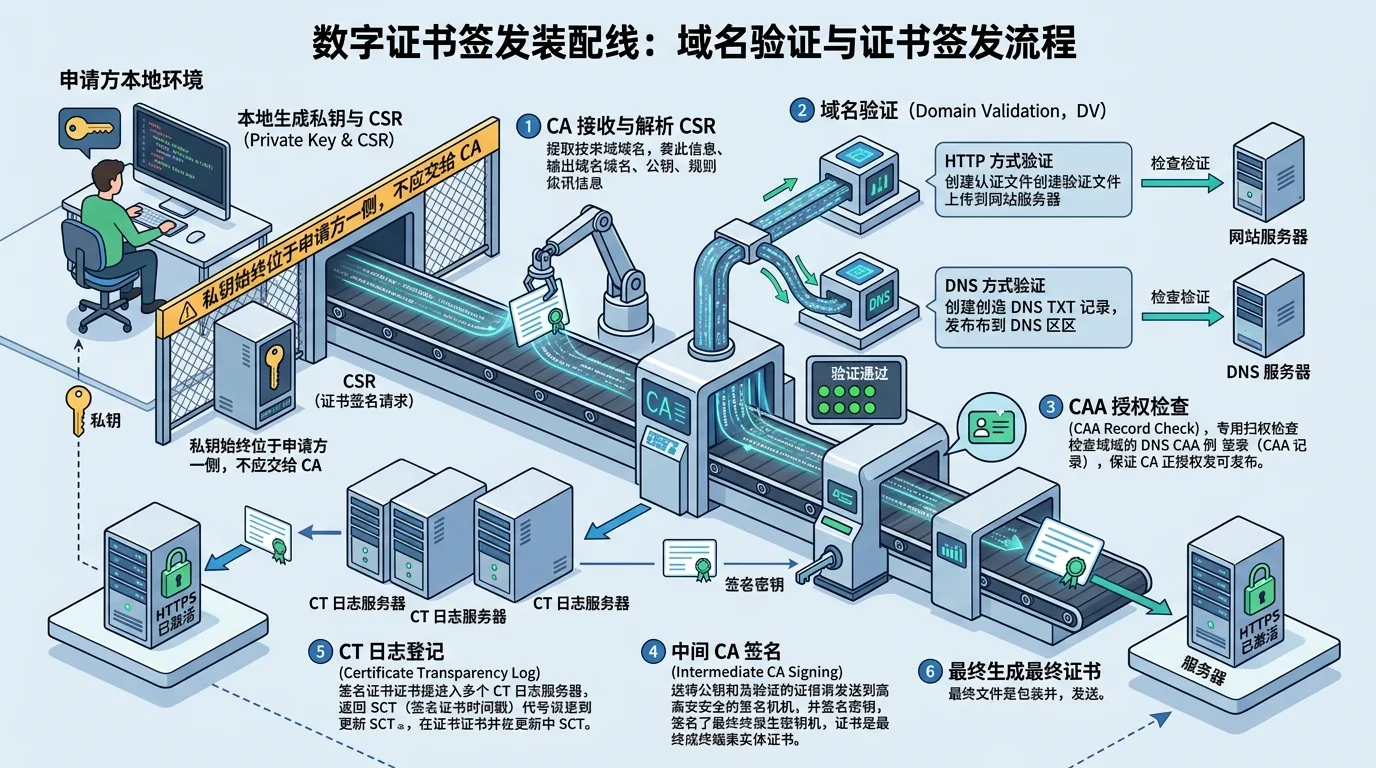
- The applicant generates keys and a certificate request or automated order, supplying domains and relevant organization information. The private key normally stays under the applicant's control.
- HTTP, DNS or TLS-ALPN challenges verify domain control. CAA can additionally restrict whether the chosen CA is authorized.
- After validation, an intermediate signs the certificate. The server deploys it with the needed intermediates; clients check names, validity and trust.
- Issuance appears in certificate transparency logs. Compromise or misissuance may require early revocation published through CRL or OCSP mechanisms.
Free, commercial and cloud-managed certificates
Free automated CAs reduce HTTPS costs. Short lifetimes and automated renewal do not imply weaker encryption. Commercial differences often concern organization validation, support, service agreements, management and compliance rather than payment making encryption safe.
A CDN or cloud can manage edge certificates while using a different public or private certificate to the origin. Distinguish the user's connection endpoint from the backend link; the edge certificate does not reveal the entire origin setup.
Practical use and interpretation
Issuer, validation information and chain explain how a browser establishes technical trust. A familiar CA or commercial certificate reflects management choices, not proof of trustworthy business operations or safe content.
An unknown issuer may reflect an incomplete chain, private CA or failed handshake. Identify a CA only from clear chain data. Organization identity also needs comparison with certificate fields and independent public information.
Points to consider
Issuer, validation method and chain explain technical trust, not the reliability of a business or its claims.
Frequently asked questions
Are free CA certificates cryptographically weaker?
Not inherently. Suitable algorithms, keys, hostname matching and a trusted chain allow free DV certificates to establish secure TLS.
Does a familiar CA make a website trustworthy?
The CA verifies the relevant certificate-application requirements. DV establishes domain control, not endorsement of content or business conduct.
Why is an intermediate shown instead of a root?
Intermediates normally issue website certificates. Clients validate onward to trusted roots, protecting root keys and simplifying management.