KNOWLEDGE ARTICLE
What Is AAAA Record?
IPv6 address record
Maps a domain or hostname to an IPv6 address.
At a glance
AAAA serves a similar role to A but returns IPv6. When both exist, clients choose usable paths according to network conditions.
Providing an IPv6 entry point
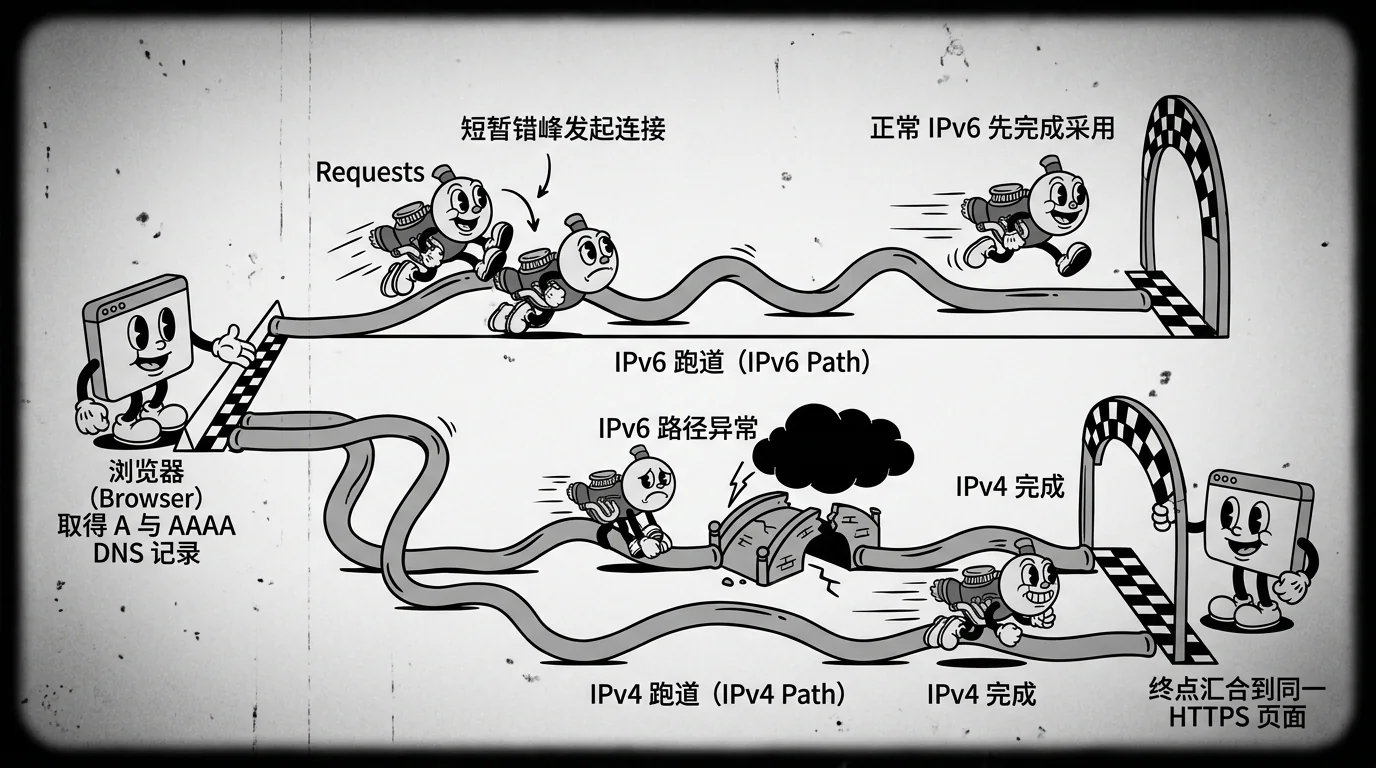
AAAA maps a name to a 128-bit IPv6 address, corresponding to IPv4's A record. Publishing both creates a dual-stack entry point. IPv6-capable clients generally evaluate the paths during connection rather than permanently selecting one protocol.
IPv6 has a larger address space and a different notation, but the record still supplies only an address. Working access also requires routing, firewalls, load balancing, TLS and application services along the IPv6 path.
How dual-stack clients choose a path
- After resolving A and AAAA, browsers combine operating-system address selection with network history. Modern implementations commonly use Happy Eyeballs to avoid long stalls on a broken path.
- An AAAA answer does not prove the IPv6 port is reachable. Missing routes or firewall rules can cause slow connections and fallback on some networks.
- A CDN may expose IPv6 at the edge while connecting to its origin over IPv4. Public AAAA only establishes a clue about the user-facing entry point.
- IPv6 addresses can change with geography and routing. Counts, prefixes and ASN provide architectural clues, not a fixed physical-server inventory.
Checks needed before enabling IPv6
Adding AAAA alone is insufficient. Check listeners, load balancers, security groups, WAF, logging, rate limits, monitoring and origin policy. Otherwise IPv4 and IPv6 may expose different security behavior.
Test DNS, TCP/QUIC, TLS and HTTP from several IPv6 networks, comparing content and redirects with IPv4. Publishing an unreachable AAAA can hurt users more than waiting until the path is ready.
Practical use and interpretation
An AAAA response confirms a published IPv6 address; connectivity can then be tested separately. If the address exists but the connection fails, describe configured IPv6 DNS with a possible access problem, rather than a simple supported/unsupported label.
No answer can mean authoritative absence, a different service hostname or a temporary lookup problem. Insufficient evidence leaves IPv6 status unknown; a confirmed absence supports 'no IPv6 entry point found'.
Points to consider
AAAA indicates an IPv6 entry point; a real connection test is still needed to establish availability.
Frequently asked questions
Does AAAA prove complete IPv6 support?
No. Validate routing, ports, TLS, HTTP content and security policies on the actual IPv6 path.
Why can enabling IPv6 slow access for some users?
An unreachable or poor IPv6 route can delay fallback to IPv4. Check routing, firewalls, load balancing and connectivity from multiple regions.
Must a site retain both A and AAAA?
Dual stack provides broader compatibility. IPv6-only depends on user networks and translation mechanisms; suitability depends on the audience and infrastructure.