Website profiles · Technology insights · Alternatives

cute-kaomoji.com

Cute Kaomoji - Discover the ultimate collection of cute kaomoji on our website! Find the perfect emoji to express your emotions with adorable kaomojis (ᵔᴥᵔ), including cat faces (=^・ω・^=), smiles (^ω^), hearts (♡^▽^♡), and more. Visit now for more clicks and sharing fun!

No paid content found Multilingual
Visit website
Profile views 6 Outbound visits 2 Normal
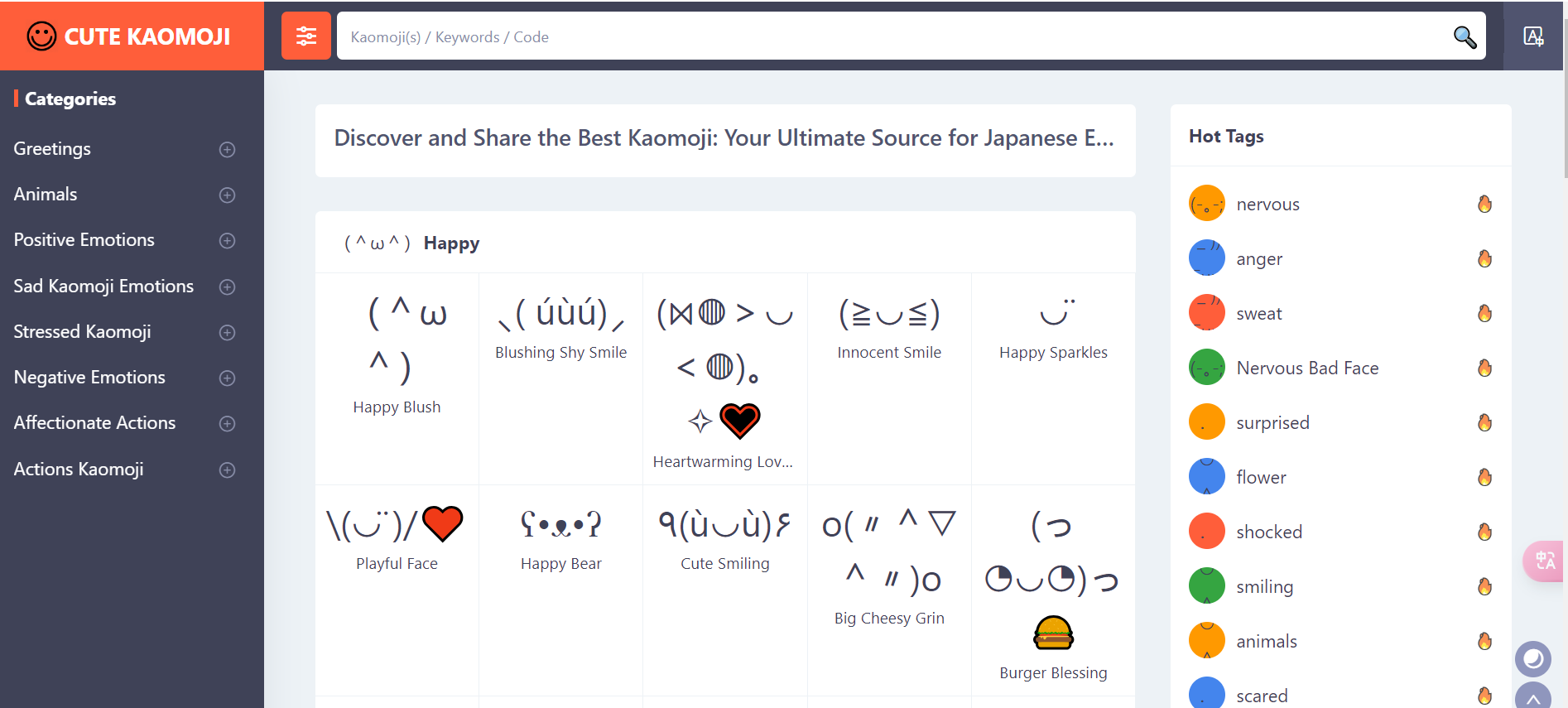
Cute Kaomoji Full homepage screenshot

At a glance

Category
Other
Language
English
Paid-content signal
No paid content foundObserved
Registered
2024
Hosting
CloudflareInferred
HTTPS certificate trusted
PassedObserved
Last updated

Website review

This review may include AI-generated content and is not individually verified. Domain, certificate and other facts come from the observed data on this page.

What is Cute Kaomoji?

Cute Kaomoji is a browsable collection of Japanese-style text emoticons — kaomoji — organized by mood and use. The site groups faces under categories such as Happy, Love, Kissing, Dancing, and Anger, and each entry pairs the face with a plain-English label and a "Copy" button, so you can grab the symbol string and paste it into a chat, post, or comment. The page also offers an interface in English, Spanish, and Japanese.

What you'll find there

  • Mood-based categories. Instead of hunting through one long list, you start from a feeling: happy, blushing, love, kissing, dancing, angry.
  • Labels that explain the face. Entries like "Happy Blush," "Heartwarming Love Smile," "Bear Kiss," or "Boogie Down Gangnam Style" tell you the intended tone before you paste.
  • One-click copying. The main practical feature is the Copy button next to each kaomoji, which matters because these strings use characters that are tedious to type manually.
  • Variety within a mood. A single category mixes simple faces with elaborate ones, so you can pick something subtle or something loud.

Who it suits

It's most useful for people who chat, comment, or post on platforms where emoji feel too generic or where image stickers aren't available — Discord, Twitch chat, forums, YouTube comments, text messages. Kaomoji are plain text, so they survive copy-paste across apps that mangle images or custom emoji. If you write in a casual, playful register and want a face that reads as cute rather than corporate, this is the kind of site you'd keep open in a tab.

The trade-off is that text faces render differently depending on the font and platform. A face built from combining marks, hearts, or musical notes can look misaligned or show as boxes on some devices, and long ones may wrap awkwardly in narrow chat boxes. Shorter, simpler faces are the safer choice for anything public.

A practical next step

Pick your platform first, then your face. For a phone chat with a small input box, choose a compact option like (^ω^) or ʕ•ᴥ•ʔ. For a forum signature or a Discord message where alignment holds, the longer decorative ones — say (⋈◍>◡<◍)。✧♡ — work better. Test-paste into the actual app before committing, and keep two or three favorites saved in a notes file so you're not re-browsing each time.

If you want a wider range beyond cute and kawaii moods, general-purpose kaomoji libraries such as Kaomoji.ru cover categories like despair, confusion, and table-flip frustration that this collection only touches on.

How do I copy and paste a kaomoji to use in a text or social media post?

Copy a kaomoji the same way you copy any short text: select the whole face, copy it, then paste it where you want it. Most kaomoji sites put a "Copy" button next to each face, which is faster and avoids cutting off a bracket or part of the symbol.

Step by step

  1. Find the kaomoji you like, for example a happy face like (^ω^) or a cat like (=^・ω・^=).
  2. Click the Copy button beside it if one is available. Otherwise, drag your cursor across the entire kaomoji and press Ctrl+C (Windows) or Cmd+C (Mac).
  3. Open your text message, social media post, comment box or bio field.
  4. Paste with Ctrl+V or Cmd+V.

On a phone, press and hold the kaomoji, tap Select all or drag the selection handles to cover the whole face, then tap Copy. In your messaging app, press and hold the text field and tap Paste.

What to watch out for

  • Select the full kaomoji. These faces mix parentheses, slashes, dots and special characters, so missing one character can break the look.
  • Font and platform support vary. Some kaomoji contain rare symbols or combining marks that may display as boxes or misaligned on certain apps. Test the paste before posting somewhere important.
  • Length limits. Social media bios and some comment fields have character caps. Longer kaomoji with extra sparkles or hearts eat into that space.
  • Plain text is safest. Kaomoji work as ordinary characters, so they survive copy-paste into most apps without special formatting.

Where to find them

Cute Kaomoji groups faces by mood and use, such as happy, love, kissing and dancing categories, and includes a copy option for each entry. If you want a broader set of expressions beyond cute styles, Kaomoji.ru is a long-running collection organized by emotion.

A practical next step: keep a small note on your phone or computer with five or six kaomoji you use often. That way you can paste them quickly without hunting for them each time.

Which kaomoji should I choose to express love or affection in a message?

For love or affection, pick a kaomoji whose gesture matches the relationship and the tone of the message. Cute Kaomoji groups these by mood rather than by a single "best" one: its Love section includes blushing, heart, kiss and hug faces, and its Kissing section leans more playful or romantic.

Quick matching

Feeling Kaomoji from the site Where it fits
Warm, soft affection ( ͈̆ ᴗ ͈̆♡) Blushing Kiss Close friends, partners, a gentle goodnight
Excited love ♡^▽^♡ Excited Cheer Good news, reunions, enthusiastic replies
Cute, shy crush ⸜( ̇ ̆ ̇)⸝ Blushing Shy Smile Early dating, flirty but low-pressure
Sending a heart (っ◔◡◔)っ ♥ Smiling Heart Quick reaction in a chat
Playful kiss (づ ̄ 3 ̄)づ Love Hug and Kiss Established couples, inside-joke affection
Animal-cute affection ʕʽɞʼʔ Bear Kiss Friends who like cute animals, casual warmth

How to decide

  1. Match the gesture to the relationship: a heart or blush face reads as affectionate; a kiss face reads as romantic or cheeky. A "hug" kaomoji is safer for a friend than a kissing one.
  2. Match the energy to the message. A quiet "thinking of you" pairs better with ( ͈̆ ᴗ ͈̆♡) than with a dancing or cheering face.
  3. Check how it renders. Some kaomoji use combining marks, so they can look misaligned in older apps or certain fonts. Copy one, paste it into the exact app you'll send from, and see it on your own screen first.
  4. Keep one per message. A single kaomoji carries the feeling; several in a row dilute it and can look like spam.

A concrete example

If you're texting a partner after a long day: "Made it home safe ( ͈̆ ᴗ ͈̆♡)". If you're replying to a friend's good news: "That's amazing ♡^▽^♡". If you want something flirty but not heavy: "You're trouble ⸜( ̇ ̆ ̇)⸝".

Next step

Open the Love section on Cute Kaomoji, copy two or three that fit your message, and test them in your messaging app before sending. For more options beyond this collection, the Japanese emoticon communities on Reddit and the archives at Kaomoji.ru are useful, though their tone ranges wider than the cute, affectionate set here.

What are the best cat kaomoji for cute pet-themed chats?

For pet-themed chats, the strongest cat kaomoji are the compact, instantly readable ones. A cat face works best when it looks like a cat even to someone who has never seen Japanese emoticons before, and when it fits into a chat without breaking the line.

From the collection on Cute Kaomoji, the cat examples given are built from ears, whiskers and a small round face. The classic (=^・ω・^=) is the safest all-purpose choice: the ^ ears and = whiskers read as a cat at a glance, and the ω mouth keeps it soft rather than sharp. The bear-style ʕ•ᴥ•ʔ is also listed under the happy faces, and while it is technically a bear, many pet chats use it for a round-faced cat or a small fluffy animal because it is symmetrical and easy to read.

Matching the cat to the moment

  • Everyday cute reply: (=^・ω・^=) — neutral, friendly, works after almost any message.
  • Excited or greeting: a happy face like (^ω^) or ⸜( ̇ ̆ ̇)⸝ paired with cat ears if you want to build your own.
  • Affectionate pet chat: a heart kaomoji such as ♡^▽^♡ or ( ͈̆ ᴗ ͈̆♡) reads as warmth without needing a cat shape.
  • Playful or cheeky: ʕ•ᴥ•ʔ or a dancing face like ᕕ( ᐛ )ᕗ if your pet has just done something ridiculous.
  • Apologetic after a mess: something like (ɔˆ 3(ˆ⌣ˆc) softens the tone while staying cute.

A quick comparison

Kaomoji Reads as Best used for
(=^・ω・^=) Cat General pet chat, introductions, neutral replies
ʕ•ᴥ•ʔ Bear or round pet Fluffy, cozy or slightly silly moments
(^ω^) Happy face Quick reactions, no cat shape needed
♡^▽^♡ Heart face Affection, missing your pet, good news
ᕕ( ᐛ )ᕗ Dancing figure Celebrating a pet's antics

Practical tip

Kaomoji are plain text, so they survive copy-paste into most chat apps, but very wide ones can wrap awkwardly on narrow phone screens. Shorter faces such as (=^・ω・^=) and ʕ•ᴥ•ʔ are safer for group chats and comments. If you want variety without hunting, keep two or three favourites saved in a notes app: one neutral cat, one heart, one silly. That covers most pet-themed replies, and you can browse the happy, love and dancing sections on Cute Kaomoji when you want something new.

How can I share a kaomoji with someone else or on social media?

Copy the kaomoji characters themselves, not a screenshot. Kaomoji are plain text, so they paste directly into chat apps, social posts, comments and email. On Cute Kaomoji, each entry has a "Copy" button next to the face, which places the exact characters on your clipboard.

Sharing in practice

  • Direct message or text: Paste the kaomoji at the end of a sentence, e.g. "See you tomorrow (^ω^)". Keep it on its own line if the face is wide, since some fonts misalign long ones like ᕕ( ᐛ )ᕗ.
  • Social posts: Kaomoji work in captions and comments on most platforms. They count as regular characters, so long faces eat into character limits.
  • Email: Fine for informal mail, risky in professional correspondence. Some corporate mail filters or older clients render the Unicode symbols as boxes.
  • Stickers, notes, usernames: Because they are text, they can go almost anywhere text is allowed, including profile bios and document headings.

A quick decision guide

Situation Good choice Watch out for
Casual chat with friends Any face, including long dancing ones Nothing much
Public social comment Short, widely supported faces like (^ω^) Character limits, platform formatting
Work email or formal post Skip, or use a plain emoticon Looks unprofessional; font issues
Cross-platform sharing Test-paste once before sending Some symbols break in older apps

Practical next step

Pick the face that matches the tone first, then test it. Copy your chosen kaomoji, paste it into the exact app or site you plan to use, and check that every symbol survives. If it breaks into empty boxes, choose a simpler face. The site groups entries by mood, such as its Happy, Love, Kissing and Dancing sections, which makes it faster to find a fitting expression than scrolling a single long list. If you want a wider pool of faces to compare, Emojipedia covers standard emoji rather than kaomoji, so it is a different tool rather than a substitute.

Are there kaomoji for expressing anger or frustration in a playful way?

Yes. Cute Kaomoji groups a set of angry and frustrated faces alongside its happy, love, and dancing categories, and they lean comic rather than genuinely hostile. From the site's own listings:

  • (∩-´)⊃━━☆゚.*・。゚` — labelled "Magic Wand Anger"
  • ᕦ(ò_óˇ)ᕤ — "Flexing Strongman"
  • ╭∩╮(Ο_Ο)╭∩╮ — "Double Middle Finger"
  • ヽ(´ー)人(´∇)人(Д´)ノ` — "Friendly Party Goer" (also filed under Dancing)
  • ((*´-ω・人´・ω-*)) — "Frustrated Anger"
  • 凸(¬‿¬)凸 — "Cheeky M"
  • ˚‧o·(˚ ˃̣̣̥⌓˂̣̣̥ )‧o·˚ — "Sobbing and Angry"

Which one to pick

Situation Face to reach for Why
Mild irritation at a friend 凸(¬‿¬)凸 The smirk keeps it teasing, not hostile
Mock outrage, "I'm so done" (∩-´)⊃━━☆゚.*・。゚` The magic-wand flourish turns rage into a gag
Pretend toughness ᕦ(ò_óˇ)ᕤ Reads as flexing bravado rather than real anger
Genuine sulk that still needs to be cute ˚‧o·(˚ ˃̣̣̥⌓˂̣̣̥ )‧o·˚ Sobbing face signals hurt, not attack
Group-chat pile-on, played for laughs ヽ(´ー)人(´∇)人(Д´)ノ` Three characters suggest a crowd, so it works as banter

A practical note on tone

The middle-finger face ╭∩╮(Ο_Ο)╭∩╮ is the one entry here that can land badly. In a casual chat between friends it reads as a joke; in a work channel, a first message to someone, or a public comment thread, the gesture survives the cartoon styling and can still offend. If you want the playful effect without the risk, the magic-wand or flexing options do the same job with less edge.

Next step

Copy the face you want directly from the category page, since kaomoji depend on exact character combinations and retyping them by hand usually breaks the spacing or the combining marks. If you want to go further, browse the wider collection at Cute Kaomoji for the happy, love, and dancing sets, which mix well with an angry face when you want a mock-furious reply softened by a heart or a dance move.

Related questions

More questions →
What Are Cat Kaomoji and How Do You Use Them?

Cat kaomoji are Japanese-style text emoticons built from keyboard characters to look like cats — for example (=^・ω・^=) or ʕ•ᴥ•ʔ. You use them by copying the plain text and pasting it into chats, social posts, or comments. They work best where plain text is supported and the font renders Japanese and Unicode characters correctly.

What makes a kaomoji a "cat" kaomoji

A kaomoji (顔文字, literally "face character") is read straight-on rather than rotated 90 degrees like Western emoticons. Cat versions borrow cat-specific features:

  • Pointed ears — ^ or ・ shapes at the top, as in (=^・ω・^=)
  • Whiskers — = or ~ marks flanking the face
  • Paws or a rounded muzzle — ω, ᴥ, or ・ in the center
  • Round head outlines — parentheses ( ) or bear-like ʕ ʔ brackets

The site's collection shows the range: ʕ•ᴥ•ʔ Happy Bear sits alongside cat-style faces, and the same ear-and-whisker logic appears across the happy, love, and dancing categories.

Common cat kaomoji and what they signal

Kaomoji Style Typical mood
(=^・ω・^=) Classic cat with whiskers Neutral, friendly
ʕ•ᴥ•ʔ Bear/cat hybrid face Happy, cute
(ΦωΦ) Wide-eyed cat Curious, alert
(=`ω´=) Cat with set features Determined, cheeky
ฅ^•ﻌ•^ฅ Cat with raised paws Playful, affectionate

Mood matching matters more than exact style. If you want a happy tone, the site groups faces like (^ω^) Happy Blush and ʕ•ᴥ•ʔ Happy Bear under its happy section; for affectionate messages, the love section includes ( ͈̆ ᴗ ͈̆♡) Blushing Kiss and ♡(.◜ω◝.)♡ Heartful Love.

How to copy and use a cat kaomoji

  1. Find the face you want on a kaomoji collection page.
  2. Select the text — drag across the kaomoji, or use the copy button if the site provides one. The site labels entries with a "Copy" action next to each face.
  3. Paste it into your message, caption, or comment field.
  4. Check the rendering in the target app before sending.

Expected result: the kaomoji appears as a single readable face. If it breaks into boxes or question marks, the app or font doesn't support some of the characters.

Avoiding formatting problems

  • Use plain text. Rich-text editors, some CMS fields, and certain email clients may strip or alter the characters.
  • Test in the target app first. A face that looks fine in a browser may render differently in a mobile chat app.
  • Watch character width. Kaomoji mix full-width and half-width characters; some platforms add unexpected spacing.
  • Keep a fallback. If a complex face fails, a simpler one like (=^・ω・^=) is more widely supported.

Choosing the right cat kaomoji for the moment

  • Casual greeting or sign-off → a simple cat face like (=^・ω・^=)
  • Affection or compliments → a heart-bearing face such as ( ͈̆ ᴗ ͈̆♡)
  • Playful or silly reply → a paw-raised or dancing face like ᕕ( ᐛ )ᕗ
  • Apology or soft tone → a pleading face such as (ɔˆ 3(ˆ⌣ˆc)

The site organizes faces by mood — happy, love, kissing, dancing, and anger — so browsing the category closest to your intent is faster than scanning everything.

Where cat kaomoji work well

They fit naturally in social media captions, chat messages, forum posts, usernames, and profile bios. They're less reliable in formal documents, code, or systems that restrict non-ASCII characters. Because they're plain text, they don't need image hosting or special apps — just a font that covers the characters used.

What Are Kawaii Kaomoji and How Do You Use Them?

Kawaii kaomoji are cute Japanese emoticons built from punctuation marks, letters, and symbols rather than pictures. You use them by copying the full character string and pasting it into a chat, caption, comment, or bio. They work on most platforms because they are plain text, but the exact look depends on the font and device. If you want a quick answer: pick a face like (^ω^), ( ͈̆ ᴗ ͈̆♡), or ʕ•ᴥ•ʔ, copy it exactly, and paste it where you want to add a cute tone.

What makes kaomoji different from emoji

Kaomoji are text-based faces. They are made from keyboard characters such as parentheses, dots, slashes, Greek letters, and Japanese kana. Emoji are single picture characters supplied by the platform.

That difference matters in practice:

  • Kaomoji can be typed, copied, and edited character by character. They often show more detail in the eyes, mouth, and hands.
  • Emoji are standardized images. They look the same across most apps, but you cannot easily change their expression.
  • Kawaii kaomoji specifically lean into a cute, soft, or affectionate style. Common signals include round eyes, small mouths, hearts, blush marks, and animal ears.

The source collection on Cute Kaomoji groups faces by mood, including happy, love, kissing, dancing, and anger categories. That grouping is useful because the same base face can change meaning with one small symbol.

Common kawaii kaomoji categories

The examples below come from the Cute Kaomoji collection. Each one is a complete string you can copy.

Happy kaomoji

Kaomoji Meaning
(^ω^) Happy blush
⸜( ̇ ̆ ̇)⸝ Blushing shy smile
(≧◡≦) Innocent smile
ʕ•ᴥ•ʔ Happy bear
(✿◠‿◠) Happy flower
o(〃^▽^〃)o Big cheesy grin

Love kaomoji

Kaomoji Meaning
( ͈̆ ᴗ ͈̆♡) Blushing kiss
(◍•ᴗ•◍)♡ ✧*。 Smiling love giving
♡ ́・ᴗ・♡` Cute smiling eyes
(⋈◍>◡<◍)。✧♡ Heartwarming love smile
♡^▽^♡ Excited cheer
(ღ ̆⌣ ̆)♥ L♡ve ㄚ♡u Smiling love

Kissing kaomoji

Kaomoji Meaning
(づ ̄ 3 ̄)づ Love hug and kiss
(ɔˆ 3(ˆ⌣ˆc) Apologetic plea
(〃 ́∀〃)ε●)chu♪ Music kissing face
ʕʽɞʼʔ Bear kiss
( ̆・з・) Innocent kiss
(○ ́3)ノ` Cheerful kiss and wave

Dancing kaomoji

Kaomoji Meaning
ᕕ( ᐛ )ᕗ Happy dance
ヽ(⌐■_■)ノ♪♬ Boogie down Gangnam style
♪┏(・o・)┛♪ Musical dancing
┗ (・o・ ) ┓♪ Dancing music joy
ヽ(* ̄o ̄*)ノ♩♫♪ Dancing and singing
\( ̅▿ ̅\) (/ ̅▿ ̅)/ Double dancing

Cat and animal kaomoji

The source description highlights cat faces such as (=^・ω・^=) and bear faces such as ʕ•ᴥ•ʔ. Animal kaomoji are a major part of the kawaii style because ears, paws, and snouts are easy to suggest with a few symbols.

How to copy and paste kawaii kaomoji

  1. Select the full kaomoji string. Start from the first parenthesis or symbol and end at the last one. Missing a single character can break the face.
  2. Copy it. Use your device's copy command.
  3. Paste it into the target field. This can be a chat message, social media caption, comment, username, or profile bio.
  4. Check how it renders. Some platforms trim extra spaces, change fonts, or convert certain symbols. If the face looks broken, try a simpler kaomoji with fewer special characters.
  5. Adjust spacing if needed. Some apps collapse repeated spaces. If a face depends on alignment, it may look different after pasting.

A practical example: if you want to send a cute good-morning message, copy (^ω^) and paste it after your text. If you want a love-themed reply, use ( ͈̆ ᴗ ͈̆♡) instead. The mood changes without changing the sentence.

Compatibility and display issues

Kaomoji are plain text, but not all text is treated equally.

  • Font support: Some symbols, especially rare kana, combining marks, or special punctuation, may not exist in every font. The face can appear as boxes or question marks.
  • Platform trimming: Social platforms sometimes remove leading or trailing spaces. Faces that rely on exact spacing may shift.
  • Line breaks: Long kaomoji can wrap onto a second line in narrow chat bubbles.
  • Encoding: Most modern apps use Unicode, which supports the symbols in the Cute Kaomoji collection. Older systems or limited fonts may not.
  • Search and hashtags: Kaomoji usually do not work well as searchable keywords because search engines treat the symbols as punctuation.

If a kaomoji breaks, choose a shorter one. Faces like (^ω^), (≧◡≦), or ʕ•ᴥ•ʔ use common characters and tend to survive across more platforms.

Where to find more kawaii kaomoji

Cute Kaomoji organizes faces into mood-based sections, including happy, love, kissing, dancing, and anger. Each entry includes a copy option, which reduces the risk of missing a character. The site also offers language options in English, Spanish, and Japanese, so you can browse the same collection in different interface languages.

For a broader search, look for collections that group by category rather than by a single list. Mood-based grouping makes it easier to find the right face for a specific message, whether you need a shy smile, a heart, a kiss, or a dance.

Quick answer recap

Kawaii kaomoji are cute text-based Japanese emoticons. Copy the full string, paste it into your chat or caption, and check that your platform displays it correctly. Start with common faces like (^ω^), ( ͈̆ ᴗ ͈̆♡), or ʕ•ᴥ•ʔ, then explore mood-based collections when you want something more specific.

What Are Cute Kaomoji and How Do You Use Them?

Cute kaomoji are Japanese-style emoticons built from standard keyboard characters and Unicode symbols, such as (^ω^), ʕ•ᴥ•ʔ, and ♡^▽^♡. Unlike a single emoji, a kaomoji is a short text face you copy and paste into chats, posts, or comments. They work best when you want a softer, more handmade feel than a standard emoji — and they need no app or account to use.

What Makes a Kaomoji Different From an Emoji

An emoji is a single pre-drawn picture (😊). A kaomoji is assembled from text: parentheses form the face outline, letters and symbols form eyes and mouths, and punctuation adds motion or props.

That difference matters in practice:

  • Kaomoji match your text. They inherit the font and color of whatever you paste them into, so they sit inside a sentence instead of interrupting it.
  • They carry more expression. A face like (っ◔◡◔)っ 🍔 includes a gesture, not just a mood.
  • They are copy-paste only. You type them by pasting, not by pressing a key.

Common Categories of Cute Kaomoji

Cute Kaomoji organizes its collection by emotion and action. The main groups on the site are Happy, Love, Kissing, and Dancing, with cat, bear, and other animal faces appearing throughout.

Category Example What it signals
Happy (^ω^) Simple, friendly smile
Happy ʕ•ᴥ•ʔ Bear face, playful and warm
Love ( ͈̆ ᴗ ͈̆♡) Blushing affection
Love ♡^▽^♡ Excited, cheerful love
Kissing (づ ̄ 3 ̄)づ Hug-and-kiss gesture
Kissing ʕʽɞʼʔ Bear kiss
Dancing ᕕ( ᐛ )ᕗ Running or dancing motion
Dancing ヽ(⌐■_■)ノ♪♬ Confident, musical celebration

Animal faces are their own draw: cat kaomoji like (=^・ω・^=) and bear faces like ʕ•ᴥ•ʔ read as cute because the round shapes and small features mimic a soft, non-threatening expression.

How to Copy and Use a Kaomoji

  1. Find the face. Browse a category — for example, the Happy section lists (^ω^), ⸜( ̇ ̆ ̇)⸝, and (✿◠‿◠).
  2. Copy it. Select the whole kaomoji, including any surrounding symbols or props, and copy it.
  3. Paste it where you type. Drop it into a chat message, a social post, a comment, or a profile bio. No special input method is required.
  4. Check how it renders. Send it once and look at the result before relying on it.

The expected result is that the face appears inline with your text. If it looks broken, the platform is likely missing a character — see below.

Picking the Right Kaomoji for the Moment

Match the face to the emotion you actually want to send:

  • Casual and friendly: (^ω^) or (◕ ◡ ◕)
  • Affectionate but not over the top: ( ͈̆ ᴗ ͈̆♡) or (ღ ̆⌣ ̆)♥
  • Playful or silly: ʕ•ᴥ•ʔ or ᕕ( ᐛ )ᕗ
  • Celebratory: ヽ(⌐■_■)ノ♪♬ or ♬♪♫ ヾ(*・。・)ノ ♬♪♫
  • Kissing or apologetic: (づ ̄ 3 ̄)づ or (ɔˆ 3(ˆ⌣ˆc)

A quick rule: the more symbols a kaomoji contains, the more playful it reads. For a formal or professional message, a plain (^ω^) is safer than a face full of hearts and music notes.

Display Problems to Expect

Kaomoji are not rendered as images, so their appearance depends on the platform and font. Common issues:

  • Misalignment. Faces that rely on combining marks or unusual spacing can shift on some devices, making eyes and mouths line up incorrectly.
  • Missing characters. Rare symbols may show as empty boxes if the font does not include them.
  • Width differences. A kaomoji that looks compact on desktop can appear stretched on mobile.

If a face looks wrong, try a simpler version from the same category — for example, swap a decorated love face for ♡^▽^♡. Testing once before a big post saves the awkward result of a broken face in a public comment.

What Are Kaomoji Emojis and How Do You Use Them?

Kaomoji emojis are Japanese-style emoticons built from standard text characters—parentheses, punctuation, letters, and symbols—rather than the colorful picture icons on your phone's keyboard. A kaomoji like (^ω^) or ʕ•ᴥ•ʔ is typed text, so it works anywhere plain text is accepted: chat apps, social posts, comments, usernames, and even some games. You use them by copying the full character string and pasting it into your message. The main trade-off: they render differently depending on the font and platform, so alignment can shift between devices.

Kaomoji vs. standard emoji

Feature Kaomoji Standard emoji
Made of Text characters and symbols Pre-drawn image glyphs
Appearance Monochrome, font-dependent Full color, fixed design
Orientation Usually read upright, face-on Fixed artwork
Portability Works as plain text anywhere Needs emoji font support
Examples (^ω^), ( ͈̆ ᴗ ͈̆♡), ᕕ( ᐛ )ᕗ 😊 ❤️ 🐻

Because kaomoji are just text, they survive copy-paste into environments where emoji images might be stripped out or replaced with boxes—though the reverse problem exists too: unusual Unicode symbols can show as empty boxes on older systems.

Finding kaomoji by emotion

Cute Kaomoji organizes its collection by mood, which is the fastest way to find one that fits. The site's categories include:

  • Happy — smiles and cheerful faces such as (^ω^), (≧◡≦), and ʕ•ᴥ•ʔ (a happy bear)
  • Love — heart-themed faces like ( ͈̆ ᴗ ͈̆♡), ♡^▽^♡, and (ღ ̆⌣ ̆)♥
  • Kissing — puckered faces including (づ ̄ 3 ̄)づ, ʕʽɞʼʔ, and ( ̄ε ̄ʃƪ)
  • Dancing — moving figures such as ᕕ( ᐛ )ᕗ, ヽ(⌐■_■)ノ♪♬, and ♪┏(・o・)┛♪
  • Anger — frustrated or defiant faces like (∩-´)⊃━━☆゚.*・。゚andᕦ(ò_óˇ)ᕤ`

Each entry on the site has a Copy button next to it, so you can grab the exact character string without selecting it manually—useful for kaomoji that mix many diacritics and combining marks.

How to use a kaomoji

  1. Pick your kaomoji from a category that matches the feeling you want to express.
  2. Copy the full string, including every parenthesis, accent, and spacing character. Partial copies break the face.
  3. Paste it into your message where you'd normally put an emoji.
  4. Check how it looks after sending. If the face is misaligned or shows boxes, the font or platform doesn't fully support those characters.

Example

To send a warm greeting with a blushing love face, you'd paste:

( ͈̆ ᴗ ͈̆♡) Hi! Hope you're having a good day.

The kaomoji sits inline with your text just like a word would.

Common issues and things to watch

  • Font compatibility. Some kaomoji use combining diacritics and rare Unicode blocks. On systems without those glyphs, parts of the face may appear as squares or vanish. Simpler kaomoji like (^ω^) are far more portable than elaborate ones.
  • Alignment drift. Because kaomoji are text, line height and character width vary by font. A face that looks perfectly centered on one device may sit slightly off on another.
  • Spacing matters. Extra or missing spaces inside a kaomoji change the look. Always copy the whole string rather than retyping it.
  • Platform rules. Some forums, usernames, or form fields restrict non-ASCII characters, so test before relying on a kaomoji in those spots.
  • Right-to-left or mixed-script contexts. Kaomoji are designed to read left-to-right; in RTL text they can appear out of order.

Where kaomoji work best

Kaomoji shine in casual, text-first settings: messaging apps, social media captions, comment sections, Discord servers, and profile bios. They're also a good fit when you want a softer or more handmade feel than a standard emoji provides—(づ ̄ 3 ̄)づ reads differently from a kissing emoji image, and that difference is the point.

If you need a reaction that must look identical for everyone, a standard emoji is the safer choice. If you want personality and don't mind minor rendering differences, a kaomoji from a categorized collection like Cute Kaomoji gives you a much wider and more expressive range.

What Are Smiley Kaomoji and How Do You Use Them?

Smiley kaomoji are Japanese-style text emoticons built from punctuation, symbols, and characters — like (^ω^), (≧◡≦), or (✿◠‿◠) — that you copy and paste to show a smiling mood in chats, comments, and social posts. They work anywhere plain text is accepted, but the exact look depends on the font and device doing the rendering. If you just want a happy face to drop into a message, pick one from a collection, copy it, and paste it in; if you need it to display reliably everywhere, favor simpler symbol combinations.

What makes a kaomoji a "smiley" kaomoji

A kaomoji (顔文字, literally "face character") is a face drawn sideways-up rather than rotated like Western emoticons. A smiley kaomoji is any of these faces whose main job is to read as happy, friendly, or warm. The smile usually comes from the mouth and eye characters:

  • Mouth: ω, ◡, ▽, ᴗ, ⌣, 3
  • Eyes: ^, ◕, ◠, ≧, •, ˙
  • Wrapping: parentheses ( ), brackets, or arms like \\( )/

So (^ω^) is a classic happy smile, while (≧◡≦) reads as a bigger, more delighted grin. The same face can shift meaning with one character change — swap the mouth for 3 and it becomes a kiss.

Common smiley kaomoji by mood

Collections group smiley faces by emotion, which makes picking one faster. The categories on Cute Kaomoji's happy, love, and kissing sections map roughly to these moods:

Mood Example kaomoji What it signals
Plain happy (^ω^) Simple, friendly smile
Blushing / shy ⸜( ̇ ̆ ̇)⸝ Bashful but pleased
Innocent smile (≧◡≦) Bright, wholesome joy
Playful \\(◡̈ )/♥︎ Cheerful, a little flirty
Big grin o(〃^▽^〃)o Over-the-top happiness
Warm / loving (⋈◍>◡<◍)。✧♡ Affectionate smile
Kissing (づ ̄ 3 ̄)づ Smile with a kiss

If you're unsure which to use, match the intensity: (^ω^) for a normal reply, (≧◡≦) when you're genuinely excited, and a heart version when the message is affectionate.

How to copy and use a smiley kaomoji

  1. Find one you like. Open a kaomoji collection and scan the happy or smiley section. The face itself is the preview — there's no image to download.
  2. Copy the whole thing. Select from the opening bracket or arm through the closing one, including any trailing symbols like ♡ or ✧. Missing a character breaks the face.
  3. Paste it into your text field. Works in chat apps, social media comments, forum posts, and anywhere that accepts Unicode text.
  4. Check how it renders. Look at the pasted result before sending. If it looks right, you're done.

The expected result is the face appearing inline with your text, at the same size as the surrounding characters.

Why a smiley kaomoji sometimes breaks

Kaomoji aren't images — they're sequences of Unicode characters, and not every device or app has a font that covers all of them. Common problems:

  • Boxes or question marks appear where a special character (like ω, ◕, or combining marks) isn't supported.
  • Misaligned faces happen when characters have different widths on different platforms, so the eyes and mouth drift apart.
  • Stripped characters occur in some input fields that filter out unusual symbols.

Fixes, in order of effort:

  1. Switch to a simpler kaomoji using only widely supported characters — (^_^), (^-^), or :)-style faces survive almost everywhere.
  2. Try a different device or app to confirm it's a font issue, not a typo.
  3. Avoid stacking many combining marks or rare symbols if you need the face to look the same for everyone.

Picking the right smiley kaomoji

Choose based on three things: mood (happy, shy, loving), intensity (subtle vs. excited), and compatibility (how widely it needs to display). For a quick friendly reply, a simple (^ω^) is safe and clear. For a warm message to someone close, a heart smiley like ♡^▽^♡ carries more feeling. When you're posting somewhere with unknown font support, lean toward the plainest version so the smile survives the trip.

Website Overview

The available information shows a mix of normal operation and configuration gaps. Depending on how the website is used, these gaps may affect secure access or the consistency of its public presentation.

Domain and Registration

The domain has about 2 years of registration history; its current configuration provides more context than age alone. The domain uses the common .com extension, which is not an independent safety signal.

DNS and Email

Nameservers are provided by Cloudflare, indicating managed DNS hosting. No CNAME was found; the observed records resolve directly to addresses. No MX record was found. A conventional explicit inbound-mail route is not configured. DNSSEC signatures were not detected, so this additional DNS authenticity protection is not confirmed. The lowest observed DNS TTL is 300 seconds.

TLS and Certificates

The public key uses EC with 256 bits. The server supplied a complete certificate chain. No organization name is present in the certificate; the available fields are consistent with domain validation. The certificate was issued within the Google Trust Services cloud or CDN ecosystem. The certificate's total validity is about 90 days, consistent with a short renewal cycle.

HTTP and Browser Security

The checked browser-security headers were not detected, leaving fewer explicit browser-side safeguards. No X-Powered-By header was found, reducing one common source of backend fingerprinting information. The cf-ray response header indicates a CDN or caching proxy in the delivery path. No obvious internal addresses or debug information were found in the headers. The Server header identifies cloudflare without an exact version.

Technology Stack Analysis

The public page identifies jQuery, Cloudflare without precise versions, leaving fewer clues for version-specific scanning.

Search and Social Sharing

The meta description has 271 characters and may be shortened in search results. The page declares 4 language or regional alternatives using hreflang. The title has 62 characters, within a common display range. No Generator meta tag is publicly exposed. A viewport declaration is present, providing a basis for mobile layout.

Hosting and Email

DNSCloudflare
HostingCloudflare
EmailUnknown
Approximate IP geolocation (inferred; a CDN or proxy may differ from the origin server) Location unknown Inferred 104.21.58.222

Registration details

RDAP / WHOIS

RegistrarNameSilo, LLC
Registered2024-07-05
Expires2027-07-05
Domain statusactive
Nameserverskristin.ns.cloudflare.com、max.ns.cloudflare.com
DNSSECunsigned

DNS records

DNS

TypeNameValueTTLPriority
Awww.cute-kaomoji.com104.21.58.222300—
Awww.cute-kaomoji.com172.67.209.23300—
AAAAwww.cute-kaomoji.com2606:4700:3033::ac43:d117300—
AAAAwww.cute-kaomoji.com2606:4700:3035::6815:3ade300—
NScute-kaomoji.comkristin.ns.cloudflare.com86400—
NScute-kaomoji.commax.ns.cloudflare.com86400—

TLS and certificates

TLS / SSL

AssessmentNormal configuration
Supported protocolsTLSv1.2、TLSv1.3
Negotiated protocolTLSv1.3
Certificate subjectcute-kaomoji.com
IssuerGoogle Trust Services
Valid until2026-11-10T13:28 · Remaining when checked: 36 days
Verification detailsCertificate trust: Passed · Hostname match: Passed

HTTP response headers

HTTP

HeaderValue
content-typetext/html; charset=UTF-8
servercloudflare

Identified technologies

jQueryCloudflare

Pages, Search and Sharing

Meta descriptionCute Kaomoji - Discover the ultimate collection of cute kaomoji on our website! Find the perfect emoji to express your emotions with adorable kaomojis (ᵔᴥᵔ), including cat faces (=^・ω・^=), smiles (^ω^), hearts (♡^▽^♡), and more. Visit now for more clicks and sharing fun!
Canonical URLhttps://www.cute-kaomoji.com/en
LanguageEnglish (default) · Multilingual
Twitter CardNot detected
All bots 0 allowed · 0 disallowed

No sitemaps found

User reviews (0)

  • No reviews yet.