
 简体中文
简体中文 English
Website review
This review may include AI-generated content and is not individually verified. Domain, certificate and other facts come from the observed data on this page.
What is Flagdoku?
Flagdoku is a daily flag-themed logic puzzle on Flagdoku. You fill a grid by guessing nine flags, and each flag must satisfy both the row category and the column category for its cell.
It plays like a crossover between Sudoku-style constraint reasoning and a geography quiz. You are not just naming a random flag; you are finding one that fits two clues at once, such as a region, color, pattern, or other flag characteristic. The page also describes a “flag of the day” that fits all categories, a maximum score of 9, and penalties only for wrong answers in the sense that they earn no points.
A typical session is short: open the day’s grid, scan the row and column labels, then work from the most restrictive intersections first. If one row asks for a very specific combination, solve those cells before the more general ones. The archive and numbered cells let you replay earlier puzzles, which is useful if you want to practice without waiting for tomorrow’s set.
For a new player, start with flags you know well and use elimination: if a flag clearly fails one category, it cannot go in that cell even if it fits the other. For a teacher or quiz host, it works as a warm-up because it rewards recall plus deduction rather than pure memorization. The main trade-off is that progress depends on both flag knowledge and category interpretation; if a category is unfamiliar, the puzzle can stall until you look it up.
How do I play Flagdoku?
Flagdoku is a daily flag-based logic puzzle: you fill a 3x3 grid by guessing nine flags, and each flag must satisfy both the row category and the column category for its cell. Think of it as Sudoku-style constraint solving using flag knowledge instead of numbers.
Basic rules
- Guess 9 flags that fill the grid.
- A flag must meet the criteria of both its row and its column.
- A wrong answer scores 0 points; each correct guess gives 1 point, so the maximum score is 9.
- One flag is the "flag of the day" — it fits every category in the grid.
- A new puzzle appears each day, and you can replay earlier ones from the archive by clicking the #Number cell.
How a round works
- Read the row and column labels before guessing. The intersection tells you what the flag must be.
- Start with the cell where you are most confident — often a continent or color category you know well.
- Use each correct answer to narrow the rest: if a flag is already used, it cannot fill another cell.
- Save the "flag of the day" for last; it is the one flag that satisfies all categories.
Example scenario Suppose a row is "Europe" and a column is "contains red." You need a European flag with red in it. If you guess a flag that is European but has no red, it fails the column; if it has red but is not European, it fails the row. Only the intersection works.
Practical tips
- Treat categories as filters, not hints. A flag that fits one label but not the other is still wrong.
- Keep a mental list of flags by color and region; this is the main skill the puzzle tests.
- If you get stuck, check the archive for previous puzzles to see how categories are usually phrased.
- The daily format means one puzzle per day, so the archive is useful for extra practice.
Where it fits Flagdoku suits people who enjoy daily geography games and already know a fair number of world flags. If you are new to flags, the archive is a better starting point than the daily puzzle, because you can work at your own pace without losing a daily streak.
For a next step, open the archive and play an earlier #Number puzzle to learn the category style before attempting today's grid.
What are the rules for winning Flagdoku?
Flagdoku is a daily flag-based logic puzzle played on a 3×3 grid. You win by filling all nine cells with the correct flags, where each flag must satisfy both the row category and the column category for its cell.
The core rules
- Guess 9 flags that fill the Flagdoku grid.
- Each flag must meet the criteria of both its row and its column.
- A wrong answer scores nothing.
- Each correct guess gives 1 point, so the maximum score is 9.
- One flag is the "flag of the day" that fits into all categories.
- A new puzzle appears daily; previous games are available through the archive.
How the categories work
Think of the grid like a mini sudoku with flags instead of numbers. Suppose a row is "flags with red" and a column is "flags from Asia." The cell where they meet needs a flag that is both red and Asian. Some cells are easier than others, and the "flag of the day" is the one that satisfies every category at once.
Practical next step
Start with the most restrictive row or column, since fewer flags will qualify. If you get stuck, use the archive to practice older grids and learn how the categories overlap. Flagdoku is at Flagdoku.
How does scoring work in Flagdoku?
Scoring in Flagdoku is based on correct guesses: each correct flag you place in the grid earns 1 point, and a wrong answer earns nothing. The maximum score is 9, because a completed grid contains nine flags. There is also a special flag of the day that fits all categories; finding it is part of the daily challenge.
H3 Practical example Imagine a 3×3 grid where each row and column has a category, such as “has red,” “has a star,” or “is in Europe.” A flag in a cell must satisfy both its row and column criteria. If you place a flag that satisfies the row but not the column, it counts as wrong and gives 0 points. If you place a flag that satisfies both, you get 1 point.
H3 What this means for your result
- 9/9: every cell correct, including the flag of the day.
- 8/9 or lower: you missed one or more cells; wrong guesses do not reduce your score below zero, they just do not add points.
- The daily format means you can compare scores over time, but a single day’s score is out of 9.
A useful next step is to treat each cell as a two-condition filter: check the row category first, then the column category, and only guess when a flag satisfies both. If you want to practice without affecting a daily score, use the archive to replay previous games via the numbered cells. For a broader flag-recognition workout, you could also try Sporcle or JetPunk, though their scoring systems differ from Flagdoku’s 9-point daily grid.
Can I play previous Flagdoku puzzles?
Yes — Flagdoku keeps an archive of past grids. The game's own instructions point you to the archive, and the page also notes that you can replay a specific earlier game by clicking its #Number cell.
H3 Practical ways to use it
- Catch up on missed days: If you skip a few days, work through the archive at your own pace rather than losing those puzzles.
- Practise a weak category: Older grids let you repeat the same style of flag-and-category reasoning without waiting for the next daily puzzle.
- Compare with friends: Replaying a numbered puzzle gives everyone the same board, so scores are easier to compare than on different days.
H3 How to decide whether to start with the archive or today's puzzle
- If you want the shared daily experience and the "flag of the day" element, play the current puzzle first.
- If you are new to the format, an archived puzzle is a low-pressure place to learn how rows and columns must both be satisfied before you take on a timed or scored daily attempt.
- If you are returning after a long break, pick an early archived number and work forward.
One thing worth knowing from the game's own rules: wrong answers score nothing, while each correct guess is worth 1 point out of a maximum of 9. That makes archived puzzles useful for calibration — you can see whether your misses come from flag recognition or from misreading the category logic.
For a different daily geography habit, GeoGuessr focuses on location guessing rather than flag grids.
What is the flag of the day in Flagdoku?
The "flag of the day" in Flagdoku is the one flag that satisfies every category in the daily grid at once. It's the puzzle's centerpiece: you're trying to find the single flag that fits all row and column criteria, not just nine unrelated flags.
How it works in practice
- The grid is a 3×3 layout. Each row and each column carries a category (for example, a region, a color, a symbol, or a shape).
- A flag belongs in a cell only if it meets both its row's category and its column's category.
- You score 1 point per correct guess, up to 9. Wrong guesses earn nothing.
- The "flag of the day" is the flag that fits all categories — the one that would be valid everywhere.
- A new puzzle appears daily, and earlier puzzles are reachable through the numbered cells or the archive.
A concrete example
Say a row is "flag contains red" and a column is "flag of an Asian country." The correct cell is a red-bearing Asian flag. The flag of the day would be one that clears every such pairing simultaneously.
Your next step
Open the day's grid, read every row and column label first, and note the intersections before guessing — then work from the most restrictive category (the one with the fewest matching flags) inward. If you want to compare with other daily geography puzzles, Flagdoku is the relevant one here.
One trade-off worth knowing: because each guess is all-or-nothing, a wrong guess costs you a point but also gives no feedback, so careful elimination beats rapid guessing.
 Amazon.com, Inc.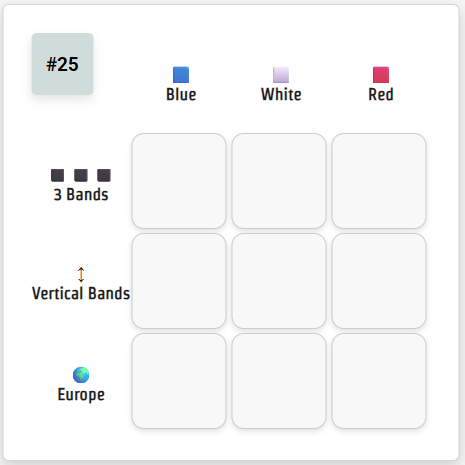
User reviews (0)