Website profiles · Technology insights · Alternatives

gunguesser.com

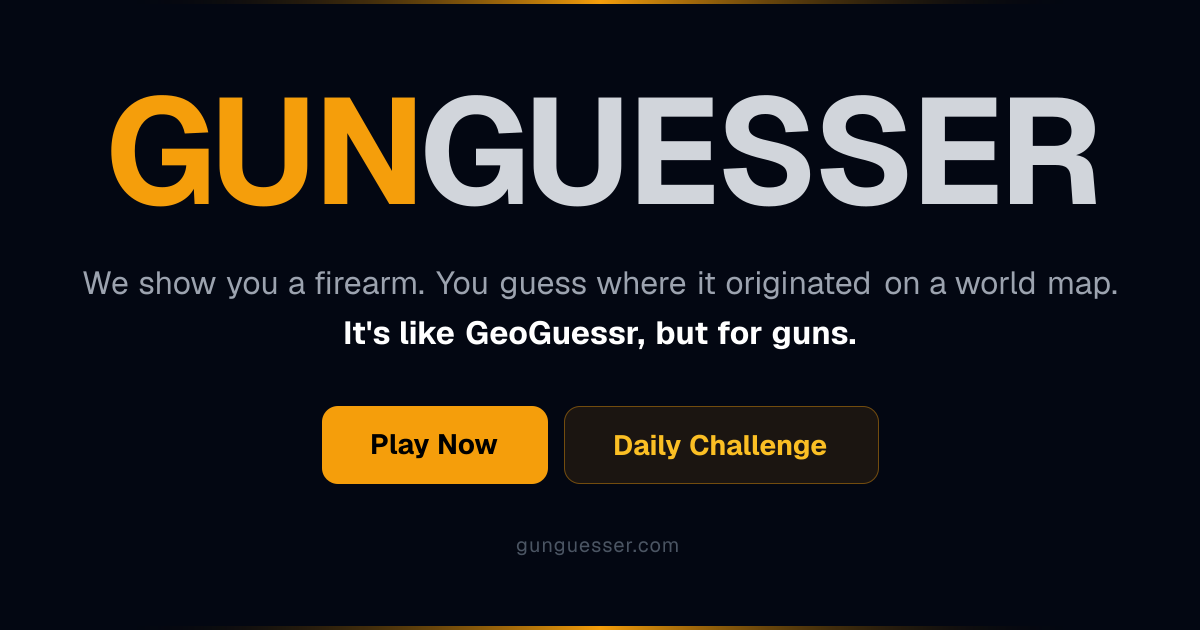
We show you a firearm. You guess where it originated on a world map.

No paid content found
Visit website
Profile views 1 Outbound visits 0 Normal
GunGuesser Full homepage screenshot

At a glance

Category
Games & Board Games
Language
English
Paid-content signal
No paid content foundObserved
Registered
2026
Hosting
VercelInferred
HTTPS certificate trusted
PassedObserved
Last updated

Website review

This review may include AI-generated content and is not individually verified. Domain, certificate and other facts come from the observed data on this page.

What is GunGuesser?

GunGuesser is a free browser-based geography quiz built around firearms history. Each round shows you a gun along with its name, type, designer and design year, and you drop a pin on a world map to guess where it was designed. Closer pins score higher, and the game runs five rounds for up to 50,000 points, with a daily challenge and leaderboard layered on top. The site describes itself as "GeoGuessr for guns" and says its database covers 900+ historical and modern firearms.

Who it suits

  • History and geography fans who enjoy map-pinning games but want a subject with more texture than street signs.
  • Curious beginners: the site says no technical knowledge of ballistics is needed, only attention to where designs come from.
  • Quiz-habit players who like a short daily round with a score to compare.

What a round actually asks of you

The screen gives you the firearm's identity and year but withholds location hints, so the challenge is recall and inference: does the designer's name, the era, or the silhouette point to a particular arms-producing country? That makes it closer to a history quiz than a pure visual game. If you want a comparison point, GeoGuessr applies the same pin-on-a-map mechanic to real-world street imagery, while GunGuesser swaps landscapes for design provenance.

Trade-offs to weigh

  • Knowledge-heavy, not reflex-heavy: players who know arms history will score well quickly; others learn by missing, which the site frames as the point.
  • Self-described as educational, not authoritative: it states plainly that it is not a reference source, so treat it as a game that teaches, not an encyclopedia.
  • Niche audience: the subject matter won't appeal to everyone, and the site is explicit that it is for historical and educational purposes only.

If you want to test it, play one daily challenge first: it takes a few minutes and tells you quickly whether the recall-and-pin loop holds your interest before you commit to longer solo sessions.

How does the scoring work in GunGuesser, and how close does my map pin need to be to earn points?

GunGuesser scores each round by how close your map pin lands to the firearm's true country of origin: the closer the guess, the higher the score. A full game is five rounds with a maximum of 50,000 points, which works out to roughly 10,000 points per round if you nail every location. The site describes the format as "GeoGuessr for guns," so the scoring logic follows that model—distance-based scoring rather than a simple right/wrong check.

The page does not publish a precise distance-to-points formula, so treat any specific "within X km earns Y points" figure as unconfirmed. What it does make clear is the practical setup for each round:

  • You are shown a firearm with its name, type, designer, and design year.
  • No location hints are given, so the designer and year are your main clues.
  • You drop a pin on the world map to guess where it was designed.
  • Closer pins score higher; you climb the daily leaderboard across five rounds.

A practical way to use the scoring

Since the designer and year are visible, the scoring rewards historical knowledge more than raw geography. A rifle designed in 1891 by a Belgian, for example, points you toward Belgium before you ever think about the map. If you are unsure, pin the country you associate with the designer or the era's dominant arms industry rather than a random spot—being in the right country should score better than a wild guess, even if you cannot confirm the exact city.

For a concrete test of how strict the scoring is, play one Daily Challenge and compare two rounds: one where you pin the correct country but the wrong region, and one where you pin the right city. The point difference between those two results will tell you how much precision actually matters before you invest in memorizing design locations.

If you want to cross-check a firearm's origin while learning, general reference sources such as Wikipedia are the same kind of material GunGuesser says it draws from, and the site links each firearm to further reading.

What are the different game modes in GunGuesser, and how does the daily challenge differ from solo play?

GunGuesser's page describes Solo Play and a Daily Challenge as its two main modes. Both ask you to identify where a firearm originated by placing a pin on a world map, but they differ in structure and pacing.

Solo Play

  • Five rounds per session, with a maximum of 50,000 points.
  • You see the firearm's name, type, designer and design year, but no location hints.
  • Scoring rewards proximity: closer pins earn higher scores.
  • Because it is a self-contained session, Solo Play suits a longer sitting where you want to build a score across several firearms in one go.

Daily Challenge

  • Also framed around five rounds and a leaderboard, with the page inviting players to "top the daily leaderboard."
  • The shared daily format means you are comparing your result against other players working on the same set, rather than only against your own past sessions.
  • It works well as a short routine: one attempt per day, then check where your pin placements rank.

How to choose

If you want to practise or play for an extended period, Solo Play gives you repeated five-round runs. If you prefer a fixed daily puzzle and a competitive comparison with the wider player base, the Daily Challenge is the better fit.

A practical next step: start with Solo Play to learn the map-pinning interface and how scoring responds to distance, then move to the Daily Challenge once your guesses are consistently landing in the right region. The site's community discussion on Reddit is also referenced for player-suggested firearms and identification strategies.

How can I improve at identifying a firearm's country of origin if I know almost nothing about guns?

Start with the information the game gives you, not the gun's appearance. GunGuesser shows each firearm's name, type, designer and design year before you pin the map, and deliberately withholds location hints. That means the designer's name and the year are your best clues, and you can build pattern recognition from those before you know anything about calibers or mechanisms.

A practical way to build the skill

  1. Read the name for national signals. Many firearms carry the name of a place, an arsenal, or a designer associated with one country. Treat the name as a first hypothesis, then check it against the designer and year.
  2. Learn designers as country markers. A small set of designers recurs across many entries. When you see a designer you recognize, recall the country you last matched them to and test it again.
  3. Use the year as a narrowing tool. Design year tells you which national arms industries were active and which service rifles were in use. A design from a major war period narrows the plausible origins sharply.
  4. Keep a personal log of misses. After each round, note the firearm, your guess, the correct country and the clue you overlooked. Reviewing ten misses teaches more than playing fifty rounds passively.
  5. Group by region, not by individual gun. Learn that a cluster of designs comes from one country's arsenals, then extend outward. Regional familiarity makes unfamiliar entries easier to place.

What to expect from the game

The site describes five-round solo play with up to 50,000 points, closer pins scoring higher, and a daily challenge with a leaderboard. Scoring rewards approximate geography, so a confident regional guess beats a wild pin. The database is described as covering 900+ firearms, from pre-1900 breechloaders through World War-era service rifles to modern sporting and military designs.

If you want a second angle on the same skill, Wikipedia entries for individual firearms usually state the country of origin and designer in the opening lines, which mirrors the fields the game displays. The site's own subreddit is also described as a place where players share silhouette and furniture-based identification strategies; reading those threads is a fast way to pick up heuristics.

A decision criterion for practice

If you know almost nothing, spend your first sessions on the designer-and-year fields and ignore visual details. Once you can name a country from those two fields more often than not, start using shape, wood furniture and magazine type as tie-breakers between neighboring countries. That sequence keeps you from guessing on appearance alone, which is the most common way beginners stall.

Where does GunGuesser get its firearm data and images, and how accurate is the information?

GunGuesser describes its firearm data as coming from publicly available historical records, Wikipedia entries and other verified reference materials. Each entry in its database of 900+ firearms includes a designer, design year, country of origin and a link to further reading. Images are credited to Wikimedia Commons and other open repositories with attribution. The site presents itself as accurate enough for educational play rather than as a reference authority.

What that means for accuracy

The sourcing model explains both the strengths and the limits. Wikipedia and open image repositories are broad and usually reliable on well-documented military arms, so common service rifles, famous pistols and major wartime designs are likely to be solid. The weaker spots tend to be obscure prototypes, civilian sporting guns and designs with disputed origins—exactly the cases where a single source can be wrong or where "country of origin" is genuinely ambiguous (designed in one country, manufactured in another, adopted by a third).

A practical way to judge a round: treat the answer as a strong hint, not a verdict. If a pin scores badly on a gun you know well, check the linked reading before assuming you were wrong.

How to use it sensibly

  • For casual learning, the sourcing is fine. The designer-and-year fields give you real anchors for remembering where arms industries developed.
  • For anything you'll cite or rely on, follow the further-reading link and cross-check against a specialist source. The site itself says it does not claim reference authority.
  • For disputed cases, note that the game needs one pin-able answer per gun, so nuance gets flattened. A gun designed by an expatriate or built under licence will have a "correct" country that a historian might argue with.

The community is part of the accuracy mechanism: players suggest firearms and report errors through the project's subreddit, so corrections happen, but on a solo-developer timescale rather than an editorial one.

Next step: pick five guns you know well, play them, and compare your pins against the stated origins. That tells you quickly whether the database's conventions match your own understanding—and where you should double-check before trusting it.

Can I suggest new firearms or report errors in the GunGuesser database, and how does the community contribute?

Yes. GunGuesser's page says players suggest new firearms and report errors through its community, chiefly the r/GunGuesser subreddit; the site presents the database as something the community keeps alive rather than a fixed, closed list. Contributions are practical: proposing firearms to add, flagging mistakes in entries, and sharing identification strategies such as reading silhouette, wood furniture or magazine shape. The page also notes that every firearm entry carries a designer, design year, country of origin and a further-reading link, which gives you concrete details to cite when you report a problem.

How to contribute usefully

  • Suggestions: name the firearm, its designer, design year and country of origin, and ideally point to a public reference so the entry can be checked.
  • Error reports: say which field looks wrong and what the correct value should be, rather than only that something is off.
  • Strategy sharing: post the cues you use to place a pin, since the page describes this as a recognised way players help each other improve.

What to expect

The site describes itself as accurate enough for educational gaming, not as a reference authority, and it draws on public historical records, Wikipedia and open image repositories. Treat corrections as community-reviewed improvements rather than instant edits, and expect a solo-run project to process suggestions at its own pace. If you want a broader firearms reference to check details before posting, Wikipedia is the kind of public source the site itself cites.

A sensible next step: before suggesting a firearm, confirm it is not already among the 900+ entries, then post with the four core fields plus one supporting link.

Related questions

More questions →
How Does the Guess the Gun Origin Game Work?

Gun Guesser is a browser-based geography and history quiz: each round shows you a firearm with its name, type, designer, and design year, and you drop a pin on a world map to guess where it was designed. Closer pins score higher, and a full game runs 5 rounds for up to 50,000 points. You can start with the solo mode or the daily challenge; no account or firearms expertise is mentioned as a requirement.

The Core Loop, Step by Step

  1. A firearm appears. You see its name, type, designer, and design year. That's the full clue set.
  2. You read the clues, not a location. There are no location hints, so the designer's name, the design year, and the firearm's type are what you work from.
  3. You drop a pin on the world map where you believe the gun was designed.
  4. You score by distance. The closer your pin lands to the true origin, the more points you earn.
  5. Repeat for 5 rounds, then check where you stand on the daily leaderboard.

The site describes itself as "like GeoGuessr, but for guns" — the map-guessing format is the same, but the clue is a historical object rather than a street view.

What You See vs. What's Hidden

Shown to you Hidden from you
Firearm name Country of origin
Type (e.g., service rifle, breechloader) Any map or region hint
Designer —
Design year —

Because the origin is hidden, the designer and year do most of the work. A design year places the firearm in a historical period, and the designer's name is often tied to a national arms industry. The site notes that players who start knowing almost nothing often find themselves naming countries from a silhouette alone after a few weeks of casual play.

Scoring and the Leaderboard

  • Per round: points scale with how close your pin is to the true design origin.
  • Per game: 5 rounds, up to 50K points total.
  • Daily challenge: a shared puzzle with a daily leaderboard, so you can compare your pin placement against other players.

Scope of the Firearm Database

The database covers 900+ historical and modern firearms across every major arms-producing country, from pre-1900 breechloaders through World War-era service rifles to contemporary sporting and military designs. Each entry includes the designer, design year, country of origin, and a link to further reading. Images come from Wikimedia Commons and other open repositories with attribution, and data is sourced from public historical records, Wikipedia, and reference materials.

The site is explicit that it is an educational geography and history game, not a reference authority — accurate enough for educational play, but not a source to cite for technical specifications.

How to Start

  • Solo Play: a 5-round game at your own pace.
  • Daily Challenge: the shared daily puzzle with leaderboard ranking.
  • Community: players suggest new firearms and report errors on the r/GunGuesser subreddit, and share strategies for identifying guns by silhouette, wood furniture, or magazine shape.

A Practical Tip for Your First Games

Treat each round as two separate guesses: first use the design year to narrow the era, then use the designer and firearm type to narrow the country. For example, a late-19th-century breechloader with a European designer points you toward the major arms-producing nations of that period rather than a modern manufacturing country. Pinning the design origin — not where a particular model was later produced or exported — is the distinction that separates high scores from near misses.

What Is Gun Guesser and How Do You Play the Firearm Origin Map Game?

Gun Guesser is a free browser-based geography and history game at gunguesser.com in which you are shown a firearm's name, type, designer, and design year, then drop a pin on a world map to guess where it was designed. Closer pins score higher. It suits anyone curious about arms history or map games; you don't need technical firearm knowledge, only a willingness to reason about where things come from.

The Core Loop

Each round gives you a firearm card with four facts:

  • Name
  • Type
  • Designer
  • Design year

No location hints are provided. You place a pin on the world map, and the game scores your guess by geographic distance from the actual origin—the closer the pin, the higher the score.

Scoring and Format

A standard game runs 5 rounds with a maximum of 50,000 points. Scores feed into a daily leaderboard, so you can compare your result against other players each day.

Game Modes

  • Solo Play — a 5-round session at your own pace.
  • Daily Challenge — a shared daily puzzle with its own leaderboard.

The site also links to a community on Reddit at r/GunGuesser, where players suggest new firearms, report errors, and share identification strategies.

What's in the Database

The database covers 900+ historical and modern firearms, spanning every major arms-producing country—from pre-1900 breechloaders through World War-era service rifles to contemporary sporting and military designs. Each entry includes the designer, design year, country of origin, and a link to further reading. Images come from Wikimedia Commons and other open repositories with attribution, and the data is drawn from public historical records, Wikipedia, and verified reference materials.

Who It's For

The project was built by a solo developer aiming for a middle ground between expert-only gun content and oversimplified material. You don't need to know muzzle velocities or trigger weights—just pay attention to origins. According to the site, players who start knowing almost nothing often find themselves naming countries from silhouette alone after a few weeks of casual play. Some top players have never owned or fired a gun; they simply enjoy maps and history.

An Educational Game, Not a Reference Authority

Gun Guesser describes itself as an educational geography and history game. It does not claim to be a reference authority, only accurate enough for educational gaming, and it states that it does not endorse, promote, or facilitate firearm use—all content is presented for historical and educational purposes.

How to Start

  1. Go to gunguesser.com.
  2. Choose Play Now for a solo 5-round game or Daily Challenge for the shared puzzle.
  3. Read the firearm's name, type, designer, and year.
  4. Drop a pin where you believe it was designed.
  5. Repeat for all 5 rounds and check your total against the leaderboard.

If you enjoy GeoGuessr-style deduction or want a low-pressure way to build firearms-history knowledge, Gun Guesser is worth a try. If you need authoritative technical specifications, use a dedicated reference source instead.

What Is "GeoGuessr for Guns" and How Does GunGuesser Work?

"GeoGuessr for guns" refers to GunGuesser (gunguesser.com), a browser-based geography and history game where you are shown a firearm and must pin its country of origin on a world map. It borrows GeoGuessr's core loop—drop a pin, score by proximity—but replaces street-view scenery with firearm metadata: name, type, designer, and design year. No real firearms are involved; it's an educational quiz built on a database of 900+ historical and modern guns.

How a Round Works

Each round follows the same three-step structure:

  1. See the firearm. The game displays the gun's name, type, designer, and design year. There are no location hints—the historical metadata is your only clue.
  2. Pin the origin. You drop a pin on the world map where you believe the firearm was designed.
  3. Score by distance. Closer guesses earn higher scores. A game runs 5 rounds with up to 50,000 points total, and results feed into a daily leaderboard.

The key input is the design year and designer name. A rifle designed in 1891 by a Belgian engineer points toward Belgium; a Cold War-era service rifle with a Soviet designer points toward the USSR/Russia. The map pin is the output, and proximity to the actual origin country determines your score.

Game Modes

The site lists these ways to play:

Mode What it is
Solo Play 5 rounds at your own pace, scored up to 50K
Daily Challenge A shared daily puzzle with a leaderboard
Community Discussion and firearm suggestions on r/GunGuesser

The daily challenge is the mode most comparable to GeoGuessr's daily format—everyone gets the same sequence and competes on the same board.

How It Differs from GeoGuessr

Both games test geographic knowledge through a proximity-scored map pin. The difference is the clue source:

  • GeoGuessr gives you visual street-level evidence—road markings, vegetation, architecture, license plates—and asks you to infer a location.
  • GunGuesser gives you historical text—designer, year, type—and asks you to infer a country of design.

That means GunGuesser rewards knowledge of arms history and industrial geography rather than visual deduction. You don't need technical expertise like muzzle velocities or trigger weights; the game is designed to sit between "expert-only" and "too simplistic," per the site's own description. Players who start knowing little often learn to identify origin countries from silhouette, wood furniture, or magazine shape after a few weeks of casual play.

Practical Tips for Better Guesses

  • Anchor on the design year first. Pre-1900 designs narrow the field to a handful of arms-producing nations; World War-era service rifles cluster around major belligerents; contemporary designs spread wider.
  • Use the designer's name. Many designers are strongly associated with one country's national arsenals.
  • Learn the major arms-producing countries as a mental shortlist. The database spans "every major arms-producing country," so most answers fall within a recognizable set rather than obscure states.
  • Treat misses as study. Each firearm entry includes designer, year, country of origin, and a further-reading link, so a wrong guess is a direct pointer to what to learn.

What to Know Before Playing

GunGuesser is free to play in the browser according to the site's own framing ("Play Now"), and it presents itself strictly as an educational geography and history game—it does not endorse or facilitate firearm use. Data is sourced from public historical records, Wikipedia, and reference materials, with images from Wikimedia Commons and open repositories under attribution. The project is run by a solo developer and refined through community error reports and firearm suggestions, so treat it as an accurate-enough learning game rather than an authoritative reference.

If your goal is a daily map-guessing habit with a history angle, start with the Daily Challenge to benchmark yourself, then use Solo Play to drill the eras and designers you miss most.

What Is a Firearm Geography Quiz and How Does the Gun Origin Guessing Game Work?

A firearm geography quiz shows you a gun and asks you to pin its country of origin on a world map. On GunGuesser, each round displays a firearm's name, type, designer, and design year, but no location hints — you drop a pin, and closer guesses score higher. It tests geography and arms-history knowledge rather than technical firearm expertise, so you can start with little background and improve by playing.

The Core Loop: See a Firearm, Pin Its Origin

Each round follows the same three steps:

  1. Read the card. You see the firearm's name, type, designer, and design year. That's the full information set — there are no country clues, no flag hints, no partial map reveal.
  2. Drop a pin. You place a marker on the world map where you believe the firearm was designed.
  3. Score by proximity. The closer your pin lands to the actual origin, the more points you earn.

The design year is often the most useful signal. A weapon dated to the 1890s narrows the field to countries with established arms industries at that time, while a mid-20th-century design points toward the major World War-era producers. Designer names work the same way: once you learn to associate a name with a nation, later rounds become faster.

Scoring and Round Structure

A standard session runs 5 rounds with up to 50,000 points available, and results feed into a daily leaderboard. The scoring rewards precision, so a pin in the right country beats a pin on the right continent, and a near-exact placement beats both.

The site also offers a Daily Challenge, which works like a shared puzzle: everyone gets the same sequence, and the leaderboard compares how players did on identical rounds. If you want a low-pressure way to build knowledge, the daily format is a good habit — one short session per day, with a score you can track over time.

What the Quiz Tests — and What It Doesn't

This is not a firearms technical quiz. You don't need muzzle velocities, trigger weights, or model-number recall. The skills that actually matter are:

  • Geography: knowing where countries are and being able to place a pin accurately under time or score pressure.
  • History: connecting design years and eras to the nations that were producing arms at the time.
  • Pattern recognition: learning visual and design cues — silhouette, wood furniture, magazine shape — that players in the community cite as identification strategies.

The database covers 900+ historical and modern firearms, from pre-1900 breechloaders through World War-era service rifles to contemporary sporting and military designs, spanning every major arms-producing country. That breadth means the quiz rewards general historical awareness more than memorizing any single weapon.

How Beginners Get Better

The learning curve is the point. Players who start knowing almost nothing often find themselves naming countries from a silhouette alone after a few weeks of casual play, according to the site. Three habits speed that up:

  • Use the year first. Before looking at the gun's shape, anchor the design year to the countries that had active arms industries then.
  • Build designer-to-country associations. Each round gives you the designer's name; treat repeated names as flashcards.
  • Review misses, not just scores. A pin that landed in the wrong country teaches more than a lucky near-miss.

Practical Notes Before You Start

  • No account details are specified in the available information, so treat login requirements as unconfirmed rather than assuming open access.
  • Pricing is not stated in the source material; don't assume it's free.
  • The site frames itself as educational, presenting content for historical and educational purposes and sourcing data from public historical records, Wikipedia, and reference materials, with images from Wikimedia Commons and other open repositories under attribution. It describes itself as accurate enough for educational gaming rather than a reference authority.
  • Community input matters: players suggest firearms and report errors on the project's subreddit, so the database is partly crowd-informed.

If you like map-guessing games and history, the loop is simple enough to try in a few minutes: read the card, trust the year, and place your pin.

Website Overview

Page metadata, canonical configuration and social previews work together to provide more consistent search and sharing presentation.

Domain and Registration

The domain was registered less than a year ago and has limited historical evidence to assess. Transfer-protection status is present, helping reduce the risk of unauthorized domain transfers. The domain uses the common .com extension, which is not an independent safety signal.

DNS and Email

The lowest TTL is 60 seconds, supporting rapid record changes at the cost of more frequent lookups. Nameservers are provided by vercel-dns.com, indicating managed DNS hosting. CAA records restrict which certificate authorities are authorized to issue certificates. No CNAME was found; the observed records resolve directly to addresses. No MX record was found. A conventional explicit inbound-mail route is not configured.

TLS and Certificates

The certificate uses an RSA 2048-bit public key, offering broad client compatibility. The server supplied a complete certificate chain. No organization name is present in the certificate; the available fields are consistent with domain validation. The certificate was issued by Let's Encrypt, commonly associated with automated certificate services. The certificate's total validity is about 89 days, consistent with a short renewal cycle.

HTTP and Browser Security

CORS permits any origin to read this response. This is common for public resources; sensitive responses need narrower handling. No X-Powered-By header was found, reducing one common source of backend fingerprinting information. All six checked browser-security headers are present. Their effectiveness still depends on the policy values and application behavior. No obvious internal addresses or debug information were found in the headers. The Server header contains the custom value Vercel.

Technology Stack Analysis

The public page identifies Next.js, Vercel without precise versions, leaving fewer clues for version-specific scanning.

Search and Social Sharing

Twitter Card metadata is configured. JSON-LD includes Organization data, helping describe the organization as an entity. The title has 10 characters, within a common display range. A meta description is present, with 68 characters. The observed directives allow indexing and link following.

Hosting and Email

DNSvercel-dns.com
HostingVercel
EmailUnknown
Approximate IP geolocation (inferred; a CDN or proxy may differ from the origin server) United States flagUnited States Inferred 216.150.1.1

Registration details

RDAP / WHOIS

RegistrarName.com, Inc.
Registered2026-04-11
Expires2027-04-11
Domain statusclient transfer prohibited
Nameserversns1.vercel-dns.com、ns2.vercel-dns.com
DNSSECunsigned

DNS records

DNS

TypeNameValueTTLPriority
Agunguesser.com216.150.1.11800—
Agunguesser.com216.150.16.11800—
NSgunguesser.comns1.vercel-dns.com86400—
NSgunguesser.comns2.vercel-dns.com86400—
TXTgunguesser.comgoogle-site-verification=X5D3LrJISIp_vVZBZVxD3aPOtJVgnefm-sFZgBgujVI60—
CAAgunguesser.com0 issue "letsencrypt.org"60—
CAAgunguesser.com0 issue "pki.goog"60—
CAAgunguesser.com0 issue "sectigo.com"60—

TLS and certificates

TLS / SSL

AssessmentNormal configuration
Supported protocolsTLSv1.2、TLSv1.3
Negotiated protocolTLSv1.3
Certificate subjectgunguesser.com
IssuerLet's Encrypt
Valid until2027-01-13T19:34 · Remaining when checked: 85 days
Verification detailsCertificate trust: Passed · Hostname match: Passed

HTTP response headers

HTTP

HeaderValue
content-typetext/html; charset=utf-8
cache-controlpublic, max-age=0, must-revalidate
serverVercel
strict-transport-securitymax-age=63072000
content-security-policydefault-src 'self'; script-src 'self' 'unsafe-inline' 'unsafe-eval'; style-src 'self' 'unsafe-inline'; img-src 'self' https: data:; font-src 'self'; connect-src 'self'; frame-ancestors 'none'; base-uri 'self'; form-action 'self';
x-frame-optionsDENY
x-content-type-optionsnosniff
referrer-policyorigin-when-cross-origin
permissions-policycamera=(), microphone=(), geolocation=()
access-control-allow-origin*

Identified technologies

Next.jsVercel

Pages, Search and Sharing

Meta descriptionWe show you a firearm. You guess where it originated on a world map.
Canonical URLhttps://gunguesser.com
LanguageEnglish (default)
Twitter Cardsummary_large_image
All bots 1 allowed · 7 disallowed
  • Allow/
  • Disallow/admin
  • Disallow/admin/
  • Disallow/api/
  • Disallow/score/
  • Disallow/duel/
  • Disallow/lobby/
  • Disallow/game/

User reviews (0)

  • No reviews yet.