Website profiles · Technology insights · Alternatives

imhex.werwolv.net

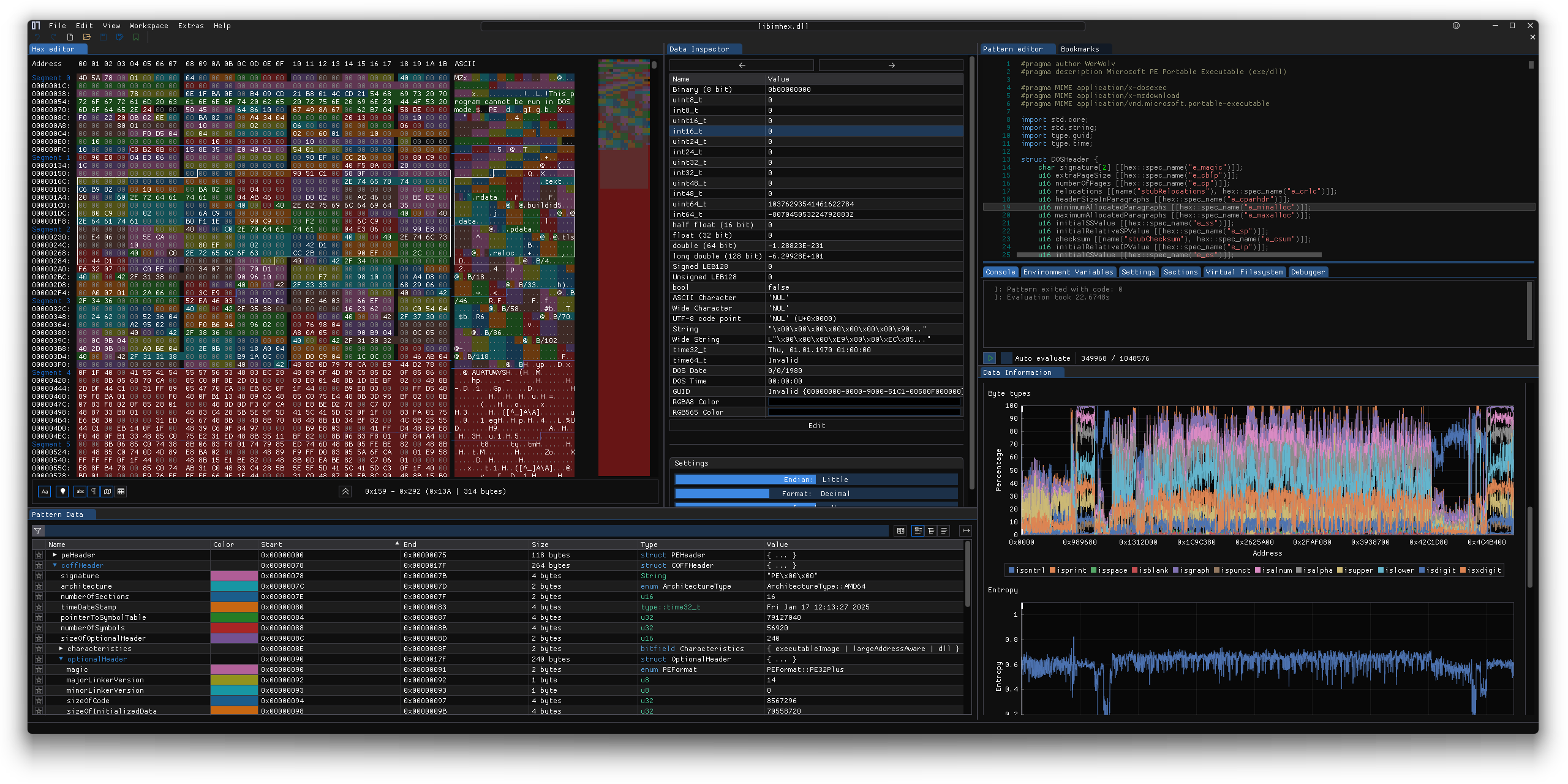
ImHex is a free, open-source hex editor for reverse engineers and developers, featuring Pattern Language, data analysis, visualization and disassembly.

No paid content found
Visit website
Profile views 9 Outbound visits 1 Normal
ImHex Full homepage screenshot

At a glance

Category
Development
Language
English
Paid-content signal
No paid content foundObserved
Registered
2018
Hosting
FastlyInferred
HTTPS certificate trusted
PassedObserved
Last updated

Website review

This review may include AI-generated content and is not individually verified. Domain, certificate and other facts come from the observed data on this page.

What is ImHex?

ImHex is a free, open-source hex editor aimed at reverse engineers and developers. It is built around inspecting and interpreting binary data rather than just viewing raw bytes: alongside a standard hex view, it offers a Pattern Language for describing file structures, data analysis and visualization tools, and disassembly support.

H3 What that means in practice

  • Pattern Language: you can write a description of a file format (headers, fields, structs) and have ImHex parse and annotate the bytes, which is far more readable than manually counting offsets.
  • Data analysis and visualization: useful when you need to spot structure, entropy or repeating patterns across a large binary.
  • Disassembly: lets you move between raw bytes and machine code without switching tools.
  • Open source: the code can be audited, extended or self-compiled, which matters in security-sensitive workflows.

H3 Who it suits

  • Reverse engineers examining unknown or proprietary file formats and firmware.
  • Developers debugging binary output, serialization formats or protocol dumps.
  • Security analysts and students who want a capable tool without licensing costs.

If you mainly need quick byte edits, a lightweight editor may be faster. If your work involves understanding what a binary contains, ImHex's format-description approach is the main draw.

A practical next step: download it from ImHex, open a file whose format you already know, and write a short Pattern Language script for its header. That single exercise shows whether the tool fits your workflow better than a plain hex viewer.

How does ImHex's Pattern Language help reverse engineers?

ImHex's Pattern Language helps reverse engineers by letting them describe a binary's structure as a readable, reusable script rather than decoding bytes by hand. Instead of manually mapping offsets and data types, you write a pattern that declares fields, types, arrays, and conditions; ImHex then applies it to the loaded file and displays the parsed results alongside the raw hex. This turns a wall of bytes into a labeled, structured view, which speeds up identifying headers, records, and variable-length sections.

Its practical value comes from how it handles the messy parts of real formats:

  • Conditional and variable-length fields: Patterns can branch and size fields based on earlier values, which suits formats with flags, version-dependent layouts, or length-prefixed blocks.
  • Nested structures and arrays: You can model repeated records and embedded structures once and reuse them, instead of re-deriving offsets each time.
  • Reusable, shareable definitions: A pattern is a text artifact, so teams can keep format definitions in version control and apply them consistently across samples.
  • Readable output: Parsed fields appear with names and values, making anomalies and unexpected values easier to spot than in raw hex.

For a concrete scenario: an analyst examining a proprietary file format can start by declaring a magic number and header fields, then progressively add structures as they discover them. When a field's meaning is unclear, they can adjust the pattern and immediately see how the interpretation changes across the file, using ImHex's data analysis and visualization features to confirm hunches.

The trade-off is that Pattern Language requires an initial investment: you must understand the format well enough to describe it, and a wrong assumption produces misleading output. For one-off inspections of a few bytes, manual hex reading may be faster. Patterns pay off when a format recurs, is complex, or must be documented for others.

As a next step, identify the recurring binary format you inspect most often, write a small pattern covering just its header, and expand it field by field as your understanding grows.

What are the key differences between ImHex and other hex editors?

ImHex stands apart from most hex editors by treating binary inspection as a programmable analysis task rather than just byte editing. According to the site description, it is a free, open-source hex editor aimed at reverse engineers and developers, and its distinguishing features are the Pattern Language, data analysis, visualization and disassembly.

Where it differs most

  • Pattern Language. Instead of manually reading offsets, you can describe a file format as a pattern and have ImHex parse and annotate the data. This is the feature most other editors lack; typical tools make you interpret structures by hand or write external scripts.
  • Built-in analysis and visualization. Data analysis and visualization are presented as core capabilities, so inspecting entropy, distributions or structure is part of the editor rather than a separate utility.
  • Disassembly. Having disassembly alongside hex editing suits reverse engineers who move between raw bytes and machine code in one place.
  • Open source and free. This matters for auditors, students and teams that need to inspect or modify the tool, and it avoids license costs common in commercial reverse-engineering suites.

How it compares in practice

Need ImHex's approach Typical alternative
Parsing custom formats Pattern Language definitions Manual offset math or external scripts
Visual inspection Integrated visualization Separate plotting tools
Code-level review Built-in disassembly Dedicated disassembler
Licensing Free, open source Often commercial

A concrete scenario. A firmware analyst receives an undocumented update file. With a conventional editor, they note offsets in a scratchpad and cross-reference a disassembler. With ImHex, they can write a pattern for the suspected header, see the structure highlighted, and check the disassembly view, keeping context in one workspace. The trade-off is learning the Pattern Language, which is extra effort if you only need occasional byte edits.

Next step. If you regularly reverse-engineer formats, start with the Pattern Language documentation on ImHex. If your work is simple patching, a lighter editor may be faster to learn.

Can ImHex be used for malware analysis and reverse engineering?

Yes. ImHex is built for exactly this kind of work: it's a free, open-source hex editor aimed at reverse engineers and developers, with features like Pattern Language, data analysis, visualization, and disassembly. For malware analysis, the practical value is in inspecting raw bytes, mapping binary structures, and spotting anomalies without leaving the editor.

Where it fits in a malware workflow

  • Static inspection: Open a suspicious sample and examine headers, sections, strings, and embedded resources directly. This is the first pass before running anything in a sandbox.
  • Pattern Language: Describe a file format or structure once, then apply it to parse fields, offsets, and nested data. Useful for custom packers, proprietary containers, or config blobs that generic tools won't recognize.
  • Data analysis and visualization: Entropy views and byte-distribution graphs help flag packed, encrypted, or compressed regions—often the first sign of obfuscation.
  • Disassembly: Built-in disassembly gives a quick look at code regions without switching tools, handy for confirming entry points or spotting shellcode.

Trade-offs to weigh

ImHex is strongest as an inspection and pattern-matching environment, not a full disassembler or debugger. For deep control-flow analysis, dynamic tracing, or unpacking, you'll typically pair it with dedicated tools—for example Ghidra for decompilation, x64dbg for Windows debugging, or VirusTotal for a quick multi-engine reputation check. ImHex complements these rather than replacing them.

A concrete next step

If you have a sample, start by loading it in ImHex, run an entropy visualization to locate packed sections, then write a Pattern Language definition for the file header to confirm the format. That sequence turns a wall of bytes into a structured picture fast—and tells you whether you need a debugger next.

One caveat: since it's open source and community-driven, verify that any plugins or pattern files you download come from trusted sources, especially in a malware context.

How to install and set up ImHex on different operating systems?

ImHex is a free, open-source hex editor aimed at reverse engineers and developers, with features like Pattern Language, data analysis, visualization and disassembly. Setup is mostly a matter of picking the right package for your OS and, on Linux, choosing between a native package and a portable build.

Windows and macOS

  • Windows: Download the installer or portable build from the official site, then run it. If you use a package manager, a manifest may exist, but the official download is the simplest route.
  • macOS: Download the .dmg, drag ImHex to Applications, and launch it. Recent macOS versions may require you to allow the app in System Settings → Privacy & Security the first time.

Linux

  • AppImage: Download the AppImage, mark it executable (chmod +x), and run it. This avoids dependency conflicts and is a good choice on distributions without a packaged version.
  • Distribution packages: Some distros and community repositories provide ImHex; install through your package manager if a maintained package exists. Otherwise use the AppImage or build from source.
  • Flatpak: A Flatpak build is often available, which can simplify installation and sandboxing on many distributions.

First-run setup

  • Install the Pattern Language files you need if you plan to parse file formats; many community patterns are available separately.
  • Configure your theme, font and plugin settings in the preferences.
  • If you use disassembly or data analysis features, check that the relevant plugins or external tools are enabled.

Practical next step

If you are on Linux, start with the AppImage to confirm ImHex runs on your system, then switch to a native package or Flatpak if you want automatic updates. On Windows or macOS, the official installer or .dmg is usually enough, and you can add patterns as you need them. For downloads and documentation, use the official site: ImHex.

What types of data visualization and analysis does ImHex offer?

ImHex focuses on making raw binary data legible rather than just editable. Its analysis features are built around the Pattern Language, a C-like syntax for describing the structure of a file. Once you write a pattern, ImHex parses the bytes into named, typed fields, so you see a struct or file header laid out instead of an undifferentiated hex dump. It also offers data visualization and disassembly, aimed at reverse engineers and developers working with unknown or proprietary formats.

H3 Practical uses

  • Format reverse engineering: Define a pattern for a suspected header, then iterate as fields line up or fail, which is faster than tracking offsets by hand.
  • Firmware and save-file inspection: Visualize regions and jump between structures to spot tables, checksums or embedded records.
  • Malware or file-format triage: Combine structured parsing with disassembly views when a region turns out to be executable code.

H3 Trade-offs The Pattern Language is powerful but requires learning; for a one-off look at a few bytes, a plain hex editor is quicker. Visualization and disassembly help you form hypotheses, but they don't replace a dedicated debugger or disassembler for deep code analysis.

Next step: if you have a file with a repeating structure, start by writing a minimal pattern for its first field and expand it as you confirm each offset. Compare with Ghidra if your main goal is disassembly rather than data structure.

Related questions

More questions →
What Are Open-Source UI Element Libraries and How Do They Differ From UI Frameworks?

An open-source UI element library is a collection of individual, ready-made interface pieces—buttons, cards, inputs, toggles, loaders—that you copy into your own project and adapt. A UI framework, by contrast, is a structured system of components, conventions, and often a theming layer that governs how your whole interface is built. The practical difference: an element library gives you a snippet; a framework gives you a way of working. If you need a polished button in ten minutes, reach for the element library. If you're building a 40-screen product with a team, you probably want the framework.

What "open-source UI element library" actually means

The term gets used loosely, so it helps to separate the parts:

  • Open-source: the code is publicly available, and the license tells you what you may do with it—copy, modify, redistribute, or use commercially.
  • UI element: a single, self-contained piece of interface, usually small enough to read in one sitting. A button with hover states, a pricing card, a search field.
  • Library: a browsable, searchable collection of those elements, typically contributed by many different people.

On a site like Uiverse, elements are shared by a community and written in plain CSS or Tailwind. You find one you like, copy the markup and styles, paste them into your project, and adjust colors, spacing, and text to fit. There's no package to install and no build step required—which is exactly the appeal, and also the source of most of the confusion.

Element library vs. UI framework: the core differences

Dimension Open-source UI element library UI framework / design system
Unit of reuse A single snippet you copy A component you import or call
Installation None; paste into your code Package install, config, sometimes a provider
Consistency Depends on you; each element may look different Enforced by shared tokens and APIs
Theming Manual edits per element Central theme/config file
Updates You own the copy; no upstream updates Version bumps bring fixes and changes
Accessibility Varies per contributor; must be checked Usually tested and documented
Best for Prototypes, landing pages, small sites, one-off needs Multi-page apps, teams, long-lived products
Learning curve Low—read the CSS Higher—learn the API and conventions

The table isn't a verdict. It's a map of trade-offs. Element libraries win on speed and freedom; frameworks win on consistency and maintenance.

Licensing and attribution: what to check before you paste

This is where people get into trouble, and it's worth slowing down for.

  1. Find the license. Every element or collection should state one. Common open-source licenses include MIT, Apache-2.0, and BSD. Some projects use copyleft licenses like GPL, which can impose obligations if you redistribute your code.
  2. Understand what the license permits. MIT and Apache-2.0 are permissive: you can typically use the code in commercial and closed-source projects. Copyleft licenses may require you to release derivative source under the same terms.
  3. Check attribution requirements. Permissive licenses usually require you to keep the copyright notice and license text somewhere in your project. That's a real obligation, not a formality.
  4. Look for per-element terms. On community sites, the site's overall terms and the individual contributor's stated wishes may differ. If a contributor asks for credit, honor it.
  5. When in doubt, ask or avoid. If a snippet has no license at all, you don't have clear permission to reuse it. Treat "no license" as "not open source," even if the code is publicly visible.

This article is general information, not legal advice. For commercial products with real exposure, have someone qualified review the licenses you're relying on.

How to use a community element in your project: a practical workflow

Here's a repeatable process that avoids most of the usual mess.

1. Start from a real need, not a browsing session

Decide what you need first—"a compact primary button with a loading state"—then search. Browsing aimlessly produces a pile of pretty snippets that don't fit together.

2. Copy the smallest version that works

Take the markup and the styles. Strip anything you don't need: demo wrappers, extra animations, decorative layers. Less code means fewer surprises.

3. Convert it to your conventions

If your project uses design tokens or CSS variables, replace hard-coded values:

/* Before: hard-coded */
.button { background: #4f46e5; border-radius: 8px; }

/* After: token-based */
.button { background: var(--color-primary); border-radius: var(--radius-md); }

This one step is what keeps a copied element from looking like a foreign object in your UI.

4. Check accessibility before you ship

Community elements vary widely here. Verify at minimum:

  • Keyboard focus is visible and the element is reachable by Tab.
  • Color contrast meets WCAG AA (4.5:1 for normal text).
  • Interactive elements use semantic HTML (<button>, not a clickable <div>).
  • Form inputs have associated labels.
  • Motion respects prefers-reduced-motion.

5. Test in context

Paste it into a real page with real content. Long labels, small screens, and dark mode break more copied elements than anything else.

6. Note where it came from

Keep a short comment or an internal credits file: source, license, date. Future you—and your legal reviewer—will be grateful.

Where element libraries genuinely shine

  • Prototypes and demos: you need something clickable today, not a design system.
  • Landing pages and marketing sites: a handful of distinctive elements, each custom.
  • Filling gaps: your framework lacks one specific component, and you don't want to build it from scratch.
  • Learning: reading well-made CSS is one of the fastest ways to improve.
  • Small projects: a personal site doesn't need a theming architecture.

Where they fall short

  • Consistency at scale: ten elements from ten contributors rarely look like one product.
  • Maintenance: you own every copy. When your design changes, you edit each one.
  • Accessibility debt: you inherit whatever the contributor did or didn't do.
  • No upstream fixes: a bug fixed in the original won't reach your copy.
  • Integration friction: different naming conventions, different units, different assumptions about resets.

When to choose which

Choose an element library when the scope is small, the timeline is short, or you need a few distinctive pieces rather than a whole system.

Choose a framework or design system when multiple people build multiple screens over months, when consistency is a product requirement, or when accessibility and theming need to be guaranteed rather than checked.

A hybrid works well for many teams: adopt a framework for the structural components—forms, navigation, layout—and borrow individual elements for the places where you want personality. Just route every borrowed element through the same token and accessibility checks, so it lands as part of your system rather than beside it.

The short version: open-source UI element libraries are a fast, flexible way to get good-looking interface pieces into a project. They are not a substitute for a design system, and the license and accessibility details are the part worth reading carefully.

Is ImHex Free and Open Source?

Yes. ImHex is described as a free, open-source hex editor, and its official project site is imhex.werwolv.net. That means you can use it without paying for a license, and the source code is available for inspection, modification, and redistribution under its open-source license.

What "free and open source" means here

  • Free: No purchase or subscription is required to use the editor.
  • Open source: The code is publicly available, so you can review it, build on it, or contribute to it.
  • Official source: imhex.werwolv.net is the project's website, where you can find information about the tool and how to get it.

Who ImHex is for

ImHex is built for reverse engineers and developers. Its feature set includes:

  • Pattern Language for describing and parsing binary data structures
  • Data analysis and visualization tools
  • Disassembly support

If your work involves inspecting binary files, understanding unknown formats, or analyzing compiled code, these features are directly relevant.

How to get started

  1. Go to imhex.werwolv.net.
  2. Look for the project's download or repository links (the site is the official entry point for project information).
  3. Install the version appropriate for your operating system.
  4. Open a binary file and explore the analysis, visualization, and disassembly features.

Because ImHex is open source, you can also build it from source if you prefer, or check the code before trusting it with sensitive files.

Quick summary

Question Answer
Is ImHex free? Yes
Is it open source? Yes
Official website imhex.werwolv.net
Primary audience Reverse engineers and developers
Key features Pattern Language, data analysis, visualization, disassembly

If you need a hex editor that costs nothing, can be audited, and is aimed at technical binary work, ImHex fits that description based on its official project page.

Does ImHex Include Disassembly Support?

Yes. ImHex lists disassembly among its core features, alongside its hex editing, Pattern Language, data analysis, and visualization capabilities. It is positioned as a free, open-source hex editor built for reverse engineers and developers, so disassembly is presented as part of a reverse-engineering workflow rather than as a standalone tool.

What the feature list tells you

According to the project's own description, ImHex provides:

  • Hex editing — the base function of viewing and modifying binary data.
  • Pattern Language — a way to describe and parse binary structures.
  • Data analysis — inspecting and interpreting raw bytes.
  • Visualization — representing data in graphical form.
  • Disassembly — translating machine code bytes into readable instructions.

The important detail is that these are described together. Disassembly is not advertised as a separate product or add-on; it sits inside the same environment as the editor and analysis tools.

Why combining disassembly with a hex editor matters

In reverse engineering, you rarely look at instructions in isolation. A typical task looks like this:

  1. Open a binary in ImHex.
  2. Locate a region of interest by inspecting raw bytes.
  3. Switch to a disassembly view to read the instructions at that location.
  4. Cross-check the instruction bytes against the hex view to confirm what you are seeing.
  5. Use Pattern Language or data analysis to interpret surrounding structures.

The value of an integrated disassembler is that steps 2 through 4 happen without exporting data to another program. You keep the byte-level view and the instruction-level view side by side, which reduces context switching and transcription errors.

Who this suits

ImHex's disassembly support fits workflows where you need to:

  • Inspect firmware, executables, or unknown binary blobs.
  • Correlate raw bytes with the instructions they encode.
  • Document binary formats with Pattern Language while also reading code.
  • Do exploratory analysis rather than full-scale software reverse engineering in a dedicated disassembler.

If your primary job is deep, large-project reverse engineering with heavy decompilation, you may still want a dedicated disassembler. ImHex is better understood as a hex editor with analysis and disassembly built in, not a replacement for a full reverse-engineering suite.

Practical caveats

The source material confirms that disassembly is a listed feature, but it does not specify which architectures are supported, how deep the disassembly view goes, or how it is configured. Those details are not established by the available description, so verify them against the current build before relying on ImHex for a specific instruction set.

A reasonable next step is to open a binary you already understand, jump to a known function, and compare the disassembly output against your expectations. That tells you quickly whether the feature covers your target architecture and workflow.

What Is ImHex's Pattern Language Used For?

ImHex's Pattern Language is a domain-specific language for describing the structure of binary data so the hex editor can parse a file and display its fields as readable, named values instead of raw bytes. You use it when you need to understand an unknown or undocumented file format, verify that a file matches a specification, or navigate a large binary by its logical structure rather than by offsets. It is most useful to reverse engineers, security analysts, and developers working with binary formats; it is not a general-purpose programming language and is not needed if you only want to view or patch individual bytes.

The problem it solves

A hex editor shows bytes and their offsets. That is enough to change a value, but not enough to answer questions like "where does the header end," "which four bytes are the length field," or "is this array of 16 records or one 64-byte blob." Pattern Language closes that gap by letting you write a description of the format once, then apply it to any file of that type.

When a pattern is applied, ImHex reads the file according to your description and presents the result as structured data: named variables, nested structs, arrays, and enums, each tied back to the byte range it occupies. Selecting a field in the pattern view highlights the corresponding bytes in the hex view, and vice versa.

What you can describe

The language is built around the same constructs you would expect from a C-like struct definition, which makes patterns readable to anyone familiar with binary formats:

  • Primitive types such as u8, u16, u32, s32, float, and double, with explicit endianness where the format requires it.
  • Structs that group related fields into a named type, including nested structs.
  • Arrays of fixed or computed length, so a count field can drive the size of the data that follows.
  • Enums that map numeric values to readable names.
  • Conditional and computed fields, so a pattern can branch on a flag or calculate a size from earlier values.
  • Pointers and offsets, for formats that store data at a location referenced elsewhere in the file.

Because the language is evaluated against the actual file, a pattern that assumes the wrong layout will produce visibly wrong values or fail to parse — which is itself useful feedback when you are testing a hypothesis about a format.

Typical uses

Task How Pattern Language helps
Reverse engineering an unknown format Write a partial pattern, apply it, and refine field by field as the structure becomes clear
Validating a file against a spec Encode the documented layout and check whether real files parse cleanly
Navigating large binaries Jump between named fields instead of scrolling to raw offsets
Documenting a format The pattern doubles as an executable description that others can reuse
Analyzing captured or generated data Inspect records, headers, and payloads as structured values

How it fits with ImHex's other features

Pattern Language is one of several analysis tools in ImHex, alongside data analysis, visualization, and disassembly. It is the piece that turns a byte stream into a typed view, so the other features have something structured to work with. A pattern does not modify the file by itself; it is a lens for reading it. If you also want to edit values, you do that through the hex editor, and the pattern view reflects the change.

When not to use it

Skip Pattern Language if your goal is a one-off byte edit, if the format is already well served by an existing parser or library in your own toolchain, or if you have no intention of reusing the description. Writing a pattern has a cost, and it pays off when the format is complex, recurring, or shared with others. For a single field in a single file, reading the offset directly is faster.

What Data Analysis and Visualization Features Does ImHex Offer?

ImHex is a free, open-source hex editor built for reverse engineers and developers, and its data analysis and visualization features go well beyond what a typical hex editor provides. According to the project's own description, the tool centers on a Pattern Language, plus data analysis, visualization, and disassembly capabilities. If you need to inspect an unknown binary, map out a file format, or debug a data structure at the byte level, these features are the reason to choose ImHex over a plain hex viewer.

Pattern Language: Describing and Parsing Binary Structures

The Pattern Language is ImHex's signature analysis feature. Instead of reading raw bytes manually, you write a pattern that describes how a file is laid out, and ImHex applies it to parse and annotate the data.

Typical uses include:

  • Defining structs, fields, and their sizes so the editor can label regions of the file
  • Applying the same pattern across many files of the same format
  • Turning an undocumented or partially documented format into a readable, structured view

This is what makes ImHex useful for reverse engineering: you encode your understanding of a format once, then reuse it as you analyze more samples.

Data Analysis Capabilities

Beyond pattern-based parsing, ImHex is positioned as a data analysis tool rather than just a viewer. In practice this means you can:

  • Examine raw bytes alongside interpreted values
  • Navigate and inspect large files without losing your place
  • Combine structural parsing with manual byte-level inspection when a format is only partly known

The exact set of analysis panels and tools is best confirmed against the current build, since the project is actively developed and its feature set evolves.

Visualization

ImHex includes data visualization as a first-class feature. Visualization helps when raw numbers are hard to interpret at a glance — for example, spotting patterns, distributions, or anomalies across a file. This is especially valuable when scanning firmware, save files, or proprietary formats where structure isn't obvious from the bytes alone.

Disassembly

ImHex also offers disassembly, which extends its usefulness from data files into executable analysis. For developers and reverse engineers, having disassembly in the same tool as hex editing and pattern parsing reduces the need to switch between applications.

Who These Features Are For

Scenario Relevant ImHex feature
Reverse engineering an unknown format Pattern Language
Inspecting and interpreting raw bytes Data analysis
Spotting patterns or anomalies visually Visualization
Analyzing executable code Disassembly
Debugging a binary data structure Pattern Language + data analysis

Practical Notes

  • ImHex is described as free and open source, so there's no licensing barrier to trying these features.
  • Because the project is under active development, verify the specific analysis and visualization panels in your installed version rather than relying on older descriptions.
  • The Pattern Language has its own syntax and learning curve; expect to invest some time before it pays off on complex formats.

If your work involves understanding binary data at a structural level, ImHex's combination of Pattern Language, analysis, visualization, and disassembly covers the full path from raw bytes to interpreted meaning in one tool.

Website Overview

An established domain and managed infrastructure suggest continuity of operations and may support dependable delivery, although neither guarantees service quality. Page metadata, canonical configuration and social previews work together to provide more consistent search and sharing presentation.

Domain and Registration

Registered in 2018, this domain has about 8 years of history. That suggests continuity, although ownership and purpose may have changed. Transfer-protection status is present, helping reduce the risk of unauthorized domain transfers. The registrar is Cloudflare, Inc., a widely used domain service provider. The domain uses the common .net extension, which is not an independent safety signal.

DNS and Email

Nameservers are provided by Cloudflare, indicating managed DNS hosting. MX records point to the Proton Mail email service. DNSSEC is enabled, allowing validating resolvers to authenticate signed DNS data. CAA records restrict which certificate authorities are authorized to issue certificates. The CNAME points to werwolv.github.io, associated with GitHub Pages.

TLS and Certificates

The certificate uses an RSA 2048-bit public key, offering broad client compatibility. The server supplied a complete certificate chain. No organization name is present in the certificate; the available fields are consistent with domain validation. The certificate was issued by Let's Encrypt, commonly associated with automated certificate services. The certificate's total validity is about 89 days, consistent with a short renewal cycle.

HTTP and Browser Security

The checked browser-security headers were not detected, leaving fewer explicit browser-side safeguards. CORS permits any origin to read this response. This is common for public resources; sensitive responses need narrower handling. No X-Powered-By header was found, reducing one common source of backend fingerprinting information. The x-cache, x-served-by, via response header indicates a CDN or caching proxy in the delivery path. No obvious internal addresses or debug information were found in the headers.

Technology Stack Analysis

The public page identifies Fastly without precise versions, leaving fewer clues for version-specific scanning.

Search and Social Sharing

Twitter Card metadata is configured. JSON-LD includes Organization data, helping describe the organization as an entity. The title has 36 characters, within a common display range. A meta description is present, with 151 characters. The observed directives allow indexing and link following.

Hosting and Email

DNSCloudflare
HostingFastly
EmailProton Mail
Approximate IP geolocation (inferred; a CDN or proxy may differ from the origin server) United States flagUnited States Inferred 185.199.108.153

Registration details

RDAP / WHOIS

RegistrarCloudflare, Inc.
Registered2018-06-01
Expires2027-06-01
Domain statusclient transfer prohibited
Nameserverscortney.ns.cloudflare.com、kip.ns.cloudflare.com
DNSSECsigned

DNS records

DNS

TypeNameValueTTLPriority
Awerwolv.github.io185.199.108.1533600—
Awerwolv.github.io185.199.109.1533600—
Awerwolv.github.io185.199.110.1533600—
Awerwolv.github.io185.199.111.1533600—
AAAAwerwolv.github.io2606:50c0:8000::1533600—
AAAAwerwolv.github.io2606:50c0:8001::1533600—
AAAAwerwolv.github.io2606:50c0:8002::1533600—
AAAAwerwolv.github.io2606:50c0:8003::1533600—
MXwerwolv.netmail.protonmail.ch30010
MXwerwolv.netmailsec.protonmail.ch30020
NSwerwolv.netcortney.ns.cloudflare.com86400—
NSwerwolv.netkip.ns.cloudflare.com86400—
TXTwerwolv.netgoogle-site-verification=rbLVrrkDMMX9Agm-g1N1OXG-saHLj7DvZW9gQ2t9B4Q300—
TXTwerwolv.netpm-verification=djoufpdvzyetjvbeipdbamrtwyqekh300—
TXTwerwolv.netprotonmail-verification=1188c2f503d66eb534144e6d9913d4e59a3555b4300—
TXTwerwolv.netv=spf1 include:_spf.protonmail.ch ~all300—
CNAMEimhex.werwolv.netwerwolv.github.io300—
CAAwerwolv.net0 issue "comodoca.com"3600—
CAAwerwolv.net0 issue "digicert.com; cansignhttpexchanges=yes"3600—
CAAwerwolv.net0 issue "letsencrypt.org"3600—
CAAwerwolv.net0 issue "pki.goog; cansignhttpexchanges=yes"3600—
CAAwerwolv.net0 issue "ssl.com"3600—
CAAwerwolv.net0 issuewild "comodoca.com"3600—
CAAwerwolv.net0 issuewild "digicert.com; cansignhttpexchanges=yes"3600—
CAAwerwolv.net0 issuewild "letsencrypt.org"3600—
CAAwerwolv.net0 issuewild "pki.goog; cansignhttpexchanges=yes"3600—
CAAwerwolv.net0 issuewild "ssl.com"3600—
DSwerwolv.net2371 13 2 c4c5b1ce54d1cc6b78d028e37f953ee64c87182f00315e9560acd571e856e36986400—
DMARC_dmarc.werwolv.netv=DMARC1; p=quarantine300—

TLS and certificates

TLS / SSL

AssessmentNormal configuration
Supported protocolsTLSv1.2、TLSv1.3
Negotiated protocolTLSv1.3
Certificate subjectimhex.werwolv.net
IssuerLet's Encrypt
Valid until2026-12-05T04:15 · Remaining when checked: 62 days
Verification detailsCertificate trust: Passed · Hostname match: Passed

HTTP response headers

HTTP

HeaderValue
content-typetext/html; charset=utf-8
cache-controlmax-age=600
serverGitHub.com
access-control-allow-origin*

Identified technologies

Fastly

Pages, Search and Sharing

Meta descriptionImHex is a free, open-source hex editor for reverse engineers and developers, featuring Pattern Language, data analysis, visualization and disassembly.
Canonical URLhttps://imhex.werwolv.net/
LanguageEnglish (default)
Twitter Cardsummary_large_image
All bots 1 allowed · 0 disallowed
  • Allow/

User reviews (0)

  • No reviews yet.