
 简体中文
简体中文 English
Website review
This review may include AI-generated content and is not individually verified. Domain, certificate and other facts come from the observed data on this page.
What is Listdle?
Listdle is a curated directory of daily browser games in the Wordle mold — one puzzle a day, the same for everyone, usually solvable in a few minutes. Rather than hosting the games itself, it links out to them and organizes them by category, so it works as a discovery hub when you have finished your usual daily and want something new.
What you'll find there
The catalog is broad and clearly leans on word and geography puzzles, based on the category counts shown on the page:
| Category | Games listed |
|---|---|
| Word | 176 |
| Geography | 70 |
| Trivia | 52 |
| Sports | 51 |
| Logic | 41 |
| Math | 35 |
| Movies & TV | 31 |
| History | 24 |
| Music | 22 |
| Video games | 22 |
Smaller categories include shapes, color, price, mystery and an "other" bucket. The page also surfaces a "Game of the Day," a "Best" view and a "Favorites" view, plus a "Surprise Me" option for picking at random.
Who it suits
- Daily-puzzle regulars who want a rotation beyond word games — the geography and logic sections are the obvious next stops.
- Commuters and coffee-break players — these are short, single-attempt games, so they fit small windows rather than long sessions.
- People who like variety in answer format. The listed games are not all typing guesses: examples on the page include tapping cities on a 3D globe, drawing a flag from memory, recreating colors from memory, resizing an object to match real-world scale, and deducing a four-digit code from graded clues.
Trade-offs to know
Because Listdle is an index rather than a platform, quality and difficulty vary from game to game, and each link takes you to a different site with its own look, ads and account policies. There is no unified streak or score across games. Category counts tell you where the volume is, not which games are good — the "Best" and "Favorites" views are the better starting filters.
A practical next step
Pick one category you already enjoy and one you don't, and try a single game from each. If you like word puzzles, browse that section; if you want something visual, try the geography or color entries. Then use Favorites to build a short daily rotation of three or four games instead of scrolling the full list each morning.
How can I find a daily game like Wordle that matches my interests?
Use Listdle as a category-driven directory: it groups daily games by theme, so you can start from the kind of puzzle you already enjoy rather than scrolling through a single generic list. Its page shows categories such as Word, Geography, Trivia, Sports, Logic, Math, Movies & TV, History, Music, Video Games, Shapes, Color, Price, Mystery, and Other.
H3 Practical way to choose
- Pick the category closest to your interests, not the game with the most entries.
- Try one game from that category for a few days. Daily games work best when the format fits your routine.
- If you like wordplay, start with Word. If you prefer deduction, try Logic. If you want variety, Trivia and Other mix formats more freely.
- Use the site’s Best and Favorites views if you want a shorter shortlist, and Surprise Me if you do not want to choose.
H3 What the categories suggest
- Word: closest to Wordle-style guessing, with the largest listed group.
- Geography: map, flag, and ranking challenges, good if you like place knowledge rather than vocabulary.
- Trivia: broad question-based games, often with daily sets.
- Logic: deduction puzzles, including code-breaking and optimization.
- Movies & TV, Music, Video Games: media-focused guessing for fans of those topics.
- Math, Shapes, Color: more visual or numerical daily challenges.
- Price, Mystery, Other: useful for browsing less standard formats.
For example, if you enjoy Wordle but want something less word-focused, a Logic game such as Kode asks you to deduce a four-digit code from graded clues, while a Geography game such as MapTap tests location recall on a 3D globe. If you want a quick daily trivia habit, Daily Orbs offers several short puzzles per day, and Krillion rewards deeper or rarer answers rather than obvious ones. These are examples from the site’s listing, not guarantees that every game will suit you.
A useful next step is to open one category, try two games for three days each, and keep the one you actually remember to play. For broader alternatives, you can also check The New York Times games section, which includes Wordle and other daily puzzles, or Power Language for Wordle itself.
Which daily games are best for someone who prefers logic puzzles over word games?
For logic-first players, Listdle's most relevant picks are Kode and Seedle.io, with Murdle and Anything Grid as worthwhile alternatives. The site's own category counts support this: LOGIC is a smaller slice than WORD (41 vs. 176), so the logic side is more curated than crowded — you can work through the standouts without wading through filler.
Strongest logic-first options
- Kode — A four-digit code-breaking puzzle where you deduce the combination from graded clues. The key design choice is that it removes trial-and-error guessing, so progress comes from reasoning rather than brute force. Listed as a Game of the Day on the site.
- Seedle.io — A crop-farming puzzle about placing crops in the most optimal arrangement to maximize score. This is optimization logic rather than deduction logic: you're weighing constraints and trade-offs, which suits players who like planning more than code-cracking.
- Murdle — A deduction puzzle in the logic category. If you enjoy eliminating possibilities and building a case from clues, this is the closest fit to classic logic-grid solving.
If you want logic with a twist
- Anything Grid — Fill each cell with something matching both the row and column categories. It's a constraint-satisfaction puzzle: simple rules, but the difficulty comes from finding an entry that satisfies two conditions at once.
- Size It Up — A visual estimation game where you resize one object to match another's real-world scale. Not logic in the deduction sense, but it rewards calibration and spatial reasoning rather than vocabulary.
A practical way to choose
| If you prefer... | Start with |
|---|---|
| Pure deduction, no guessing | Kode |
| Optimization and planning | Seedle.io |
| Classic clue-elimination solving | Murdle |
| Fast constraint puzzles | Anything Grid |
A useful next step: try one deduction game and one optimization game on the same day. They exercise different thinking, and you'll quickly learn which style keeps you coming back — that's a better guide than the category label alone.
How do I play the daily geography games on Listdle?
Listdle is a directory, not a game itself. You don't play geography games on Listdle — you use it to find them, then play each one on its own site. The geography category is one of the largest on the page, so it's a good place to start if map-and-country puzzles are your thing.
The basic flow
- Open Listdle and pick the GEOGRAPHY category (70 titles listed).
- Browse or use the Best, Favorites, and Surprise Me filters to narrow things down.
- Click through to a game and play it on its own site.
- Come back the next day — these are daily puzzles, so a fresh round usually appears once per day.
What the geography games actually ask you to do
The page lists several distinct formats, which is useful because "geography game" can mean very different skills:
- MapTap — you get one tap per city to pinpoint five cities on a 3D globe, with historical facts shown after each round.
- Vexle — draw a country's flag from memory and see how close you get.
- GeoRankle — match countries to their highest global statistical rankings, such as population or GDP per capita.
So the category splits roughly into locating things, recalling visual details, and reasoning about data. If you're strong on maps but hopeless at flags, you can pick accordingly rather than assuming you're "bad at geography."
A practical way to choose
| If you want… | Try | Why |
|---|---|---|
| A quick spatial challenge | MapTap | Five taps, one attempt each, immediate feedback |
| A drawing/recall challenge | Vexle | Tests memory, not recognition |
| A knowledge-and-deduction mix | GeoRankle | Rankings reward reasoning about relative size and wealth |
One thing worth knowing: because each game lives elsewhere, difficulty, scoring and whether there's a streak system all vary. Listdle's category counts and labels are the main guide it gives you.
Next step: start with one game from each of the three formats above for a few days. You'll quickly learn which style you actually enjoy, then use the Favorites feature to keep those in reach instead of re-browsing the full list.
What are the most popular daily games on Listdle according to categories?
The largest category on Listdle is words, with 176 entries—far ahead of everything else. That reflects how thoroughly the Wordle-style format has been applied to vocabulary and spelling. Geography follows at 70, then trivia at 52, sports at 51 and logic at 41. Mid-sized groups include math (35), movies & TV (31), history (24), music and video games (22 each), shapes (18), color (17), price (13) and mystery (11), with a long tail of 51 items filed under "other."
What the category sizes suggest
| Category | Entries | What you'll find |
|---|---|---|
| Word | 176 | The core Wordle-like guessing format, in many variations |
| Geography | 70 | Map, flag and country-ranking challenges |
| Trivia | 52 | Multi-question daily sets across topics |
| Sports | 51 | Daily guessing built on teams, players and results |
| Logic | 41 | Deduction puzzles rather than vocabulary |
| Math, Movies & TV, History | 35, 31, 24 | Numeric, film and historical daily puzzles |
A high count means more choice within a category, but it also means more overlap: with 176 word games, many will feel similar, so the "best" and "favorites" filters matter more there than in smaller categories like mystery or price, where almost everything is worth a look.
Concrete examples from the page show how varied the formats get. Kode, a logic pick, gives you graded clues to deduce a four-digit code rather than guessing blind. Krillion asks seven trivia questions a day and rewards rare answers over obvious ones. Daily Orbs runs four short trivia puzzles with different answer formats, and you win the day by collecting six orbs. FilmLink connects two movies through shared actors. Color tests whether you can recreate five colors from memory. MapTap gives you one tap per city on a 3D globe, then reveals historical facts. Vexle has you draw a country's flag from memory, and GeoRankle matches countries to rankings such as population or GDP per capita. Size It Up is a visual estimation game about real-world scale, and Anything Grid asks you to fill cells that satisfy two categories at once.
If you only have a few minutes a day, start with a single-answer game like Kode or Vexle; if you want a longer session, the multi-question trivia entries such as Krillion or Daily Orbs fit better. Use the category counts as a rough map of where the site's depth lies, not as a quality ranking—then lean on the "best" and "favorites" tabs to narrow the word and geography lists before trying anything.
Can I save my favorite daily games and get personalized recommendations on Listdle?
Yes for favorites, but only in a limited way. Listdle's page shows a Favorites control alongside Best and Surprise Me, so you can flag games you want to return to. That is the extent of personalization the page evidence supports: your saved list, plus the ability to jump back into it.
There is no indication of an account, profile, or recommendation engine that learns your tastes. "Best" is a curated label, and "Surprise Me" is a random-ish discovery shortcut, not a personalized feed. So if you are expecting a Netflix-style "because you liked FilmLink, try…" experience, that is not what this is.
What that means in practice
| Goal | What Listdle offers | Practical workaround |
|---|---|---|
| Revisit games you like | Favorites list | Star the ones you actually play daily, not every interesting one |
| Discover new games | Best / Surprise Me, plus category browsing | Pick a category you rarely touch and try one game per week |
| Personalized recommendations | Not evidenced | Keep your own shortlist by theme (word, logic, geography) |
A concrete routine
Say you already play a word game every morning and want to branch out. Open the LOGIC category (41 games listed) and try one, such as Kode, which asks you to deduce a four-digit code from graded clues rather than guessing blindly. If it sticks, favorite it. If not, use Surprise Me once and move on. Over a week or two, your Favorites list becomes your real daily rotation, and the category counts help you avoid the trap of only ever seeing the biggest categories like WORD (176 games) while ignoring smaller ones like MYSTERY (11) or COLOR (17).
Decision criterion
Use Listdle if you want a browsable, no-account directory and are happy to curate your own rotation. Look elsewhere if you specifically want an algorithm to learn your preferences and serve recommendations; that capability is not shown here. For a broader daily-puzzle directory, Puzzle Garage covers similar ground.
 Amazon Route 53
 Google Workspace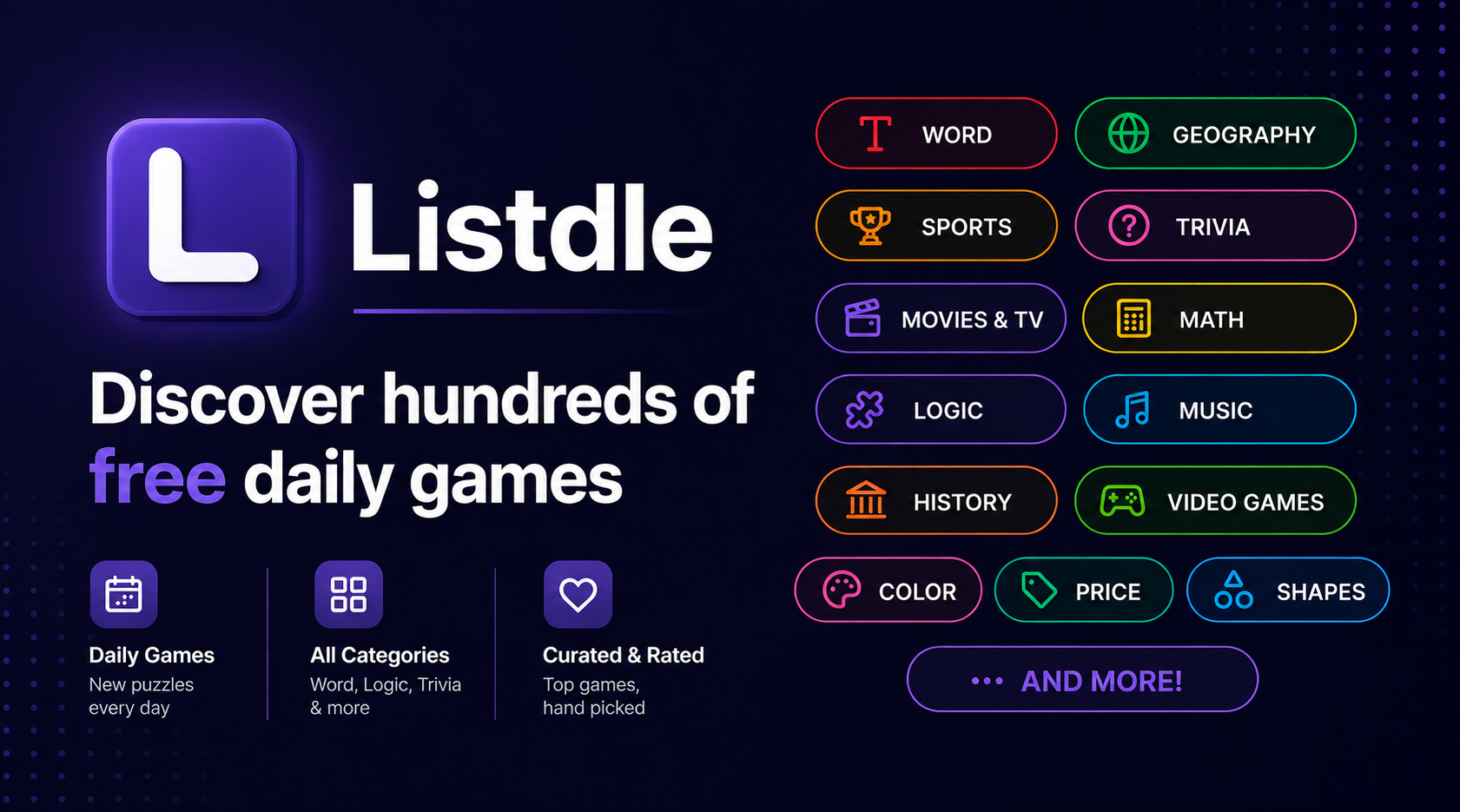

User reviews (0)