Website profiles · Technology insights · Alternatives

masscode.io Paid content

Categories: Productivity

Organize code snippets, Markdown notes, API requests, diagrams, and calculations in massCode: a free, open-source developer workspace with local storage.

Visit website

Updated: 2026-09-27 09:30 Language: English (default) Access: Normal

Profile views 1 Outbound visits 0
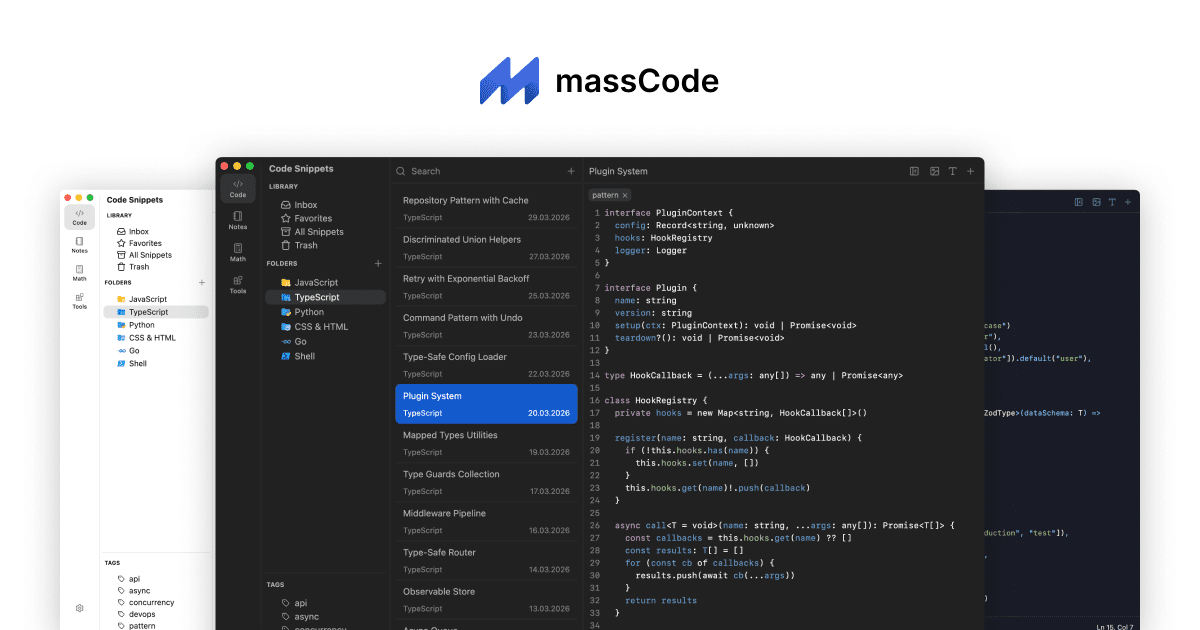
massCode Full homepage screenshot
Editorial Review

Website Review

What is massCode?

massCode is a free, open-source developer workspace that keeps small, reusable pieces of work in one place: code snippets, Markdown notes, API requests, diagrams, and calculations. Its defining trait is local storage — your material lives on your machine rather than in a hosted account.

What you can keep in it

  • Code snippets, organized so you can retrieve them quickly.
  • Markdown notes for technical documentation or personal reference.
  • API requests, so you can test and revisit endpoints without a separate client.
  • Diagrams and calculations — the small utilities you reach for mid-task.

Who it suits

A backend developer who tests the same handful of endpoints every week, or someone who keeps a growing library of config fragments, shell commands, and setup notes. The page evidence emphasizes connected knowledge: linking notes to the snippets and API requests they explain, and exploring those connections in a graph. That matters most when your notes have outgrown a flat folder structure.

Where it fits and where it doesn't

Your situation massCode is a good fit Consider something else
You want your snippets and notes on your own disk Yes —
You work across several machines and want automatic sync — A cloud-synced or team-hosted tool
You need teammates to share and edit the same library — A collaborative knowledge base
You want one tool for snippets, notes, and API calls Yes —

The trade-off is straightforward: local storage gives you privacy and no dependency on a service, but synchronization, backup, and sharing become your responsibility. If you collaborate heavily, weigh that against the convenience of a hosted alternative.

A useful next step

Pick one real task you repeat — say, three API calls you re-test after every deploy — and try doing it entirely inside massCode for a week. If retrieving and linking that material feels faster than your current mix of editor tabs and scratch files, the tool has earned a place in your setup. More at massCode.

How do I migrate my existing code snippets and notes into massCode?

massCode does not advertise a one-click importer, so migration is mostly a copy-and-paste job: bring your snippets in as individual snippets and your notes in as Markdown notes, then rebuild the folder and tag structure that made them findable in your old tool.

What "migrating" means here

massCode is a local developer workspace for snippets, Markdown notes, API requests, diagrams and calculations. Its own page emphasises connected knowledge — linking notes to the snippets and API requests they explain, and viewing those links as a graph. That shapes how you should migrate: don't dump everything into one folder. Sort as you import.

A practical sequence

  1. Export from your current tool first. Most snippet managers and note apps offer JSON, Markdown or plain-text export; Markdown is the easiest format to work with.
  2. Decide your top-level structure before importing. A common split is language or stack for snippets, and project or topic for notes.
  3. Import in batches, one folder at a time, so you can tag consistently as you go.
  4. Paste notes as Markdown. If your old tool exported Markdown, the formatting usually survives; code fences generally carry over.
  5. Recreate tags deliberately. Tags are what make a local, search-driven workspace useful months later.
  6. Rebuild links last. Once notes and snippets exist, add the note-to-snippet connections that massCode is built around.

Choosing what to bring at all

Content type Worth migrating? Why
Reusable snippets you actually paste Yes This is the core use case
Notes that explain a snippet or API Yes They gain value by being linked
One-off scratch files Usually no They add noise to search
Secrets, tokens, credentials No Keep these in a password manager

A concrete scenario

Suppose you keep 200 snippets in a cloud snippet manager and 60 project notes in a separate notes app. Export the snippets as JSON, the notes as Markdown. Create folders such as "TypeScript", "SQL" and "Docker" for snippets, and "Project notes" for the Markdown. Import the notes first so they exist as anchors, then add snippets and tag each one with both a language and a project. Finally, open a note like "Auth flow" and link it to the JWT and session snippets it references, so the graph view reflects how you actually work.

Decision criteria

  • If you rely on real-time sync across devices, check how you'll handle that before committing; massCode's emphasis is local storage on your machine.
  • If your current tool has no export at all, migrate only the snippets you've used in the last few months rather than everything.
  • If you have thousands of snippets, migrate in stages and keep the old tool installed until you're confident nothing important is missing.

For official download and documentation, start at massCode.

Can I use massCode to organize and run API requests alongside my code snippets?

Yes. massCode is built around a developer workspace that combines code snippets, Markdown notes, and API requests in one place, with local storage rather than a hosted account. The page specifically describes connecting technical notes to the snippets and API requests they explain, so an API request can sit next to the snippet that documents or implements it.

H3 Practical ways to use it

  • Keep a request collection for an internal service and link each request to the snippet that shows how the endpoint is called.
  • Store a Markdown note explaining auth, required headers, or environment variables, then link it to the relevant requests and snippets.
  • Use the graph view when you want to see how notes, snippets, and requests relate, useful when returning to a project after time away.
  • Keep everything local if you work with private endpoints or prefer not to sync request data to a third-party service.

H3 What to check before committing

  • Does it support the request features you rely on, such as environments, variables, and authentication methods? The page emphasizes organization and linking rather than a full API testing suite.
  • How well does it handle large collections? Graph and search views become less useful as a workspace grows, so test with your real volume.
  • Do you need team sharing or cloud sync? Local storage is a strength for privacy but a limitation for collaboration.

H3 How it compares in practice

Need massCode's fit
Snippets plus notes plus API requests in one local workspace Strong fit
Linking requests to explanatory notes and snippets Strong fit, based on the described graph and connections
Heavy API testing with advanced scripting and CI Likely limited; use a dedicated API client instead
Team-shared request collections Local-first storage makes this harder

If your main goal is a personal, local knowledge base where requests and snippets reinforce each other, massCode is a reasonable choice. If your main goal is collaborative API testing at scale, pair it with a dedicated tool such as Postman or Insomnia rather than replacing one with the other.

How does massCode's local storage keep my data private and portable?

massCode stores your snippets, notes, API requests, diagrams, and calculations on your own machine rather than in a hosted account. That local-first design is what makes the workspace both private and portable: privacy because nothing needs to leave your computer to be saved or searched, and portability because the data lives in files you control rather than behind a service you have to log into.

What that means in practice

  • Privacy: Your saved knowledge stays on your device. There is no requirement to upload snippets or notes to a remote server for the core workspace to function.
  • Portability: Because the workspace is file-based and local, you can move it between machines, keep it in a synced folder, or back it up like any other directory. You are not locked into an export format controlled by the vendor.
  • Offline use: A local workspace remains usable without a network connection, which matters when you are on a plane, in a restricted network, or working with sensitive client code.

A concrete scenario

Suppose you keep internal API keys, database connection strings, and proprietary snippets for a client project. With a local workspace, those stay on your laptop. To move to a new machine, you copy the workspace folder instead of re-creating an account and re-entering everything. If you want sync across devices, you choose the mechanism — a private Git repository, an encrypted cloud folder, or a direct transfer — rather than accepting whatever the vendor provides.

Trade-offs to weigh

Concern Local storage behaviour What to plan for
Privacy Data stays on your machine Your device security and disk encryption become the main safeguard
Portability Files you can copy and back up You manage backups and versioning yourself
Multi-device sync Not automatic Use your own sync or version-control setup
Collaboration Not built around shared cloud accounts Sharing means exporting or sharing files deliberately

Next step

Before committing, decide how you will back up and sync the workspace folder. A simple approach is to keep it inside a private Git repository or an encrypted sync folder, then test a restore on a second machine. If your team needs shared, permissioned access with an audit trail, a local-first tool may not fit that requirement — that is a genuine limitation, not a flaw. You can review the project and its documentation at massCode.

What is the graph view in massCode and how does it help me connect notes to snippets?

The graph view in massCode is a visual map of how your saved items relate to one another. Instead of treating notes, snippets, and API requests as separate lists, it draws them as connected nodes, so a technical note can sit next to the snippet or request it explains. That matches massCode's stated idea of "connected knowledge": you explore links between notes in a graph, and you can connect technical notes to the snippets and API requests they document.

For a solo developer, this mostly solves the "where did I put that?" problem. A typical workflow: you save a note explaining an authentication flow, then attach the working snippet that implements it and the API request that tests it. Later, opening the note shows the related snippet immediately, rather than making you search three separate folders. It is less useful if you only store a handful of snippets with no cross-references, since a graph with few links looks like scattered dots.

A few practical points:

  • The graph is a navigation aid, not a replacement for search. Quick keyword lookup is still faster when you already know the name.
  • It rewards consistent linking. If you rarely connect items, the view stays sparse.
  • Local storage means your linked knowledge stays on your machine, which suits private or client work.

Next step: pick one recent problem you solved and create three linked items — a note, the snippet, and the request — then open the graph to confirm the connections appear. If that feels natural, keep linking as you save; if not, stick to tags and search.

Related tools worth comparing: Obsidian Obsidian for note-centric graphs, and massCode itself massCode for a developer-focused mix of snippets, notes, and API requests.

How can I contribute to or sponsor the open-source massCode project?

You can support massCode in two main ways: contribute code or content through its open-source repository, or sponsor the project financially. The site itself points to a sponsorship route via Open Collective, where you can become a sponsor.

Ways to contribute

  • Code and bug fixes: Since massCode is open source, the most direct contribution is through its repository. Look for issues labeled as bugs or good first issues, then submit a pull request. This suits developers who use the app and want to fix an annoyance or add a small feature.
  • Documentation and translations: Clear docs and localized interfaces help more people adopt the tool. If you notice missing setup steps or awkward wording, a documentation pull request is a low-friction first contribution. Translators are especially useful for a developer tool with an international audience.
  • Bug reports and feature requests: A precise report — steps to reproduce, expected vs. actual behavior, and your OS — is a real contribution. It saves maintainers time and often precedes a fix. Feature requests are most useful when they describe the workflow problem, not just the desired button.
  • Community help: Answering questions in the project's discussion spaces (issues, discussions, or chat) helps other users and reduces maintainer load. This fits people who know the app well but don't have time to write code.

Ways to sponsor

  • Recurring sponsorship: The site links to Open Collective for becoming a sponsor, with a monthly contribution option. This is the clearest financial path shown on the page and is suited to individuals or companies who rely on the tool and want to sustain maintenance.
  • One-time or tiered support: Open Collective typically supports both one-off and recurring contributions, though the exact tiers and benefits are set by the project. Check the project's Open Collective page for current options rather than assuming a specific amount or perk.
  • Employer matching: If your company depends on massCode, ask whether it has an open-source sponsorship budget or matching program. This can turn a small personal donation into a meaningful recurring one.

How to choose

If you have... Best fit
Time and coding skills Pull requests for bugs or small features
Writing or language skills Documentation and translation
Deep product knowledge, little time Issue triage and community answers
Money but little time Recurring sponsorship via Open Collective
A company using the tool Employer sponsorship or matching

A practical next step: open the project's repository, read the contributing guidelines, and pick one issue labeled for newcomers. If you'd rather give money than time, use the sponsor link on massCode to reach the project's Open Collective page and choose a recurring amount you can sustain.

Related questions

More questions →
What Are Open-Source UI Element Libraries and How Do They Differ From UI Frameworks?

An open-source UI element library is a collection of individual, ready-made interface pieces—buttons, cards, inputs, toggles, loaders—that you copy into your own project and adapt. A UI framework, by contrast, is a structured system of components, conventions, and often a theming layer that governs how your whole interface is built. The practical difference: an element library gives you a snippet; a framework gives you a way of working. If you need a polished button in ten minutes, reach for the element library. If you're building a 40-screen product with a team, you probably want the framework.

What "open-source UI element library" actually means

The term gets used loosely, so it helps to separate the parts:

  • Open-source: the code is publicly available, and the license tells you what you may do with it—copy, modify, redistribute, or use commercially.
  • UI element: a single, self-contained piece of interface, usually small enough to read in one sitting. A button with hover states, a pricing card, a search field.
  • Library: a browsable, searchable collection of those elements, typically contributed by many different people.

On a site like Uiverse, elements are shared by a community and written in plain CSS or Tailwind. You find one you like, copy the markup and styles, paste them into your project, and adjust colors, spacing, and text to fit. There's no package to install and no build step required—which is exactly the appeal, and also the source of most of the confusion.

Element library vs. UI framework: the core differences

Dimension Open-source UI element library UI framework / design system
Unit of reuse A single snippet you copy A component you import or call
Installation None; paste into your code Package install, config, sometimes a provider
Consistency Depends on you; each element may look different Enforced by shared tokens and APIs
Theming Manual edits per element Central theme/config file
Updates You own the copy; no upstream updates Version bumps bring fixes and changes
Accessibility Varies per contributor; must be checked Usually tested and documented
Best for Prototypes, landing pages, small sites, one-off needs Multi-page apps, teams, long-lived products
Learning curve Low—read the CSS Higher—learn the API and conventions

The table isn't a verdict. It's a map of trade-offs. Element libraries win on speed and freedom; frameworks win on consistency and maintenance.

Licensing and attribution: what to check before you paste

This is where people get into trouble, and it's worth slowing down for.

  1. Find the license. Every element or collection should state one. Common open-source licenses include MIT, Apache-2.0, and BSD. Some projects use copyleft licenses like GPL, which can impose obligations if you redistribute your code.
  2. Understand what the license permits. MIT and Apache-2.0 are permissive: you can typically use the code in commercial and closed-source projects. Copyleft licenses may require you to release derivative source under the same terms.
  3. Check attribution requirements. Permissive licenses usually require you to keep the copyright notice and license text somewhere in your project. That's a real obligation, not a formality.
  4. Look for per-element terms. On community sites, the site's overall terms and the individual contributor's stated wishes may differ. If a contributor asks for credit, honor it.
  5. When in doubt, ask or avoid. If a snippet has no license at all, you don't have clear permission to reuse it. Treat "no license" as "not open source," even if the code is publicly visible.

This article is general information, not legal advice. For commercial products with real exposure, have someone qualified review the licenses you're relying on.

How to use a community element in your project: a practical workflow

Here's a repeatable process that avoids most of the usual mess.

1. Start from a real need, not a browsing session

Decide what you need first—"a compact primary button with a loading state"—then search. Browsing aimlessly produces a pile of pretty snippets that don't fit together.

2. Copy the smallest version that works

Take the markup and the styles. Strip anything you don't need: demo wrappers, extra animations, decorative layers. Less code means fewer surprises.

3. Convert it to your conventions

If your project uses design tokens or CSS variables, replace hard-coded values:

/* Before: hard-coded */
.button { background: #4f46e5; border-radius: 8px; }

/* After: token-based */
.button { background: var(--color-primary); border-radius: var(--radius-md); }

This one step is what keeps a copied element from looking like a foreign object in your UI.

4. Check accessibility before you ship

Community elements vary widely here. Verify at minimum:

  • Keyboard focus is visible and the element is reachable by Tab.
  • Color contrast meets WCAG AA (4.5:1 for normal text).
  • Interactive elements use semantic HTML (<button>, not a clickable <div>).
  • Form inputs have associated labels.
  • Motion respects prefers-reduced-motion.

5. Test in context

Paste it into a real page with real content. Long labels, small screens, and dark mode break more copied elements than anything else.

6. Note where it came from

Keep a short comment or an internal credits file: source, license, date. Future you—and your legal reviewer—will be grateful.

Where element libraries genuinely shine

  • Prototypes and demos: you need something clickable today, not a design system.
  • Landing pages and marketing sites: a handful of distinctive elements, each custom.
  • Filling gaps: your framework lacks one specific component, and you don't want to build it from scratch.
  • Learning: reading well-made CSS is one of the fastest ways to improve.
  • Small projects: a personal site doesn't need a theming architecture.

Where they fall short

  • Consistency at scale: ten elements from ten contributors rarely look like one product.
  • Maintenance: you own every copy. When your design changes, you edit each one.
  • Accessibility debt: you inherit whatever the contributor did or didn't do.
  • No upstream fixes: a bug fixed in the original won't reach your copy.
  • Integration friction: different naming conventions, different units, different assumptions about resets.

When to choose which

Choose an element library when the scope is small, the timeline is short, or you need a few distinctive pieces rather than a whole system.

Choose a framework or design system when multiple people build multiple screens over months, when consistency is a product requirement, or when accessibility and theming need to be guaranteed rather than checked.

A hybrid works well for many teams: adopt a framework for the structural components—forms, navigation, layout—and borrow individual elements for the places where you want personality. Just route every borrowed element through the same token and accessibility checks, so it lands as part of your system rather than beside it.

The short version: open-source UI element libraries are a fast, flexible way to get good-looking interface pieces into a project. They are not a substitute for a design system, and the license and accessibility details are the part worth reading carefully.

How massCode Connects Notes, Snippets, and API Requests

massCode connects notes, snippets, and API requests by letting you link them to each other, then showing those links in a graph view. The point is to keep the explanation, the code, and the request that proves it together, so you don't have to remember which folder held which piece. This works best if you already keep technical notes and reusable code in one place and want to stop re-searching for the same answer.

The three content types and what each holds

massCode is described as a developer workspace that organizes code snippets, Markdown notes, API requests, diagrams, and calculations, with local storage. Each type plays a different role:

Type What it stores Typical use
Markdown notes Written explanations, decisions, how-tos "Why we chose this auth flow"
Code snippets Reusable code fragments The actual function or config block
API requests Saved request definitions The call that exercises an endpoint

The value isn't in any one type. It's that a note can point at the snippet it explains, and that snippet can sit next to the request that uses it.

How the connection works

The mechanism is linking: you associate a technical note with the snippets and API requests it explains. Instead of duplicating code into a note or pasting a note into a snippet comment, you keep each item in its native form and record the relationship between them.

The site describes this directly: "Connect technical notes to the snippets and API requests they explain, so the next step is always close."

So the model is:

  1. Write the note as the explanation layer.
  2. Keep the snippet as the executable layer.
  3. Keep the API request as the verification layer.
  4. Link them so any one entry point leads to the others.

What the graph view adds

massCode includes a graph that visualizes links between your notes. The site frames it as "See how your ideas connect. Explore the links between your notes in a graph."

Two practical consequences:

  • Discovery by association. You find related material by following edges rather than by remembering exact titles or folders.
  • Gap spotting. Isolated nodes are notes you never linked to anything — often the ones you'll forget you wrote.

The graph is a navigation aid, not a search replacement. Use it when you know roughly where an idea lives but not what you named it.

Why this helps lookup and reuse

The failure mode this design targets is fragmentation: the explanation lives in one app, the snippet in another, the API request in a third, and the connection between them lives only in your memory.

When the three are linked:

  • Reuse gets faster. You land on the note, and the working snippet is one step away instead of a separate search.
  • Context survives. A snippet without its note is just code; the link restores why it exists.
  • Requests stay honest. An API request attached to the note it tests is easier to trust than one floating alone.

What to check before adopting it

  • Local storage. massCode stores data locally, per the site description. Confirm that matches how you want to back up and sync across machines.
  • Open source. It's described as free and open source, so you can inspect and self-manage it.
  • Sponsorship is optional. The site links to a sponsorship checkout, which is a funding path, not a required purchase.

If your current setup already links notes to code well, the gain is smaller. If you regularly re-find the same snippet by re-reading old notes, the linking plus graph is the part worth testing first.

What Is OpenAPI-Generated API Documentation and How Does It Work?

OpenAPI-generated API documentation is reference documentation that is produced automatically from an OpenAPI description file rather than written by hand. You write (or generate) a machine-readable specification of your API — endpoints, parameters, request bodies, responses, schemas, and auth — and a documentation tool reads that file and renders a browsable, often interactive reference site. The spec becomes the single source of truth; the docs become a build artifact.

This differs from manually written docs in one fundamental way: with hand-written docs, the prose is the source of truth and the API is described separately. With spec-driven docs, the API description is the source, and every page, table, and code sample is derived from it.

How the workflow actually runs

A typical spec-driven documentation pipeline has five stages:

  1. Author or generate the spec. You either write an OpenAPI document by hand (YAML or JSON), or generate it from code annotations, framework metadata, or a design-first editor. Design-first means the spec is written before implementation; code-first means it is extracted from existing code.
  2. Validate and lint. The spec is checked against the OpenAPI schema and against style rules — consistent naming, required descriptions, no undocumented 4xx responses, no orphaned schemas.
  3. Bundle and transform. Multi-file specs are combined, $ref pointers are resolved, and the document is optionally split into per-tag or per-version outputs.
  4. Render. A documentation tool converts the spec into HTML: an endpoint list, a sidebar of operations, parameter tables, response schemas, and a "try it" console.
  5. Publish and version. The rendered site is deployed, and each API version gets its own snapshot so consumers can read docs matching the version they call.

Steps 2 through 5 are usually automated in CI. If the spec fails validation, the docs build fails — which is the point.

Spec-driven vs. hand-written documentation

Dimension OpenAPI-generated Hand-written
Source of truth The spec file The prose
Consistency with the API High, if the spec is accurate Drifts as the API changes
Effort per endpoint Low after setup Repeated for every endpoint
Narrative and tutorials Weak; needs separate pages Strong
Code samples Generated per language from schemas Written and maintained manually
Customization Bounded by the tool's templates Unlimited
Failure mode Accurate spec, poor docs, or stale spec Beautiful docs that describe an API that no longer exists

The practical conclusion most teams reach: generate the reference, write the guides. Reference material is repetitive and mechanical, which is exactly what generation is good at. Conceptual explanations, migration notes, and tutorials carry judgment that a spec cannot express.

What you get out of the box

Generated reference pages commonly include:

  • An operation list grouped by tag or path, with HTTP method and path.
  • Parameter tables showing name, location (path, query, header, cookie), type, required flag, and description.
  • Request and response schemas rendered as expandable trees, including nested objects and arrays.
  • Authentication details pulled from the securitySchemes section.
  • Interactive request consoles that let a reader send a real call from the browser.
  • Generated code samples in several languages, derived from the same schemas.
  • Multiple output formats, such as a static site, a single HTML file, or a mock server.

Because all of these come from one document, changing a field name in the spec updates the parameter table, the schema tree, and every code sample at once.

Where spec-driven documentation breaks down

Generation is not free. The trade-offs are real:

Spec quality becomes documentation quality. A field with no description produces a table row with an empty cell. A vague summary produces a vague heading. Tools can enforce presence of descriptions via linting, but they cannot enforce that the description is useful.

Customization has limits. If you need a page that does not map to an OpenAPI concept — a conceptual overview, a pricing explanation, a comparison of two endpoints — you write it outside the generator and link to it.

Not everything is expressible. Webhooks, streaming responses, long-polling behavior, and complex multi-step flows are awkward or impossible to describe fully in OpenAPI. Those need prose.

The spec can go stale. If the spec is maintained separately from the implementation, it drifts just like hand-written docs. The mitigation is to generate the spec from code, or to test the implementation against the spec in CI.

Interactive consoles need care. A "try it" button that hits a production API with real credentials is a security and rate-limit problem. Point it at a sandbox, or disable it.

Deciding whether to adopt it

Adopt spec-driven reference documentation if most of these are true:

  • Your API has more than a handful of endpoints, or changes frequently.
  • You ship client SDKs or code samples in more than one language.
  • Multiple teams consume the API and need a consistent, always-current reference.
  • You already have, or are willing to maintain, an OpenAPI description.

Stay with hand-written docs, or a hybrid, if:

  • Your API is small and stable, and the reference fits on one page.
  • Your documentation is mostly conceptual and contains little endpoint-level detail.
  • You cannot commit to keeping the spec in sync with the implementation.

A reasonable middle path: generate the reference from the spec, and hand-write the getting-started guide, authentication walkthrough, and error-handling page. Link the two directions so readers can move from concept to endpoint and back.

A minimal starting checklist

  1. Produce one valid OpenAPI document for a single API version.
  2. Add a linter with rules for descriptions, operation IDs, and error responses.
  3. Wire the docs build into CI so a failing spec fails the build.
  4. Render the reference and review it as a reader, not as the author.
  5. Write the two or three conceptual pages the generator cannot produce.
  6. Version the published docs alongside the API version.

The core idea is simple: describe the API once, in a format both machines and humans can read, and let the reference documentation fall out of that description. Everything else — tooling, hosting, interactivity — is a detail on top of that decision.

What Is massCode and What Can You Use It For?

massCode is a free, open-source developer workspace that keeps code snippets, Markdown notes, API requests, diagrams, and calculations in one place, with local storage. It fits developers who want a single, searchable home for the small pieces of knowledge and tooling they reach for every day, and who prefer their data to stay on their own machine. If you already have a snippet manager, a notes app, and a scratch pad for API calls, massCode's pitch is that you can replace several of them with one tool.

What massCode actually is

The project describes itself as "your developer workspace" — a desktop-style environment for organizing the artifacts of day-to-day development rather than a full IDE or a cloud service. Two properties define it:

  • Free and open source. You can use it without paying, and the source is available to inspect or contribute to. The site's only visible monetization is a sponsorship link (via Open Collective), not a paid tier.
  • Local storage. Your work lives on your machine. That matters if you handle internal snippets, credentials-adjacent notes, or client code you would rather not sync to a third-party server.

The tagline "Your work. On your machine." reinforces that the storage model is a deliberate feature, not an afterthought.

What you can keep in it

massCode groups several content types that developers usually scatter across different apps:

Content type Typical use
Code snippets Reusable functions, config blocks, boilerplate you paste often
Markdown notes Technical notes, explanations, project scratchpads
API requests Saved HTTP calls you re-run during development
Diagrams Visual sketches that support your notes or snippets
Calculations Quick numeric work you want to keep alongside the rest

The value is consolidation: instead of a snippet tool, a separate notes app, and a REST client, you work in one workspace with one search.

The feature that ties it together: connected knowledge

The site highlights a graph view that shows links between your notes. The stated idea is to "connect technical notes to the snippets and API requests they explain, so the next step is always close."

In practice, this means a note about, say, an authentication flow can link directly to the snippet that implements it and the API request that tests it. When you return to the topic months later, you follow the links instead of hunting through folders. This is the main differentiator versus a plain snippet manager, which usually stores items in isolation.

Where it fits in a real workflow

Consider a common task: you are integrating a third-party payment API.

  1. You save the request you used to test the endpoint, so you can re-run it later.
  2. You keep the signing/verification snippet next to it.
  3. You write a short Markdown note explaining the gotchas you hit.
  4. You link the note to both the snippet and the request.

Later, when a different project needs the same integration, you open the note, follow the links, and have everything in one place — no re-reading old chat threads or re-deriving the signing logic. The same pattern applies to internal library usage, environment setup steps, or recurring SQL you keep forgetting.

Who should look closer — and who should not

Worth trying if you:

  • Want snippets, notes, and API requests in one local workspace.
  • Care about keeping developer knowledge on your own machine.
  • Like the idea of linking notes to the code and requests they describe.

Probably not the right fit if you:

  • Need real-time collaboration or team-shared snippet libraries as a core requirement.
  • Want a full cloud sync service across many devices out of the box.
  • Are looking for a complete IDE rather than a workspace for saved knowledge and small tools.

How to evaluate it

Because it is free and open source, the cost of trying it is low. Install it, move a handful of your most-used snippets and one or two API requests in, and write one note that links to them. If the graph and the single-search workflow save you time within a week, it earns a place in your setup. If you find yourself missing a specific integration or sync feature, that is your signal to keep your existing stack.

Does massCode Store Data Locally? What Local Storage Means for Developers

Yes. massCode is built around local storage: your snippets, Markdown notes, API requests, diagrams, and calculations live on your own machine rather than in a vendor-hosted account. That means the app can work without a network connection, and your saved knowledge stays under your direct control. The trade-off is that syncing across devices and backing up your data become your responsibility, not something the tool handles for you.

What "local storage" actually means here

When a developer tool stores data locally, the files it creates are written to your computer's disk. The application reads and writes them directly. There is no round trip to a remote server required for the core action of saving or opening an item.

massCode's own description frames this as a design choice, not a limitation: it is "a free, open-source developer workspace with local storage," and one of its page headings puts it plainly — "Your work. On your machine."

So the practical meaning is:

  • Saving a snippet or note does not require an account. The write goes to local files.
  • Opening the app does not require a connection. The data is already where the app expects it.
  • The vendor is not in the data path. There is no hosted database holding your content by default.

Why this matters for privacy and control

For developers, the value of local storage usually comes down to three things:

Concern With local storage With a cloud-account tool
Who can read your data You (and anyone with access to your machine) You and the service operator
Offline use Works Often degraded or blocked
Account required No Usually yes
Cross-device sync You set it up Usually built in
Data portability Files are already on disk Depends on export features

If you store internal API keys, proprietary endpoint shapes, client-specific code, or unreleased architecture notes, keeping them off a third-party server removes a whole category of risk. It also means a service outage or a pricing change can't lock you out of your own notes.

The trade-offs you should plan for

Local storage is not free of obligations. The same property that keeps your data private also means nobody else is protecting it.

  • Backups are on you. If the disk fails and you have no copy, the data is gone. A folder-sync service, a Git repository, or a scheduled archive solves this.
  • Multi-machine work needs a plan. massCode does not present itself as a sync service, so moving between a laptop and a desktop means you choose the mechanism — a synced folder, a private repo, or manual transfer.
  • Sharing is manual. There is no shared workspace by default; you export or copy what you want to hand off.

How it fits the rest of the workspace

Local storage doesn't make massCode a set of isolated files. The app is organized as a connected workspace: snippets, Markdown notes, API requests, diagrams, and calculations sit together, and the notes side supports linking between ideas — the site describes exploring "the links between your notes in a graph" and connecting "technical notes to the snippets and API requests they explain."

That structure is what makes local storage usable rather than just private. You get the relationships of a knowledge tool without the account requirement of a hosted one.

Who should choose it on this basis

Local storage is a good fit if you:

  • want your snippets and notes to remain readable and portable as files,
  • work offline or on networks you don't fully trust,
  • prefer not to create yet another account for a personal knowledge tool,
  • are willing to handle your own backup and sync.

It's a weaker fit if you expect automatic multi-device sync out of the box, need real-time collaboration, or want a vendor to guarantee durability of your data. In those cases, the local-first design shifts work onto you that a hosted tool would otherwise absorb.

The short version: massCode keeps your developer knowledge on your machine, which buys privacy, offline access, and control — and asks you to own backup and syncing in return.

Website Overview

Identifiable technologies and additional version or configuration signals make the service easier to fingerprint, which may help targeted scanners narrow their checks. An established domain and managed infrastructure suggest continuity of operations and may support dependable delivery, although neither guarantees service quality.

Domain and Registration

Registered in 2019, this domain has about 6 years of history. That suggests continuity, although ownership and purpose may have changed. Transfer-protection status is present, helping reduce the risk of unauthorized domain transfers. The registrar is Cloudflare, Inc, a widely used domain service provider. The domain uses the common .io extension, which is not an independent safety signal.

DNS and Email

Nameservers are provided by Cloudflare, indicating managed DNS hosting. No CNAME was found; the observed records resolve directly to addresses. No MX record was found. A conventional explicit inbound-mail route is not configured. DNSSEC signatures were not detected, so this additional DNS authenticity protection is not confirmed. The lowest observed DNS TTL is 300 seconds.

TLS and Certificates

The certificate uses an RSA 2048-bit public key, offering broad client compatibility. The server supplied a complete certificate chain. No organization name is present in the certificate; the available fields are consistent with domain validation. The certificate was issued by Let's Encrypt, commonly associated with automated certificate services. The certificate's total validity is about 89 days, consistent with a short renewal cycle.

HTTP and Browser Security

The Server header exposes the software version: nginx/1.10.3 (Ubuntu). This makes version-targeted checks easier, but is not proof of an exploitable vulnerability. The checked browser-security headers were not detected, leaving fewer explicit browser-side safeguards. The headers contain possible internal network information: nginx/1.10.3 (Ubuntu). No X-Powered-By header was found, reducing one common source of backend fingerprinting information. No explicit CDN or WAF marker was found in the response headers.

Technology Stack Analysis

The public page identifies VitePress 1.6.4, nginx 1.10.3, with exact versions exposed for 2 technologies. These details can narrow vulnerability checks, although exposure alone is not a vulnerability.

Search and Social Sharing

The Generator tag identifies VitePress v1.6.4, making the publishing system easier to fingerprint. Twitter Card metadata is configured. JSON-LD includes Product or Offer data, potentially supporting eligible product search features. The title has 53 characters, within a common display range. A meta description is present, with 153 characters.

Hosting and Email

DNSCloudflare
HostingDigitalOcean, LLC
EmailUnknown
Location United States flagClifton, New Jersey, United States 104.236.81.198

User reviews (0)

  • No reviews yet.

Pages, Search and Sharing

Meta descriptionOrganize code snippets, Markdown notes, API requests, diagrams, and calculations in massCode: a free, open-source developer workspace with local storage.
Canonical URLhttps://masscode.io/
LanguageEnglish (default)
Twitter Cardsummary_large_image
All bots 1 allowed · 0 disallowed
  • Allow/

Registration details RDAP / WHOIS

RegistrarCloudflare, Inc
Registered2019-12-31
Expires2026-12-31
Domain statusclientTransferProhibited https://icann.org/epp#clientTransferProhibited
Nameserversdonovan.ns.cloudflare.com、luciana.ns.cloudflare.com
DNSSECunsigned

DNS records

TypeNameValueTTLPriority
Amasscode.io104.236.81.198300—
NSmasscode.iodonovan.ns.cloudflare.com86400—
NSmasscode.ioluciana.ns.cloudflare.com86400—

TLS and certificates

AssessmentNormal configuration
Supported protocolsTLSv1.2
Negotiated protocolTLSv1.2
Certificate subjectmasscode.io
IssuerLet's Encrypt
Valid until2026-11-10T06:49 · Remaining when checked: 43 days
Verification detailsCertificate trust: Passed · Hostname match: Passed

HTTP response headers

HeaderValue
content-typetext/html
servernginx/1.10.3 (Ubuntu)

Identified technologies

VitePress 1.6.4nginx 1.10.3