Website profiles · Technology insights · Alternatives

memegenscript.com

Create memes online for free. Choose from 481 popular meme templates, add your text, and download or share the image. Also available as an API.

No paid content found
Visit website
Profile views 8 Outbound visits 0 Normal
Memegenscript Full homepage screenshot

At a glance

Category
Development
Language
English
Paid-content signal
No paid content foundObserved
Registered
2026
Hosting
CloudflareInferred
HTTPS certificate trusted
PassedObserved
Last updated

Website review

This review may include AI-generated content and is not individually verified. Domain, certificate and other facts come from the observed data on this page.

What is Memegenscript?

Memegenscript is a free browser-based meme generator. You pick from 481 templates, type your caption, drag the text where you want it, then download the image. The site says no signup is required and downloads carry no watermark. It also offers an API, which is the main thing that sets it apart from typical meme-makers.

Who it suits

  • Casual users who want a fast meme without creating an account.
  • People who can't find the right template and want to request one (the site points to a request option and GitHub).
  • Developers or automation-minded users who'd rather generate memes programmatically than through a web form.

What you actually get

Aspect What the site states
Templates 481, browsable and filterable
Cost Free
Account No signup
Download No watermark
Text control Type and drag text into position
Automation An API is available

The template list leans heavily on recognizable internet and pop-culture images — Distracted Boyfriend, This Is Fine, Drakeposting, Surprised Pikachu and many others — so most people will find something familiar without hunting.

A practical next step

If you just need one meme, open the template gallery, filter for a keyword, and start typing. If you're building something — a Slack bot, a scheduled social post, an internal tool — check the API before investing time in the web editor, since that's the capability most competing generators don't offer. A reasonable decision rule: use the site directly for one-off images, and treat the API as the reason to choose this over other free generators when you need memes generated repeatedly or automatically.

The trade-off is typical of template-based generators: speed and familiarity in exchange for originality. If you need a custom image that isn't in the 481, you're dependent on the request process rather than uploading your own base image — worth confirming on the site if that matters to you.

How do I create a meme with Memegenscript without signing up?

You can do it entirely in the browser: open Memegenscript, pick one of the 481 templates, type your caption, drag the text where you want it, then download the image. The page states there is no signup, no watermark on downloads, and no talent required.

Step-by-step

  1. Go to the site and scan Featured memes if you want something current, or All meme templates for the full list.
  2. Click a template — the page shows examples like Distracted Boyfriend, Drakeposting, This Is Fine and Surprised Pikachu.
  3. Add your text in the caption fields and drag each block to reposition it.
  4. Download the result. If you can't find the image you want, the page offers a Request a template option and a GitHub request route.

Who this suits

  • Someone posting a quick reaction image in a group chat or on social media.
  • A writer or community manager who needs a one-off visual without creating an account.
  • Developers: the same page notes an API, so you can automate generation instead of using the editor by hand.

Trade-off to know No signup means no saved drafts or template history tied to an account, so download anything you want to keep. If you plan to make many memes with a consistent style, the API is the more efficient path; for a single joke, the editor is faster.

Next step: pick one template now and test the text placement — drag the caption before you download, since the layout you see is what gets exported.

Can I use the Memegenscript API to generate memes programmatically?

Yes. Memegenscript offers an API alongside its browser-based generator, so you can create memes from code rather than clicking through the site manually. The page presents the API as a companion to the free template library of 481 meme images.

H3 Practical uses

  • Bot replies: a Discord or Slack bot that turns a user's message into a meme and posts the image back.
  • Scheduled social posts: generate a meme from a template plus a caption on a cron job, then publish it.
  • Internal tools: a small dashboard where a marketing team types text and downloads a finished image without opening a design app.

H3 What to check before building

  • Endpoint and request format: whether you send a template identifier plus text boxes, or a template URL plus coordinates. This decides how much of your code is layout logic.
  • Template identifiers: how you look up a specific template (name, slug, or numeric ID) so your calls stay stable when the library changes.
  • Text placement: whether the API accepts top/bottom text only or arbitrary positioned text boxes, since many modern templates need text in unusual spots.
  • Output format and size: what image type and dimensions come back, and whether you can request a specific size.
  • Rate limits and authentication: whether calls need a key, and what happens when you exceed a quota.
  • Watermarks and licensing: the site advertises no watermark on downloads, but confirm that this also applies to API output, and check the terms for commercial use of the underlying meme images.

H3 A quick test Pick one template you already know well, such as Distracted Boyfriend or Drake, and make a single API call with placeholder text. If the returned image has your text in the right place, the integration is viable; if the text lands wrong, you will need a template that matches the API's text model or extra image-processing code on your side.

For comparison, other meme APIs exist with different template sets and pricing models, but you would need to check each provider's own documentation for details.

What meme templates are available on Memegenscript?

Memegenscript offers 481 meme templates in its library, with a mix of classic reaction images and newer internet favorites. According to the site's own listing, the featured set includes Drakeposting, Distracted Boyfriend, This is Fine, Stonks, Confused Math Lady, UNO Draw 25, Swole Doge vs. Cheems, Woman Yelling at a Cat, Gru's Plan, Anakin and Padme, Monkey Puppet, Squidward Looking Out the Window, Is This a Pigeon?, Futurama Fry, Leonardo DiCaprio Cheers, Leonardo DiCaprio Pointing, Doge, Sad Pablo Escobar, Two Paths, Epic Handshake, Left Exit 12 Off Ramp, Surprised Pikachu, and Daily Struggle.

The broader "All meme templates" list adds many more, including Three-Headed Dragon, Ancient Aliens Guy, It's A Trap!, But the Ad Said 3000, Ben Affleck Smoking, Afraid to Ask Andy, Agnes Harkness Winking, Ah Shit Here We Go Again, AI Reading the Script, Sweet Brown, AJ Styles & Undertaker, Do All the Things, Awkward Moment Seal, Anime Girl Hiding from Terminator, Do You Want Ants?, Almost Politically Correct Redneck, Arthur's Fist, Always Has Been, And Then I Said, Aura Farming, Avatar Guy, Life... Finds a Way, the Socially Awesome/Awkward Penguin variants, There Is No War in Ba Sing Se, Baby Yoda Sipping Soup, You Should Feel Bad, Milk Was a Bad Choice, Running Away Balloon, Bat Signal, Batman Slapping Robin, Be Honest, Men in Black, Somebody Get These Beggars Outta Here, Guy Hiding Behind Tree, I'm Going to Build My Own Theme Park, Bernie: I Am Once Again Asking, Best I Can Do, Big Book Small Book, Big Thumb Guy, But It's Honest Work, Bike Fall, Why Shouldn't I Keep It Trump, Bill Signing, Baby Insanity Wolf, Aragorn at the Black Gate, Bad Luck Brian, Blinking White Guy, Boardroom Meeting Suggestion, I Should Buy a Boat Cat, Bongo Cat, Why Not Both?, Both Buttons Pressed, What's in the box!?, Brace Yourselves X Is Coming, Brain Before Sleep, Bro Visited His Friend, This is Bull Shark, Bugs Bunny No, Bully Maguire Walking, SpongeBob Burning Paper, Two Guys on a Bus, What Is My Purpose?, and X X Everywhere.

If you cannot find the exact template you want, the page provides a request option. The site also notes that an API is available, which is useful if you want to generate memes programmatically rather than only through the browser.

For a quick decision: use the featured set for fast, recognizable formats; browse the full list when you need a more specific reaction; and consider the API if you are building a tool or workflow that creates memes automatically. A practical next step is to open the template list, filter or scan for your intended joke's format, then test the text placement and download behavior before committing to it for a post.

How do I request a new meme template on Memegenscript?

Use the Request a template option on the site. Memegenscript’s meme generator page includes a “Can’t find your meme? Request a template” prompt, with a separate Request on GitHub link. That means there are two practical routes: the on-site request path for a normal visitor, and the GitHub route if you prefer a public, trackable request.

For most people, the on-site option is the simpler choice. If you have a GitHub account and want to follow progress or add context, the GitHub route is more transparent.

H3 Practical example Suppose you want a template from a niche show or a local in-joke image. You would:

  1. Open the Memegenscript meme generator.
  2. Scroll to the template area and look for “Can’t find your meme? Request a template.”
  3. Use that request option, or choose Request on GitHub if you want a public issue-style request.
  4. Include the template name, a source link or image reference if possible, and a short note on why it would be useful.

H3 What to include

  • The exact meme name, if it already has one
  • A link to the original image or source
  • A short description of the joke or format
  • Any text placement notes, such as top text, bottom text or label positions

H3 Decision criterion Use the on-site request if you just want to ask. Use the GitHub request if you want to track whether it is added, comment on it, or see other requests. If the template is already among the 481 listed, you do not need to request it; search or filter the templates first.

A useful next step is to check the All meme templates and Featured memes sections before requesting, so you do not ask for something that is already available.

Are Memegenscript downloads free and watermark-free?

Yes. According to the site itself, Memegenscript lets you download memes free and without a watermark, and you don't need to create an account. The page headline is "Make a meme. Post it. Regret nothing." and it explicitly states "481 templates · free · no signup" and "no watermark on downloads." So for a casual user, the workflow is: pick a template, type your text, drag it into place, download.

A practical caveat is that "free" here describes the download of the meme image you create. The page also mentions an API, which is a separate offering aimed at developers or automated tools; it isn't clear from the page whether the API is free, metered or otherwise limited. If you plan to use it programmatically, check the API terms directly rather than assuming the same free terms as the browser tool.

What to check before relying on it

  • Watermark: The site says downloads have no watermark, which is the main thing to verify after your first export.
  • Signup: No signup is required for the basic generator, so you can test it immediately.
  • Templates: 481 templates are offered, with a request form and a GitHub option if yours is missing.
  • API use: Treat the API as a distinct product; confirm its access rules, rate limits and any cost separately.
  • Rights: Free to download doesn't automatically mean free to use commercially. Meme templates often contain third-party images, so check the source material if you're using a meme in advertising or paid content.

If your goal is a quick personal meme, this is about as low-friction as it gets. If your goal is commercial or automated use, start by testing one download and then read the API documentation before building anything on top of it.

Related questions

More questions →
Do You Need an Account or Is There a Watermark on Memegenscript Downloads?

No. According to the site itself, Memegenscript requires no signup and adds no watermark to downloads. The homepage states plainly: "481 templates · free · no signup" and "No signup, no watermark on downloads, no talent required." So you can pick a template, type your text, and download the finished image without creating an account or paying.

This applies to the standard browser-based workflow described on the site. It does not tell you anything about rate limits, commercial-use terms, or what an API integration might require — those details aren't covered in the available page content.

What the no-account workflow looks like

The site describes a short, linear process:

  1. Pick a template — choose from the 481 available meme templates.
  2. Add your text — type your caption into the template.
  3. Position it — drag the text wherever you want it on the image.
  4. Download — save the image, with no watermark applied.

There is no step in that description that involves registering, logging in, or verifying an email. The site frames the whole thing as immediate: "Pick a template, smash in your text, drag it wherever you want, download."

Why this matters for how you use it

Consideration What the site indicates
Account required? No — "no signup"
Watermark on output? No — "no watermark on downloads"
Cost to use? Free, per the site's own description
Editing controls Drag text to reposition it
Template count 481 templates

The absence of a signup step means you can make a meme in a single sitting without abandoning the task to create credentials. The absence of a watermark means the downloaded file is the finished image, not a branded preview — useful if you're posting it somewhere the branding would look out of place.

Things the site doesn't answer

The available page content doesn't specify:

  • Whether there are usage limits on how many memes you can generate
  • Whether downloaded memes carry any licensing restrictions for commercial use
  • Whether the API (mentioned on the site) requires credentials or has its own terms

If any of those matter for your use case, treat them as open questions rather than assuming the no-signup, no-watermark policy extends to them.

If you can't find a template

The site offers a way to request one: "Can't find your meme? Request a template," with a request option on GitHub. That's a route for filling gaps in the 481-template library rather than a workaround for account or watermark limits — those limits simply don't exist in the described workflow.

What Is OpenAPI-Generated API Documentation and How Does It Work?

OpenAPI-generated API documentation is reference documentation that is produced automatically from an OpenAPI description file rather than written by hand. You write (or generate) a machine-readable specification of your API — endpoints, parameters, request bodies, responses, schemas, and auth — and a documentation tool reads that file and renders a browsable, often interactive reference site. The spec becomes the single source of truth; the docs become a build artifact.

This differs from manually written docs in one fundamental way: with hand-written docs, the prose is the source of truth and the API is described separately. With spec-driven docs, the API description is the source, and every page, table, and code sample is derived from it.

How the workflow actually runs

A typical spec-driven documentation pipeline has five stages:

  1. Author or generate the spec. You either write an OpenAPI document by hand (YAML or JSON), or generate it from code annotations, framework metadata, or a design-first editor. Design-first means the spec is written before implementation; code-first means it is extracted from existing code.
  2. Validate and lint. The spec is checked against the OpenAPI schema and against style rules — consistent naming, required descriptions, no undocumented 4xx responses, no orphaned schemas.
  3. Bundle and transform. Multi-file specs are combined, $ref pointers are resolved, and the document is optionally split into per-tag or per-version outputs.
  4. Render. A documentation tool converts the spec into HTML: an endpoint list, a sidebar of operations, parameter tables, response schemas, and a "try it" console.
  5. Publish and version. The rendered site is deployed, and each API version gets its own snapshot so consumers can read docs matching the version they call.

Steps 2 through 5 are usually automated in CI. If the spec fails validation, the docs build fails — which is the point.

Spec-driven vs. hand-written documentation

Dimension OpenAPI-generated Hand-written
Source of truth The spec file The prose
Consistency with the API High, if the spec is accurate Drifts as the API changes
Effort per endpoint Low after setup Repeated for every endpoint
Narrative and tutorials Weak; needs separate pages Strong
Code samples Generated per language from schemas Written and maintained manually
Customization Bounded by the tool's templates Unlimited
Failure mode Accurate spec, poor docs, or stale spec Beautiful docs that describe an API that no longer exists

The practical conclusion most teams reach: generate the reference, write the guides. Reference material is repetitive and mechanical, which is exactly what generation is good at. Conceptual explanations, migration notes, and tutorials carry judgment that a spec cannot express.

What you get out of the box

Generated reference pages commonly include:

  • An operation list grouped by tag or path, with HTTP method and path.
  • Parameter tables showing name, location (path, query, header, cookie), type, required flag, and description.
  • Request and response schemas rendered as expandable trees, including nested objects and arrays.
  • Authentication details pulled from the securitySchemes section.
  • Interactive request consoles that let a reader send a real call from the browser.
  • Generated code samples in several languages, derived from the same schemas.
  • Multiple output formats, such as a static site, a single HTML file, or a mock server.

Because all of these come from one document, changing a field name in the spec updates the parameter table, the schema tree, and every code sample at once.

Where spec-driven documentation breaks down

Generation is not free. The trade-offs are real:

Spec quality becomes documentation quality. A field with no description produces a table row with an empty cell. A vague summary produces a vague heading. Tools can enforce presence of descriptions via linting, but they cannot enforce that the description is useful.

Customization has limits. If you need a page that does not map to an OpenAPI concept — a conceptual overview, a pricing explanation, a comparison of two endpoints — you write it outside the generator and link to it.

Not everything is expressible. Webhooks, streaming responses, long-polling behavior, and complex multi-step flows are awkward or impossible to describe fully in OpenAPI. Those need prose.

The spec can go stale. If the spec is maintained separately from the implementation, it drifts just like hand-written docs. The mitigation is to generate the spec from code, or to test the implementation against the spec in CI.

Interactive consoles need care. A "try it" button that hits a production API with real credentials is a security and rate-limit problem. Point it at a sandbox, or disable it.

Deciding whether to adopt it

Adopt spec-driven reference documentation if most of these are true:

  • Your API has more than a handful of endpoints, or changes frequently.
  • You ship client SDKs or code samples in more than one language.
  • Multiple teams consume the API and need a consistent, always-current reference.
  • You already have, or are willing to maintain, an OpenAPI description.

Stay with hand-written docs, or a hybrid, if:

  • Your API is small and stable, and the reference fits on one page.
  • Your documentation is mostly conceptual and contains little endpoint-level detail.
  • You cannot commit to keeping the spec in sync with the implementation.

A reasonable middle path: generate the reference from the spec, and hand-write the getting-started guide, authentication walkthrough, and error-handling page. Link the two directions so readers can move from concept to endpoint and back.

A minimal starting checklist

  1. Produce one valid OpenAPI document for a single API version.
  2. Add a linter with rules for descriptions, operation IDs, and error responses.
  3. Wire the docs build into CI so a failing spec fails the build.
  4. Render the reference and review it as a reader, not as the author.
  5. Write the two or three conceptual pages the generator cannot produce.
  6. Version the published docs alongside the API version.

The core idea is simple: describe the API once, in a format both machines and humans can read, and let the reference documentation fall out of that description. Everything else — tooling, hosting, interactivity — is a detail on top of that decision.

Does Memegenscript Offer an API for Generating Memes?

Yes. Memegenscript states on its site that the meme generator is "also available as an API," alongside the browser-based tool. That makes it relevant if you want to generate memes programmatically instead of clicking through a web page. The site does not publish API endpoints, authentication details, rate limits, or pricing on the page described here, so treat the API as announced but not documented in that source — you would need to check the site directly for access and usage terms.

What the site confirms

The homepage describes two ways to use the same underlying template library:

  • Browser generator — pick a template, add text, drag it into position, then download or share. The site says this is free, requires no signup, and adds no watermark to downloads.
  • API — mentioned in the same description as an alternative way to create memes.

The template library is the shared resource: 481 templates, including widely used formats like Distracted Boyfriend, Drake, Surprised Pikachu, This Is Fine, Stonks, and Two Guys on a Bus.

Browser generator vs. API use

Dimension Browser generator API
How you interact Point-and-click interface Programmatic requests
Signup Site says no signup needed Not specified on the page
Output Download or share the image Not specified on the page
Watermark Site says none on downloads Not specified on the page
Best for One-off memes, quick edits Automating meme creation at scale
Template access 481 templates listed Presumably the same library, but unconfirmed

When the API is the right choice

The API makes sense when manual creation doesn't scale. For example, if you run a bot that posts a reaction meme for each trending topic, or a Slack integration that turns a message into a meme on demand, doing that by hand in a browser defeats the purpose. In those cases you want a service you can call from code.

The browser generator remains the better fit for occasional use: you can see the template, position text visually, and judge the result before downloading.

What to verify before relying on the API

Because the page evidence only announces the API without technical detail, confirm these points on the site before building on it:

  • Endpoints and request format — how you specify a template and text.
  • Authentication — whether keys are required and how they are issued.
  • Rate limits and quotas — relevant if you generate at volume.
  • Pricing — the page describes the browser tool as free but says nothing about API cost, so don't assume the API is free.
  • Output format — image type and whether a download URL is returned.
  • Template identifiers — how the 481 templates are referenced in requests.

The site also links to a guide aimed at AI agents, which may be the most direct route to API specifics if it covers machine access.

Bottom line

Memegenscript does offer an API for meme generation, per its own site description, and it shares the same 481-template library as the free, no-signup browser tool. Use the browser for one-off memes; consider the API for automation. Before committing, check the site for endpoint, auth, and pricing details, since none of those are established by the page described here.

How to Create and Download a Meme on Memegenscript

Memegenscript is a free browser-based meme generator with 481 templates, and you can finish a meme without creating an account. The workflow is: pick a template, type your text, drag it into position, then download or share the image. Downloads have no watermark, and there is no signup step anywhere in that path. This guide covers each step, what to expect, and where people usually get stuck.

Before you start

You need a browser and an image you want to caption — everything else is handled on the site. Two things worth knowing up front:

  • No account is required. The site states "no signup" as part of its core pitch, so you can go straight from template to download.
  • Downloads are watermark-free. The site explicitly says there is no watermark on downloads, so the exported image is clean.
  • An API exists. If you want to generate memes programmatically rather than by hand, the site notes it is "also available as an API." The page does not document endpoints or auth here, so treat that as a pointer, not a spec.

Step 1: Find a template

The library holds 481 templates, split into a featured set and a full list.

  1. Open the template area. The page presents "Featured memes" first — a curated set the site calls "Certified bangers" — followed by "All meme templates."
  2. Use the filter control to narrow the list if you already know roughly what you want (e.g., a reaction face, a two-panel format, a specific character).
  3. Browse the full list if the featured set doesn't fit. It is long and alphabetical-ish in places, so filtering is faster than scrolling.

Featured examples include Distracted Boyfriend, Drakeposting, Surprised Pikachu, This is Fine, Stonks, Confused Math Lady, Gru's Plan, Change My Mind, and Woman Yelling at a Cat. The full list adds formats like Ancient Aliens Guy, Bad Luck Brian, Bernie: I Am Once Again Asking, Boardroom Meeting Suggestion, and hundreds more.

There is also a Meme characters section if you want to start from a character rather than a scene.

If your template isn't there: the page offers a "Request a template" option and a request on GitHub. That's the correct path when you need a format the library doesn't carry — don't try to force an unrelated template to fit.

Step 2: Add your text

Once a template is open, the captioning is direct: you type text into the template and it appears on the image.

  • Enter your text for the caption area(s) the template provides. Multi-panel templates (Gru's Plan, Drake, Two Guys on a Bus) give you more than one text field — fill each panel separately so the joke lands in the right order.
  • Keep text short. Meme templates have limited space, and long lines either shrink or overflow depending on how the editor handles them. If a line looks cramped, cut words rather than fighting the layout.
  • Match the template's structure to your joke. A "reaction" template wants one punchline; a "comparison" template wants two contrasting halves.

Step 3: Position the text

The site's own description of the flow is "drag it wherever you want." That means text placement is manual, not locked to fixed top/bottom slots.

  • Drag each text block to the position you want.
  • Check that text doesn't cover the part of the image that carries the joke — faces, gestures, and the punchline object are usually what you must keep visible.
  • On multi-panel templates, position text within each panel rather than across the whole image.

This is the step where most memes go wrong: text sitting on top of the subject, or two blocks overlapping. Move things, then look at the whole image before exporting.

Step 4: Download or share

When the meme looks right, export it.

  • Download gives you the finished image file. Per the site, this download carries no watermark.
  • Share is offered as an alternative if you'd rather push it out directly than save a file first.

Verify the export before you post: open the downloaded file and confirm the text is legible, nothing is cut off at the edges, and the panels read in the intended order.

Common snags and how to handle them

Problem What's happening Fix
Template you want isn't in the 481 The library is finite Use "Request a template" or the GitHub request
Text is hard to read Placement or length Shorten the line, move it off busy areas of the image
Joke doesn't land Template/joke mismatch Switch to a template whose structure matches your setup–punchline
Multi-panel text is confusing Text placed across panels Fill and position each panel independently
You want to automate it Manual editing doesn't scale Look into the API the site mentions

What this tool is and isn't

Good fit: quick one-off memes, no-account use, clean downloads, a wide template shelf, and a path to request missing formats.

Weaker fit: precise typographic control, custom template uploads, or batch generation by hand. For batch or programmatic work, the API is the relevant route — but the page here doesn't specify its endpoints, limits, or access terms, so check the API documentation directly before building on it.

The whole process — template, text, drag, download — is designed to take a couple of minutes, and nothing in it requires you to sign up.

What meme templates are available on Memegenscript?

Memegenscript lists 481 meme templates on its site, split into a "Featured memes" section and a full "All meme templates" list, plus a "Meme characters" grouping. You can filter the list to narrow it down, and if the template you want isn't there, the site offers a template request option (also available on GitHub). The page states the tool is free, requires no signup, and adds no watermark to downloads.

How the templates are organized

The site presents templates in three overlapping ways:

  • Featured memes — a curated set the site describes as "Certified bangers," meant as a starting point.
  • All meme templates — the complete alphabetical list of all 481.
  • Meme characters — templates grouped around recurring characters/figures.

There's also a filter control above the template list, which is the practical way to find something specific rather than scrolling through hundreds of entries.

Examples of templates you'll find

The featured set covers a mix of classic reaction images and newer formats. Examples named on the page include:

Category Examples
Classic reaction Distracted Boyfriend, Surprised Pikachu, Drakeposting, Change My Mind, This is Fine
Character/figure Doge, Cheems, Baby Yoda, Monkey Puppet, Gru's Plan
Finance/work Stonks, Boardroom Meeting Suggestion, "But It's Honest Work"
Absurd/niche Three-Headed Dragon, Ancient Aliens Guy, "Ight Imma Head Out," Absolute Cinema

The full list runs from entries like "Three-Headed Dragon" and "Ancient Aliens Guy" through to "Buzz Lightyear" and beyond — it's a long, alphabetized catalog rather than a small hand-picked set.

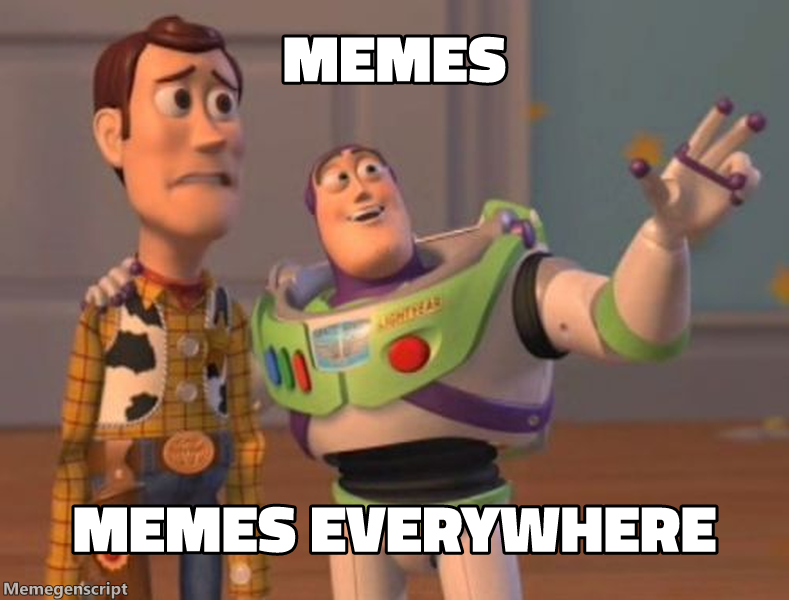
How to narrow the list

  1. Go to the template area of the site.
  2. Use the filter templates control to search or narrow by name.
  3. Pick a template, add your text, drag it into position, then download.

The page notes you can also use the tool as an API, and there's a separate guide aimed at AI agents if you're automating rather than clicking through the UI.

If your template is missing

Not every meme format exists in the catalog. When you can't find one, the site provides a Request a template option, with a Request on GitHub link as an alternative route. That's the intended path for getting a format added rather than working around it.

What to check before relying on it

  • Count: 481 templates as listed — treat this as the current catalog size, since it can change.
  • Cost/signup: The page states free, no signup, no watermark on downloads. No pricing page or payment details are referenced, so there's nothing to verify beyond that claim.
  • Availability: The API and AI-agent guide are mentioned but not detailed here; if you need programmatic access, check those pages directly.

Website Overview

Page metadata, canonical configuration and social previews work together to provide more consistent search and sharing presentation.

Domain and Registration

The domain was registered less than a year ago and has limited historical evidence to assess. Transfer-protection status is present, helping reduce the risk of unauthorized domain transfers. The registrar is Cloudflare, Inc., a widely used domain service provider. The domain uses the common .com extension, which is not an independent safety signal.

DNS and Email

Nameservers are provided by Cloudflare, indicating managed DNS hosting. No CNAME was found; the observed records resolve directly to addresses. No MX record was found. A conventional explicit inbound-mail route is not configured. TXT records include verification markers for Google. Such markers may also remain after a service stops being used. DNSSEC signatures were not detected, so this additional DNS authenticity protection is not confirmed.

TLS and Certificates

The public key uses EC with 256 bits. The server supplied a complete certificate chain. No organization name is present in the certificate; the available fields are consistent with domain validation. The certificate was issued within the Google Trust Services cloud or CDN ecosystem. The certificate's total validity is about 90 days, consistent with a short renewal cycle.

HTTP and Browser Security

The checked browser-security headers were not detected, leaving fewer explicit browser-side safeguards. CORS permits any origin to read this response. This is common for public resources; sensitive responses need narrower handling. No X-Powered-By header was found, reducing one common source of backend fingerprinting information. The cf-ray response header indicates a CDN or caching proxy in the delivery path. No obvious internal addresses or debug information were found in the headers.

Technology Stack Analysis

The public page identifies Cloudflare without precise versions, leaving fewer clues for version-specific scanning.

Search and Social Sharing

Twitter Card metadata is configured. The title has 55 characters, within a common display range. A meta description is present, with 143 characters. The observed directives allow indexing and link following. No Generator meta tag is publicly exposed.

Hosting and Email

DNSCloudflare
HostingCloudflare
EmailUnknown
Approximate IP geolocation (inferred; a CDN or proxy may differ from the origin server) Location unknown Inferred 104.21.37.47

Registration details

RDAP / WHOIS

RegistrarCloudflare, Inc.
Registered2026-09-17
Expires2027-09-17
Domain statusclient transfer prohibited
Nameserversnewt.ns.cloudflare.com、zelda.ns.cloudflare.com
DNSSECunsigned

DNS records

DNS

TypeNameValueTTLPriority
Amemegenscript.com104.21.37.47300—
Amemegenscript.com172.67.203.244300—
AAAAmemegenscript.com2606:4700:3033::6815:252f300—
AAAAmemegenscript.com2606:4700:3035::ac43:cbf4300—
NSmemegenscript.comnewt.ns.cloudflare.com86400—
NSmemegenscript.comzelda.ns.cloudflare.com86400—
TXTmemegenscript.comahrefs-site-verification_a617d2d8650e7ebf5a83ebf53b250098c2397bd48f0e682ab99bd75fe3986023300—
TXTmemegenscript.comgoogle-site-verification=wNmG5sildOOa0iCvYcM5edBtVlAbbjevoW_iDdvWsV4300—

TLS and certificates

TLS / SSL

AssessmentNormal configuration
Supported protocolsTLSv1.2、TLSv1.3
Negotiated protocolTLSv1.3
Certificate subjectmemegenscript.com
IssuerGoogle Trust Services
Valid until2026-12-16T04:13 · Remaining when checked: 73 days
Verification detailsCertificate trust: Passed · Hostname match: Passed

HTTP response headers

HTTP

HeaderValue
content-typetext/html; charset=utf-8
cache-controlpublic, max-age=600, s-maxage=3600
servercloudflare
access-control-allow-origin*

Identified technologies

Cloudflare

Pages, Search and Sharing

Meta descriptionCreate memes online for free. Choose from 481 popular meme templates, add your text, and download or share the image. Also available as an API.
Canonical URLhttps://memegenscript.com/
LanguageEnglish (default)
Twitter Cardsummary_large_image
All bots 1 allowed · 3 disallowed
  • Allow/
  • Disallow/docs
  • Disallow/examples
  • Disallow/images/preview.jpg

User reviews (0)

  • No reviews yet.