
 简体中文
 English
Website review
This review may include AI-generated content and is not individually verified. Domain, certificate and other facts come from the observed data on this page.
What is Pixoguess?
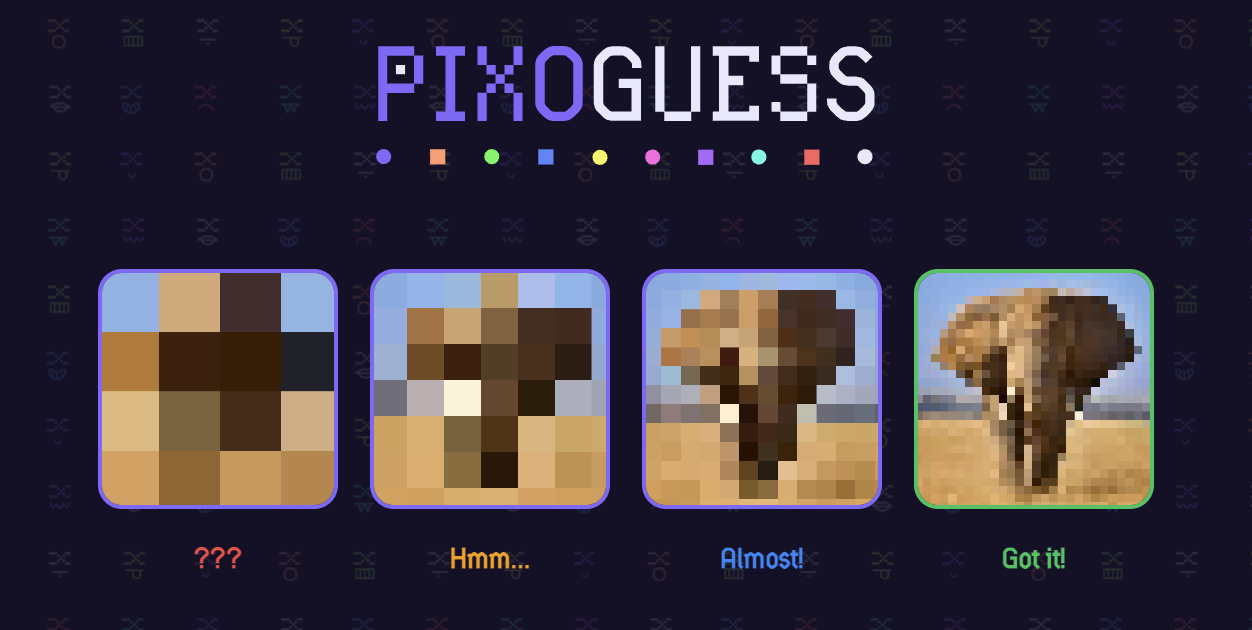
Pixoguess is an online multiplayer party game built around a simple race: each round, a pixelated image slowly becomes clearer, and players compete to be the first to identify what it shows. The faster you recognize the picture, the better you do — so the game rewards quick pattern recognition and a bit of nerve, since guessing early is risky but guessing late lets others beat you to it.
It's aimed at casual group play rather than solo puzzling. The natural uses are game nights with friends, family gatherings, or streaming sessions where a host and audience can play along and react to the reveals together. Because rounds are short and the core loop is easy to explain, it suits mixed groups where not everyone is a heavy gamer.
A practical way to decide if it fits your evening: ask whether your group enjoys fast, laugh-driven guessing games more than long strategic ones. If yes, Pixoguess is a low-friction pick — you can try it directly at Pixoguess and see how your group handles the "guess too early vs. too late" tension.
How do you play a round of Pixoguess with friends?
A round of Pixoguess is a race to name an image that starts out heavily pixelated and sharpens over time. Whoever recognises the picture earliest scores the points; waiting too long makes it easy for everyone else. The page describes it as an online multiplayer party game for game nights, streams or casual sessions with friends.
The flow of a round
- Gather everyone in the same game. Since it is online multiplayer, each friend joins from their own device rather than crowding around one screen.
- Watch the image resolve. The picture begins as a blocky mosaic and gradually reveals more detail. Early on you are guessing from colour, shape and outline alone.
- Type your guess as soon as you have one. Speed is the whole game — the longer you deliberate, the more the image gives away and the less your answer is worth relative to faster players.
- Compare results and move on. Points are tallied and the next image begins.
Practical tactics
- Call the category first, then narrow it. A blurry patch of blue and tan could be a beach, a swimming pool or a painting; deciding "outdoor scene" early stops you from fixating on one wrong idea.
- Guess early even when unsure. In a speed-based format, a fast wrong guess usually costs less than a slow correct one. Treat your first three guesses as cheap probes.
- Watch other players' pace. If someone answers instantly, the image is probably a well-known object or character, so think in terms of common subjects rather than obscure ones.
- Use it as background entertainment for streams. Because each round is short and the reveal is visual, an audience can play along in chat without needing accounts or setup.
Deciding whether it fits your group
Pixoguess suits friends who want something with almost no rules to explain and rounds short enough to fill a gap between other activities. It is a lighter choice than drawn-guessing games such as skribbl.io or word-based party games like Gartic Phone, where the fun comes from what players create rather than what they recognise. If your group prefers talking and laughing over competing, a drawing game may land better; if they like quick, tense recognition challenges, this format is the closer match.
Next step: open Pixoguess, start a room, and share the join details with one friend for a two-player test round before inviting the whole group — that tells you immediately whether the reveal speed feels right for your crowd.
Can Pixoguess be used for Twitch streams or online game nights?
Yes. Pixoguess fits both Twitch streams and online game nights, because the core loop is a shared race to name a pixelated image as it gradually sharpens. That format gives a stream audience something to shout at the screen and gives a private group a simple, low-explanation party activity.
Where it works best
- Twitch or other livestreams: The slow reveal creates natural suspense and chat participation. Viewers can type guesses while the streamer plays, which turns a solo screen into a group guessing session.
- Online game nights: Friends can join from separate locations and compete on the same images, so no one needs to install anything beyond opening the site.
- Casual drop-in groups: Because the premise is "guess the picture," new players need almost no rules briefing, which suits mixed groups and rotating guests.
Practical considerations
The format rewards quick recognition, so it works better as a fast, light round-based activity than as a long strategic session. For streams, the main variable is how you involve chat: a streamer playing alone gets less out of it than one who reads guesses aloud or runs chat-versus-streamer rounds. For private game nights, agree in advance on round length and whether hints are allowed, since the fun depends on everyone racing under the same constraint.
If you want a concrete next step, try one short session with three or four people first: it will show you whether the reveal speed suits your group's pace before you commit to a full stream segment or party night. For related party-game options, skribbl.io and Gartic Phone are established alternatives worth comparing if your group prefers drawing-based formats.
How many players can join a Pixoguess multiplayer game?
The available page information does not state a player limit for Pixoguess. It describes the game as an online multiplayer party game for guessing pixelated images with friends, suited to game nights, streams or casual group play, but gives no minimum or maximum number of players.
As a practical next step, open Pixoguess and check the lobby or room-creation screen, or start a room and see how many invite slots appear. If you are planning a specific group size, test with that number before a scheduled session.
For context, party guessing games of this style commonly work with small groups of roughly 3–8 players, while stream-oriented formats can involve larger audiences through chat. That is general advice, not a confirmed Pixoguess specification.
Do you need to download or install anything to play Pixoguess?
No. Pixoguess runs in the browser, so there is nothing to download or install—you open the site, join or create a room, and play. The page describes it as an online multiplayer party game where players race to identify images as they slowly unblur.
What this means in practice
- Guests can join quickly: A friend can hop in from a link without setup, which suits game nights, streams, or casual groups.
- Device matters more than installs: A modern browser and a stable connection are the practical requirements; a larger screen helps with spotting details in pixelated images.
- Expect some latency: Since rounds are timed races, slower connections may put players at a slight disadvantage—worth testing with your group before a stream.
Next step: Open Pixoguess in your browser, create a room, and share the invite with one friend to confirm it works on your devices before inviting a bigger group.
Is Pixoguess free to play?
Yes. Pixoguess is free to play in the browser — there is no paywall, account requirement or purchase step mentioned on the site. You open the page, join or create a room, and start guessing.
What "free" covers here
- The game itself: multiplayer rounds where a pixelated image slowly resolves and players race to name it.
- Access: it runs in a web browser, so no download or install is needed.
- Group play: the format is built around rooms with friends, which suits game nights, Discord calls or streams.
What to keep in mind
Free browser party games usually earn nothing from the players, so expect the practical limits rather than a price tag: the experience depends on a stable connection for everyone in the room, and the image pool is whatever the site offers. If you plan a stream, do a short test round first to check timing and how readable the reveal is on screen.
A sensible next step: open pixoguess.com, start a room, and run one round with two or three friends before committing a full game night to it.
 Cloudflare

User reviews (0)