
 简体中文
 English

Website review
This review may include AI-generated content and is not individually verified. Domain, certificate and other facts come from the observed data on this page.
What is Tactic or Not?
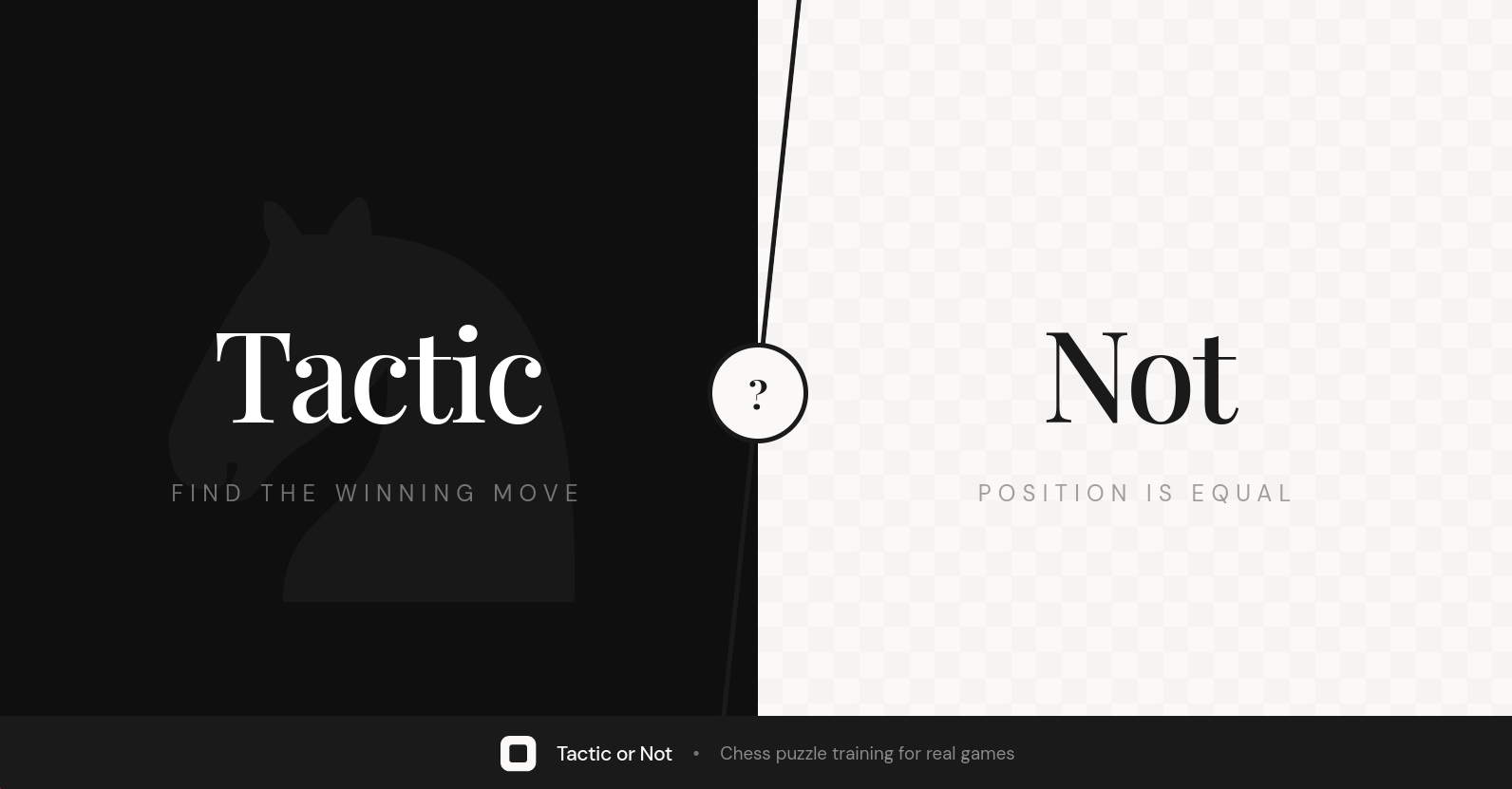
Tactic or Not is a free chess pattern-recognition trainer built around a specific criticism of ordinary puzzle training: in a normal tactics puzzle you already know a tactic exists, so you practice calculation but not the judgment of whether to look for one at all. The site quotes Magnus Carlsen making that point and then builds its method around it.
What makes it different
Standard puzzle trainers show only positions with a winning combination. Tactic or Not mixes those with quiet positions where there is nothing to find, so the training task becomes two-part: decide first, calculate second.
- Tactical positions — there is a forcing line to find, and you play it.
- Quiet positions — several reasonable moves exist and no tactic is available; the correct response is to recognize that and decline to hunt.
- Spot It / Play It modes — the two modes separate the recognition step from the execution step, so you can train "is there something here?" independently of "what exactly is the move?"
- Adaptive rating and leaderboard — every puzzle affects a dynamic rating, so the mix adjusts as you improve and you can compare yourself with other users.
- 1v1 battles and unlimited sessions — head-to-head puzzle play for users who want pressure and repetition rather than a fixed daily set.
Who it suits
The premise is aimed at club players whose tactical calculation is decent but who still miss opportunities or, more often, burn time calculating in positions where nothing is there. That second failure mode is the one conventional puzzle sets never expose, because the format tells you a tactic exists before you start thinking. A player who freezes in quiet middlegames, or who calculates for ten minutes and then plays a nothing move, is the target user.
It is less useful if you are a beginner still learning basic motifs — you need pattern exposure before you can benefit from being told that some positions have no pattern.
Practical next step
Treat the quiet positions as the real test. When you meet one, commit to "no tactics" before you calculate anything, and note whether your instinct was right. If you find yourself calculating deeply in quiet positions, that is the habit the trainer is designed to break. For conventional volume drilling alongside it, Lichess's puzzle tools are at Lichess and Chess.com's at Chess.com.
How does Tactic or Not train players to tell when a tactic actually exists?
Tactic or Not trains that judgment by making "no tactic here" a legitimate, scoreable answer. Instead of serving only positions with a forced win, it mixes tactical positions with quiet, balanced ones. In a tactical position, you find the only move(s); in a quiet position, you click "No Tactics" rather than hunting for a combination that isn't there. The site frames this around Magnus Carlsen's point that ordinary puzzles teach you to expect a tactic because you already know one exists — so the trainer's core drill is deciding whether to calculate at all, not just calculating well.
What the two modes ask of you
- Spot It: you judge the position and either play the tactic or declare there's nothing to find.
- Play It: in quieter positions, several moves may be acceptable, so you're choosing a good practical move rather than a single "only move."
The practical difference: Spot It tests recognition and restraint, while Play It tests decision-making when no knockout blow exists. Both are unlimited, with a dynamic rating that moves as you solve, plus daily challenges, puzzle rush, and head-to-head battles.
A concrete way to use it
If you're a club player who blitzes out combinations in puzzles but drifts in real games, spend a week on quiet positions only. Treat every "No Tactics" click as a win, and after each one, name the one or two candidate moves you'd actually play. That converts recognition into a habit you can carry into a game. Pair it with a broader trainer such as Lichess for volume and Chess.com for structured lessons, and use Tactic or Not specifically for the "is there anything here?" skill those sites tend to under-train.
Decision criterion
Choose it if your problem is false alarms — seeing tactics that aren't there, or wasting time calculating in quiet positions. Skip it if your weakness is raw calculation depth or endgame technique, where a conventional puzzle set or a dedicated endgame trainer will help more.
What is the difference between the Spot It and Play It modes?
Spot It and Play It differ in what they ask you to decide about a position, not in difficulty level. Spot It is a recognition check: you look at a position and judge whether a winning tactic exists, committing to "No Tactics" when nothing is there. Play It is a move-selection task: you actually make a move, and the position is scored against a set of acceptable moves rather than a single solution.
How the two modes compare
| Spot It | Play It | |
|---|---|---|
| Your task | Decide if a tactic exists, and find it when it does | Choose and play a move |
| Correct answer | A specific move in tactical positions; "No Tactics" in quiet ones | Any move counted as acceptable |
| Main skill trained | Pattern recognition and threat detection | Decision-making and move choice |
| Typical mistake it exposes | Calculating in a position where nothing works | Missing that a position demands precision |
What this means in practice
The distinction matters most in quiet positions. In a standard puzzle set you know a tactic is there, so you calculate until you find it. Spot It removes that guarantee: sometimes the honest answer is that there is nothing to find, and clicking "No Tactics" is the correct result. Play It goes further by making you commit to a move, which is closer to how a real game feels — you cannot pass, and a merely reasonable move may still be graded as acceptable rather than best.
A concrete example: you are a club player who solves tactics well but keeps drifting in equal middlegames, either forcing premature attacks or missing small chances. Spot It would train you to stop hunting for combinations that are not present. Play It would train you to pick a sound move in those same positions and see whether your choice holds up.
How to choose
Use Spot It when your problem is over-calculating or failing to sense danger. Use Play It when your problem is choosing between several plausible moves. If you are unsure, alternate: recognition failures show up as wrong "No Tactics" calls, while decision failures show up as unacceptable moves.
As a next step, run a short set in each mode and note which error type you make more often. The site frames the mix of tactical and quiet positions as the core of its training approach, so treating the two modes as a diagnostic pair is the most direct way to use it. For a second opinion on general puzzle training, Lichess and Chess.com both offer large puzzle sets, though their puzzles are generally drawn from positions where a tactic is known to exist.
How does the rating system and leaderboard work on Tactic or Not?
Tactic or Not uses its rating and leaderboard as a way to track whether you are improving at the specific skill the site trains: recognizing when a tactic exists and when a position is quiet. The site describes a dynamic rating that changes as you solve puzzles, with every puzzle shaping that rating. A leaderboard then ranks users so you can compare your standing with other players and follow your progress over time.
What the rating reflects
The rating is tied to the puzzle mix, not just raw tactical ability. Because positions include both tactical and quiet ones, you are rewarded for correct judgment in both cases: finding the winning move when there is one, and correctly declining when there is not. This matters because a player who calculates well but assumes every position contains a tactic will not score as well as someone who can tell the difference.
Leaderboard and progression
The leaderboard gives the rating a social and competitive layer. You can see where you stand among other users and track whether your position rises over time. The site also lists unlimited training sessions and 1v1 head-to-head puzzle battles, so the rating can serve as a benchmark across different modes rather than a single score from one puzzle type.
Practical use
If you want to know whether your pattern recognition is actually improving, use the rating as a long-term trend rather than a daily score. A useful next step is to play a mix of tactical and quiet positions and note whether your accuracy on quiet positions improves alongside your tactical accuracy. If your rating stalls, the likely cause is one of the two skills lagging: either you miss tactics, or you keep searching for tactics that are not there. The leaderboard is most useful as a comparison tool, not as the main reason to train.
What counts as an acceptable move in Play It?
In Play It, an acceptable move is any move the position genuinely allows that does not lose the advantage — not just the single engine-best move. Quiet positions usually have several reasonable continuations, so the trainer treats them as correct rather than forcing one "only move" solution.
That distinction matters because it mirrors real chess. In a quiet, roughly balanced position there is often no knockout blow; a solid developing move, a sensible trade, or a small improvement can all be fine. Play It is designed to reward that kind of decision-making, which is why the site pairs it with Spot It: Spot It asks whether a tactic exists (and you click "No Tactics" when it doesn't), while Play It asks you to make a good move in positions where nothing forcing is available. The site frames the overall mix as tactical positions alongside quiet ones, so you practise recognising when to calculate rather than assuming a tactic is always there.
The practical trade-off: because several moves can pass, Play It is a weaker test of precise calculation than a single-solution puzzle. If you want to check whether you found the best move, you would need an engine or a coach; if you want to train judgement about whether a position demands action at all, the looser standard is the point. A useful habit is to play your move, then ask yourself which alternatives were equally acceptable and why — that reflection is where the pattern recognition actually sticks.
Next step: try a few Play It positions and, before moving, say out loud whether you think a tactic exists. Compare that call with what the position actually offered. For more on the modes and rating system, see Tactic or Not.
How does the puzzle mix combine tactical and quiet positions?
The mix is the whole point: Tactic or Not deliberately serves both positions where a tactic exists and positions where none does, so you practise the recognition step that ordinary puzzle sets skip. In a standard tactics trainer every position has a solution, which teaches you to hunt for a combination even when the board offers nothing. Here, roughly half the work is deciding whether to calculate at all.
What each type asks of you
- Tactical positions — there is a forcing line to find, and you are expected to calculate it and play it.
- Quiet positions — no tactic is available. The correct response is to recognise that and decline to force matters, rather than manufacture a combination that isn't there.
The site frames this around a Magnus Carlsen remark that puzzles train you to see puzzles, while games don't announce themselves that way. That is the gap the mixed format targets: in a real game you spend most moves in quiet positions and must judge when the moment to strike has arrived.
How the formats use the mix
The two modes, Spot It and Play It, apply the mix differently. Spot It is the recognition drill — you decide whether a tactic exists and act on that judgement. Play It asks for a move in positions where more than one continuation can be acceptable, which is closer to how a quiet position actually feels over the board: several reasonable plans, no single "only move."
Practical use
If you already solve tactics reliably but miss combinations in your own games, the quiet positions are the useful half — they punish the reflex to force. If your problem is the opposite, that you play too passively and let winning shots slip, the tactical half keeps that sharp. The mix is also a useful self-test: track whether your errors cluster on false positives (calculating when nothing is there) or false negatives (missing a real tactic), and drill the weaker side.
A sensible next step is to run a session and note which error type you make more often, then use the rating and leaderboard to track whether that balance shifts over time.
 Cloudflare

User reviews (0)