
 简体中文
 English

Website review
This review may include AI-generated content and is not individually verified. Domain, certificate and other facts come from the observed data on this page.
What is TekkenDocs?
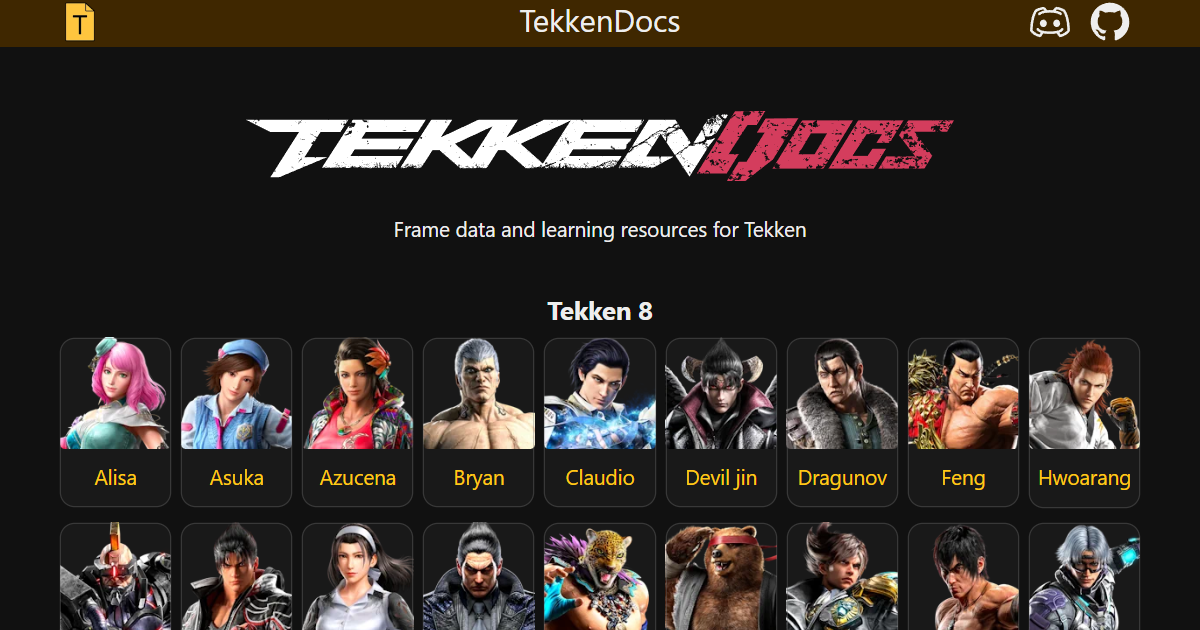
TekkenDocs is a frame-data and learning resource for the Tekken series, focused mainly on Tekken 8 with archived coverage of Tekken 7 and Tekken Tag Tournament 2. It is aimed at players who want to move past button-mashing: knowing which moves are safe, which are punishable, and how to respond to what an opponent does.
TekkenDocs
What you can actually do there
- Look up frame data — full move lists with frame advantage, detailed properties, and video clips, so you can check whether a move is safe on block or punishable before you commit to it in a match.
- Read character guides — key moves, combos, punishers, and defensive tips attributed to high-level players, useful when picking up a new character or patching a gap in your game.
- Drill with quizzes — a daily challenge of ten moves where you guess block frames and keep a streak, plus a quiz for consecutive correct guesses. This turns frame data into recall rather than a reference you have to look up mid-set.
- Compare and review — move comparison, stats, ranks, and flash-card features for structured study, plus a getting-started section for newcomers.
Who it suits
The site fits a player who already knows the basics and wants to stop losing to the same move repeatedly. If you are deciding between two characters, the character guides and comparison tools give you concrete differences in punishers and key moves rather than vague tier talk. Complete beginners may find the frame numbers abstract at first and should start with the getting-started material or a simpler character introduction.
A practical next step
Pick your main, open their frame-data page, and write down the five moves you use most. Check each one's block frames, then note the punisher you should use when an opponent blocks it. Run the daily challenge for a week to make those numbers stick. For broader context, the site also points to external references such as Wavu Wank for ranked-game data, Ewgf.gg for rank distribution and character win rates, and start.gg for finding offline tournaments.
How do I use frame data to improve my Tekken gameplay?
Frame data tells you whose move recovers first when two actions meet. You use it to decide whether you can attack after blocking, which punisher fits the situation, and when it is your turn to press a button. The practical skill is not memorising every number — it is reading three values and connecting them to a decision.
The three numbers that matter most
| Value | What it tells you | What you do with it |
|---|---|---|
| Startup | How many frames before a move becomes active | Judge whether it can interrupt or beat a slower option |
| On block | Your frame situation after the opponent blocks | Negative enough means stop pressing; plus frames mean your next move is favoured |
| On hit | Your frame situation after the move connects | Decide whether to continue pressure, mix up, or reset to neutral |
A move at −10 on block is typically punishable by a 10-frame punisher; a move at −14 needs a bigger, slower punish. Moves at −1 to −3 usually leave you safe enough to block or step rather than gamble. Large plus frames on block (for example +5 or more) let you keep your turn with a fast follow-up.
A workable routine
- Pick one character and learn their ten most common moves: jab, df1, a generic low, a launcher, a safe mid, and their main punishers.
- In practice mode, set the dummy to block and record the opponent's common moves. Note what you can punish after blocking.
- Learn one punish per situation: a 10-frame punish, a 12–13 frame punish, and a launch punish for very unsafe moves.
- Take it online and focus on one thing per session — for example, only punishing a specific move you kept losing to.
TekkenDocs supports this directly: it lists full move lists with frame advantage and in-depth details, plus character guides covering key moves, combos, punishers and defensive tips written by high-level players. Its daily challenge and frame quiz — guessing block frames and keeping a streak — turn raw numbers into recall practice, which is closer to how you actually need them mid-match.
Where frame data does not help
Frame data assumes both players act immediately. Real opponents delay, sidestep, backdash or use armour, so a "correct" punish can still whiff. Use the numbers to narrow your options, then confirm in matches. Movement, spacing and reading habits usually matter more than a two-frame difference.
For a broader reference, Wavu Wiki covers character and system mechanics, and TekkenDocs is the frame-data and drill resource described above. A sensible next step: open your character's page, pick the one move that keeps beating you, and spend ten minutes learning its punish before your next session.
Which Tekken 8 characters have the best punishers and key moves?
TekkenDocs does not rank characters by "best" punishers. Its character guides list key moves, combos, punishers and defensive tips for each fighter, written by high-level players, so you compare the lists yourself rather than reading a tier verdict. Frame data pages give the block-frame and advantage numbers behind those recommendations.
Use the guides to check what a character can actually punish, not just how hard they hit:
- Standard punishers: Look for a 10-frame punish that works from jab range, a 12-frame option, and a reliable whiff punisher. These decide most rounds.
- Key moves: The guide's key-move list shows the pokes, launchers and counter-hit tools a character leans on, which is usually more important than a single big punish.
- Defensive tips: These tell you which situations the character struggles to escape, useful when picking a secondary.
Characters worth checking first
If you want strong, straightforward punishment, start with the guides for Kazuya, Jin, Bryan, Paul, Steve and Dragunov. For characters whose punishers are shorter but whose key moves carry the gameplan, compare Law, Hwoarang, Nina and Lili. Mishima-style characters reward execution, so weigh your own consistency before committing.
How to decide
- Open two or three character guides on TekkenDocs and compare their 10-frame and 12-frame punishers side by side.
- Check the key-move list against how you like to play: pressure, keepout or whiff punishment.
- Use the frame data pages to confirm the exact block frames before you practise.
- Test the daily challenge and frame quiz to build the block-frame recall you need to punish on reaction.
A practical example: if you block a common -12 move, a character with a fast, high-damage 12-frame punisher converts it every time, while a character without one gets a weaker poke. That gap matters more than any overall tier list.
How can I practice block frame recognition with daily challenges and quizzes?
TekkenDocs offers two purpose-built drills for this: a Daily challenge ("ten moves a day" where you guess the block frames and keep a streak going) and a Frame quiz (guess block frames correctly in a row). Both live under the site's main features at TekkenDocs, alongside the frame data pages they draw from.
How to actually use them
- Warm up with the Daily challenge — it caps at ten moves, so it fits a five-minute session before you play.
- Follow with the Frame quiz when you want volume; the streak format punishes guessing, so it exposes which characters you're weakest on.
- When you miss, look up that move in the site's frame data (full move lists with frame advantage and details) and note whether you were off by a little or a lot. Being off by one or two frames usually means a recall problem; being wildly off means you don't know the move at all.
- Revisit the same quiz the next day. Spaced repetition matters more than long single sessions here.
Why frame recognition is worth drilling
Block frames decide what you can do after blocking: whether your character's fastest punisher connects, whether you can sidestep, or whether you must simply hold pressure. Players who learn this stop mashing after minus moves and stop freezing after punishable ones. The drills train recognition in isolation, which is faster than learning it mid-match.
Trade-offs and limits
- Quizzes test recall of numbers, not timing. You still need practice mode or real matches to convert that knowledge into reactions.
- Streak-based formats can encourage memorizing a few common moves and avoiding unfamiliar characters. Deliberately mix in characters you rarely face.
- Frame data assumes both players act at the same frame; online latency shifts real outcomes, so treat the numbers as a baseline rather than a guarantee.
Other routes if you want more context
- Wavu Wiki for mechanics and per-character explanations behind the numbers.
- Wavu Wank if you want ranked-match data and a chess-style rating to track your own progress over time.
- Ewgf.gg for rank distribution and character win rates, useful for deciding which matchups to study next.
A practical next step: run today's Daily challenge, write down every move you miss, and spend ten minutes in practice mode blocking those specific moves on both sides.
Where can I find upcoming Tekken tournaments and offline events?
For upcoming offline Tekken events, start with TekkenDocs' tournament finder: it plots upcoming tournaments registered on start.gg on a world map, so you can see what's near you rather than scrolling a text list.
How to use it
- Open TekkenDocs TekkenDocs and go to the tournament finder under "Other features."
- Scan your region on the map, then check each event's listing on start.gg for date, venue, entry fee and game version.
- Confirm details at the source before travelling — map listings can lag behind schedule changes or cancellations.
Other places worth checking
- start.gg — the registration platform itself; search by game and location for the most current listings.
- Local scene Discords and regional Facebook groups — often the fastest for weeklies and last-minute venue changes.
- Wavu — ranked-player database, handy for checking who attends your local scene before you go.
Choosing between them
| Source | Best for | Trade-off |
|---|---|---|
| TekkenDocs map | Quick geographic overview | Only shows events registered on start.gg |
| start.gg search | Full event details and registration | No map view; you filter manually |
| Community groups | Weeklies, casuals, changes | Fragmented, hard to search |
If you're new to offline play, pick a local weekly first — lower stakes, cheaper, and you'll meet the people who know about the bigger majors. If you're travelling for a major, register early on start.gg and check the TekkenDocs map for anything else happening nearby on the same weekend.
What resources are available for learning Tekken 7 characters and mechanics?
TekkenDocs is primarily a Tekken 8 frame-data and learning site, but it keeps a Tekken 7 section with character pages covering the full Tekken 7 roster, from Akuma and Geese to Lei, Marduk and Lucky Chloe. Use those pages for move lists and frame data when you are still playing Tekken 7 or labbing legacy characters. The site's character guides, key moves, punishers and combo write-ups, however, are built around Tekken 8, so treat the Tekken 7 material as reference data rather than a full teaching curriculum.
For mechanics, the site's "Getting started with Tekken" section and its move comparison, stats and flash-card features are useful for drilling universal ideas such as frame advantage, punishment and movement. The daily challenge and frame quiz are quick ways to test whether you actually know block frames rather than just reading them.
If you want Tekken 7-specific learning, combine TekkenDocs frame data with community resources:
- Wavu Wiki — extensive character and mechanics write-ups, including legacy games.
- TekkenDocs — frame data and roster pages, with a dedicated Tekken 7 character list.
- Ewgf.gg — stats and rank information if you want to gauge the player base.
A practical next step: pick one Tekken 7 character, open their TekkenDocs page, and write down their ten most common moves with frame data. Then lab punishers against a friend or training dummy, using the frame quiz to keep the numbers fresh.
 Cloudflare

User reviews (0)