
 简体中文
 English

Website review
This review may include AI-generated content and is not individually verified. Domain, certificate and other facts come from the observed data on this page.
What is This X Does Not Exist?
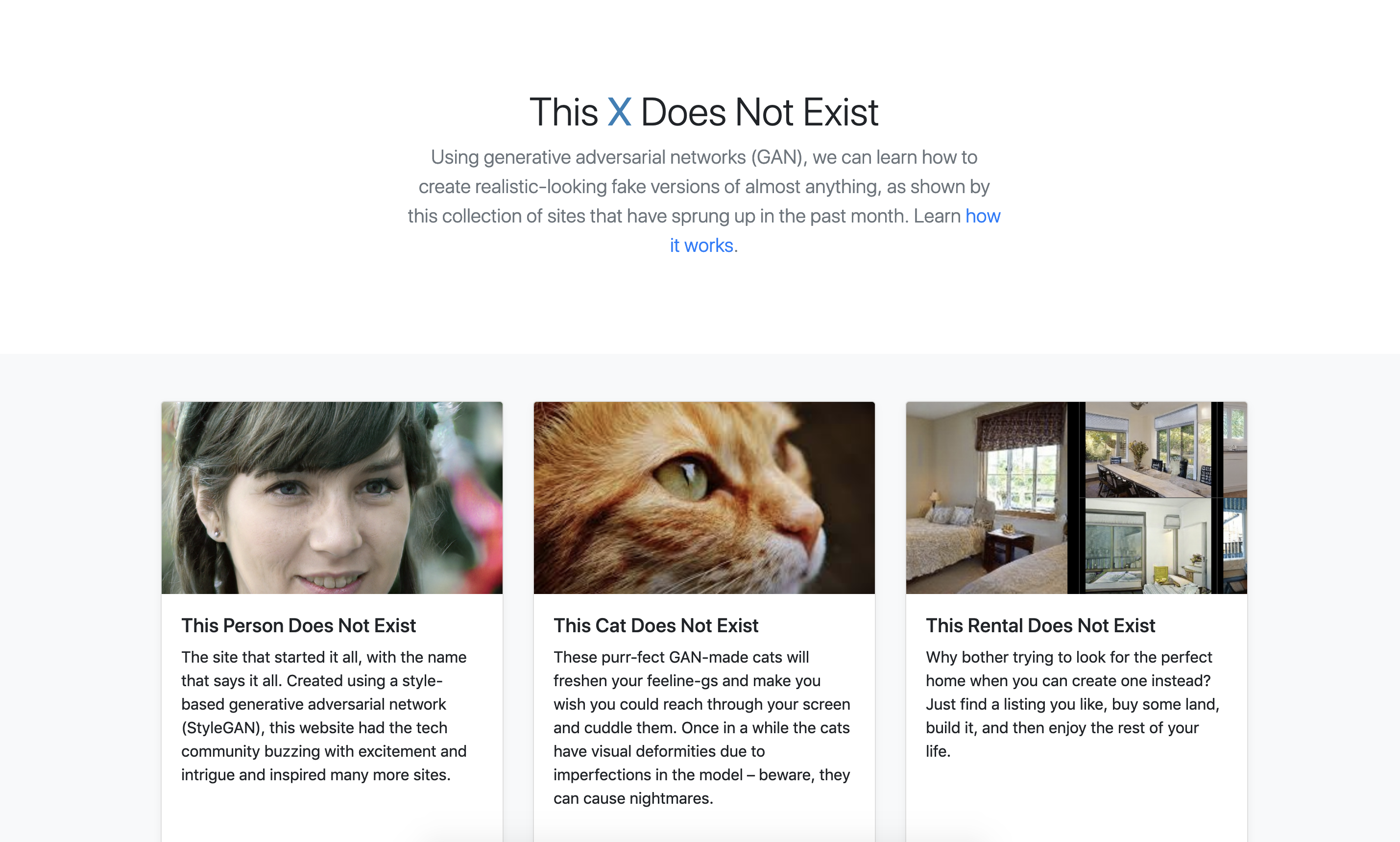
This X Does Not Exist is a directory-style website that collects and explains a family of web projects generating synthetic media with machine learning. Its central idea is simple: a generative adversarial network (GAN) can learn the patterns of real examples and then produce new ones that look plausible. The site's own description frames it as a showcase of how realistic-looking fakes can be created for almost anything, and it points readers to an explanation of how the technology works.
The collection is built around one breakout project and many riffs on it. This Person Does Not Exist, created by Phillip Wang, is described as the site that started it all, using a style-based GAN (StyleGAN) to generate faces. From there, the pattern spreads: This Cat Does Not Exist generates cat images, This Rental Does Not Exist generates home listings, This Waifu Does Not Exist generates anime-style characters, This Question Does Not Exist generates Stack Overflow-style questions, This Resume Does Not Exist generates résumés, This Emotion Does Not Exist interprets facial expressions, and This Vessel Does Not Exist generates ceramic vessels.
What each entry actually is
| Site | What it generates | Notable detail from the page |
|---|---|---|
| This Person Does Not Exist | Human faces | StyleGAN; credited as the origin of the trend |
| This Cat Does Not Exist | Cat images | Occasional deformities from model imperfections |
| This Rental Does Not Exist | Home listings | Presented as an alternative to searching for a real home |
| This Waifu Does Not Exist | Anime-style characters | Described as stranger than the others, with an engrossing plot summary |
| This Question Does Not Exist | Stack Overflow questions | Includes an "Other Random Questions" sidebar of synthetic questions |
| This Resume Does Not Exist | Résumés | Uses TextgenRNN, an RNN rather than a GAN; headshots come from This Person Does Not Exist |
| This Emotion Does Not Exist | Emotion labels from faces | Uses a relatively simple model rather than deep learning |
| This Vessel Does Not Exist | Ceramic vessels | Draws a parallel between GAN generators/discriminators and apprentices/masters |
Who it is for
It works best as a starting point for anyone curious about generative models but not ready to read a paper. The individual sites are quick to open and immediately show the output, so a teacher, student or designer can demonstrate what a GAN does in seconds. The résumé example is also a useful case study for product people: the company behind it used generated content to showcase a résumé template builder, which is a concrete example of synthetic media as marketing rather than as a research demo.
A practical next step
Pick one entry that matches what you want to understand and look at the output critically. If you are evaluating whether generated faces could stand in for stock photography, for instance, open This Person Does Not Exist and look for asymmetries, odd backgrounds or hairline artifacts instead of judging a single image. The cat entry's own warning about deformities is a good reminder that these models fail in visible ways, and the failures tell you more about the model's limits than the successes do. For a broader set of related demos, This Person Does Not Exist is the canonical single-purpose example, while this directory is the better place to see the range of what the same basic idea has been applied to.
How does This X Does Not Exist use GANs to generate fake content?
This X Does Not Exist is a directory-style showcase of small websites that each use a generative model to invent a plausible-looking example of one narrow category: a face, a cat, a rental listing, a résumé, a Stack Overflow question, and so on. The models are trained on real examples of the category, then produce new samples that imitate the patterns they learned rather than copying any single original.
What "generate" means here
Most of the linked sites are built on generative adversarial networks. In a GAN, two networks train against each other: a generator proposes fake samples, and a discriminator tries to tell those fakes from real ones. Each round of feedback pushes the generator toward outputs the discriminator can no longer easily reject. The result is content that looks statistically similar to the training data — convincing at a glance, but not a record of anything that actually happened.
A few entries depart from that pattern, which is part of the site's teaching value:
- This Person Does Not Exist uses a style-based GAN (StyleGAN) to synthesize faces.
- This Resume Does Not Exist uses a recurrent neural network specialized in text generation, not a GAN, and pairs its fake résumés with headshots from the face site.
- This Emotion Does Not Exist is described as not necessarily using deep learning, showing that a simpler model can still classify expressions.
Why the format matters
Each site reduces a model to a single button-press: reload and get a new synthetic sample. That makes the underlying idea legible to people who will never train a network. It also makes the failure modes visible — the cat site's occasional deformities are the model's imperfections showing through, not a bug in the webpage.
Practical uses and trade-offs
- Teaching and demos: A concrete example beats an abstract diagram when explaining what a generator produces.
- Design and prototyping: Synthetic faces or listings can stand in for real material in mockups, avoiding privacy and licensing issues.
- Awareness: Seeing how ordinary the fakes look is a useful calibration for anyone assessing online content.
- Limits: Outputs are not real people, homes or documents; they can carry biases from training data, and they should not be presented as authentic records.
A useful next step
Pick one category close to your own work — a product photo, a customer review, a form entry — and ask what a model trained on real examples of it would get right and what it would plausibly get wrong. That question is usually more instructive than the demo itself. The original face generator, This Person Does Not Exist, remains the clearest starting point for seeing the effect firsthand.
Which websites are part of the This X Does Not Exist collection and what can each one generate?
The collection is a directory of single-purpose generative sites, each producing a plausible-looking fake of one category of thing. The original is the face generator; the rest apply the same trick to cats, apartments, anime characters, forum posts, resumes, emotions and pottery.
What each site generates
| Site | What it generates | Notes from the collection |
|---|---|---|
| This Person Does Not Exist | Photorealistic human faces | The one that started it, built on a style-based GAN (StyleGAN); credited to Phillip Wang |
| This Cat Does Not Exist | Cat photos | Occasionally shows deformities from model imperfections |
| This Rental Does Not Exist | Rental-property listings | Credited to Christopher Schmidt |
| This Waifu Does Not Exist | Anime-style character portraits | Credited to Gwern Branwen |
| This Question Does Not Exist | Stack Overflow-style programming questions | Includes an "Other Random Questions" panel of further synthetic questions; credited to Brad Dwyer |
| This Resume Does Not Exist | Full resume documents | Uses a text-generation RNN rather than a GAN; headshots come from the face site; credited to Enhancv |
| This Emotion Does Not Exist | Emotion readings from facial expressions | Not deep learning; a simpler model; credited to Jan Schneider |
| This Vessel Does Not Exist | Ceramic vessels | Framed as a parallel between GAN generators/discriminators and apprentice/master potters |
How to use this
Treat it as a menu rather than a product. If you need synthetic faces for a mockup, the person site is the obvious pick. If you need placeholder text with structure — a resume layout, a Q&A thread — the resume or question sites fit better, because they generate documents rather than single images. The cat and waifu sites are the weakest for anything client-facing, since visible artifacts appear often enough to be a real risk.
A practical check before relying on any of them: generate ten outputs in a row and look for repeated faces, garbled text or anatomical errors. These are demo generators, so consistency across many samples is the thing to test, not the quality of one lucky result.
Can the AI-generated faces, cats, or other content from these sites be used for commercial projects?
The short answer: treat every image or text sample from this collection as a demo, not as a licensed asset. The page presents each generator as an experiment and names its creator, but it does not state that outputs carry commercial rights.
Where the risk actually sits
Two separate things need clearing before commercial use:
- The model or output. GAN and RNN outputs are generally not copyrightable in the US, because they lack human authorship. That cuts both ways: you may not be able to stop a competitor from reusing the same generated face, and you may not be able to register it as your own.
- The site and its terms. Each generator is a separate project with its own creator and its own rules. Some permit reuse, some ask for attribution, some are silent. Silence is not permission.
There are also practical hazards beyond licensing. As the page itself notes, GAN output can include visual deformities, and generated faces can land uncomfortably close to a real person's likeness. Using a synthetic headshot in an ad, a dating profile, or a testimonial implies a real endorser who does not exist. That is a consumer-protection and false-advertising problem, not just a copyright one.
A workable decision path
- Check the individual site's terms, not this index page. The index is a directory; the terms live with each project.
- Assume no license unless one is stated. If you cannot find terms, contact the creator in writing and keep the reply.
- Prefer outputs you can document. A model you run yourself, with a permissive license and a saved prompt and seed, gives you a defensible paper trail.
- For anything customer-facing, disclose synthetic origin where it could mislead — stock-style portraits, testimonials, product photos.
- Have counsel review high-stakes uses such as advertising, packaging, or anything implying endorsement.
Quick comparison
| Use case | Practical risk | Sensible move |
|---|---|---|
| Mood board, internal mockup | Low | Use freely, do not ship |
| Blog illustration | Medium | Verify terms; credit if asked |
| Ad or product page | High | Written permission or your own model |
| Fake headshot of a "person" | Very high | Avoid; likeness and deception risk |
If you want a concrete next step: pick the one generator you actually need, find its creator's page, and read the terms before you download anything. For a face you intend to publish, This Person Does Not Exist is the origin point of the format and the clearest example of why a generated portrait needs a permission check rather than an assumption.
How can I create my own 'This X Does Not Exist' website using GANs?
The sites collected at This X Does Not Exist are mostly thin wrappers around a trained generative model: pick a narrow subject, train or fine-tune a model on a large set of examples of that subject, then serve a fresh sample on every page load. The "This X" formula works because the subject is tight enough that a model can imitate it convincingly, and because the output is instantly verifiable by eye — a face, a cat, a floor plan.
The practical build path
- Choose a subject with abundant, legally usable data. Faces, cats, logos, handwritten digits and floor plans all have public datasets. The narrower and more consistent the subject, the less data and compute you need.
- Pick a model family that matches the output. StyleGAN-style architectures suit images where fine texture and symmetry matter. Text subjects — resumes, questions, listings — are better served by a text generator, as the site notes for its resume example, which used a recurrent network rather than a GAN.
- Train or fine-tune. Fine-tuning an existing pretrained model on your subject is far cheaper than training from scratch and is how most of these single-purpose sites get good results quickly.
- Serve samples on demand. Generate a batch ahead of time and cache images, or run inference live. Pre-generating is simpler and cheaper; live generation feels fresher but needs a GPU-backed host.
- Add the minimum framing. A headline in the "This X Does Not Exist" pattern, a regenerate button, and a short explanation of what the model is doing.
Trade-offs to weigh
| Approach | Effort | Output quality | Best for |
|---|---|---|---|
| Fine-tune a pretrained image model | Moderate | High | Faces, animals, objects, interiors |
| Train a small model from scratch | High | Variable | Novel or niche subjects with clean data |
| Use a text generator | Low to moderate | Good for short text | Resumes, questions, listings, names |
| Simple classifier or mapping model | Low | Not generative | Emotion or attribute labeling |
A concrete scenario
Suppose you want "This Chair Does Not Exist." You collect a few thousand chair photos on plain backgrounds, fine-tune an image model, and pre-generate 500 samples. Your site shows one at random with a regenerate button. The failure mode to expect is deformation — the source site warns that its cat model occasionally produces disturbing artifacts, and chairs will show the same problem as impossible legs or merged cushions. Curate the pre-generated set by hand and discard the broken ones.
Decision criteria
- If your subject is visual and texture-heavy, use a GAN-style image model.
- If your subject is text, use a text model and accept that coherence degrades over long outputs.
- If you have little compute, pre-generate and host static images.
- If your subject has no public dataset, budget time for collection and cleaning first — that, not the model, is usually the bottleneck.
A useful next step is to browse the existing collection at This X Does Not Exist and note which subjects are already taken, then pick an adjacent one where a dataset plausibly exists.
Why do some generated images, like the cats, have visual deformities?
The deformities come from the limits of the generator itself, not from a deliberate filter or a bug being triggered. A GAN learns by having one network generate images and another judge whether they look real; over training, the generator gets better at producing convincing output, but it never learns the underlying rules of anatomy, fur texture or lighting. It only learns patterns that tend to satisfy the judge. Where the training examples were thin, inconsistent or visually ambiguous, the model fills the gap with a plausible-looking approximation — an extra limb, a distorted eye, fur that melts into the background.
The cat example is a useful illustration because cats are a hard target: fur has fine, high-frequency detail, and cat faces vary enormously in pose, breed and lighting. A model trained on a limited or noisy set of cat photos will reproduce the average shape well and the details poorly. The site's own note that the cats occasionally show deformities, and that these can be unsettling, matches what you would expect from this kind of model rather than indicating a defect in the site.
Why the effect varies by subject
| Subject type | Typical failure mode | Reason |
|---|---|---|
| Faces | Blurred ears, odd hair edges, background smearing | Faces are highly structured and well represented in training data, so the model gets the overall layout right and struggles at boundaries |
| Animals such as cats | Distorted paws, merged fur, strange eyes | Fine texture and varied poses are harder to model than a frontal face |
| Text-heavy outputs such as resumes or questions | Plausible wording that does not hold up on close reading | Text generation models capture style and phrasing better than factual consistency |
| Simple or abstract subjects | Fewer obvious deformities | Less fine detail and less variation to reproduce |
What this means in practice
If you are using these images for a mockup, a placeholder avatar or a design draft, deformities are usually tolerable and can even be useful, since they make clear the image is synthetic. If you need something that will be looked at closely — a profile photo, a product shot, a published illustration — inspect the image at full size before relying on it, and expect to discard a meaningful share of outputs. The practical move is to generate several candidates and choose the one whose weak points fall outside the area a viewer will focus on.
For a quick sense of how different generators behave, the collection at This X Does Not Exist groups several of these projects together, which makes it easy to compare how each subject matter holds up.
 Google Cloud DNS
 Fastly

User reviews (0)