
 简体中文
简体中文 English
Website review
This review may include AI-generated content and is not individually verified. Domain, certificate and other facts come from the observed data on this page.
What is AI Bingo?
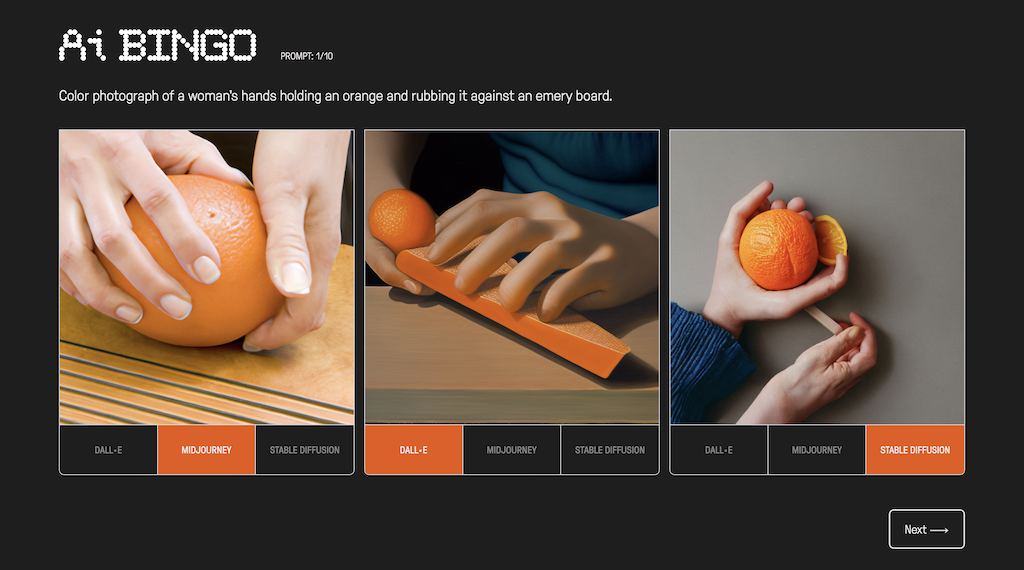
AI Bingo 🤖 is a browser-based guessing game built around AI-generated images from DALL·E, Midjourney and Stable Diffusion. The premise is simple: you look at an image produced by an AI model and try to work out what it was prompted with, or which model made it. It turns the usual "guess what the AI was asked to draw" curiosity into a quick, repeatable game rather than a one-off experiment.
How it fits into a typical use
- Casual play: A five-minute break where you test your instinct for how these models behave.
- Prompt practice: Seeing what a given text prompt actually produces is a fast way to sharpen your sense of phrasing and specificity.
- Model comparison: Because the game draws on three different generators, it nudges you to notice stylistic tells — Midjourney's painterly polish, Stable Diffusion's range, DALL·E's tendency toward literal interpretation.
Who it suits
It works best for people who already have some familiarity with AI image tools and want a light way to test that familiarity. Complete beginners can still play, but they will mostly be guessing; the value comes from pattern recognition that builds over repeated rounds.
A practical next step
Play a few rounds and, after each one, note why you chose your answer — colour palette, composition, text rendering, or how surreal the details are. That habit turns a guessing game into a real diagnostic for how well you read AI output. If you want to go deeper, try the same prompt across OpenAI's DALL·E, Midjourney and Stability AI's Stable Diffusion, then compare the results side by side.
How do I play AI Bingo?
AI Bingo is a casual guessing game built around AI-generated images. You are shown a picture made by a text-to-image model, and your job is to work out which tool or prompt produced it.
The basic loop
- Open the site and start a round.
- Look at the generated image and the options or hints on screen.
- Pick the answer you think fits — for example, which model made it, or which prompt it came from.
- Submit and see whether you were right.
- Move to the next image and repeat, building a streak or score.
The guessing format works because different models have recognisable tendencies: some render text badly, some favour glossy, over-lit faces, others produce a particular kind of surreal detail. Players who have spent time with these tools start to spot the fingerprints.
Who it suits
- Curious newcomers who want a low-stakes way to see what AI image tools actually output.
- Prompt hobbyists who already use DALL·E, Midjourney or Stable Diffusion and want to test their eye.
- Groups looking for a quick, shareable quiz-style activity.
It is not a deep tutorial on how to write prompts, and it will not teach you the underlying model architecture. Treat it as entertainment with a side effect of pattern recognition.
A practical next step
Play one round and, for each image, note why you chose your answer — the lighting, the hands, the texture, the composition. That reasoning is the transferable skill. If you want to go further, generate your own images in two different tools from the same prompt and compare them side by side; the differences you notice there are exactly the cues the game rewards.
For related browsing, the wider ecosystem includes OpenAI for DALL·E, Midjourney and Stability AI for Stable Diffusion, though the game itself is a self-contained browser experience.
Can I play AI Bingo with friends or is it single-player?
AI Bingo is built for sharing, not for solo play. The page describes it as "A DALL•E, Midjourney and Stable Diffusion guessing game," so the core activity is looking at AI-generated images and guessing which model produced them. That format works best when you compare answers with other people — you can play it as a group activity by taking turns or voting on each image, and disagreement about whether something looks like DALL•E or Midjourney is part of the fun.
There is no indication of accounts, lobbies or score tracking, so treat it as a casual, same-room or screen-shared game rather than an online multiplayer service with invites and leaderboards.
Practical ways to use it with others
- Screen-share quiz night: one person controls the browser, everyone else shouts or writes down guesses before the reveal.
- Classroom or workshop warm-up: use a few rounds to show how similar outputs from different generators can look, then discuss why.
- Team icebreaker: split into pairs, give each pair a fixed number of images, and compare scores at the end.
When single-player makes more sense
If you mainly want to sharpen your own eye for model-specific quirks — lighting, texture, typography, anatomy — playing alone and keeping a private tally of your misses is a reasonable drill. The trade-off is that you lose the calibration that comes from hearing why someone else guessed differently.
A useful next step: open the site on one device, pick a set number of rounds before you start, and agree on whether guesses are spoken or written. That small bit of structure is what turns a browser toy into a game that a group can actually finish.
What image generation models does AI Bingo use?
AI Bingo uses three image generation models: DALL·E, Midjourney, and Stable Diffusion. The site presents itself as a guessing game built around images produced by those tools, so the core loop is judging which model made a given picture.
How the three models differ in practice
| Model | Typical visual signature players learn to spot |
|---|---|
| DALL·E | Often smoother, more literal prompt-following; can render text and simple objects cleanly |
| Midjourney | Frequently more stylized, painterly or cinematic, with strong lighting and composition |
| Stable Diffusion | Wider range because of community fine-tunes; can look photographic, illustrative or rough depending on the checkpoint |
Those are tendencies, not guarantees. A good next step is to play a round and, after each guess, note which cues misled you—composition, texture, hands, text, lighting. Over a few rounds you build a personal checklist: if the image looks like an oil painting with dramatic rim light, lean Midjourney; if it is plain and prompt-literal, lean DALL·E; if it is inconsistent or unusually styled, lean Stable Diffusion.
This makes the game useful for anyone who needs to recognize AI-generated imagery—designers auditing mood boards, editors checking submissions, or curious users training their eye. The trade-off is that model outputs overlap heavily and update over time, so the skill is probabilistic rather than a reliable identification method.
Do I need an account or paid subscription to play AI Bingo?
No account or paid subscription is needed. AI Bingo is a browser-based guessing game: you open the site, look at AI-generated images from tools such as DALL·E, Midjourney and Stable Diffusion, and try to work out the prompt or model behind them. There is no signup wall described, and no paid tier is indicated.
What that means in practice
- You can start immediately. No email, password or profile creation is required to try a round.
- No payment is involved. The game does not present subscription or checkout steps, so there is nothing to cancel later.
- Progress is likely local to your session. Without an account, expect scores or streaks to live in the browser rather than sync across devices — treat it as a casual game, not a tracked profile.
A quick scenario
You have five minutes between meetings and want a low-commitment brain teaser. You open AI Bingo 🤖, play a few rounds, and close the tab. Nothing is stored on a server you need to manage, and you never hit a paywall mid-game.
When an account would matter
If you later want saved history, leaderboards or cross-device progress, that would normally require an account. This game does not offer that, so decide based on whether you need persistence — if not, the no-signup approach is the better trade-off.
How does AI Bingo compare to other AI image guessing games?
AI Bingo is a browser-based guessing game built around AI-generated images from DALL·E, Midjourney and Stable Diffusion. You look at an image and try to work out the prompt or subject behind it. Its distinguishing choice is breadth: rather than tying itself to one image generator, it mixes outputs from several, which makes the guessing less about learning a single model's visual habits and more about reading AI imagery in general. It's also lightweight — no account or download implied by the site itself — so it works as a quick solo break or a casual round with friends.
Where it fits among similar games
Most AI image guessing games fall into a few categories, and the differences matter more than the surface similarity:
| Type | What you guess | Best for |
|---|---|---|
| Prompt-reconstruction games | The original text prompt | People curious about how wording shapes output |
| "Real or AI?" games | Whether an image is human-made or generated | Testing your eye for artifacts and tells |
| Model-comparison games | Which generator produced the image | Learning to spot stylistic fingerprints |
| Multi-model guessing like AI Bingo | The subject or prompt across several generators | Casual play without committing to one model's quirks |
If your goal is specifically to train your eye on one tool — say, to recognise Midjourney's rendering style — a single-model game will teach you faster. If you want variety and don't care which model made the picture, a mixed-source game like this one keeps rounds from feeling repetitive.
A practical way to choose
Ask what you want out of a session. For a five-minute distraction with friends, a broad, low-friction game wins. For deliberate practice in spotting AI artifacts, pick a game with a real-or-fake format and a difficulty curve. For understanding prompt craft, choose one where you write or reconstruct prompts.
Two other well-known options in the space are That's Cursive and Which Face Is Real? — both take a different angle, so comparing them against AI Bingo is mostly about matching format to purpose rather than deciding which is "better."
 DigitalOcean
 Amsterdam, North Holland, The Netherlands
User reviews (0)