
 biddytarot.com
No paid content found
biddytarot.com
No paid content found
Categories: Education & Learning
Biddy Tarot, the #1 Online Tarot Education Source. Learn how to read Tarot with online Tarot courses, Tarot tutorials, and modern Tarot card meanings.
 Visit website
 Updated: 2026-09-23 02:10
 Language: English (default)
 Access: Normal
 Profile views 2
 Outbound visits 0
Related questions
More questions →How to Use Ahrefs for Your First SEO Audit: A Step-by-Step Tutorial
If you're new to Ahrefs and want to run your first SEO audit, the fastest path is: open Site Explorer, enter your target URL, review the Overview for a health snapshot, then dig into Organic Keywords, Top Pages, and Site Audit to find specific problems. From there, build a short prioritized to-do list instead of trying to fix everything at once.
This tutorial walks through that workflow using a realistic starting scenario, explains what the numbers mean, and shows how to turn findings into actions.
Before You Start: Pick a Narrow Scope
A common beginner mistake is auditing an entire large website on day one. The reports become overwhelming, and you can't tell which issues matter.
Instead, choose one of these starting points:
- A single important page (your homepage or a key product/service page)
- A small site (under ~50 pages, e.g., a personal blog or small business site)
- One section of a bigger site (e.g.,
/blog/)
For this tutorial, assume you're auditing a small business site with about 30 pages. The same steps scale up later.
You'll need an Ahrefs account to follow along. Ahrefs offers paid plans, and pricing and feature limits change over time, so check the current Pricing page for what's included in each tier before committing.
Step 1: Enter Your Target in Site Explorer
Site Explorer is Ahrefs' core tool for analyzing any website or URL.
- Open Site Explorer from the top navigation.
- In the search box, paste your domain (e.g.,
example.com). - Choose the Exact URL or Domain mode depending on scope. For a full-site view, use Domain or Prefix; for a single page, use Exact URL.
- Press Enter.
You'll land on the Overview report. Don't try to absorb everything — focus on four numbers first.
Reading the Overview Snapshot
| Metric | What it tells you | How to use it |
|---|---|---|
| Ahrefs Rank (AR) | Relative strength of the site's backlink profile vs. others in the database | Useful for comparing against competitors, not as a standalone goal |
| Organic traffic | Estimated monthly visits from search | A rough trend indicator, not exact analytics |
| Organic keywords | Estimated number of keywords the site ranks for | Shows breadth of visibility |
| Backlinks / Referring domains | Total links and unique sites linking to you | Referring domains matter more than raw backlink count |
Important caveat: Ahrefs' traffic and keyword numbers are estimates based on its own data. They won't match Google Search Console or your analytics exactly. Treat them as directional, not absolute.
Step 2: See What You Already Rank For
Go to Organic Keywords in the left sidebar. This shows queries where your site appears in search results.
Sort by Traffic (descending) to see which pages bring the most estimated visitors. Then look for:
- Keywords ranking in positions 4–15 — these are often the easiest wins. A small content or on-page improvement can push them onto page one.
- Keywords with high volume but low position — potential opportunities if the topic is relevant.
- Irrelevant keywords — if you rank for something off-topic, it may signal thin or mismatched content.
Write down 5–10 of the position 4–15 keywords. These become your first optimization targets.
Step 3: Find Your Best and Weakest Pages
Open Top Pages. This ranks your URLs by estimated organic traffic.
Look for two things:
- Your top performers — understand what topics and formats work. Can you create more content like this?
- Pages with traffic but poor rankings — these may need on-page fixes (title, headings, internal links).
If a page gets zero traffic and targets a topic you care about, it's a candidate for a rewrite or consolidation.
Step 4: Run a Technical Site Audit
Now move to Site Audit. This crawls your site and flags technical and on-page issues.
- Click Site Audit → New project.
- Enter your domain and set crawl settings (default is usually fine for a small site).
- Start the crawl and wait for it to finish.
Once complete, you'll see a Health Score and a list of issues grouped by category.
Which Issues to Fix First
Not all issues are equal. Prioritize in this order:
| Priority | Issue type | Why it matters |
|---|---|---|
| 1 | Broken links (404s) | Bad for users and crawl efficiency |
| 2 | Pages blocked from indexing | They can't rank at all |
| 3 | Missing or duplicate title tags | Directly affects click-through and relevance |
| 4 | Slow-loading pages | Affects experience and rankings |
| 5 | Thin content | Low value to users and search engines |
Ignore low-impact warnings (like minor meta description length) until the big items are handled.
Step 5: Turn Findings Into a To-Do List
You now have raw data. Convert it into a short, actionable list. Example:
- Fix 3 broken links found in Site Audit.
- Rewrite title tags on 5 pages with duplicate titles.
- Improve 4 pages ranking in positions 6–12 by adding missing subtopics and internal links.
- Remove or update 2 thin pages with no traffic.
Keep the list to 5–10 items max for your first audit. Finishing a short list beats starting a long one.
Common Beginner Mistakes
- Chasing every red flag. Site Audit flags many minor issues. Fix what affects rankings and users first.
- Trusting estimates as exact numbers. Ahrefs data is modeled, not measured from your analytics.
- Auditing a huge site too early. Start small to learn the interface.
- Ignoring search intent. A page can be technically perfect but still fail if it doesn't match what searchers want.
- Forgetting to re-crawl. After fixes, run Site Audit again to confirm improvements.
Where to Go Next
Once your first audit is done:
- Compare with competitors using Site Explorer's Competing Domains and Content Gap reports.
- Track keyword rankings over time with Rank Tracker.
- Explore backlink opportunities in the Backlinks and Link Intersect reports.
- Set up recurring Site Audit crawls so new issues surface automatically.
Your first audit isn't about perfection — it's about building a repeatable habit: enter a target, read the key reports, pick the highest-impact fixes, and act. Do that once a month and your site's health compounds.
What is Biddy Tarot?
Biddy Tarot is an online tarot education platform founded by Brigit, positioned as a source for learning tarot through courses, tutorials, and modern card meanings. It suits people who want to read tarot for themselves or others, and those considering turning tarot into a business. The site also offers a certification program for becoming a "Tarot Advisor."
What the site offers
The homepage organizes its offerings into three starting points:
- Learn the Tarot basics — what tarot is, how it works, and how to expand your knowledge.
- Read tarot for yourself and others — tips for reading with confidence and guidance on next steps.
- Grow your intuitive business — how to create an online tarot business.
Beyond these, the site publishes a blog and a podcast. Recent blog topics include an "Align with Your Highest Potential" tarot spread and a "Relationship Check-In" tarot spread. The podcast covers themes like "The Rise of the Trusted Tarot Advisor" and why human tarot readings hold value even when AI can generate readings quickly.
The certification program
The site promotes a Tarot Advisor Certification, described as "the next evolution" of Biddy Tarot's certification program. The stated goal is to help participants build confidence, practical skills, and professional credibility to become a tarot advisor people trust. The homepage shows a "Doors Now Open" banner for enrollment, but no pricing or payment details appear in the available page content.
Who it's for
| If you want to... | Biddy Tarot's relevant offering |
|---|---|
| Understand tarot fundamentals | Basics tutorials and card meanings |
| Read for yourself or friends | Reading guidance and blog spreads |
| Become a professional reader | Tarot Advisor Certification |
| Build a tarot business | Intuitive business guidance |
| Follow tarot content regularly | Blog and podcast |
The site's stated mission is to make tarot "accessible, intuitive, and empowering for everyone," framing it as a tool for self-discovery and personal growth rather than only fortune-telling.
What to check before committing
The homepage does not list course prices, refund terms, or certification requirements in the available content. If cost or time commitment matters to you, visit the individual course or certification pages directly before enrolling. The "Doors Now Open" language suggests enrollment may be periodic rather than always available, so timing is worth confirming.
How Do Online Master's Courses in Europe Work?
Online master's courses in Europe are generally structured the same way as on-campus degrees: you complete a set number of credits (usually 60–120 ECTS), pass assessments, and receive the same degree title as campus students at that institution. What changes is the delivery mode. Programs range from fully online and asynchronous to hybrid formats that require short residencies, and recognition depends far more on the institution's accreditation than on whether you studied from home or on campus.
The main formats you'll encounter
Fully online, asynchronous
All coursework, lectures, and materials are delivered through a learning platform. You study on your own schedule within weekly or module deadlines. This is the most flexible option and the most common for working professionals.
Fully online, synchronous
You attend live seminars and lectures at fixed times, often via video conferencing. This mimics a campus timetable and works well for discussion-heavy subjects, but it requires you to be available in the institution's time zone.
Hybrid or blended
Most study is online, but you attend one or more short on-campus periods — typically a kick-off week, a lab-intensive block, or a final thesis defense. Some programs in fields like engineering, health, or business use this to cover practical components.
Online with optional campus tracks
A smaller number of programs let you switch between online and on-campus modules, or complete the degree online but attend electives in person.
Credits, ECTS, and what the degree is worth
European master's programs use the ECTS system:
| Program type | Typical credits | Typical duration (full-time) |
|---|---|---|
| Taught master's (MA, MSc, LLM) | 60–120 ECTS | 1–2 years |
| MBA | 60–90 ECTS | 1–2 years |
| Research master's (MPhil, MRes) | 120 ECTS | 2 years |
One ECTS credit represents roughly 25–30 hours of total student workload, including self-study. A 90-ECTS online master's therefore carries the same academic weight as a 90-ECTS on-campus master's at the same institution.
The key question is not "online or not" but who accredits the program. In most European countries, the national quality assurance agency or the state recognizes degrees from accredited institutions regardless of delivery mode. If you need the degree for a regulated profession, a visa, or a public-sector job, verify recognition with the relevant authority in your own country before enrolling — this is a general rule, not legal advice for your situation.
Admission requirements for international applicants
Requirements vary by country and institution, but online master's programs commonly ask for:
- A completed bachelor's degree (or equivalent) in a relevant field.
- A minimum grade or GPA, sometimes expressed as a class of degree.
- English proficiency — IELTS, TOEFL, or an equivalent, unless your previous degree was taught in English. Some programs accept a waiver or an internal test.
- A motivation letter or statement of purpose.
- A CV, especially for MBA and executive programs.
- Letters of recommendation (often 1–2).
- Work experience for MBA and some professional master's degrees.
- Specific prerequisites such as statistics, programming, or a portfolio for design and technical fields.
Typical application steps
- Shortlist 3–5 programs and check each one's accreditation and recognition in your country.
- Confirm the language of instruction and whether your proficiency test meets the threshold.
- Prepare documents early — transcripts, translations, and credential evaluations can take weeks.
- Check application deadlines; many European programs have rolling admissions, but some have fixed intakes.
- Submit the application and any application fee.
- If admitted, complete enrollment, pay any deposit, and set up your student account and platform access.
How exams, thesis work, and support are handled remotely
- Assessment: written assignments, online proctored or open-book exams, group projects, presentations, and participation. Some programs use timed take-home exams instead of invigilated ones.
- Thesis or capstone: usually supervised remotely via video calls and email, with milestones and a final written submission. Some institutions require an oral defense by video; a few require it on campus.
- Support: academic advisors, library access (often digital), technical helpdesk, and career services. Quality varies widely, so ask current students or check program pages for what is actually provided.
- Interaction: discussion forums, cohort groups, and live sessions. Asynchronous programs can feel isolating if you don't build in regular contact.
Practical considerations before you commit
- Time zones: synchronous programs may schedule classes in the institution's local time. Check whether live sessions fall at workable hours for you.
- Language of instruction: many European master's programs are taught in English, but not all. Confirm the language for lectures, exams, and thesis supervision.
- Tuition structure: online programs are often priced per credit or per year, and may differ from on-campus rates. Public universities in some countries charge modest fees; private and executive programs cost more. Ask for a full breakdown of tuition, platform fees, and any residency costs.
- Recognition and mobility: if you plan to work in a regulated profession or apply for a visa, confirm in advance that the specific degree is accepted where you intend to use it.
- Time commitment: expect 15–20 hours per week for a full-time online master's, or roughly half that for part-time study.
Online vs. on-campus: a quick comparison
| Factor | Online | On-campus |
|---|---|---|
| Flexibility | High; study around work | Fixed timetable |
| Networking | Digital, sometimes weaker | In-person, stronger |
| Cost | Often lower tuition, no relocation | Tuition plus living costs |
| Practical/lab work | Limited or via short residencies | Full access |
| Recognition | Depends on accreditation, not mode | Depends on accreditation |
| Campus experience | Minimal | Full |
A simple decision checklist
- Is the program accredited and recognized in the country where you plan to use the degree?
- Does the format (async, sync, hybrid) fit your schedule and time zone?
- Are the language requirements realistic for you?
- Can you meet the prerequisites and admission documents?
- Does the total cost — tuition plus any residency travel — fit your budget?
- Does the program offer the support you'll need to finish a thesis remotely?
If you can answer yes to all six, an online master's from a European institution is a credible route to the same degree title as campus study. If any answer is uncertain, resolve that point before you apply rather than after you enroll.
How to Learn Tarot for Yourself and Others with Biddy Tarot
Biddy Tarot is an online Tarot education site built around three starting points: learning the basics, reading for yourself and others, and growing an intuitive business. If your goal is to read confidently for yourself and then for other people, the site's own structure gives you a clear path — start with card meanings and foundational lessons, practice with spreads, then build reading confidence before considering certification. The site describes itself as an online Tarot education source offering courses, tutorials, and modern card meanings.
Start with the basics
Biddy Tarot's first suggested track is "Learn The Tarot Basics" — what Tarot is, how it works, and how to expand your knowledge. This is the right entry point if you are new to the cards.
What to do:
- Work through the foundational material on what Tarot is and how a reading works.
- Use the modern Tarot card meanings as your reference while you learn — look up cards as you encounter them rather than trying to memorize all 78 at once.
- Expect the goal to be familiarity, not recall. The site frames Tarot as a tool for self-discovery and personal growth rather than a fixed set of definitions.
Verification: you can tell you are ready to move on when you can look at a card and describe its general theme without checking the meaning page.
Read for yourself, then for others
The second track is "Read Tarot For Yourself & Others," described as top tips for reading with confidence plus advice on next steps. The order matters: self-reading builds the fluency you need before you sit across from someone else.
A practical sequence:
- Self-reading first. Pull cards for your own questions and write down what you see before consulting meanings. This trains intuition rather than lookup.
- Add spreads for structure. Biddy Tarot publishes spreads you can use directly, including an "Align with Your Highest Potential" spread for tapping into a future version of yourself, and a "Relationship Check-In" spread for understanding where you and a partner stand, what each of you needs, and how to move forward.
- Then read for others. The confidence tips are aimed at this transition — the point where you stop second-guessing every card.
Common sticking point: readers often jump to reading for others before they are comfortable being wrong in their own readings. If you freeze when a card doesn't match your expectation, stay in self-reading longer.
Use the site's ongoing content as practice material
Beyond the structured tracks, Biddy Tarot maintains a blog and podcast that function as continuing practice:
| Resource | What it gives you |
|---|---|
| Blog articles | New spreads and reflections, such as the highest-potential and relationship check-in spreads |
| Podcast | Discussion of what makes a trusted reader, including episodes on the rise of the trusted Tarot advisor and why readings are worth more than you think |
| Card meanings | The reference layer you return to while practicing |
The podcast is useful specifically if you intend to read for others or charge for readings — it addresses the gap between a genuine reader and a convincing fake, which is a positioning question as much as a skill question.
If you want to go further: certification
Biddy Tarot offers a Tarot Advisor Certification, described on the site as a new and evolved program to build confidence, practical skills, and professional credibility. The homepage states "Doors Now Open" for this program.
Choose this path only if:
- You already read for yourself and others with reasonable confidence, and
- You want professional credibility or to build a Tarot business, not just personal practice.
If you are still learning card meanings, the basics and self-reading tracks come first. Certification is the third step, not the entry point.
What Biddy Tarot is not
It is an education and content site — courses, tutorials, card meanings, spreads, a blog, and a podcast. The homepage does not list prices or payment details, so check the individual course or certification page for current cost and enrollment terms before committing.
How Biddy Tarot Helps You Grow an Intuitive Tarot Business
Biddy Tarot supports intuitive Tarot businesses in three main ways: it teaches the business side directly ("Grow Your Intuitive Business"), it offers a Tarot Advisor Certification for professional credibility and practical skills, and it publishes blog and podcast content on positioning yourself as a trusted, paid reader in a market flooded with free and AI-generated readings. This is aimed at readers who already read Tarot and want to turn it into income, not at people looking for a first introduction to the cards.
The three paths Biddy Tarot lays out
The site frames its offering as "3 Ways We Can Get Started Together," and the third is the business track:
- Learn the Tarot Basics — what Tarot is, how it works, and how to expand your knowledge.
- Read Tarot For Yourself & Others — tips for reading with confidence and advice on next steps.
- Grow Your Intuitive Business — how to create an online Tarot business that "feeds your soul and supports your life."
If your goal is a business rather than personal practice, the third path is the entry point, and the first two function as prerequisites in practice: you need reading skill before you can sell readings.
Tarot Advisor Certification
The certification is positioned as the structured route to professional credibility. The site describes it as "the new and evolved Tarot Advisor Certification," with doors currently open, and states its purpose as building "the confidence, practical skills, and professional credibility to become the Tarot Advisor people trust."
What that means for a business:
- Confidence matters because pricing your readings requires believing they are worth paying for.
- Practical skills are the reading and client-facing abilities you'll use in every session.
- Professional credibility is what a prospective client checks before booking — a certification gives them something to verify.
The site also notes the program has evolved from an earlier Biddy Tarot certification, so if you've seen references to a previous version, this is the current one.
The market argument behind the business content
Biddy Tarot's podcast addresses the business problem directly. Episode 7, "The Rise of the Trusted Tarot Advisor," argues that readers are "at a turning point": AI can generate card meanings and entire readings in seconds, free information is everywhere, and "the gap between a genuine reader and a convincing fake is becoming" the deciding factor for clients.
Episode 6, "Why Your Tarot Readings Are Worth More Than You Think," poses the same question from the pricing side — if AI can produce a reading in seconds and card meanings are free everywhere, why would anyone pay for a human reading?
The business implication is that competing on information alone doesn't work. The differentiator the site pushes is trust and the human element, which is also why the certification emphasizes credibility rather than card knowledge alone.
What the blog adds for practitioners
Beyond business strategy, the blog publishes spreads you can use with clients or in your own practice, including:
- Align with Your Highest Potential Tarot Spread — for tapping into a future version of yourself and aligning thoughts, actions, and energy with it.
- Relationship Check-In Tarot Spread — a gentle check-in for understanding where you and a partner stand, what each of you needs, and how to move forward.
These are usable client material, and published spreads are also a way to demonstrate your reading style to potential clients.
Success stories as evidence
The site includes a "Success Stories" section alongside its press features ("As Featured In..."). For someone deciding whether to invest in a certification or business training, these are the closest thing to outcome evidence on the site — worth reading before you commit, and worth comparing against what you specifically want your business to look like.
How to decide whether this fits you
| Your situation | What's most relevant |
|---|---|
| You're new to Tarot entirely | Start with the basics path; business content will be premature |
| You read confidently but haven't charged for it | The "Grow Your Intuitive Business" path and the pricing-focused podcast episode |
| You want a credential clients can verify | Tarot Advisor Certification |
| You want client-ready material | The blog's published spreads |
| You're deciding whether to invest | Read the Success Stories and the certification's stated outcomes first |
One caveat: the site describes what the certification builds (confidence, skills, credibility) rather than guaranteeing income. Treat it as training and positioning, not a revenue promise — your results will depend on how you apply it and how you market yourself.
Website Overview
An established domain and managed infrastructure suggest continuity of operations and may support dependable delivery, although neither guarantees service quality. Page metadata, canonical configuration and social previews work together to provide more consistent search and sharing presentation.
Domain and Registration
Registered in 2001, this domain has about 25 years of history. That suggests continuity, although ownership and purpose may have changed. Transfer-protection status is present, helping reduce the risk of unauthorized domain transfers. The registrar is GoDaddy.com, LLC, a widely used domain service provider. The domain uses the common .com extension, which is not an independent safety signal.
DNS and Email
Nameservers are provided by Cloudflare, indicating managed DNS hosting. MX records point to the Google Workspace email service. No CNAME was found; the observed records resolve directly to addresses. SPF and DMARC are configured. DKIM status is unknown. TXT records include verification markers for Google, Meta. Such markers may also remain after a service stops being used.
TLS and Certificates
The public key uses EC with 256 bits. The server supplied a complete certificate chain. No organization name is present in the certificate; the available fields are consistent with domain validation. The certificate was issued within the Google Trust Services cloud or CDN ecosystem. The certificate's total validity is about 90 days, consistent with a short renewal cycle.
HTTP and Browser Security
The checked browser-security headers were not detected, leaving fewer explicit browser-side safeguards. No X-Powered-By header was found, reducing one common source of backend fingerprinting information. The cf-ray, x-cache response header indicates a CDN or caching proxy in the delivery path. No obvious internal addresses or debug information were found in the headers. The Server header identifies cloudflare without an exact version.
Technology Stack Analysis
The public page identifies WordPress, jQuery, Google Tag Manager, Cloudflare without precise versions, leaving fewer clues for version-specific scanning.
Search and Social Sharing
The Generator tag identifies Custom v.1.0.4, making the publishing system easier to fingerprint. Twitter Card metadata is configured. JSON-LD includes Organization data, helping describe the organization as an entity. The title has 58 characters, within a common display range. A meta description is present, with 150 characters.
 Hosting and Email
 Cloudflare
 Hosting
 Google Workspace
 Location
 unknown
104.26.10.72
Location
Location unknown
104.26.10.72
 Pages, Search and Sharing
| Meta description | Biddy Tarot, the #1 Online Tarot Education Source. Learn how to read Tarot with online Tarot courses, Tarot tutorials, and modern Tarot card meanings. |
|---|---|
| Canonical URL | https://biddytarot.com/ |
| Language | English (default) |
| Twitter Card | summary_large_image |
Social Sharing Preview
11 fields
Sharing metadata
| og:url | https://biddytarot.com/ |
|---|---|
| og:type | website |
| og:image | https://biddytarot.com/wp-content/uploads/2025/09/Biddytarot-online-card-reading.jpg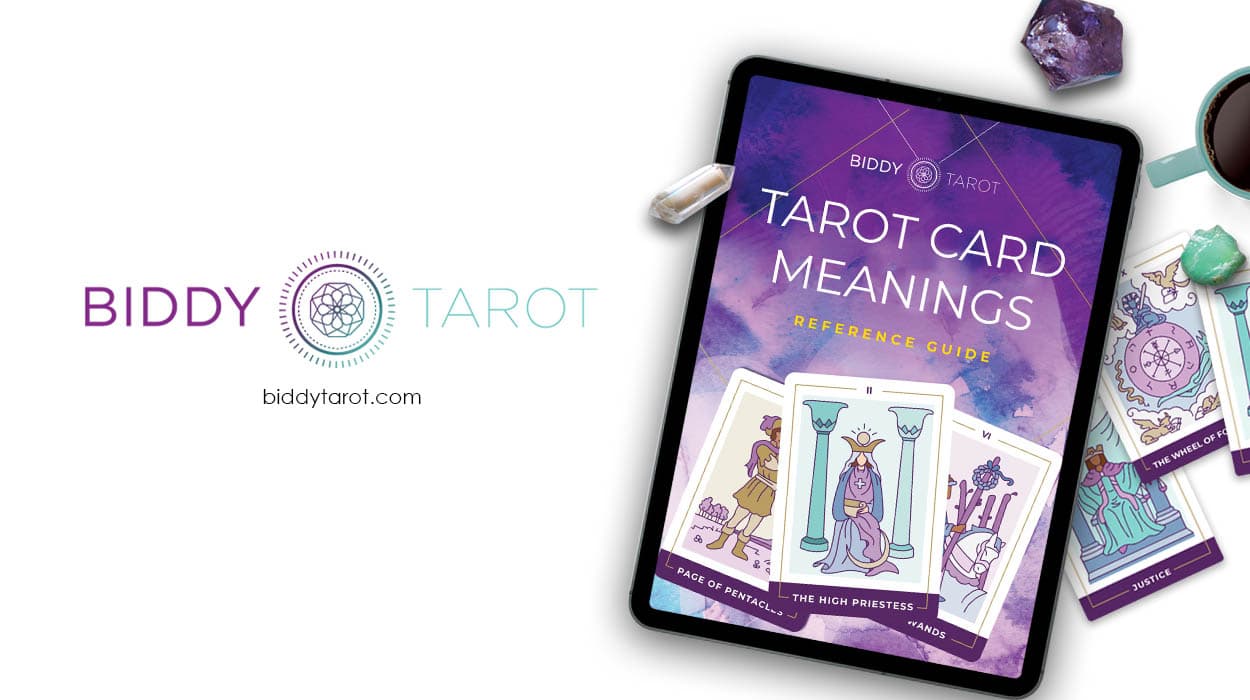 |
| og:title | Biddy Tarot | Online Tarot Courses and Tarot Card Meanings |
| og:locale | en_US |
| og:site_name | Biddy Tarot |
| og:image:type | image/jpeg |
| og:description | Biddy Tarot, the #1 Online Tarot Education Source. Learn how to read Tarot with online Tarot courses, Tarot tutorials, and modern Tarot card meanings. |
| og:image:width | 1250 |
| og:image:height | 700 |
| twitter:card | summary_large_image |
robots.txt (opens in a new tab)
0 rulesNo rules found
No matching rules.
Sitemaps
1 Registration details RDAP / WHOIS
| Registrar | GoDaddy.com, LLC |
|---|---|
| Registered | 2001-07-02 |
| Expires | 2027-07-02 |
| Domain status | client delete prohibited、client renew prohibited、client transfer prohibited、client update prohibited |
| Nameservers | chin.ns.cloudflare.com、ken.ns.cloudflare.com |
| DNSSEC | unsigned |
 DNS records
| Type | Name | Value | TTL | Priority |
|---|---|---|---|---|
| A | biddytarot.com | 104.26.10.72 | 270 | — |
| A | biddytarot.com | 104.26.11.72 | 270 | — |
| A | biddytarot.com | 172.67.70.75 | 270 | — |
| AAAA | biddytarot.com | 2606:4700:20::681a:a48 | 300 | — |
| AAAA | biddytarot.com | 2606:4700:20::681a:b48 | 300 | — |
| AAAA | biddytarot.com | 2606:4700:20::ac43:464b | 300 | — |
| MX | biddytarot.com | aspmx.l.google.com | 300 | 1 |
| MX | biddytarot.com | alt1.aspmx.l.google.com | 300 | 5 |
| MX | biddytarot.com | alt2.aspmx.l.google.com | 300 | 5 |
| MX | biddytarot.com | alt3.aspmx.l.google.com | 300 | 10 |
| MX | biddytarot.com | alt4.aspmx.l.google.com | 300 | 10 |
| MX | biddytarot.com | mxa.mailgun.org | 300 | 20 |
| MX | biddytarot.com | mxb.mailgun.org | 300 | 25 |
| NS | biddytarot.com | chin.ns.cloudflare.com | 86400 | — |
| NS | biddytarot.com | ken.ns.cloudflare.com | 86400 | — |
| TXT | biddytarot.com | ZAC3943 | 300 | — |
| TXT | biddytarot.com | facebook-domain-verification=np2sr5mdtsv4o9sysjvekv2ejfkx9h | 300 | — |
| TXT | biddytarot.com | google-site-verification=1i5XzzO6KNKI43ZUKmjz7Lucl6MPrW400THtN3JRNT0 | 300 | — |
| TXT | biddytarot.com | google-site-verification=1ng7AsoRYCrd3JT-2pga76ltVnCChfdUve6plRI4f5g | 300 | — |
| TXT | biddytarot.com | google-site-verification=TfXepP54NXVTwopdEEhMDrFkoCF1JAcpWGCPrfL8oBQ | 300 | — |
| TXT | biddytarot.com | google-site-verification=hffAmvY2NlHvHx-MetGZtqHaQxOXNQ2j5ShkgEoYxns | 300 | — |
| TXT | biddytarot.com | v=spf1 include:_spf.google.com include:spf.leadconnectorhq.com include:mailgun.org ~all | 300 | — |
| DMARC | _dmarc.biddytarot.com | v=DMARC1; p=reject; fo=1; pct=100; rua=mailto:[email protected]; | 300 | — |
 TLS and certificates
| Assessment | Normal configuration |
|---|---|
| Supported protocols | TLSv1.2、TLSv1.3 |
| Negotiated protocol | TLSv1.3 |
| Certificate subject | biddytarot.com |
| Issuer | Google Trust Services |
| Valid until | 2026-12-17T14:02 · Remaining when checked: 85 days |
| Verification details | Certificate trust: Passed · Hostname match: Passed |
 HTTP response headers
| Header | Value |
|---|---|
| content-type | text/html; charset=utf-8 |
| cache-control | max-age=0 |
| server | cloudflare |
 Identified technologies
Recent Updates
- Website images
- Screenshots
- Pages and Search Information
- Network details
- Website Technologies
- HTTP Response Information
- TLS and certificates
- DNS Information
- Domain Registration
- Website profile
- Website Description
- Website Name
- Website profile
- Website Description
- Website Name
User reviews (0)