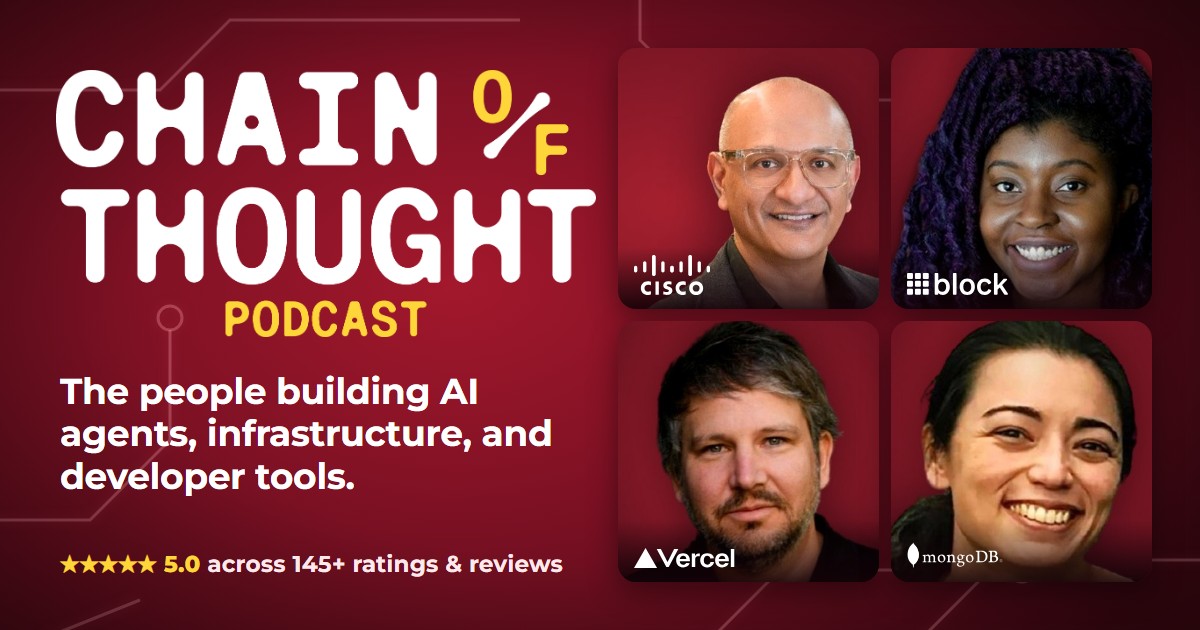
Website profiles · Technology insights · Alternatives

chainofthought.show

The podcast where builders reason through what’s changing in AI infrastructure. Hosted by Conor Bronsdon, with guests from NVIDIA, Google DeepMind, and AMD.

Paid content
Visit website
Profile views 2 Outbound visits 0 Normal
Chain of Thought Podcast Full homepage screenshot

At a glance

Category
Artificial Intelligence
Language
English
Paid-content signal
Paid contentObserved
Registered
2025
Hosting
CloudflareInferred
HTTPS certificate trusted
PassedObserved
Last updated

Website review

This review may include AI-generated content and is not individually verified. Domain, certificate and other facts come from the observed data on this page.

What is Chain of Thought Podcast?

Chain of Thought Podcast is a show for people building AI systems rather than just talking about them. Host Conor Bronsdon interviews engineers, founders, CTOs and product leads from companies such as NVIDIA, Google DeepMind and AMD, focusing on AI infrastructure, agents, evaluation and enterprise deployment. Its framing is practical: what is changing in the stack, and what does that change mean for teams shipping AI.

What you get

  • Episodes — long-form conversations, often around an hour, with show notes and transcripts. Topics cluster around AI agents, evals and reliability, enterprise AI, RAG, hardware, observability, coding and agent memory.
  • Explainers — short "plain answers" pieces aimed at questions builders actually ask, such as whether to use a single agent or a multi-agent system, how to give an agent identity and permissions, and how to choose between LLM-as-a-judge and human review.
  • A newsletter — new episodes plus the host's essays connecting them, described as up to once a week.
  • Multiple listening options — YouTube, Spotify, Apple Podcasts and RSS.

Who it suits

It is most useful if you are an engineer, founder or operator who needs to make decisions about architecture, evaluation or tooling, and you prefer hearing how named practitioners handled a problem in production over vendor marketing. If you want beginner-level AI explanations or quick news summaries, the episode length and depth will feel like more than you need. If you want academic research discussion, the guest mix is skewed toward industry roles.

One recent example is an episode with Kimberly Logan of Walrus Protocol on switching models without starting over — a concrete infrastructure concern for teams trying to avoid lock-in. Another features Sonar CTO Andrea Malagodi on why strong AI engineers can still be measured badly, which is a management and metrics question as much as a technical one.

How to start

Pick the topic list rather than the newest episode. If your immediate problem is evaluation, start with the evals or LLM-as-a-judge explainer, then listen to the related episode; if it is agent design, start with the single-agent versus multi-agent explainer. Episode pages include show notes and transcripts, so you can scan the argument before committing an hour. For a broader set of practitioner interviews, Latent Space covers similar ground from a builder angle.

Which episodes should I start with if I'm new to the show?

Start with the newest episode and one topic-specific episode that matches your work. The show’s own page offers a “New here? Start here” entry point, and the episode list is organized by topic, so you can pick a lane rather than sampling randomly.

Good starting points

  • If you care about model portability: EP 77, “Switching Models Shouldn't Mean Starting Over,” with Kimberly Logan of Walrus Protocol. It is the latest episode, so it reflects the show’s current focus, and the subject suits anyone worried about vendor lock-in or rework when swapping models.
  • If you work in a large organization: EP 76, “Your Best AI Engineer Might Have the Worst Metrics,” with Sonar CTO Andrea Malagodi. This is the enterprise AI angle, and the title signals a metrics and measurement discussion rather than a pure tooling demo.
  • If you are building agents: EP 75, “Why Context Alone Isn't Enough for Enterprise AI Agents,” with WisdomAI CPO Kapil Chhabra. A useful counterweight if you have been told that better retrieval or a bigger context window solves everything.
  • If you are a product engineer: EP 74, “AI Codes: Product Engineers Decide What to Build,” with Laurie Voss of Arize. This leans toward how teams decide what to build with AI, which is often the harder question.

How to choose

Your situation Start with
You want the current state of the show EP 77
You need buy-in inside a company EP 76
You are designing an agent system EP 75
You are deciding what to ship EP 74

A practical next step: open the show’s explainer index first, find the question closest to your own, then listen to the episode linked from that explainer. The explainers are short and point to the guests who have handled the problem in production, which is a faster route than starting at episode one. If you prefer audio only, the show is distributed on YouTube, Spotify and Apple Podcasts, and there is an RSS feed for any podcast app.

How do I subscribe to the podcast and the newsletter?

Subscribe on the platform you already use, and sign up for the newsletter separately by email — they are two different lists.

  • Podcast: Use the "Subscribe" link on Chain of Thought Podcast, or follow the show on YouTube, Spotify, Apple Podcasts, or its RSS feed. Subscribing gets you new episodes automatically; the site also offers direct episode audio downloads and show notes with transcripts.
  • Newsletter: Enter your email address in the newsletter signup box and confirm. It is described as essays from the conversations plus new episodes, sent up to once a week, with unsubscribe available anytime.

A practical next step: if you mainly want episodes, pick one podcast app and subscribe there. If you want the host's written takeaways and explainers, add the newsletter as well. Expect roughly one email a week rather than a daily stream, so the newsletter is low-commitment alongside a podcast subscription.

Where can I listen to Chain of Thought Podcast on YouTube, Spotify, or Apple Podcasts?

You can listen on all three: YouTube, Spotify, and Apple Podcasts. The show's "Follow the show" section lists those three alongside an RSS feed, so any standard podcast app can also pick it up if you prefer a player that isn't one of the big platforms.

Choosing between them

Platform Best for Trade-off
YouTube Seeing guests and any on-screen material; the show reports 3,050+ subscribers there Video eats more bandwidth and battery than audio-only
Spotify One app for music and podcasts, with playback speed and offline downloads Requires a Spotify account; some catalog features vary by region
Apple Podcasts iPhone, iPad, Mac and CarPlay users who want a built-in app Apple-only ecosystem; less convenient on Android or Windows

A practical next step

If you are new to the show, start with the episode page rather than the platform feed: each entry has show notes and a transcript, so you can skim the argument before committing to a 55–85 minute listen. Episodes like EP 77 with Kimberly Logan of Walrus Protocol on switching models, or EP 76 with Sonar CTO Andrea Malagodi on AI engineering metrics, are good tests of whether the interview style suits you. If it does, subscribe on whichever platform you already use daily — the show publishes roughly weekly, and the newsletter covers the same themes in written form for people who prefer reading.

One caveat worth knowing: episode lengths run long, so if you commute in short blocks, download in advance and use a faster playback speed rather than trying to finish in one sitting.

What are the key takeaways from the podcast's explainers on enterprise AI failures and AI agent guardrails?

The explainers do not offer one universal fix. They pair each question with guests who have hit the problem in production, so the takeaways read as practical decision rules rather than research summaries.

Enterprise AI failures and ROI

The recurring theme is that failure is usually organizational and measurement-related, not a shortage of model capability. Projects stall when no one defines what success looks like before launch, when the metric chosen rewards activity rather than business outcome, and when the pilot never gets a path into daily operations. The Sonar episode with CTO Andrea Malagodi makes the counterintuitive point in its title: your best AI engineer might have the worst metrics. A team can ship impressive demos and still look unsuccessful if it is measured on the wrong thing.

For a reader deciding whether to fund a project, the practical test is to write down the business decision the system will change and the number that should move. If neither exists, the project is not ready, regardless of how good the model is.

AI agent guardrails

Guardrails are treated as a design layer, not a final filter. The explainer connects them to permissions, identity and evaluation: an agent needs to know who it acts for, what it may touch, and how its actions are checked. Context alone is not enough — the WisdomAI episode with CPO Kapil Chhabra argues that giving an agent more information does not give it judgment about when to stop or escalate.

How the two topics connect

Question Where the risk sits Useful first move
Why do enterprise AI projects fail to show ROI? Measurement and ownership Define the decision and the metric before building
How do you set agent guardrails? Scope of action and oversight Decide what the agent may do, for whom, and when a human steps in

An evaluation lead at a mid-size company can use the first explainer to reset executive expectations, then the second to scope an agent's permissions before it touches customer data. The two are meant to be read together: ROI depends on the agent behaving predictably, and guardrails are only meaningful if someone owns the outcome.

A useful next step is to start with the explainer that matches your current blocker, then follow the linked guest episode for the production detail. Browsing by topic such as AI Evaluation & Reliability or AI Agents helps if you are unsure which applies. The show is also listed on YouTube, Spotify and Apple Podcasts if you prefer audio over the written explainers.

Who are the typical guests on Chain of Thought Podcast and what topics do they cover?

Chain of Thought Podcast features practitioners who build and operate AI systems rather than commentators or futurists. The show's own framing is "conversations with the people building AI agents and infrastructure," and its guest roster includes people from NVIDIA, Google DeepMind, and AMD, alongside startup founders, CTOs, and product leaders.

Who tends to appear

  • Engineers and technical leads working on AI infrastructure, model serving, and hardware.
  • Founders and executives at AI startups — for example, the CPO of WisdomAI and the CTO of Sonar have appeared in recent episodes.
  • Product and platform leaders at larger AI and developer-tooling companies, including Arize.
  • Researchers and specialists from major labs, given the NVIDIA, Google DeepMind, and AMD connections.

The common thread is that guests have shipped something and can speak from production experience, not just theory.

What they talk about

Episodes cluster around a set of recurring themes, which the site groups by topic:

  • AI agents — architecture, memory, and guardrails.
  • AI evaluation and reliability — evals, LLM-as-a-judge versus human review, and what leaders should know.
  • Enterprise AI — why projects fail to show ROI and how teams measure value.
  • Open source AI, RAG and retrieval, AI hardware, and observability.
  • AI coding — how product engineers decide what to build.

Recent episode titles illustrate the range: switching models without starting over, why context alone isn't enough for enterprise agents, and why a strong AI engineer might have misleading metrics.

How to use it

If you are choosing episodes, start with the topic index rather than the newest release. The site's explainers map common builder questions — agent identity and permissions, single versus multi-agent systems, eval strategy — to the guests who have handled those problems in production. That makes it easy to pick an episode that matches a decision you are actually facing, whether you are an engineer implementing agents or a leader trying to justify AI spend.

For broader context, other shows cover adjacent ground: Latent Space leans toward engineering deep dives, and Software Engineering Daily covers infrastructure more generally.

Related questions

More questions →
What Topics Does the Chain of Thought Podcast Cover?

The Chain of Thought Podcast covers AI infrastructure, AI agents, and AI evaluation and reliability, with recurring subtopics including enterprise AI, AI security, multi-agent systems, RAG and retrieval, AI hardware, AI observability, AI coding, agent memory, multimodal AI, and context management. It is hosted by Conor Bronsdon and features guests from companies such as NVIDIA, Google DeepMind, and AMD. If your interest is in how AI systems are actually built and operated in production—rather than general AI news—the topic range is likely to match.

Core themes

The show describes itself as "conversations with the people building AI agents and infrastructure," aimed at engineers, founders, and operators shipping AI. Three themes anchor most episodes:

  • AI infrastructure — the systems, hardware, and serving layers that AI products run on.
  • AI agents — how agents are designed, given context and memory, and deployed.
  • AI evaluation and reliability — how teams measure whether AI systems work.

Subtopics you can browse

The site groups episodes and explainers under a topic navigation, which is the fastest way to check whether your area is covered:

Topic What it points to
AI Agents Agent design, guardrails, deployment
AI Evaluation & Reliability Evals, LLM-as-a-judge vs. human review
Enterprise AI Why enterprise AI projects do or don't show ROI
Open Source AI Open model and tooling discussions
RAG & Retrieval Retrieval-augmented generation
AI Hardware Compute and infrastructure hardware
AI Observability Monitoring AI systems in production
AI Coding AI-assisted software development
Agent Memory How agents retain and use context
Multimodal AI Models handling more than text
Context Management Supplying the right context to models

Two content formats

The podcast publishes in two forms, and they serve different needs:

  1. Episodes — long-form guest interviews. Recent examples include an episode on switching models without starting over (Walrus Protocol), one on AI engineering metrics (Sonar), and one on why context alone isn't enough for enterprise AI agents (WisdomAI). Episodes run roughly 56–83 minutes based on the listed durations.
  2. Explainers — short "plain answers to the questions builders ask," each linked to guests who have dealt with the issue in production. Examples include whether to build a single agent or a multi-agent system, how to give an agent identity and permissions, and what AI evals are.

How to decide if it fits

  • Choose it if you want practitioner-level discussion of AI infrastructure, agents, and evals, and you value guest experience from production deployments.
  • Look elsewhere if you want beginner-level AI introductions or broad industry news rather than build-and-operate detail.

To check fit quickly, start with the explainers page for a topic you care about, then move to the full episode list. The show is available on YouTube, Spotify, Apple Podcasts, and RSS, and there is a free email newsletter with new episodes and essays.

How Active and Established Is the Chain of Thought Podcast?

As of October 8, 2026, the Chain of Thought Podcast has published 77 episodes, accumulated 164,924+ downloads and full-episode views, and built an audience across YouTube (3,050 subscribers), its newsletter (1,200+ subscribers), and the host's social following (17K+ on LinkedIn and X combined). Those numbers, published on the show's own site, indicate a regularly running podcast with a modest but multi-channel audience rather than a dormant or brand-new project.

What the published numbers show

The show lists its own metrics under a "By the numbers" section, dated October 8, 2026:

Metric Figure
Episodes 77
Downloads + full-episode views 164,924+
YouTube subscribers 3,050
Newsletter subscribers 1,200+
Host following (LinkedIn + X) 17K+

A few things are worth reading into these figures:

  • 77 episodes is the strongest signal of consistency. A show does not reach that count without a sustained release schedule. The episode numbering (EP 77, EP 76, EP 75, EP 74) confirms these are sequential, tracked releases rather than one-off uploads.
  • Downloads and views are reported together, so the 164,924+ figure blends audio downloads with full-episode video views. It is an aggregate reach number, not a pure download count.
  • The audience is spread across channels. YouTube (3,050), the newsletter (1,200+), and the host's social following (17K+) are separate pools, so total reach is larger than any single number suggests.

How recent the activity is

The most recent episodes listed on the site are dated within weeks of the metrics snapshot:

  • EP 77 — "Switching Models Shouldn't Mean Starting Over," with Kimberly Logan of Walrus Protocol, October 7, 2026
  • EP 76 — "Your Best AI Engineer Might Have the Worst Metrics," with Sonar CTO Andrea Malagodi, October 5, 2026
  • EP 75 — "Why Context Alone Isn't Enough for Enterprise AI Agents," with WisdomAI CPO Kapil Chhabra, September 24, 2026
  • EP 74 — "AI Codes: Product Engineers Decide What to Build," with Laurie Voss of Arize, September 22, 2026

Episodes 76 and 77 landed two days apart in early October 2026, and the prior two arrived in late September. That pattern points to an active, currently publishing show rather than one that has gone quiet.

What "established" means here

Beyond episode count, the show has built supporting infrastructure that signals maturity:

  • A guest roster from named companies. The site highlights guests from NVIDIA, Google DeepMind, and AMD, alongside figures from Sonar, WisdomAI, Arize, and Walrus Protocol.
  • A written resource library. The site offers "All 73 explainers" — plain-answer articles on topics like enterprise AI ROI, agent identity and permissions, LLM-as-a-judge versus human review, and agent guardrails — each linked to relevant guests.
  • Multiple listening and following options. YouTube, Spotify, Apple Podcasts, and RSS are all listed, plus a newsletter described as "up to once a week, no spam, unsubscribe anytime."
  • Topic organization. Episodes are browsable by category, including AI Agents, AI Evaluation & Reliability, Enterprise AI, Open Source AI, RAG & Retrieval, AI Hardware, AI Observability, AI Coding, Agent Memory, Multimodal AI, and Context Management.

How to judge whether it fits your needs

If you are evaluating the show for its activity and credibility, weigh it this way:

  • Choose it if you want a currently publishing show with a steady back catalog (77 episodes) and a guest list drawn from recognizable AI infrastructure and agent companies.
  • Note the scale. The subscriber and download figures describe a focused audience, not a mass-market show. If you want the largest possible community, this is a smaller one.
  • Check the cadence against your needs. Recent episodes cluster within days of each other, but the site does not state a fixed weekly schedule, so treat release timing as roughly regular rather than guaranteed.
  • Use the explainers as a shortcut. If you want written answers rather than audio, the 73 explainers cover many of the same questions the episodes address.

The clearest takeaway: with 77 episodes, recent releases in October 2026, and a documented audience across four channels, the Chain of Thought Podcast is an active, established show — established in the sense of consistency and guest quality, with an audience that is engaged but not large by mainstream standards.

What is the Chain of Thought Podcast?

Chain of Thought is a podcast for engineers, founders, and operators building AI, hosted by Conor Bronsdon. It focuses on AI infrastructure, agents, and evaluation, and features guests from companies including NVIDIA, Google DeepMind, and AMD. If you want production-grounded conversations about how AI systems actually get built and run, rather than high-level hype, this show is aimed at you.

What the show covers

The stated focus is "AI infrastructure, agents, and evals," with the broader framing of "what's changing in AI infrastructure." Episodes are organized around topics such as:

  • AI Agents
  • AI Evaluation & Reliability
  • Enterprise AI
  • Open Source AI
  • RAG & Retrieval
  • AI Hardware
  • AI Observability
  • AI Coding
  • Agent Memory
  • Multimodal AI
  • Context Management

Recent episodes illustrate the range:

Episode Topic Guest
EP 77 Switching models without starting over Kimberly Logan, Walrus Protocol
EP 76 AI engineering metrics in the enterprise Andrea Malagodi, Sonar
EP 75 Why context alone isn't enough for enterprise AI agents Kapil Chhabra, WisdomAI
EP 74 Product engineers deciding what to build Laurie Voss, Arize

Who it's for

The show describes its audience as engineers, founders, and operators shipping AI. The content assumes some familiarity with building or operating AI systems — it's a builder-focused show, not an introductory AI primer.

Formats and where to listen

  • Podcast episodes — available via YouTube, Spotify, Apple Podcasts, and RSS.
  • Show notes and transcripts — each episode links to written notes and a transcript.
  • Newsletter — essays drawn from the conversations, plus new episodes, delivered up to once a week.
  • Explainers — a library of plain-answer articles on builder questions, each linked to relevant guests. Examples include "Should you evaluate AI with an LLM-as-a-judge or with human review?" and "Should you build a single agent or a multi-agent system?"

Scale and activity

As of October 8, 2026, the show reports:

  • 77 episodes
  • 164,924+ downloads and full-episode views
  • 3,050 YouTube subscribers
  • 1,200+ newsletter subscribers
  • 17K+ host following on LinkedIn and X

Is it worth following?

It's a reasonable fit if you want practitioner-level discussion of AI infrastructure, agents, and evaluation, with guests from major AI hardware and research organizations. The combination of episodes, transcripts, and written explainers makes it usable both as listening material and as a reference you can search when you hit a specific design question. The newsletter is free to subscribe to and described as up to once a week with unsubscribe anytime.

How to Listen to or Subscribe to the Chain of Thought Podcast

You can listen to the Chain of Thought Podcast on YouTube, Spotify, Apple Podcasts, or via its RSS feed, and you can subscribe to a free email newsletter for new episodes and host essays. The show is hosted by Conor Bronsdon and features guests from companies like NVIDIA, Google DeepMind, and AMD, aimed at engineers, founders, and operators building AI. All 77 episodes are available, and the newsletter has 1,200+ subscribers with delivery up to once a week.

Where to listen

The site lists four follow options under "Follow the show":

Platform What it's for
YouTube Video episodes and full-episode views
Spotify Audio episodes
Apple Podcasts Audio episodes
RSS Any podcast app that accepts a feed URL

Each episode page also offers a direct "Download the episode audio" link, so you can save an episode without going through a platform.

How to subscribe for updates

The newsletter is the main way to get new episodes and written material:

  • What you get: new episodes plus Conor's essays on what the conversations add up to.
  • Frequency: up to once a week.
  • Cost: the site labels the subscribe action "Subscribe free."
  • Unsubscribing: the site states you can unsubscribe anytime.
  • Sign-up: enter your email address on the site and confirm. By subscribing you agree to Substack's Terms of Use, Privacy Policy, and Information collection notice.

If you only want episodes, following on YouTube, Spotify, Apple Podcasts, or RSS is enough — the newsletter is optional.

Finding a specific episode or topic

  • Latest episode: the homepage surfaces the newest one. As of the site's October 8, 2026 snapshot, that was EP 77, "Switching Models Shouldn't Mean Starting Over," with Kimberly Logan of Walrus Protocol.
  • All episodes: the "All 77 episodes" link goes to the full archive.
  • Show notes and transcripts: each episode has a "Show notes & transcript" link, useful if you'd rather read than listen.
  • By topic: episodes are grouped under topics including AI Agents, AI Evaluation & Reliability, Enterprise AI, Open Source AI, RAG & Retrieval, AI Hardware, AI Observability, AI Coding, Agent Memory, Multimodal AI, and Context Management.
  • Explainers: the "AI, decoded" section answers common builder questions and links each answer to the guests who have dealt with it in production.

New here? Start with these

If you're deciding whether the show is for you, the site's "New here? Start here" entry point and the explainer pages are the fastest way to sample the format. Recent episodes give a sense of the range:

  • EP 76 — "Your Best AI Engineer Might Have the Worst Metrics," with Andrea Malagodi, CTO at Sonar (Enterprise AI, 57 min).
  • EP 75 — "Why Context Alone Isn't Enough for Enterprise AI Agents," with Kapil Chhabra, CPO at WisdomAI (AI Agents, 83 min).
  • EP 74 — "AI Codes: Product Engineers Decide What to Build," with Laurie Voss of Arize (AI Agents, 56 min).

Common snags

  • RSS in a podcast app: if your app asks for a feed URL rather than a search name, use the RSS link from the "Follow the show" section instead of searching by title.
  • Wanting to read instead of listen: use the per-episode "Show notes & transcript" link — not every platform surfaces it.
  • Expecting a paid tier: the site only signals a free newsletter subscription; there's no indication of a paid plan, so don't assume one exists.
What written resources does the Chain of Thought Podcast offer?

The Chain of Thought Podcast publishes more than audio. Alongside each episode it offers show notes and transcripts, and it maintains a separate library of short written explainers that answer common questions from AI builders. A newsletter delivers new episodes plus the host's essays. If you want to read rather than listen, the explainers and transcripts are the two main entry points.

Show notes and transcripts

Every episode page includes a "Show notes & transcript" link, so you can read the conversation instead of playing the audio. The episode listing shows this pattern consistently — for example, EP 77 with Kimberly Logan of Walrus Protocol, EP 76 with Sonar CTO Andrea Malagodi, and EP 75 with WisdomAI CPO Kapil Chhabra each carry a show notes link alongside the audio player and a "Download the episode audio" option.

Use this when you want to search a specific claim, quote a guest accurately, or skim a long episode before deciding whether to listen. Episode runtimes run long — EP 75 is listed at 83 minutes — so a transcript is often the faster path to the part you need.

Explainers: plain answers to builder questions

The site hosts a written explainer section described as "Plain answers to the questions builders ask, each linked to the guests who have dealt with it in production." As of the site's October 8, 2026 figures, it lists 73 explainers.

Each explainer pairs a question with the episode or guest who addressed it. Examples from the index:

Question Topic area
Why do most enterprise AI projects fail to show ROI? Enterprise AI
How do you give an AI agent an identity and permissions? AI Security
Should you evaluate AI with an LLM-as-a-judge or with human review? AI Evaluation & Reliability
Should you build a single agent or a multi-agent system? Multi-Agent Systems
What are AI agent guardrails, and how do you set them? AI Agents
What are AI evals, and what should leaders know about them? AI Evaluation & Reliability

This is the resource to start with if you have a specific decision to make — choosing an evaluation method, or deciding between one agent and several — and want a short written answer that points back to a practitioner who has handled it.

Browse by topic

Explainers are organized under topic headings rather than only by date. The listed topics include:

  • AI Agents
  • AI Evaluation & Reliability
  • Enterprise AI
  • Open Source AI
  • RAG & Retrieval
  • AI Hardware
  • AI Observability
  • AI Coding
  • Agent Memory
  • Multimodal AI
  • Context Management

Use the topic index when you don't have a single question in mind but want to see everything written on, say, agent memory or AI observability.

The newsletter

The newsletter carries "Essays from the conversations, in your inbox" — new episodes plus the host's essays on "what they add up to." It reports 1,200+ subscribers and is described as arriving up to once a week, with unsubscribe available anytime. Subscribing requires an email address and agreement to Substack's terms and privacy policy.

Choose the newsletter if you want the host's synthesis rather than raw transcripts, or if you'd rather have new written material pushed to you than check the site.

How to choose

  • You have a specific question → start with the explainers index.
  • You want to verify or quote something from an episode → open that episode's show notes and transcript.
  • You want to browse by subject → use the topic headings.
  • You want ongoing written analysis → subscribe to the newsletter.

One caveat: the site's numbers (77 episodes, 164,924+ downloads and full-episode views, 3,050 YouTube subscribers, 1,200+ newsletter subscribers) are stated as of October 8, 2026, so treat them as a snapshot rather than a live count.

Website Overview

Identifiable technologies and additional version or configuration signals make the service easier to fingerprint, which may help targeted scanners narrow their checks. Page metadata, canonical configuration and social previews work together to provide more consistent search and sharing presentation.

Domain and Registration

The domain was registered less than a year ago and has limited historical evidence to assess. Transfer-protection status is present, helping reduce the risk of unauthorized domain transfers. The registrar is GoDaddy.com, LLC, a widely used domain service provider. The domain uses the common .show extension, which is not an independent safety signal.

DNS and Email

Nameservers are provided by Cloudflare, indicating managed DNS hosting. No CNAME was found; the observed records resolve directly to addresses. No MX record was found. A conventional explicit inbound-mail route is not configured. TXT records include verification markers for Google. Such markers may also remain after a service stops being used. DNSSEC signatures were not detected, so this additional DNS authenticity protection is not confirmed.

TLS and Certificates

The public key uses EC with 256 bits. The server supplied a complete certificate chain. No organization name is present in the certificate; the available fields are consistent with domain validation. The certificate was issued within the Google Trust Services cloud or CDN ecosystem. The certificate's total validity is about 90 days, consistent with a short renewal cycle.

HTTP and Browser Security

The checked browser-security headers were not detected, leaving fewer explicit browser-side safeguards. No X-Powered-By header was found, reducing one common source of backend fingerprinting information. The cf-ray response header indicates a CDN or caching proxy in the delivery path. No obvious internal addresses or debug information were found in the headers. The Server header identifies cloudflare without an exact version.

Technology Stack Analysis

The public page identifies Astro 7.3.5, Google Analytics, Cloudflare, with exact versions exposed for 1 technologies. These details can narrow vulnerability checks, although exposure alone is not a vulnerability.

Search and Social Sharing

The Generator tag identifies Astro v7.3.5, making the publishing system easier to fingerprint. Twitter Card metadata is configured. JSON-LD includes Organization data, helping describe the organization as an entity. The title has 63 characters, within a common display range. A meta description is present, with 156 characters.

Hosting and Email

DNSCloudflare
HostingCloudflare
EmailUnknown
Approximate IP geolocation (inferred; a CDN or proxy may differ from the origin server) Location unknown Inferred 104.21.78.23

Registration details

RDAP / WHOIS

RegistrarGoDaddy.com, LLC
Registered2025-12-31
Expires2026-12-31
Domain statusclient delete prohibited、client renew prohibited、client transfer prohibited、client update prohibited
Nameserversharlan.ns.cloudflare.com、melissa.ns.cloudflare.com
DNSSECunsigned

DNS records

DNS

TypeNameValueTTLPriority
Achainofthought.show104.21.78.23300—
Achainofthought.show172.67.215.25300—
AAAAchainofthought.show2606:4700:3033::ac43:d719300—
AAAAchainofthought.show2606:4700:3037::6815:4e17300—
NSchainofthought.showharlan.ns.cloudflare.com86400—
NSchainofthought.showmelissa.ns.cloudflare.com86400—
TXTchainofthought.showgoogle-site-verification=C9-wsli8MgFb5AQPbsp89B-IHf1L2Wf32hV7zx8Zn4g300—
DMARC_dmarc.chainofthought.showv=DMARC1; p=quarantine; adkim=r; aspf=r; rua=mailto:[email protected];300—

TLS and certificates

TLS / SSL

AssessmentNormal configuration
Supported protocolsTLSv1.2、TLSv1.3
Negotiated protocolTLSv1.3
Certificate subjectchainofthought.show
IssuerGoogle Trust Services
Valid until2027-01-06T05:26 · Remaining when checked: 85 days
Verification detailsCertificate trust: Passed · Hostname match: Passed

HTTP response headers

HTTP

HeaderValue
content-typetext/html
cache-controlpublic, max-age=0, must-revalidate
servercloudflare

Identified technologies

Astro 7.3.5Google AnalyticsCloudflare

Pages, Search and Sharing

Meta descriptionThe podcast where builders reason through what’s changing in AI infrastructure. Hosted by Conor Bronsdon, with guests from NVIDIA, Google DeepMind, and AMD.
Canonical URLhttps://chainofthought.show/
LanguageEnglish (default)
Twitter Cardsummary_large_image
All bots 1 allowed · 0 disallowed
  • Allow/

User reviews (0)

  • No reviews yet.