
 简体中文
简体中文 English
drawafish.com
Draw a fish and watch it swim in the global tank with everyone else's fish. Create, share, and vote on fish drawings.
More topics (2)
At a glance
- Category
- Games & Board Games
- Language
- English
- Paid-content signal
- No paid content foundObserved
- Registered
- 2025
- Hosting
- FastlyInferred
- HTTPS certificate trusted
- PassedObserved
- Last updated
Related questions
More questions →What Is a Fish Tank and What Do You Need to Set One Up?
A fish tank is a glass or acrylic container that holds water and aquatic life, with a filter, heater, and lighting to keep the water livable. You need all four of those — tank, filter, heater, light — plus a substrate and a cycled filter before any fish go in. A bowl is not a fish tank: it has no filtration, no heater, and too little surface area for gas exchange, so it is only suitable for a few very tolerant species, if anything. Saltwater tanks add live rock, a protein skimmer, and reef-specific lighting, and if you want corals, the setup requirements rise again.
What separates a fish tank from a bowl
The container itself is the least important part. What makes a tank a tank is the life-support system attached to it:
- Filtration — mechanical, biological, and often chemical. The biological part is the one that matters most.
- Heating — most tropical fish need a stable 24–26 °C (75–79 °F). A bowl swings with room temperature.
- Lighting — for plants, corals, and your ability to see the fish.
- Surface area and volume — more water dilutes waste and buffers temperature swings. A larger tank is easier to keep stable than a small one, which surprises most beginners.
The essential equipment
| Component | Freshwater | Saltwater |
|---|---|---|
| Tank | 40–75 L minimum for beginners | 100 L+ recommended |
| Filter | Hang-on-back or canister | Sump or canister plus live rock |
| Heater | Yes, for tropical species | Yes, stable temperature matters more |
| Lighting | Basic LED for fish; stronger for plants | Reef-capable LED if keeping corals |
| Substrate | Gravel or sand | Sand or crushed coral, plus live rock |
| Extra | — | Protein skimmer, refractometer, salt mix |
Live rock in a saltwater tank is not decoration. It is the primary biological filter, hosting the bacteria that process fish waste.
The nitrogen cycle, and why you cycle first
Fish waste and uneaten food break down into ammonia, which burns gills and kills fish. A filter does not remove ammonia by itself — bacteria living in the filter media do. Those bacteria take weeks to establish.
The cycle runs in three stages:
- Ammonia rises from waste or an added source.
- Nitrite appears as bacteria convert ammonia. Also toxic.
- Nitrate appears as a second group of bacteria converts nitrite. Much less toxic, removed by water changes.
You cycle a tank by running it with a waste source but no fish — fishless cycling with ammonia, or a pinch of fish food — and testing daily until ammonia and nitrite both read zero and nitrate is present. That typically takes two to six weeks. Adding fish before this point is the single most common reason new tanks fail.
Basic maintenance
- Water changes — 10–20% weekly or fortnightly, replacing water with dechlorinated (freshwater) or pre-mixed saltwater at matching temperature and salinity.
- Testing — ammonia, nitrite, nitrate, pH, and for saltwater also salinity and alkalinity. Test more often in the first few months.
- Filter cleaning — rinse media in old tank water, never under tap water, which kills the bacteria.
- Glass and equipment — algae scraping, impeller cleaning, and checking the heater.
Freshwater versus saltwater, and where corals fit
Freshwater is the cheaper, more forgiving starting point. Saltwater costs more, needs a refractometer and salt mix, and punishes mistakes faster — but it is what lets you keep marine fish and invertebrates.
Corals sit at the demanding end of that spectrum. They need stable parameters, reef-grade lighting, and consistent calcium and alkalinity. If you want corals, plan the tank around them from the start rather than upgrading later. Tank-raised, aquacultured corals — grown on real rock in captivity rather than collected from a reef — are generally hardier in home aquariums and easier to place than wild-collected specimens, and they avoid the collection impact on wild reefs. That makes them the sensible first choice for a new reef tank, though they still need the same stable water conditions as any other coral.
Deciding what to set up
If you want a low-maintenance tank with colourful fish, a freshwater setup of 60–100 L with a canister filter and heater is the straightforward path. If you want a reef, budget for a larger tank, a skimmer, reef lighting, and a longer cycling and stabilising period before you add corals. Either way, the sequence is the same: set up equipment, cycle the tank, test until stable, then add livestock slowly.
Website Overview
Page metadata, canonical configuration and social previews work together to provide more consistent search and sharing presentation.
Domain and Registration
Transfer-protection status is present, helping reduce the risk of unauthorized domain transfers. The domain has about 1 years of registration history; its current configuration provides more context than age alone. The registrar is NameCheap, Inc., a widely used domain service provider. The domain uses the common .com extension, which is not an independent safety signal.
DNS and Email
Nameservers are provided by Cloudflare, indicating managed DNS hosting. MX records point to the Mailgun email service. No CNAME was found; the observed records resolve directly to addresses. SPF and DMARC are configured. DKIM status is unknown. TXT records include verification markers for Google. Such markers may also remain after a service stops being used.
TLS and Certificates
The public key uses EC with 256 bits. The server supplied a complete certificate chain. No organization name is present in the certificate; the available fields are consistent with domain validation. The certificate was issued within the Google Trust Services cloud or CDN ecosystem. The certificate's total validity is about 90 days, consistent with a short renewal cycle.
HTTP and Browser Security
The checked browser-security headers were not detected, leaving fewer explicit browser-side safeguards. CORS permits any origin to read this response. This is common for public resources; sensitive responses need narrower handling. No X-Powered-By header was found, reducing one common source of backend fingerprinting information. The cf-ray, x-cache, x-served-by, via response header indicates a CDN or caching proxy in the delivery path. No obvious internal addresses or debug information were found in the headers.
Technology Stack Analysis
The public page identifies Google Analytics, Cloudflare, Fastly without precise versions, leaving fewer clues for version-specific scanning.
Search and Social Sharing
Twitter Card metadata is configured. JSON-LD includes Product or Offer data, potentially supporting eligible product search features. The title has 13 characters, within a common display range. A meta description is present, with 117 characters. The observed directives allow indexing and link following.
Hosting and Email
 Cloudflare
 Fastly
 Mailgun
Registration details
| Registrar | NameCheap, Inc. |
|---|---|
| Registered | 2025-06-30 |
| Expires | 2027-06-30 |
| Domain status | client transfer prohibited |
| Nameservers | carl.ns.cloudflare.com、elsa.ns.cloudflare.com |
| DNSSEC | unsigned |
DNS records
| Type | Name | Value | TTL | Priority |
|---|---|---|---|---|
| A | drawafish.com | 104.21.95.214 | 300 | — |
| A | drawafish.com | 172.67.148.166 | 300 | — |
| AAAA | drawafish.com | 2606:4700:3030::ac43:94a6 | 300 | — |
| AAAA | drawafish.com | 2606:4700:3035::6815:5fd6 | 300 | — |
| MX | drawafish.com | eforward1.registrar-servers.com | 300 | 10 |
| MX | drawafish.com | eforward2.registrar-servers.com | 300 | 10 |
| MX | drawafish.com | eforward3.registrar-servers.com | 300 | 10 |
| MX | drawafish.com | mxa.mailgun.org | 300 | 10 |
| MX | drawafish.com | mxb.mailgun.org | 300 | 10 |
| MX | drawafish.com | eforward4.registrar-servers.com | 300 | 15 |
| MX | drawafish.com | eforward5.registrar-servers.com | 300 | 20 |
| NS | drawafish.com | carl.ns.cloudflare.com | 86400 | — |
| NS | drawafish.com | elsa.ns.cloudflare.com | 86400 | — |
| TXT | drawafish.com | google-site-verification=pBgR-EQMtrOpvZdErmUsyjYspcsVzL7kxaj14JPPsZM | 300 | — |
| TXT | drawafish.com | v=spf1 include:mailgun.org ~all | 300 | — |
| TXT | drawafish.com | v=spf1 include:spf.efwd.registrar-servers.com ~all | 300 | — |
| DMARC | _dmarc.drawafish.com | v=DMARC1; p=none; pct=100; fo=1; ri=3600; rua=mailto:[email protected],mailto:[email protected]; ruf=mailto:[email protected],mailto:[email protected]; | 300 | — |
TLS and certificates
HTTP response headers
| Header | Value |
|---|---|
| content-type | text/html; charset=utf-8 |
| cache-control | max-age=600 |
| server | cloudflare |
| access-control-allow-origin | * |
Identified technologies
Pages, Search and Sharing
| Meta description | Draw a fish and watch it swim in the global tank with everyone else's fish. Create, share, and vote on fish drawings. |
|---|---|
| Canonical URL | https://drawafish.com |
| Language | English (default) |
| Twitter Card | summary_large_image |
Social Sharing Preview
15 fields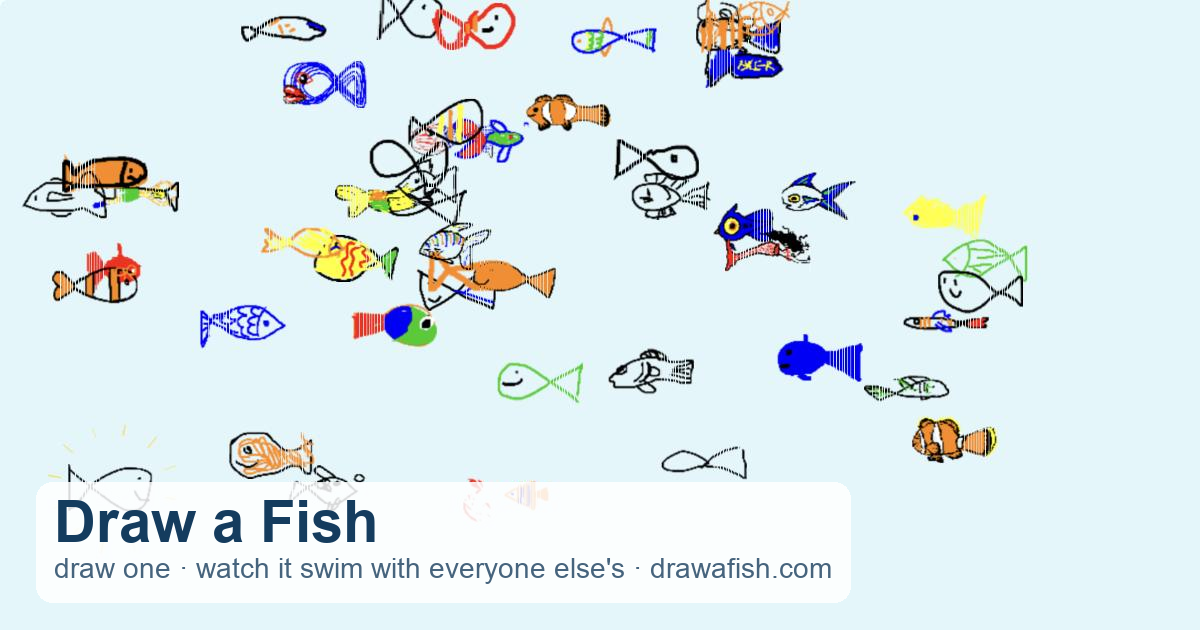

robots.txt (opens in a new tab)
12 rulesAll bots 10 allowed · 2 disallowed
- Allow
/ - Allow
/index.html - Allow
/tank.html - Allow
/rank.html - Allow
/fishtanks.html - Allow
/profile.html - Allow
/login.html - Allow
/src/css/ - Allow
/src/js/ - Allow
/public/ - Disallow
/moderation.html - Disallow
/reset-password.html
No matching rules.
Sitemaps
1Recent Updates
- Website images
User reviews (0)