Website profiles · Technology insights · Alternatives

edley.com No paid content found

Categories: Industry & Manufacturing

Edley Fabrics, Inc. Manufacturers of tulle, tricot, mesh, illusion, netting, crinoline, veiling, trim, 5804.10 tulle, lace, and industrial fabrics. We sell wholesale only. We are the source for all your tulle, netting, tricot, and trim needs!

Visit website

Updated: 2026-09-22 16:49 Language: English (default) Access: Normal

Profile views 3 Outbound visits 0
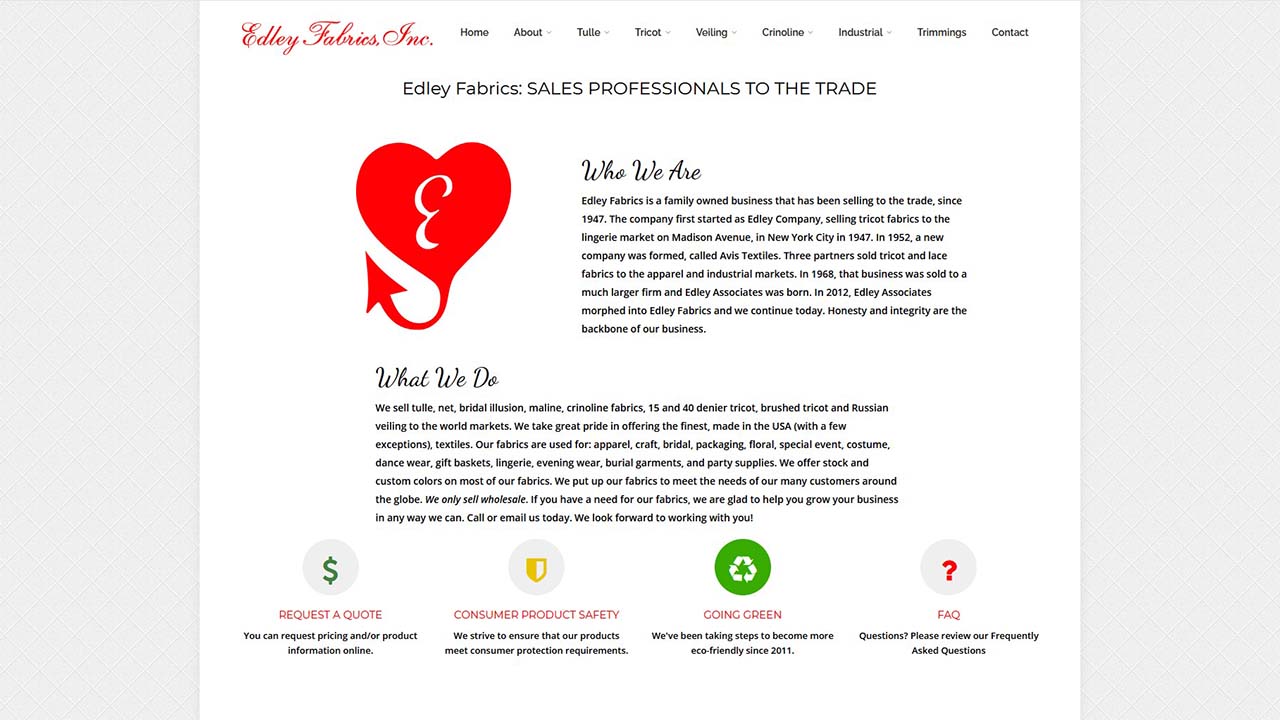
Edley Fabrics Full homepage screenshot
Editorial Review

Website Review

What is Edley Fabrics?

Edley Fabrics is a wholesale-only manufacturer and supplier of specialty fabrics, according to its own description. Its catalog centers on tulle, tricot, mesh, illusion, netting, crinoline, veiling and trim, along with lace and industrial fabrics. The site also references the 5804.10 tariff category, which covers tulles and other net fabrics.

Because the company sells wholesale rather than to consumers, its natural audience is businesses rather than individuals: bridal and eveningwear makers, costume and dancewear producers, milliners, decorators, and manufacturers that need netting or industrial fabric by the roll. The keyword list points to technical selection criteria such as denier, fishnet, nu-ganza, silk and cotton, suggesting buyers are expected to know the weight, finish and fiber they need.

A few trade-offs are worth noting. A wholesale-only model can mean better per-unit value and consistent supply for volume buyers, but it is typically a poor fit for hobby sewers wanting a few yards. The range is broad within its niche, yet it is not a general fashion-fabric store. Buyers who need apparel knits, wovens or prints may need other suppliers. Anyone comparing options could also look at Edley Fabrics directly for its current product lines.

What types of fabric does Edley Fabrics manufacture?

Edley Fabrics is a wholesale-only supplier and manufacturer focused on lightweight, open-weave and specialty fabrics. Its catalog centers on tulle, tricot, mesh, illusion, netting, crinoline and veiling, alongside trim and industrial fabrics. The listed 5804.10 reference points to the tariff category for tulle and other net fabrics, which fits that focus.

The range breaks down into a few practical groups:

  • Tulle and netting: classic bridal and craft materials, also used for packaging, decor and costume work.
  • Tricot: a smooth warp-knit, often chosen for linings, lingerie and industrial applications.
  • Illusion and veiling: fine, sheer fabrics for bridal veils, hat veiling and theatrical effects.
  • Crinoline: a stiffening fabric for structured garments, petticoats and millinery.
  • Mesh and fishnet: open constructions for apparel, sportswear and utility uses.
  • Trim and industrial fabrics: finishing components and technical textiles.

Because the business sells wholesale only, it is best suited to manufacturers, garment contractors, bridal and costume suppliers, and industrial buyers rather than individual retail shoppers. Buyers needing small cut lengths may find it less convenient, while volume purchasers gain access to a specialist range of denier and finish options.

Does Edley Fabrics sell to individuals or only wholesale?

Edley Fabrics operates as a wholesale-only supplier. According to its own description, the company sells solely to the trade rather than to individual retail customers. That means a hobbyist looking for a few yards of tulle for a costume or a single veil would generally need to buy through a retailer, a costume shop, or another business that stocks these materials.

The product range is broad but specialised: tulle, tricot, mesh, illusion, netting, crinoline, veiling, and various trims, plus industrial fabrics. These materials are typically bought in volume by businesses such as bridal and formalwear manufacturers, dancewear and costume producers, milliners, decorators, and industrial buyers.

What wholesale-only usually implies

  • Minimum order quantities may apply, though the site information does not state specific minimums.
  • Pricing is often quoted on request rather than published, so a buyer may need to contact the company directly.
  • Accounts and resale credentials are commonly required.

For individuals, the practical route is to source the same fabric types from a retail fabric store or an online retailer that sells cut lengths. For businesses, buying direct from a wholesale mill or converter can offer better per-yard costs and access to specific constructions, such as particular deniers or specialty nettings, that retail channels may not carry.

What is tricot fabric used for?

Tricot is a warp-knitted fabric known for its smooth face, slight crosswise stretch and resistance to runs. Because it holds shape well and takes dye and finishing treatments reliably, it appears in clothing, domestic textiles and industrial products rather than in a single narrow niche.

Common uses

  • Apparel: lingerie, slips, camisoles, sleepwear, linings and sportswear where a lightweight, close-fitting fabric is wanted.
  • Home textiles: mattress ticking, sheets, bedspreads, upholstery backing and blanket bindings.
  • Industrial and technical goods: netting, filters, protective covers, medical and hygiene products, and backing layers for coated or laminated materials.
  • Craft and costume work: tricot is often chosen when a stable knit is needed for backing, covering or reinforcing.

Trade-offs

Tricot tends to be durable and dimensionally stable, but its smooth hand and moderate stretch make it less suitable where heavy elasticity or a highly textured surface is required. Finer deniers give a lighter, softer result; heavier deniers are used where strength matters.

Edley Fabrics Edley Fabrics supplies tulle, tricot, netting and trimmings on a wholesale-only basis, so it is aimed at manufacturers, converters and trade buyers rather than individual retail shoppers. Buyers needing tricot for garment linings, industrial netting or trim applications would typically compare denier, width and finish before ordering.

What is the difference between tulle, netting, and mesh?

Tulle, netting and mesh are all open, hole-filled fabrics, but they differ in how they are made, how fine they are and what they are used for.

Tulle is a very fine, lightweight fabric, typically made from silk, cotton or synthetic fibres, with a hexagonal mesh structure. It is strongly associated with bridal veils, tutus, formalwear and decorative crafts because it is sheer, stiff or soft depending on finish, and drapes well.

Netting is a broader term for any open fabric with a knotted, looped or woven grid. It can be coarse or fine, rigid or flexible. Uses range from sports nets and agricultural protection to apparel and craft applications. Tulle is often described as a type of netting.

Mesh usually refers to a fabric with a regular, often synthetic, open structure. It tends to be stronger and more uniform than tulle. Mesh is common in sportswear, linings, bags and industrial applications where airflow, filtration or reinforcement matters.

Fabric Texture Typical uses
Tulle Fine, sheer, delicate Veils, tutus, decoration
Netting Variable, grid-like Sports, garden, apparel
Mesh Uniform, often stronger Sportswear, bags, industry

Edley Fabrics Edley Fabrics supplies tulle, tricot, mesh, netting, crinoline and trimmings on a wholesale-only basis, so it is suited to manufacturers, designers and trade buyers rather than individual retail customers.

How can I contact Edley Fabrics for wholesale inquiries?

Edley Fabrics is a wholesale-only supplier of tulle, tricot, mesh, illusion, netting, crinoline, veiling and trim, so it is aimed at businesses rather than individual retail buyers. The brand name in its listing includes the phone number 1-800-TRICOTS, which indicates that telephone contact is the primary channel for wholesale inquiries.

For wholesale questions, the most direct approach is to call the number shown in the company’s name. Business buyers typically use this kind of contact to ask about trade terms, minimum order quantities, available fibers and deniers, color options, and whether a particular fabric—such as Nu-Ganza, fishnet or industrial mesh—can be supplied in the needed width or finish.

If you prefer written contact, look for a contact page, email address or inquiry form on Edley Fabrics. When reaching out, include your business name, resale or tax details if relevant, the fabrics and quantities you need, and any deadlines. Because the company sells wholesale only, individual consumers looking for small cut lengths may be better served by a retail fabric shop. Prices are not shown in the supplied information, so ask directly for a quote.

Related questions

More questions →
What Are Fabric Trimmings and How Do You Choose the Right One?

Fabric trimmings are the decorative or structural edgings and accents added to a sewn or crafted piece — veiling, horse hair braid, crinoline, lace, beaded illusion, and similar materials. Choose one by matching three things to your project: the effect you want (stiffness, drape, sparkle, transparency), the construction it must survive (sewn into a hem, glued to a basket, wrapped around a bouquet), and how you'll buy it (stock vs. custom color, wholesale minimums). If you're buying from a trade-only supplier like Edley Fabrics, confirm the ordering process before you plan around a specific color.

The main types of trimmings and what each does

Trimming What it is Typical effect Common uses
Veiling Fine, open mesh, often with a diamond pattern; Russian veiling is a softer, finer variant Sheer coverage, soft drape Bridal veils, hat veils, overlays
Horse hair braid Stiff braided strip, traditionally of horsehair, now usually synthetic Holds a hem or edge rigid and flared Bridal hems, costume edges, structured ruffles
Crinoline Stiff, open-weave netting Volume and body Petticoats, underskirts, hat structure
Lace Patterned openwork fabric Decorative surface detail Bridal, evening wear, apparel accents
Beaded illusion Sheer mesh with bead or sequin work Sparkle over a sheer ground Bridal, evening wear, costume
Tulle and netting Fine hexagonal or diamond mesh Layered volume or sheer coverage Tutus, veils, floral wrap, gift packaging

The distinction that matters most in practice is stiffness versus drape. Horse hair braid and crinoline are chosen because they hold a shape. Veiling, illusion, and tulle are chosen because they stay light and let the shape underneath show through. If you pick from the wrong side of that line, the piece will either collapse or look rigid.

How to match a trimming to your project

Work through these in order:

  1. Name the job the trimming does. Is it structural (holding a hem out, building volume) or decorative (adding sparkle, softening an edge)? Structural jobs need stiffness; decorative jobs need the lightest material that still reads at the intended distance.
  2. Check the substrate. A heavy beaded illusion on a fine silk will pull and distort it. A stiff braid on a soft knit will pucker. Match the weight of the trimming to the weight of the fabric it sits on.
  3. Match the finish to the setting. Bridal and evening wear usually call for finer mesh and softer veiling; costume, floral, and packaging work can take heavier netting and bolder effects.
  4. Confirm color availability. Stock colors cover most standard needs, but custom colors are a separate process with their own lead time. Decide early whether a stock color is acceptable.
  5. Confirm how you can buy it. Some suppliers sell wholesale only, so a single retail-length purchase may not be possible. Ask about minimums and the quote process before committing to a design.

A worked example

For a bridal veil, the trimming is the veil itself: a fine illusion or Russian veiling, chosen for softness and how it photographs. For the same bride's gown hem, the trimming is horse hair braid, chosen because it holds the hem out in a clean circle. Same project, two trimmings, opposite requirements — one must disappear, one must hold a line. That contrast is the whole decision in miniature.

Material and construction factors that change the choice

  • Denier describes the weight of the yarn in tricot and similar fabrics. Higher denier means a heavier, more opaque, more durable material; lower denier means lighter and sheerer. This matters when a trimming needs to survive stress, as in aerial silks, where 40 denier tricot is used.
  • Stiffness comes from construction, not just fiber. Braided and open-weave structures hold shape; fine knits and meshes drape.
  • Sheerness determines how much of the underlying fabric or skin shows through — critical for veils and overlays.
  • Color may be stock or custom. Stock colors ship from what's on hand; custom colors are made to order.
  • Origin and compliance can matter for commercial buyers. Fabrics made in the USA, and trade programs such as USMCA, CAFTA-DR, ATPA, CBI, and HOPE, are relevant if you're sourcing for resale or for a regulated market.

Buying considerations before you order

If you're sourcing from a trade supplier, plan for these:

  • Wholesale-only policies. Some suppliers, including Edley Fabrics, sell to the trade only. Retail-length purchases may not be available.
  • Quote-based pricing. Pricing and product information are often requested rather than listed, so build a quote step into your timeline.
  • Stock versus custom. Stock colors are faster; custom colors need lead time and usually a larger commitment.
  • Ordering capability. Suppliers may support ASN and EDI, which matters if you're integrating with a larger purchasing system.

None of these are reasons to avoid a supplier — they're the questions to ask before you design around a specific trimming. Get the answers first, then choose the material.

What Is Crinoline Fabric and Which Type Should You Use?

Crinoline is a stiff, open-weave fabric used to add structure, volume, and shape to garments and crafts — most often as an inner layer in bridal, costume, and evening wear. Choose it when you need firm support that holds a silhouette (a full skirt, a stand-up collar, a shaped hat brim) rather than soft drape. If you need sheer coverage or a soft veil, you want tulle or bridal illusion instead. Edley Fabrics, a family-owned supplier to the trade since 1947, lists crinoline alongside tulle, net, bridal illusion, and horse hair braid in its product range, and sells wholesale only.

What crinoline actually is

Crinoline is defined by its hand (how it feels and behaves), not by a single fiber. The name historically referred to a stiff cloth woven from horsehair and cotton, which is why the term still overlaps with "horse hair" products today. Modern crinoline is typically a net-like or woven construction that has been stiffened so it stands away from the body and resists collapsing under the weight of an outer skirt.

Key traits to expect:

  • Stiffness — the defining property. It holds a shape rather than draping.
  • Open construction — usually a net, mesh, or loose weave, which keeps it light despite the firm hand.
  • Structure over appearance — it is normally hidden inside a garment or used as a structural base, though some craft uses leave it visible.
  • Width and put-up vary — suppliers cut and package crinoline to suit different applications, so confirm the width and roll length you need.

Edley describes its fabrics as Made in the USA and offers stock and custom colors on most of them, so color matching for a visible crinoline layer is worth asking about.

Crinoline vs. tulle, netting, illusion, and horse hair braid

These terms get used loosely, so the useful question is what each one does in a project.

Fabric Typical role Hand Choose it when
Crinoline Structural support, volume, shaping Stiff, firm You need a skirt to stand out, a brim to hold, or a base to build on
Tulle Volume with softness, layered fullness Soft to medium You want puff and layering without a rigid edge
Bridal illusion Sheer, nearly invisible overlay Very soft, fine You need a veil or a barely-there layer over another fabric
Netting Utility structure, floral and craft work Varies, often crisp You need an open grid for support, wrapping, or floral mechanics
Horse hair braid Edge stiffening and hem shaping Firm, narrow, braided You want a crisp hem or edge rather than full-panel structure

The practical rule: crinoline builds the shape, tulle and illusion soften or cover it, and horse hair braid finishes an edge. Many projects use two or three together — a crinoline base for the silhouette, tulle for the visible puff, and horse hair braid to keep the hem crisp.

Edley's own product list separates these into distinct lines — Crinoline, Baby Lift, Horse Hair, and Boning sit in one group, while Tulle, Bridal Illusion, and Netting sit in others — which reflects that they are not interchangeable.

Matching crinoline types to your project

The sub-types matter more than the umbrella term. Based on how suppliers like Edley group these products, here is how to think about the common variants:

Crinoline (standard)

The general-purpose structural fabric. Use it for:

  • Full skirt underlayers in bridal and evening wear
  • Costume and dance wear that needs to hold a shape through movement
  • Craft and floral structures where a firm base is needed

Baby lift

A lighter, gentler support layer. Reach for it when a full crinoline would be too stiff or too bulky — for example, giving a child's dress or a softly shaped skirt a bit of lift without a rigid cage effect.

Horse hair (horse hair braid)

Narrow, braided, and firm. This is an edge treatment, not a panel fabric. Use it to stiffen a hem, hold a shaped edge, or give a flounce a crisp finish. It is often sewn into a hem casing or applied along an edge.

Boning

Rigid strips used to keep a seam or edge from collapsing — for example, in a strapless bodice or a structured corset-style garment. It is a support component rather than a fabric panel.

Choosing by project

  • Bridal gown with a full skirt: standard crinoline for the base structure, tulle or illusion for the visible layers, horse hair braid for the hem.
  • Costume or dance wear: standard crinoline, or baby lift if the wearer needs lighter support.
  • Structured bodice or strapless top: boning along the seams, not crinoline panels.
  • Hat brim or shaped accessory: crinoline or a stiffened net as the base.
  • Floral and craft work: netting or crinoline depending on whether you need an open grid or a solid stiff panel.

How to work with crinoline

Crinoline behaves differently from ordinary fabric, so a few habits save time:

  1. Cut with the structure in mind. Decide which direction needs to hold and which needs to flex. Test a scrap first — stiffened fabrics can have a clear grain direction.
  2. Use sharp tools. Stiff net and crinoline dull blades quickly and can snag. Fresh rotary blades or shears give cleaner edges.
  3. Sew with a longer stitch and a sturdy needle. A universal or sharp needle in a medium weight, with a slightly longer stitch length, handles the bulk better than a fine needle and short stitch.
  4. Reduce bulk at seams. Crinoline layers add thickness fast. Trim, grade, or overlap seams rather than stacking them.
  5. Shape with heat cautiously. Some stiffened fabrics respond to steam or heat and some do not. Test on a scrap before pressing anything visible.
  6. Finish raw edges. Open weaves can fray or scratch. Bind or cover edges that will touch skin or show.

Verification: before committing to a full garment, cut a small test piece, sew a seam, and check that the shape holds and the seam lies flat. That single test catches most of the problems crinoline causes.

Common snags

  • Confusing crinoline with tulle. If the project needs softness, crinoline will make it look stiff and costume-like.
  • Using too much stiffness. Baby lift exists precisely because standard crinoline is sometimes too much.
  • Skipping the edge finish. Stiff open weaves can be scratchy against skin.
  • Assuming color availability. Edley offers stock and custom colors on most fabrics, but confirm the specific crinoline variant and color before planning a visible layer.
  • Forgetting it is a support layer. Crinoline is usually hidden; plan the visible fabric separately.

Sourcing and what to ask a supplier

Edley Fabrics sells wholesale only, so this is a trade purchase rather than a retail one. The company states it has been selling to the trade since 1947, makes its fabrics in the USA, and offers stock and custom colors on most lines. It also notes USMCA, CAFTA-DR, ATPA, CBI, and HOPE fabrics are available, and that it is ASN and EDI capable — relevant if you are ordering through a production system.

When you contact a supplier, ask:

  • Which crinoline variant fits your use (standard, baby lift, or a related support product)
  • Available widths and put-up
  • Stock colors versus custom color minimums and lead time
  • Whether the specific fabric meets the consumer safety requirements your market needs
  • Wholesale terms, since retail purchase is not offered

Edley takes pricing and product information requests online and lists a toll-free line for the US and Canada, so a quote request is the natural first step.

What Are Crafts? A Beginner's Guide to Choosing a Craft and Getting Started

Crafts are hands-on activities that turn raw materials—yarn, fabric, paper, thread—into finished objects you can use, wear, or give away. If you are new and want to start, the fastest path is to pick one category, buy a beginner pattern and the supplies that pattern lists, and finish a small project before expanding. This guide covers the main craft categories, how to match one to your time and budget, what a first project actually requires, and the mistakes that stall most beginners.

What counts as a craft

A craft is any making activity where skill in handling tools and materials determines the result. That separates it from pure assembly, and it is why the same pattern can look different in two people's hands.

Major categories you will run into:

  • Yarn crafts — knitting, crochet, and related techniques. Tools are needles or hooks; material is yarn.
  • Fabric crafts — sewing, quilting, embroidery, and appliqué. Tools are machine or hand needles, scissors, rotary cutters; material is fabric and thread.
  • Paper crafts — card making, scrapbooking, origami, paper cutting. Tools are trimmers, punches, adhesives; material is cardstock and patterned paper.
  • Surface and mixed crafts — painting, beading, polymer clay, and similar. These often overlap with the categories above.

Annie's Attic organizes its catalog around patterns, fabrics, yarns, and supplies, which maps closely to the yarn and fabric categories above—so it is a reasonable place to look once you know which category you are entering.

How to choose your first craft

Match the craft to three things: how much time you have per session, how much you want to spend before you know whether you enjoy it, and whether you want a portable or a stationary hobby.

Craft Typical first-session time Startup cost profile Portability
Crochet Short sessions work; a small project can be finished in a few sittings Low—one hook size and one yarn High, fits in a bag
Knitting Similar to crochet, slower per stitch for many beginners Low to moderate—needle sizes vary by project High
Sewing Longer setup per session (machine, cutting, pressing) Moderate to high—machine plus notions Low, needs a table
Quilting Longest—cutting and piecing before any visible result Moderate to high Low
Paper crafts Short, easy to stop and restart Low to moderate Medium

Simple selection rules:

  • If you want to finish something this week, start with crochet or a small paper project.
  • If you already own a sewing machine, sewing is the cheaper entry because the biggest cost is behind you.
  • If you dislike counting stitches, avoid knitting and crochet as a first craft and try paper or surface crafts.
  • If you want a finished object you will actually use, pick a project type first (a scarf, a tote, a set of cards) and let that decide the craft.

What a first project actually needs

Every beginner pattern has two lists: materials and tools. Buy from the pattern's list, not from a general "starter kit" description, because quantities and weights are matched to the design.

For a yarn project, the pattern will specify:

  • Yarn weight (for example worsted or DK) and the number of skeins
  • Hook or needle size, usually in mm and US size
  • Notions such as stitch markers, a tapestry needle, and scissors

For a sewing or quilting project, expect fabric yardage, thread, and possibly interfacing, batting, or a specific presser foot.

For paper crafts, expect cardstock weight, adhesive type, and any die or punch the design depends on.

Two verification steps before you buy:

  1. Check that the yarn weight in the pattern matches the yarn you are buying. Substituting a thicker or thinner yarn changes the finished size.
  2. Check the pattern's stated skill level. Most catalogs label patterns as beginner, easy, intermediate, or experienced—start at the lowest level available for the craft you chose.

Where to find patterns and materials

Annie's Attic is one option: it carries patterns, fabrics, yarns, and supplies in one place, which reduces the number of separate orders for a first project. It also has a cart and a subscription services policy, so if you sign up for anything recurring, read that policy to understand what you are agreeing to.

Other common routes:

  • Local craft and fabric stores, where you can feel yarn weight and fabric hand before buying
  • Manufacturer pattern lines, which often publish free beginner patterns
  • Community groups and classes, useful mainly for getting past the first confusing hour

If you buy online, order the full materials list in one go. Running out of a dye lot mid-project is a common reason first projects get abandoned.

Common first-project mistakes

  • Choosing a pattern above your level. A complex lace shawl as a first knit is the single most common reason beginners quit. Pick something with one repeating stitch or straight seams.
  • Wrong yarn weight. Using bulky yarn with a worsted-weight pattern produces a garment that fits no one. Match the weight on the label to the weight in the pattern.
  • Skipping the gauge swatch. For anything that must fit, work a small sample and measure it. If your stitches per inch differ from the pattern, change hook or needle size.
  • Buying tools for a craft you have not tried. Borrow or buy the minimum for one project first.
  • Not reading the whole pattern before starting. Terms and abbreviations are usually defined at the top; reading them first prevents mid-project confusion.

A practical starting sequence

  1. Pick one category from the table above based on your time and budget.
  2. Find a beginner-level pattern in that category and read its materials list.
  3. Buy exactly those materials, matching yarn weight or fabric type.
  4. Work a gauge swatch if the project needs to fit.
  5. Finish one small project before buying supplies for a second.

That sequence keeps your first investment low and gives you a finished object to judge whether the craft is worth continuing.

What Is Veiling Fabric and How Do You Choose the Right Type?

Veiling is a fine, open-mesh fabric used to make face and head coverings—most commonly bridal veils, hat veils (millinery), and costume or decorative overlays. It is sold in several distinct constructions, and the right choice depends on three things: how much stiffness or drape you want, how fine the mesh needs to be, and how wide the piece must be for your project. If you are buying for a wedding veil, a hat, or a costume, the sections below let you match the fabric to the job.

Veiling vs. tulle, illusion, maline, and net

These terms overlap, and suppliers often use them loosely. A practical way to separate them:

Term What it usually means Typical use
Veiling General category of fine mesh used for face/head coverings Bridal veils, hat veils, costume veils
Bridal illusion Very fine, soft veiling with a tight, nearly invisible mesh Traditional wedding veils
Maline A stiffer, crisper veiling that holds a shape Veils that need volume or stand-away puff
Tulle Broader term for fine netting, often stiffer and with larger holes Tutus, decor, craft, gift wrap
Net / netting Open mesh, wider range of hole sizes and stiffness Floral, craft, industrial, packaging

The key distinction is not the name but the hand of the fabric: illusion and fine veiling drape and disappear; maline and stiffer tulle hold shape. If your project needs the veil to float and be barely visible, you want a fine illusion-type veiling. If it needs to puff or stand away from the head, you want a crisper maline or stiffer tulle.

Common veiling types and how to match them to a project

Edley Fabrics lists several veiling options in its product range, including Bridal Veiling, Ultra Soft, and Russian Veiling, alongside tulle, illusion, and crinoline. Here is how to think about the main types:

Bridal illusion

  • Character: Fine, soft, sheer mesh that reads as almost invisible.
  • Best for: Classic wedding veils, birdcage veils, and any veil where you want the fabric to disappear and let the trim or the dress carry the look.
  • Watch for: Very soft illusion can be slippery to cut and sew; a rolled hem or a narrow ribbon edge helps control it.

Russian veiling

  • Character: A veiling with a denser, more defined mesh pattern—often associated with a slightly crisper hand and a more visible diamond or hexagonal structure.
  • Best for: Millinery (hat veils), vintage-style face veils, and projects where you want the mesh itself to be a design feature rather than invisible.
  • Watch for: Because the pattern is more visible, it changes the look of the finished piece; sample it before committing to a large cut.

Ultra soft veiling

  • Character: A softer, more pliable veiling intended for a gentle drape.
  • Best for: Veils that need to fall softly and move, and for projects where standard illusion feels too stiff.
  • Watch for: Softness usually means less body, so it is a poor choice if you need the veil to hold a shape on its own.

Choosing by project

Project Recommended direction Why
Traditional long wedding veil Fine bridal illusion Maximum sheerness and drape
Birdcage / face veil Russian veiling or fine illusion Defined mesh or near-invisible coverage
Hat veil (millinery) Russian veiling Holds shape, mesh reads as a feature
Costume veil or overlay Tulle or stiffer veiling More body, easier to shape and trim
Decor / craft overlay Tulle or netting Wider range of stiffness and hole size

Denier, mesh size, and width: what actually changes the result

Three variables control how veiling behaves:

  • Denier refers to the thickness of the yarn used in the mesh. Lower denier means a finer, lighter, more delicate fabric; higher denier means a heavier, more durable mesh. Edley lists tricot in 15 denier and 40 denier, and denier is a standard way to compare mesh fabrics across the board.
  • Mesh size (hole size) controls coverage and transparency. Smaller holes give a denser, more opaque look; larger holes give a more open, airy look. For veils, a finer mesh reads as more formal and more invisible.
  • Width determines whether you can cut a veil in one piece. A veil that needs to be wide and long may require extra-wide goods or a seam. Edley lists an Extra Wide category, which is relevant if you are making a long or full veil and want to avoid a center seam.

A simple rule: finer denier + smaller mesh = softer, more invisible, more formal. Heavier denier + larger mesh = more body, more visible texture, more casual or structural.

How to buy: wholesale, quotes, and samples

Edley Fabrics states plainly that it sells wholesale only and sells to the trade. That affects how you buy:

  1. Confirm you qualify as a trade buyer. If you are an individual making a single veil, a wholesale-only supplier may not be the right channel; a retail fabric shop or online veil supplier will be.
  2. Request a quote. Edley provides an online Request A Quote option for pricing and product information. Use it to ask about the specific veiling type, width, and color you need.
  3. Ask about stock vs. custom colors. Edley notes it offers stock and custom colors on most fabrics, so if you need a specific shade, ask whether it is stocked or a custom run.
  4. Ask for a sample before a large order. With veiling, the difference between illusion, Russian, and ultra soft is best judged in hand. A small swatch tells you more than any description.
  5. Check lead time and minimums. Since the site does not publish pricing or minimums, these are questions for the quote request, not assumptions.

Quick decision guide

  • Want the veil to disappear? Choose a fine bridal illusion.
  • Want the mesh to be part of the design? Choose Russian veiling.
  • Want maximum softness and drape? Choose ultra soft veiling.
  • Need structure and volume? Move toward maline, stiffer tulle, or crinoline.
  • Making a long or full veil? Check for extra-wide goods to avoid a seam.
  • Buying for resale or production? Go through the wholesale quote process and confirm stock colors, minimums, and lead times.

If you are unsure between two types, order a swatch of each and compare them against your project's need for drape, coverage, and width before you commit.

What Is Tricot Fabric and How Do You Choose the Right Denier?

Tricot is a warp-knitted fabric — yarns run vertically and interlock in a zigzag, which gives it a flat face, a slight crosswise stretch, and resistance to running or laddering. If your project needs a smooth, lightweight, semi-sheer fabric that drapes and holds shape better than tulle or net, tricot is usually the right pick. The main decision is denier: 15 denier for light, sheer, delicate work; 40 denier for heavier, stronger, more opaque applications. Edley Fabrics (edley.com), a family-owned supplier selling to the trade since 1947, stocks both weights and notes that its 40 denier is used worldwide for aerial silks.

Tricot vs. tulle, net, and mesh

These fabrics get confused because they overlap in look, but the construction and behavior differ.

| Fabric | Construction | Hand and behavior | Typical use | |---|---|---|---|---| | Tricot | Warp knit | Smooth, flat, slight stretch, resists runs | Lingerie, apparel, linings, craft, aerial silks (40 denier) | | Tulle / bridal illusion | Fine netting, often twisted or hexagonal mesh | Stiff to soft depending on finish, very sheer, no real stretch | Veils, tutus, bridal, craft | | Net / fishnet | Open mesh, knotted or knitted | Large open holes, high transparency | Costume, floral, packaging, novelty | | Mesh | Generic open-hole fabric | Varies widely by fiber and knit | Industrial, craft, backing |

The practical test: if you need opacity, a smooth surface, or stretch recovery, choose tricot. If you need maximum airiness and structure with no stretch, tulle or net is the better fit.

How denier changes the fabric

Denier measures yarn weight — the higher the number, the thicker and heavier the yarn. Edley lists tricot in 15 denier and 40 denier, and the difference drives most project decisions.

15 denier tricot

  • Light, sheer, and soft against skin
  • Good drape with modest crosswise stretch
  • Best for lingerie, lightweight apparel, sheer overlays, and delicate craft work
  • Less abrasion resistance — not the choice for load-bearing or high-wear uses

40 denier tricot

  • Noticeably heavier, more opaque, and stronger
  • Holds up to tension and repeated stress
  • Used for apparel, industrial applications, and aerial silks
  • The right weight when the fabric has to carry weight or survive friction

If you are unsure, ask yourself whether the fabric will be pulled, hung, or load-bearing. If yes, go 40 denier. If it sits against the body or drapes as an overlay, 15 denier is usually enough.

Matching tricot to real projects

  • Lingerie and evening wear: 15 denier for smooth, sheer panels and linings.
  • Everyday apparel: 15 or 40 denier depending on how much body and opacity you want.
  • Aerial silks: 40 denier — Edley specifically notes its 40 denier is used worldwide for this.
  • Craft, floral, packaging, gift baskets: either weight works; 40 denier gives more structure, 15 denier more delicacy.
  • Costume and dance wear: 40 denier for durability, 15 denier for sheer layers.
  • Bridal: tricot can serve as an underlayer, but the visible sheer layer is usually tulle or illusion, not tricot.

Don't confuse tricot with Nu-Ganza or veiling

Edley's catalog groups tricot alongside Nu-Ganza, novelty veiling, bridal veiling, Russian veiling, and crinoline. These are not interchangeable:

  • Nu-Ganza is a stiffened, sheer fabric (similar in spirit to organza) used where you want body and crispness, not stretch.
  • Veiling (bridal, Russian, novelty) is an open, fine netting for face and head coverings — much more open than tricot.
  • Crinoline and horse hair braid are stiffening and edge-support materials, not garment body fabrics.

If your project depends on stretch and a closed, smooth surface, tricot is correct. If it depends on stiffness or an open mesh look, one of the others is.

Before you order: wholesale-only sourcing

Edley Fabrics sells wholesale only, so this is a trade supplier rather than a retail source — plan for that if you are buying for a single small project. The company states it sells fabrics Made in the USA, offers stock and custom colors on most fabrics, and can be reached at 1-800-TRICOTS (874-2687) toll free in the US and Canada, or (516) 933-7444. Pricing and product information are available by request through their online quote form.

Questions worth asking a supplier before committing:

  1. Is the tricot 15 or 40 denier, and what fiber content?
  2. Is it in stock, and what is the minimum order quantity?
  3. Are custom colors available, and what is the lead time?
  4. What width is the fabric put up at?
  5. Can they send a swatch so you can confirm hand, opacity, and stretch before a full order?

Confirming denier, fiber, and minimums up front prevents the most common mistake: ordering a weight that is too sheer or too heavy for the job.

Website Overview

An established domain and managed infrastructure suggest continuity of operations and may support dependable delivery, although neither guarantees service quality.

Domain and Registration

Registered in 1996, this domain has about 29 years of history. That suggests continuity, although ownership and purpose may have changed. Transfer-protection status is present, helping reduce the risk of unauthorized domain transfers. The registrar is GoDaddy.com, LLC, a widely used domain service provider. The domain uses the common .com extension, which is not an independent safety signal.

DNS and Email

Nameservers are provided by mock3hosting.com, indicating managed DNS hosting. MX records point to the edley.com email service. No CNAME was found; the observed records resolve directly to addresses. SPF and DMARC are configured. DKIM status is unknown. DNSSEC signatures were not detected, so this additional DNS authenticity protection is not confirmed.

TLS and Certificates

The certificate uses an RSA 2048-bit public key, offering broad client compatibility. The server supplied a complete certificate chain. No organization name is present in the certificate; the available fields are consistent with domain validation. The certificate was issued by Let's Encrypt, commonly associated with automated certificate services. The certificate's total validity is about 89 days, consistent with a short renewal cycle.

HTTP and Browser Security

X-Powered-By exposes backend information: PleskLin. The checked browser-security headers were not detected, leaving fewer explicit browser-side safeguards. No obvious internal addresses or debug information were found in the headers. The Server header identifies nginx without an exact version. No explicit CDN or WAF marker was found in the response headers.

Technology Stack Analysis

The public page identifies jQuery, Bootstrap, Google Analytics, nginx without precise versions, leaving fewer clues for version-specific scanning.

Search and Social Sharing

The meta description has 242 characters and may be shortened in search results. Twitter Card metadata is configured. The title has 29 characters, within a common display range. No Generator meta tag is publicly exposed. A viewport declaration is present, providing a basis for mobile layout.

Hosting and Email

DNSmock3hosting.com
HostingLiquid Web, L.L.C
Emailedley.com
Location United States flagUnited States 69.16.238.33

User reviews (0)

  • No reviews yet.

Pages, Search and Sharing

Meta descriptionEdley Fabrics, Inc. Manufacturers of tulle, tricot, mesh, illusion, netting, crinoline, veiling, trim, 5804.10 tulle, lace, and industrial fabrics. We sell wholesale only. We are the source for all your tulle, netting, tricot, and trim needs!
Canonical URLhttps://edley.com/
LanguageEnglish (default)
Twitter Cardsummary_large_image
All bots 1 allowed · 0 disallowed
  • Allow/

Registration details RDAP / WHOIS

RegistrarGoDaddy.com, LLC
Registered1996-11-15
Expires2027-11-14
Domain statusclient delete prohibited、client renew prohibited、client transfer prohibited、client update prohibited
Nameserversns1.mock3hosting.com、ns2.mock3hosting.com
DNSSECunsigned

DNS records

TypeNameValueTTLPriority
Aedley.com69.16.238.3386400—
MXedley.commail.edley.com8640010
NSedley.comns1.mock3hosting.com86400—
NSedley.comns2.mock3hosting.com86400—
TXTedley.comv=spf1 ip4:69.16.238.33 ~all86400—
DMARC_dmarc.edley.comv=DMARC1; p=none86400—

TLS and certificates

AssessmentNormal configuration
Supported protocolsTLSv1.2、TLSv1.3
Negotiated protocolTLSv1.3
Certificate subjectedley.com
IssuerLet's Encrypt
Valid until2026-11-26T13:51 · Remaining when checked: 64 days
Verification detailsCertificate trust: Passed · Hostname match: Passed

HTTP response headers

HeaderValue
content-typetext/html
servernginx

Identified technologies

jQueryBootstrapGoogle Analyticsnginx

Recent Updates

  • Website profile