Website profiles · Technology insights · Alternatives

fundmydeductible.com

FMD is your deductible solution with a trusted name. Register as a contractor and receive and track income in a secure app with 2x more deals closed!

No paid content found
Visit website
Profile views 7 Outbound visits 12 Normal
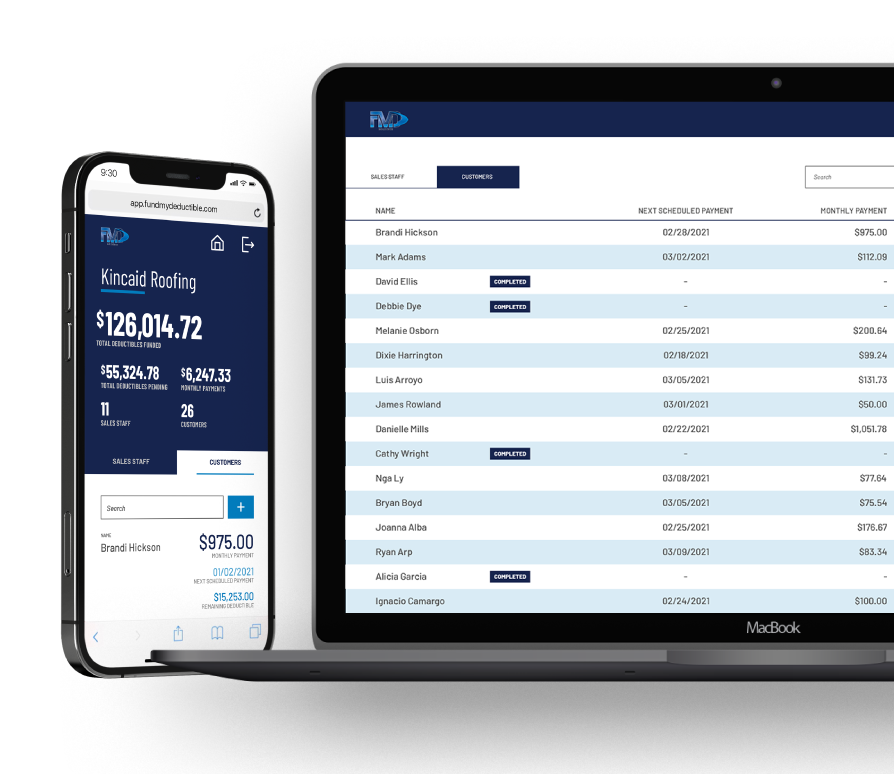
Fund My Deductible Full homepage screenshot

At a glance

Category
Finance
Language
English
Paid-content signal
No paid content foundObserved
Registered
2019
Hosting
DigitalOcean, LLCInferred
HTTPS certificate trusted
PassedObserved
Last updated

Website review

This review may include AI-generated content and is not individually verified. Domain, certificate and other facts come from the observed data on this page.

What is Fund My Deductible?

Fund My Deductible (FMD) is a platform for home-improvement contractors and their sales teams to fund homeowners' insurance deductibles through a structured payment plan, rather than having the contractor absorb or finance that cost. The pitch is that this keeps contractors compliant while collecting deductibles legally, so they stop losing deals to customers who balk at paying a large deductible up front.

How it works, per the site's stated three steps

  • Register as a contractor: set up your company and register your sales team through the site.
  • Sign up your customers: create a custom payment plan, issue an executed funding agreement, and keep all parties informed.
  • Receive and track income: contractor and salesperson portals let you monitor income and track performance.

The site claims a 5-minute setup, a free trial, and "2x more deals closed," and notes it has been referenced in industry news and at contractor events as a compliant deductible-collection tool.

Who it's for and the trade-off

The audience is roofing and other exterior/restoration contractors whose customers owe a deductible after an insurance claim. The appeal is closing jobs that would otherwise stall on that payment. The trade-off is that you're adding a third-party funding arrangement and payment plan to every affected job, which means extra paperwork, disclosure to the homeowner, and a workflow your sales team has to learn — worth it mainly if deductible hesitation is a recurring reason you lose signed contracts.

If you're evaluating it, run one month of deals through the free trial and compare your close rate against your normal process before rolling it out company-wide.

How does Fund My Deductible help contractors close more deals?

Fund My Deductible helps contractors close more deals by turning the customer's deductible from an upfront cash obstacle into a structured payment plan. The site's core promise is "NEVER LOSE ANOTHER DEAL" and "STOP FINANCING AND START FUNDING TODAY" — the pitch is that when a homeowner can't or won't pay a large deductible out of pocket, the contractor can offer a funded payment plan instead of walking away from the job or absorbing the cost.

The mechanism, per the site

The page describes a three-step process:

  1. Register as a contractor — set up your company and register your sales team on the platform.
  2. Sign up your customers — create a custom payment plan for the homeowner, receive an executed funding agreement, and keep all parties informed.
  3. Receive and track income — contractor and salesman portals let you monitor income and track performance.

The site also claims a 5-minute setup and "2x more deals closed," and says the approach is endorsed by the industry and positioned as a compliant, "legal" way to collect deductibles — it cites a conference mention of FMD as a tool for contractors to stay compliant while collecting deductibles.

Why this can move the close rate

The practical bottleneck in deductible-heavy work (roofing, storm restoration) is usually the homeowner's cash position, not their willingness to buy. A payment plan converts a single large objection into a monthly figure, which is easier for a salesperson to present and for a homeowner to accept. It also gives the sales rep something to offer at the moment of hesitation rather than sending the customer away to "think about it" — which is where deals typically die. Keeping the agreement and payment status visible to contractor and salesperson also reduces the follow-up friction that stalls paperwork.

Trade-offs to weigh

  • Contractor-funded or third-party-funded deductible arrangements carry legal and insurance-compliance risk in some states; the site leans on its compliance positioning, so verify the rules for your jurisdiction before adopting it as a standard sales tool.
  • A payment plan can shift collection risk or add administrative steps versus a clean upfront payment.
  • The "2x more deals" figure is a marketing claim on the site, not an independently verified benchmark — treat it as a target to test, not a guarantee.

A concrete decision test

Pick one recent lost job where the deductible was the stated blocker. Run it through the three-step flow — build the payment plan, present it to that homeowner, and see whether the objection actually dissolves. If it does, roll it out to your sales team; if the homeowner still balks, the problem was likely price or trust, not cash timing. The site offers a free trial, so a single-job pilot costs you little beyond setup time.

For comparison, contractors evaluating deductible-financing alternatives sometimes look at broader home-improvement financing platforms such as Acorn Finance or HomeTap, though those solve a different problem (funding the whole project rather than the deductible specifically).

Is Fund My Deductible legally compliant for collecting deductibles from homeowners?

Fund My Deductible is a payment-plan platform for collecting deductibles, not a legal compliance guarantee. The site presents itself as a tool that helps contractors stay compliant while "legally collecting deductibles," citing Steve Badger at the Win the Storm Conference, and describes a three-step process: register as a contractor, sign up customers with a custom payment plan and executed funding agreement, then receive and track income through contractor and salesman portals.

That framing matters because deductible collection is regulated at the state and insurer level, not by the platform. Some states and policies restrict contractors from paying, waiving, rebating or absorbing a homeowner's deductible; the homeowner is generally still obligated to pay it. A platform that documents a payment plan and keeps all parties informed can make the transaction more transparent, but it does not override insurance law, licensing rules or policy terms.

For a contractor considering it:

  • Use it as a documentation and payment-tracking layer. The site's emphasis on an executed funding agreement and portals suggests the value is in a clear paper trail and monitoring, not in legal cover.
  • Confirm compliance for your jurisdiction and the specific policy. Ask your own attorney or state insurance regulator whether third-party deductible funding is permitted where you work, and check the carrier's policy language.
  • Check the customer relationship. Homeowners should understand they are still responsible for the deductible and what the payment plan obligates them to do.

A practical next step: before signing up for the free trial, have your attorney review the funding agreement template and confirm it fits your state. For general context on deductible rules, see the Insurance Information Institute at Insurance Information Institute.

How do I set up a payment plan for a customer using Fund My Deductible?

Setting up a customer payment plan on Fund My Deductible happens on the contractor side, inside the app, after your company and sales team are registered. Based on the site's own description, the customer step is: set up your custom payment plan, receive the executed funding agreement, and keep all parties informed. The plan itself is yours to define—the platform handles the agreement, the funding, and the tracking around it.

The customer-facing sequence

  1. Register your company and sales team first (the site lists this as step one, with a claimed five-minute setup).
  2. Create the custom payment plan for that customer.
  3. Send it for signature; once executed, you have a funding agreement rather than a financing arrangement.
  4. Track the resulting income through the contractor and salesman portals.

Where it fits

This is aimed at home improvement contractors—roofing especially, judging by the press mentions and conference appearances—who lose jobs when a homeowner can't cover a large insurance deductible up front. The pitch is "stop financing and start funding," with the claim of double the deals closed and a free trial to test it.

Practical check before you commit

  • Confirm how your state treats deductible collection and who carries compliance responsibility; the site markets its approach as legally compliant, but the agreement terms are what govern.
  • Ask whether the homeowner's payment obligation is to you or to a third party, and what happens if a payment fails mid-plan.
  • Test one real customer through the free trial before rolling it out to your sales team, so you see the actual agreement language and portal workflow.

For background on the deductible-financing debate in roofing, trade coverage from Roofing Contractor and Insurance Journal is a reasonable starting point.

What fees or costs are involved in using Fund My Deductible after the free trial?

Fund My Deductible's page does not publish a fee schedule for what happens after the free trial. The only pricing signal on the page is the free trial itself, and the signup flow points contractors to register, set up a company, and add a sales team without listing ongoing charges.

For a contractor weighing this tool, the practical next step is to ask the vendor directly for a written cost breakdown before registering a full team. Specifically:

  • Whether the contractor, the customer, or both pay for the funding arrangement
  • Any per-deal or percentage-based charge tied to each funded deductible
  • Monthly or annual platform fees for the contractor and salesman portals
  • Whether the free trial converts automatically and what the cancellation terms are
  • Any payment processing or setup costs

The trade-off is that a deductible-funding service can help close deals that would otherwise stall on upfront cash, but the cost structure determines whether that benefit outweighs simply collecting the deductible directly. Contractors who run high-ticket jobs with frequent deductible disputes are the clearest fit; those with low-volume or small-ticket work may find per-deal fees harder to justify. Get the numbers in writing and compare them against your average job margin before committing.

For general context on deductible funding and contractor compliance, see Fund My Deductible.

How do contractors and sales team members track income and performance in Fund My Deductible?

Contractors and sales team members track income and performance through dedicated portals inside the Fund My Deductible app. According to the site, the third step of its process — "Receive and Track Income" — gives contractors and salesmen separate portals where they can monitor income and track performance. The same page also says registration covers setting up your company and registering your sales team, which is what makes per-person tracking possible in the first place.

In practice, that means a roofing company owner can see what the business is collecting while individual salespeople see their own numbers, rather than everyone working from one shared spreadsheet. The company describes the setup as a five-minute process and says the platform is intended to help close more deals by funding deductibles instead of financing them.

What the page actually specifies

  • Contractor portal and salesman portal, listed as distinct items
  • "Monitor Income" and "Track Performance" as the stated functions
  • Sales team members registered during company setup
  • Customers set up on custom payment plans, with executed funding agreements and all parties kept informed
  • Free trial offered, with no pricing details published on the page

Practical next step

If you are evaluating this for a crew, ask two questions before signing up: does each salesperson get their own login with performance visible only to them and management, and can you export income data for payroll or commission calculations? Those two answers usually decide whether a portal saves you admin time or creates a second place to reconcile.

For comparison, contractor-focused payment and financing platforms such as Acorn Finance and Service Finance approach this differently — they emphasize consumer lending rather than deductible funding — so the tracking question is really about which model fits how you collect from homeowners.

Related questions

More questions →
Is Fund My Deductible a Trusted, Industry-Endorsed Solution?

Fund My Deductible (FMD) markets itself as "The Trusted Name" and a pioneer in funding insurance deductibles, and it backs that claim with industry conference recognition, trade-media coverage, and a free trial you can use to evaluate it yourself. If you're a contractor weighing whether to adopt it, the relevant question isn't whether the marketing sounds confident — it's what third-party and industry signals actually exist, and what you can verify before committing.

What FMD claims about itself

According to the site, FMD "pioneered the Funding of Deductibles that is endorsed by the industry." The core pitch is operational rather than purely financial: contractors register, sign up customers on a custom payment plan, and then receive and track income through contractor and salesman portals. The headline benefit it advertises is closing "2x more deals" by removing the deductible as a deal-breaker.

Those are the company's own claims. Treat them as positioning, not verified outcomes — the site does not publish independent performance data behind the "2x" figure.

The industry signals it points to

FMD's trust argument rests on a handful of named, checkable references rather than anonymous testimonials:

Signal What the site states
Conference recognition FMD "Recognized at Win the Storm Conference"
Industry endorsement Steve Badger mentioned FMD as a tool to help contractors "stay compliant while LEGALLY collecting deductibles" during the Houghtaling // Badger debate
Speaking presence John Houghtaling II keynote speaker at SRC Summit 2020
Trade media Coverage including Coffee Conversations with Thea Dudley, Roofing Industry News: Ryan's Rants, and "Contractors and Homeowners Advised to Pay Deductible"

The most substantive of these is the Badger reference, because it ties FMD to a compliance framing — collecting deductibles legally — rather than just faster cash flow. That's the claim worth scrutinizing if compliance is your concern.

How to evaluate the trust claim yourself

Because the endorsements above are conference and media appearances rather than audited certifications, the practical way to test FMD is to use the free trial as a low-commitment evaluation window. The site advertises a "Start FREE Trial" and a "5 Minute Setup," so you can assess fit before scaling it across a sales team.

A concrete evaluation path:

  1. Register as a contractor — go to fundmydeductible.com, set up your company, and register your sales team.
  2. Run one customer through the flow — set up a custom payment plan, receive the executed funding agreement, and confirm all parties stay informed as the site describes.
  3. Check the income tracking — use the contractor and salesman portals to monitor income and track performance.
  4. Verify the compliance angle — if legal collection of deductibles is your reason for interest, confirm the specifics with your own counsel rather than relying on a conference mention.

The trial lets you validate the workflow and the portals on real deals before you commit your team.

Where the trust question stays open

The site does not publish pricing beyond the free-trial signal, does not list payment platforms, and does not provide independent audit or licensing details. So "trusted" here means recognized within the roofing and storm-restoration trade press and conference circuit — not independently certified. If your decision hinges on regulatory or legal assurance, the conference endorsement is a starting point, not a substitute for your own compliance review.

For contractors already operating in that industry ecosystem, the combination of named conference recognition, trade-media coverage, and a free trial is enough to justify a hands-on test. For anyone needing formal verification before adoption, the site's own materials won't supply it.

What Is Fund My Deductible?

Fund My Deductible (FMD) is a platform that contractors use to fund and collect insurance deductibles from homeowners, rather than financing them. According to the site, it is a three-step, roughly five-minute setup that gives contractors and their sales teams a way to register, sign up customers on a custom payment plan, and then track the resulting income through contractor and salesman portals. It is aimed at contractors who lose deals when a homeowner cannot pay the deductible up front.

What problem it solves

When a homeowner files an insurance claim, the deductible is the portion they owe before coverage applies. If the homeowner does not have that cash on hand, the job can stall or go to a competitor. FMD's pitch is that instead of the contractor financing the deductible, the platform handles funding it, so the deal can move forward.

The site frames this as "NEVER LOSE ANOTHER DEAL" and claims contractors close "2x more deals" after switching. Treat those as the company's own marketing claims, not independently verified figures.

How the process works

The site describes a simple three-step flow:

  1. Register as a contractor — go to fundmydeductible.com, set up your company, and register your sales team.
  2. Sign up your customers — set up a custom payment plan, receive an executed funding agreement, and keep all parties informed.
  3. Receive and track income — use the contractor and salesman portals to monitor income and track performance.

The stated setup time is about five minutes, and the site lists a free trial as the entry point.

Who it is for

  • Contractors in insurance-driven trades (roofing is the example that appears in the site's press mentions) who want to stop turning away jobs over deductibles.
  • Sales teams that need their own portal to track what they close.
  • Homeowners indirectly, as the party signing the payment plan and funding agreement.

What the site emphasizes

Claim on the site What it means
"The Deductible Solution" Positions FMD as a category tool for deductible funding
"Trusted Name" / "endorsed by the industry" Points to press coverage and conference mentions, including a Win the Storm Conference debate where FMD was cited as a tool to help contractors stay compliant while legally collecting deductibles
"Stop financing and start funding" Draws a distinction between contractor financing and FMD's funding model
Free trial The listed way to start

What to check before signing up

The site does not publish pricing beyond the free trial, so confirm current cost, contract terms, and any state-specific rules on collecting deductibles directly with FMD. Deductible collection is regulated differently across states, and the site's own framing ties the product to staying compliant — so verify the requirements for your market before relying on it.

What Is the 3-Step Process to Use Fund My Deductible?

Fund My Deductible (FMD) is a platform that contractors use to fund homeowners' insurance deductibles instead of financing them. According to the company, the process has three steps: register as a contractor, sign up your customers, and receive and track income. FMD advertises a 5-minute setup and a free trial, so you can evaluate the workflow before committing. The steps below follow the sequence published on fundmydeductible.com.

Step 1: Register as a Contractor

This step sets up your company and the people who sell for it.

  1. Go to fundmydeductible.com.
  2. Set up your company profile.
  3. Register your sales team.

Expected result: Your company and salespeople exist in the system, which is what allows customer deals to be attributed and tracked later. FMD describes this as part of a 5-minute setup, so the registration itself is meant to be quick — the time cost is mostly in gathering your company and team details before you start.

Step 2: Sign Up Your Customers

This is where the deductible funding arrangement is actually created for each homeowner.

  1. Set up your customer's custom payment plan.
  2. Receive the executed funding agreement.
  3. Keep all parties informed.

Expected result: A signed funding agreement exists for the customer, and everyone involved — contractor, salesperson, and homeowner — has visibility into the arrangement. The "executed funding agreement" is the key artifact here: it is the document that supports collecting the deductible, which is why FMD frames this step around compliance rather than just payment collection.

Step 3: Receive and Track Income

Once agreements are in place, the platform becomes a monitoring tool.

  1. Use the contractor and salesman portals.
  2. Monitor income.
  3. Track performance.

Expected result: You can see incoming funds and measure how individual salespeople are performing. Because there are separate contractor and salesman portals, both the business owner and the sales team can view relevant income without sharing one login.

The Three Steps at a Glance

Step What you do What you get
1. Register as a contractor Set up company, register sales team Company and team active in the system
2. Sign up your customers Build payment plan, receive executed funding agreement, inform all parties A signed funding agreement per customer
3. Receive and track income Use contractor and salesman portals Income monitoring and performance tracking

What FMD Emphasizes About This Process

  • Speed: The company markets a 5-minute setup, so registration is not intended to be a lengthy onboarding project.
  • Free trial: FMD promotes a free trial as the entry point, which lets you run the three steps with real or test customers before deciding.
  • Compliance framing: FMD states it pioneered deductible funding that is "endorsed by the industry," and its materials reference attorney Steve Badger describing FMD as a tool to help contractors stay compliant while legally collecting deductibles. That framing is the reason the executed funding agreement in Step 2 matters — it is the record that supports the collection.
  • Deal volume: FMD claims contractors close "2x more deals" by funding deductibles rather than financing them. Treat this as a company claim, not a verified benchmark.

Common Points to Clarify Before You Start

  • Pricing after the trial: The site promotes a free trial but does not publish plan pricing in the material reviewed here. Confirm cost and contract terms directly with FMD before your trial ends.
  • Who signs what: Step 2 assumes the homeowner executes a funding agreement. Understand your obligations and your customer's before presenting it.
  • Team structure: Decide who needs a salesman portal login versus contractor-level access, since income visibility differs between the two.
  • State and carrier rules: Deductible collection practices vary by jurisdiction and insurer. FMD's compliance positioning does not replace your own review of local requirements.
How Fund My Deductible Helps Contractors Legally Collect Deductibles

Fund My Deductible (FMD) is a platform that lets contractors and their sales teams set up customer payment plans for insurance deductibles, so a homeowner can fund the deductible over time instead of paying it all upfront. The stated goal is to keep the deal alive when a high deductible would otherwise stall or kill it, while keeping the contractor compliant. It is aimed at contractors and sales teams in insurance-driven home service work (the site's own context is roofing and storm restoration), and the site advertises a free trial and a roughly 5-minute setup.

The problem FMD is built around

In insurance-funded work, the homeowner still owes the deductible. When that number is large, contractors report losing signed deals because the customer can't or won't pay it in one lump sum. FMD's pitch is blunt: "NEVER LOSE ANOTHER DEAL" and "STOP FINANCING AND START FUNDING TODAY."

The distinction the site draws is between financing and funding. FMD positions itself as a funding tool rather than a lender, which matters because how a deductible is collected is a compliance question, not just a cash-flow one.

How the collection works

FMD describes a three-step process:

  1. Register as a contractor — go to fundmydeductible.com, set up your company, and register your sales team.
  2. Sign up your customers — set up a custom payment plan, receive an executed funding agreement, and keep all parties informed.
  3. Receive and track income — contractor and salesman portals let you monitor income and track performance.

The key mechanism is the custom payment plan plus an executed funding agreement. The customer commits to a schedule rather than a single payment, and the agreement documents it. That paper trail is what FMD sells as the compliance piece — the deductible is still collected, but through a structured, documented plan.

Why the compliance angle matters

Collecting a deductible is legal; how you do it is where contractors get into trouble. FMD leans on third-party validation for this. On its site it cites Steve Badger, during the annual Houghtaling // Badger debate at the Win the Storm Conference, mentioning Fund My Deductible as a tool to help contractors "stay compliant while LEGALLY collecting deductibles." The site also notes John Houghtaling II as a keynote speaker at SRC Summit 2020 and references coverage in roofing-industry media.

If your concern is whether a given collection method is defensible, that endorsement is the signal FMD is selling — not a legal guarantee. Compliance rules vary by state and insurer, so treat the platform as the documentation layer and confirm your specific approach against your own jurisdiction and carrier requirements.

What you actually get

Area What FMD states
Setup 3 steps, ~5-minute setup, free trial
Customer side Custom payment plan, executed funding agreement, all parties informed
Contractor side Contractor and salesman portals, income monitoring, performance tracking
Claimed outcome "2x more deals closed"
Positioning Funding (not financing) of deductibles; industry-endorsed

Who this fits, and who should look elsewhere

FMD is a reasonable fit if you are a contractor or sales organization doing insurance-funded work, you regularly lose deals at the deductible stage, and you want a documented payment-plan process with tracking for your team. The free trial and short setup lower the cost of testing it on your own pipeline.

It is a weaker fit if your customers' deductibles are already small enough to pay outright, if you operate outside the insurance-funded model FMD is built for, or if you need a lending product rather than a funding/collection process — FMD explicitly frames itself against financing.

Before committing, verify two things yourself: the current terms of the free trial (the site promotes it but the input does not state duration or limits), and whether the payment-plan structure satisfies the compliance rules in the states and with the carriers you work in.

Website Overview

Identifiable technologies and additional version or configuration signals make the service easier to fingerprint, which may help targeted scanners narrow their checks. An established domain and managed infrastructure suggest continuity of operations and may support dependable delivery, although neither guarantees service quality.

Domain and Registration

Registered in 2019, this domain has about 7 years of history. That suggests continuity, although ownership and purpose may have changed. Transfer-protection status is present, helping reduce the risk of unauthorized domain transfers. The registrar is GoDaddy.com, LLC, a widely used domain service provider. The domain uses the common .com extension, which is not an independent safety signal.

DNS and Email

MX records exist, but SPF, DKIM and DMARC were not detected. Protection against domain impersonation may be incomplete. Nameservers are provided by Cloudflare, indicating managed DNS hosting. MX records point to the Google Workspace email service. No CNAME was found; the observed records resolve directly to addresses. TXT records include verification markers for Google. Such markers may also remain after a service stops being used.

TLS and Certificates

The public key uses EC with 256 bits. The server supplied a complete certificate chain. No organization name is present in the certificate; the available fields are consistent with domain validation. The certificate was issued by Let's Encrypt, commonly associated with automated certificate services. The certificate's total validity is about 89 days, consistent with a short renewal cycle.

HTTP and Browser Security

The checked browser-security headers were not detected, leaving fewer explicit browser-side safeguards. No X-Powered-By header was found, reducing one common source of backend fingerprinting information. No obvious internal addresses or debug information were found in the headers. The Server header identifies nginx without an exact version. No explicit CDN or WAF marker was found in the response headers.

Technology Stack Analysis

The public page identifies WordPress 7.1.2, jQuery, nginx, with exact versions exposed for 1 technologies. These details can narrow vulnerability checks, although exposure alone is not a vulnerability.

Search and Social Sharing

The Generator tag identifies WordPress 7.1.2, making the publishing system easier to fingerprint. Twitter Card metadata is configured. The title has 58 characters, within a common display range. A meta description is present, with 149 characters. The observed directives allow indexing and link following.

Hosting and Email

DNSCloudflare
HostingDigitalOcean, LLC
EmailGoogle Workspace
Approximate IP geolocation (inferred; a CDN or proxy may differ from the origin server) United States flagClifton, New Jersey, United States Inferred 167.99.54.51

Registration details

RDAP / WHOIS

RegistrarGoDaddy.com, LLC
Registered2019-07-04
Expires2028-07-04
Domain statusclient delete prohibited、client renew prohibited、client transfer prohibited、client update prohibited
Nameserversken.ns.cloudflare.com、paityn.ns.cloudflare.com
DNSSECunsigned

DNS records

DNS

TypeNameValueTTLPriority
Afundmydeductible.com167.99.54.51300—
MXfundmydeductible.comaspmx.l.google.com3001
MXfundmydeductible.comalt1.aspmx.l.google.com3005
MXfundmydeductible.comalt2.aspmx.l.google.com3005
MXfundmydeductible.comalt3.aspmx.l.google.com30010
MXfundmydeductible.comalt4.aspmx.l.google.com30010
NSfundmydeductible.comken.ns.cloudflare.com86400—
NSfundmydeductible.compaityn.ns.cloudflare.com86400—
TXTfundmydeductible.comgoogle-site-verification=-wgoxPTSrvLZ6QovUiX4Vv_QmR6H8s1oc-6mqnCJajM300—

TLS and certificates

TLS / SSL

AssessmentNormal configuration
Supported protocolsTLSv1.2、TLSv1.3
Negotiated protocolTLSv1.3
Certificate subject*.fundmydeductible.com
IssuerLet's Encrypt
Valid until2026-11-17T10:10 · Remaining when checked: 48 days
Verification detailsCertificate trust: Passed · Hostname match: Passed

HTTP response headers

HTTP

HeaderValue
content-typetext/html; charset=UTF-8
servernginx

Identified technologies

WordPress 7.1.2jQuerynginx

Pages, Search and Sharing

Meta descriptionFMD is your deductible solution with a trusted name. Register as a contractor and receive and track income in a secure app with 2x more deals closed!
Canonical URLhttps://fundmydeductible.com/
LanguageEnglish (default)
Twitter Cardsummary_large_image
All bots 0 allowed · 0 disallowed

User reviews (0)

  • No reviews yet.