
 hackertab.dev
No paid content found
hackertab.dev
No paid content found
Categories: Development
Hackertab is a free start page for developers: daily dev news, trending GitHub repos and tech conferences, curated hourly from 50+ sources.
 Visit website
 Updated: 2026-09-26 09:51
 Language: English (default)
 Access: Normal
 Profile views 0
 Outbound visits 0
Related questions
More questions →How to Follow Daily Tech News Without Getting Overwhelmed
The most reliable way to keep up with daily tech news is to build a small, fixed set of sources you trust, scan headlines once or twice a day, and only go deep on stories that actually affect you. Treat news like a filter, not a firehose: pick two or three outlets with clear bylines and correction policies, add one newsletter or podcast for context, and ignore the rest until a story proves it matters. A site like CNET can serve as one part of that system—its news, reviews, and how-to sections each do a different job, so knowing which section to open saves time.
What counts as useful daily tech news
Useful tech news changes a decision, a risk assessment, or your understanding of something you already use. That includes:
- Product and platform changes that affect devices, apps, or accounts you own (pricing shifts, feature removals, security patches).
- Security and privacy incidents with confirmed scope, such as a breached service or a patched vulnerability.
- Regulatory and policy moves that change what companies can do in your region.
- Genuine product launches with shipping dates and prices, not just announcements of future announcements.
Noise looks similar but adds nothing: rewritten press releases, "reportedly" stories with no named source, rumor roundups about products that may never ship, and near-identical coverage of the same event across ten sites. A quick test—can I name one thing I would do differently after reading this?—filters most of it out.
Compare the main formats
| Format | Best for | Main trade-off |
|---|---|---|
| News feeds / homepages | Fast headline scanning, breaking stories | Easy to doomscroll; headlines lack context |
| Newsletters | A curated daily or weekly digest | Arrives on the sender's schedule; can pile up |
| Podcasts | Context, interviews, analysis during commutes | Slower; hard to skim; often days behind |
| Social accounts | Real-time alerts from sources you already trust | Algorithm-driven; rumors spread fast |
| RSS readers | Full control, no algorithm, no ads in the feed | Requires setup; some sites publish partial feeds |
A practical combination: one feed or homepage for scanning, one newsletter for a daily summary, and one podcast or long-read source for depth. That is usually enough to stay informed without spending an hour a day.
How to judge whether a tech outlet is reliable
Reliability is a set of habits you can check, not a brand you assume. Look for:
- Named bylines with a beat. A reporter who consistently covers security or chips is easier to trust than an anonymous aggregation account.
- Primary sourcing. Links to the company blog, filing, court document, or the researcher who found the flaw—not just "a report says."
- Clear labeling of rumor vs. confirmed. Words like "reportedly," "rumor," and "leak" should be visible, not buried.
- Correction practice. A visible corrections policy and updated articles with a note at the bottom are strong signals.
- Separation of news and commerce. Reviews and buying advice should disclose how products were obtained and whether affiliate links exist.
If a site publishes a striking claim with no source, no byline, and no update history, treat it as a lead to verify elsewhere, not a fact.
A simple daily routine
Step 1 — Scan (5 minutes). Open your feed or homepage once in the morning. Read headlines only. Save anything relevant with a bookmark or "read later" tool.
Step 2 — Triage (2 minutes). Sort saved items into three buckets: affects me now (security, account changes, price hikes), useful context (industry shifts, policy), and skip. Delete the third bucket without guilt.
Step 3 — Go deep (10–15 minutes, optional). Read only the first bucket in full. For the second, one solid explainer is usually better than five news briefs.
Step 4 — Weekly catch-up. Once a week, skim a newsletter or listen to a podcast episode to catch anything your daily scan missed.
A simple rule that works for most people: scan daily, read deeply twice a week. Breaking news rarely requires an immediate response unless it involves an account or device you use right now.
Where CNET fits
CNET publishes several distinct content types, and choosing the right one matters more than reading everything:
- News covers launches, policy, and industry events—useful for the daily scan.
- Reviews test specific products and are best consulted when you are actually buying something, not as daily reading.
- How-tos and advice explain settings, fixes, and workflows—read these when you have a concrete problem.
- Deals are time-sensitive and commercial; treat them as shopping leads, not news.
In practice, you might use CNET's news section as one of your two or three scan sources, check reviews only at purchase time, and search how-tos when something breaks. That keeps the site useful without turning it into another feed to clear.
Bottom line
You do not need to read everything. Pick a small set of sources with visible bylines and correction practices, scan headlines on a schedule, and reserve deep reading for stories that touch your devices, accounts, money, or privacy. Formats are tools—feeds for speed, newsletters for curation, podcasts for context—and a source like CNET is most valuable when you match its section to your actual need rather than treating it as one undifferentiated stream.
What Can You Actually Do With a Free Hosted REST API Like ReqRes?
A free hosted REST API like ReqRes gives you a real HTTP endpoint you can call immediately—no signup, no local server, no database setup. You get predictable JSON responses for users, resources, login, and registration, which makes it useful for front-end demos, integration tests, learning HTTP clients, and prototyping. What it is not is a production backend for your app: the data is shared, resets periodically, and you don't control the schema. If you need persistent, private data with auth and logs, that's where an account-based backend or a commercial licence comes in.
What "free REST API for testing and prototyping" actually means
The phrase sounds vague, so it helps to separate two things people often conflate:
- A mock/sample API — a public, hosted service with fixed or semi-fixed endpoints that return realistic-looking JSON. You don't own the data. It exists so you can point code at a URL and get a response.
- A real backend you configure — a service where you define collections, schemas, authentication, and logging, and where your data persists and belongs to you.
ReqRes's landing page describes both: a free REST API for testing and prototyping with real responses and no signup, plus an option to build your own backend with collections, auth, and logs at app.reqres.in. Those are different products with different trade-offs. The free public endpoints are the "point and go" part; the account-based backend is the "own your data" part.
What you can do with the no-signup public endpoints
1. Front-end demos without a backend
If you're building a UI and need data to render, you can fetch from a public endpoint instead of hardcoding arrays. This keeps your demo code closer to real fetch logic:
async function loadUsers(page = 1) {
  const res = await fetch(`https://reqres.in/api/users?page=${page}`);
  if (!res.ok) throw new Error(`HTTP ${res.status}`);
  const { data, total, page: current } = await res.json();
  return { users: data, total, page: current };
}
You get pagination fields, a data array, and support metadata—enough to build list views, loading states, and empty states.
2. Integration and contract tests
You can assert that your HTTP layer handles status codes, headers, and JSON shapes correctly. Typical checks:
GET /api/users/2returns200with adataobject.GET /api/users/23returns404(a non-existent user).POST /api/loginwith valid credentials returns a token; with missing fields returns400.
This is useful for testing your client wrapper, retry logic, error handling, and serialization—without spinning up your own server.
3. Learning HTTP clients and tooling
If you're new to fetch, Axios, curl, Postman, or HTTPie, a hosted API is a low-friction target. You can practice:
- Sending query parameters (
?page=2,?delay=3). - Setting headers and reading response headers.
- Handling
POST,PUT,PATCH,DELETE. - Observing status codes for success and failure.
4. Deliberate failure and latency testing
Endpoints that return 404 on purpose, or that accept a delay parameter, let you test how your app behaves when things go wrong or slow down. That's hard to do reliably against a happy-path local mock.
What the public endpoints are not good for
| Use case | Public sample endpoints | Account-based backend |
|---|---|---|
| Persistent, private data | No — shared and reset | Yes |
| Custom schema/collections | No | Yes |
| Authentication you control | Limited (demo login) | Yes |
| Request logs and debugging | No | Yes |
| Production traffic | Not intended | Depends on plan/licence |
| Team collaboration | No | Yes |
The key limitation: you don't own the data, and other people are hitting the same endpoints. Treat responses as illustrative, not authoritative.
When you'd move to an account-based backend
Consider app.reqres.in (collections, auth, logs) when any of these are true:
- You need your own collections and fields, not the fixed demo schema.
- You need data to persist between sessions and belong only to you.
- You need real authentication flows you can rely on in a demo or internal tool.
- You need request logs to debug what your client actually sent.
- You're working with a team and need shared, stable endpoints.
The trade-off is setup and, eventually, cost. The public endpoints require none; the backend requires an account and configuration.
Where pricing and licensing become relevant
The site signals a commercial licence and an upgrade path (with Stripe as the payment platform), but specific prices, plan tiers, and limits aren't stated here—so don't assume numbers. What you can reason about:
- Prototyping and learning → free public endpoints are usually enough.
- Internal tools, demos for clients, or anything you don't want reset → an account-based backend is the natural next step.
- Production or commercial use → check the licence terms and any paid plan, because "free for testing" and "free for commercial production" are not the same thing.
Before committing, read the current terms on the site rather than relying on secondhand summaries, since pricing and licence scope change.
A quick decision checklist
- Do you need data that persists and is private? If yes → account-based backend.
- Do you need a custom schema? If yes → account-based backend.
- Are you only testing HTTP behavior, UI rendering, or learning a client? If yes → free public endpoints.
- Will this touch real users or revenue? If yes → review the licence and any paid plan first.
- Do you need logs and team access? If yes → account-based backend.
If you answer "no" to 1, 2, 4, and 5, the free hosted API is likely all you need. If you answer "yes" to any of them, plan for the account-based path.
Website Overview
Page metadata, canonical configuration and social previews work together to provide more consistent search and sharing presentation.
Domain and Registration
Transfer-protection status is present, helping reduce the risk of unauthorized domain transfers. The domain has about 5 years of registration history; its current configuration provides more context than age alone. The registrar is Porkbun LLC, a widely used domain service provider. The domain uses the common .dev extension, which is not an independent safety signal.
DNS and Email
Nameservers are provided by Cloudflare, indicating managed DNS hosting. MX records point to the Cloudflare Email Routing email service. No CNAME was found; the observed records resolve directly to addresses. SPF and DMARC are configured. DKIM status is unknown. TXT records include verification markers for Google. Such markers may also remain after a service stops being used.
TLS and Certificates
The public key uses EC with 256 bits. The server supplied a complete certificate chain. No organization name is present in the certificate; the available fields are consistent with domain validation. The certificate was issued within the Google Trust Services cloud or CDN ecosystem. The certificate's total validity is about 90 days, consistent with a short renewal cycle.
HTTP and Browser Security
X-Powered-By exposes backend information: Next.js. The checked browser-security headers were not detected, leaving fewer explicit browser-side safeguards. The cf-ray response header indicates a CDN or caching proxy in the delivery path. No obvious internal addresses or debug information were found in the headers. The Server header identifies cloudflare without an exact version.
Technology Stack Analysis
The public page identifies Next.js, Cloudflare without precise versions, leaving fewer clues for version-specific scanning.
Search and Social Sharing
Twitter Card metadata is configured. JSON-LD includes Organization data, helping describe the organization as an entity. The title has 58 characters, within a common display range. A meta description is present, with 139 characters. The observed directives allow indexing and link following.
 Hosting and Email
 Cloudflare
 Hosting
 Location
 unknown
104.21.33.240
Location
Location unknown
104.21.33.240
 Pages, Search and Sharing
| Meta description | Hackertab is a free start page for developers: daily dev news, trending GitHub repos and tech conferences, curated hourly from 50+ sources. |
|---|---|
| Canonical URL | https://hackertab.dev |
| Language | English (default) |
| Twitter Card | summary_large_image |
Social Sharing Preview
10 fields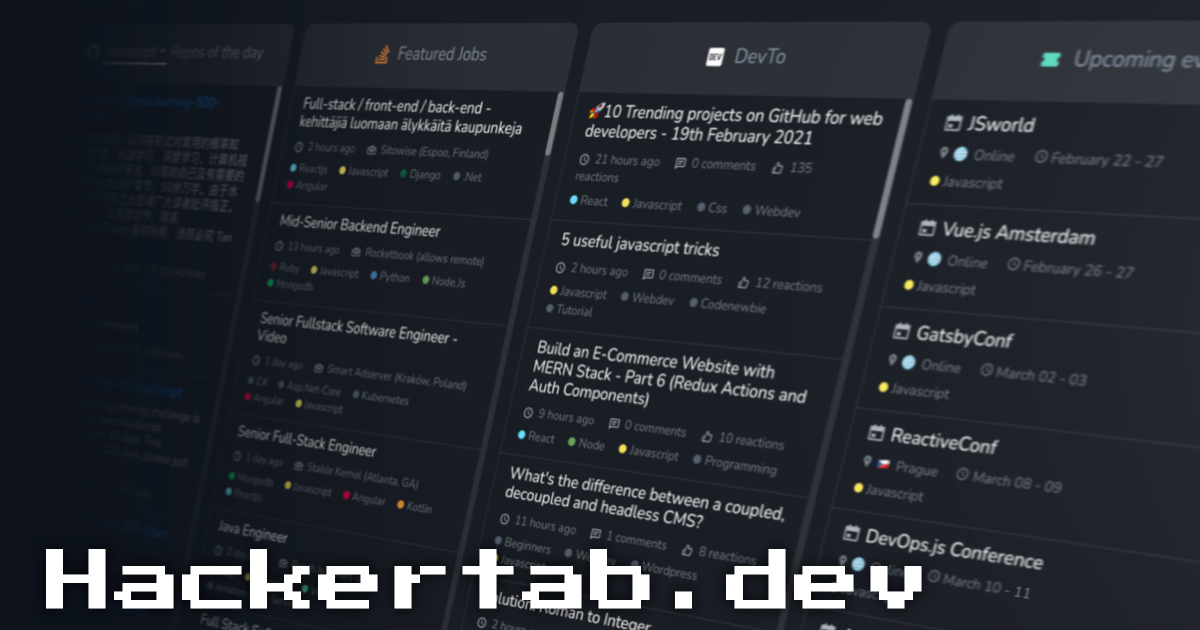

Sharing metadata
| og:url | https://hackertab.dev |
|---|---|
| og:type | website |
| og:image | https://hackertab.dev/hackertab_og_image.jpg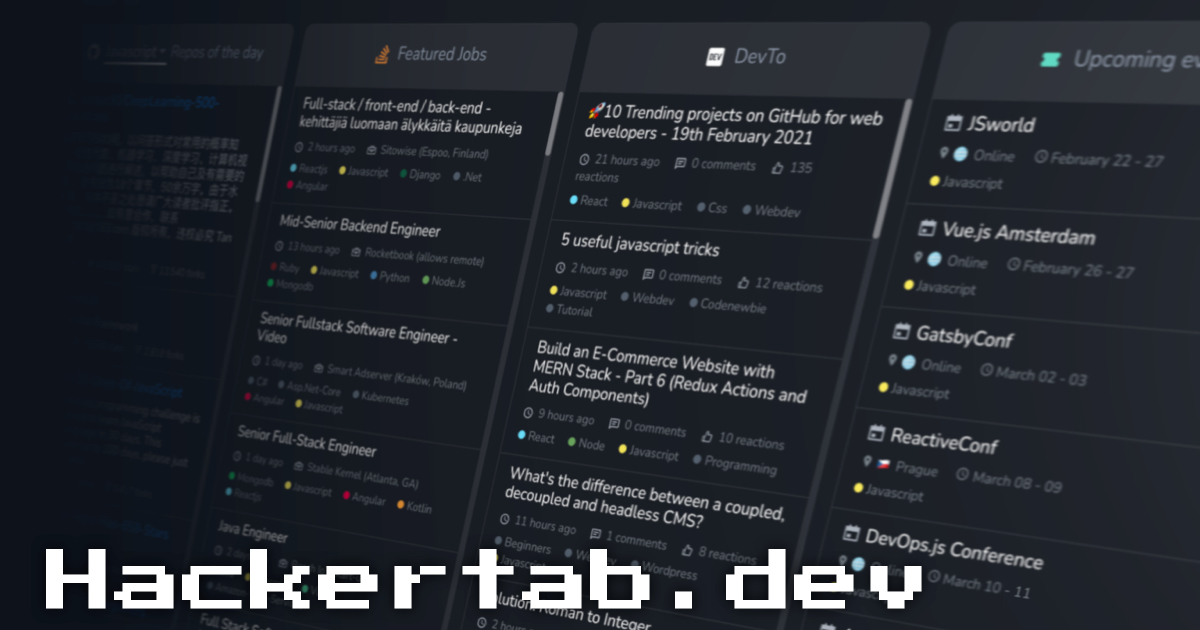 |
| og:title | Hackertab – Developer News, Tools & Conferences in One Tab |
| og:site_name | Hackertab |
| og:description | Hackertab is a free start page for developers: daily dev news, trending GitHub repos and tech conferences, curated hourly from 50+ sources. |
| twitter:card | summary_large_image |
| twitter:image | https://hackertab.dev/hackertab_og_image.jpg |
| twitter:title | Hackertab – Developer News, Tools & Conferences in One Tab |
| twitter:description | Hackertab is a free start page for developers: daily dev news, trending GitHub repos and tech conferences, curated hourly from 50+ sources. |
robots.txt (opens in a new tab)
2 rulesAll bots 0 allowed · 2 disallowed

 All bots

/api//oauth-callback/
No matching rules.
Sitemaps
1 Registration details RDAP / WHOIS
| Registrar | Porkbun LLC |
|---|---|
| Registered | 2021-02-08 |
| Expires | 2027-02-08 |
| Domain status | client delete prohibited、client transfer prohibited |
| Nameservers | karina.ns.cloudflare.com、norm.ns.cloudflare.com |
| DNSSEC | unsigned |
 DNS records
| Type | Name | Value | TTL | Priority |
|---|---|---|---|---|
| A | hackertab.dev | 104.21.33.240 | 300 | — |
| A | hackertab.dev | 172.67.151.177 | 300 | — |
| AAAA | hackertab.dev | 2606:4700:3031::6815:21f0 | 300 | — |
| AAAA | hackertab.dev | 2606:4700:3031::ac43:97b1 | 300 | — |
| MX | hackertab.dev | linda.mx.cloudflare.net | 300 | 15 |
| MX | hackertab.dev | isaac.mx.cloudflare.net | 300 | 31 |
| MX | hackertab.dev | amir.mx.cloudflare.net | 300 | 57 |
| NS | hackertab.dev | karina.ns.cloudflare.com | 86400 | — |
| NS | hackertab.dev | norm.ns.cloudflare.com | 86400 | — |
| TXT | hackertab.dev | google-site-verification=2Vfpgm4HE-X9XPRykT8tTmXGuyGp7QEqi_qbWkJ4GM0 | 300 | — |
| TXT | hackertab.dev | v=spf1 a mx include:_spf.google.com include:_spf.mx.cloudflare.net ~all | 300 | — |
| DMARC | _dmarc.hackertab.dev | v=DMARC1; p=none; rua=mailto:[email protected]; aspf=r; | 300 | — |
 TLS and certificates
| Assessment | Normal configuration |
|---|---|
| Supported protocols | TLSv1.2、TLSv1.3 |
| Negotiated protocol | TLSv1.3 |
| Certificate subject | hackertab.dev |
| Issuer | Google Trust Services |
| Valid until | 2026-12-14T23:33 · Remaining when checked: 79 days |
| Verification details | Certificate trust: Passed · Hostname match: Passed |
 HTTP response headers
| Header | Value |
|---|---|
| content-type | text/html; charset=utf-8 |
| server | cloudflare |
 Identified technologies
User reviews (0)