
 简体中文
简体中文 English
Website review
This review may include AI-generated content and is not individually verified. Domain, certificate and other facts come from the observed data on this page.
What is Open Knowledge Maps?
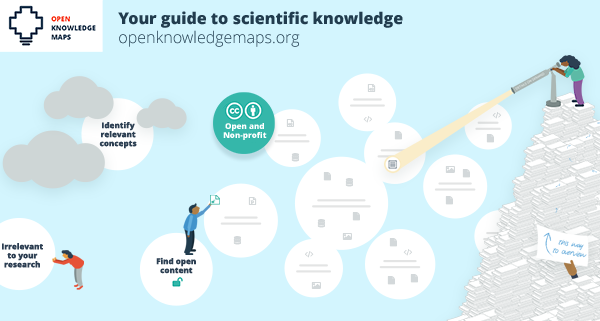
Open Knowledge Maps is a free, nonprofit search tool that turns a literature search into a visual map. Instead of returning a flat list of results, it groups research outputs into clusters so you can see the main themes in a field at a glance, then drill into the papers, datasets, software or images that matter most. It is built on open-science principles and is funded by supporting member organizations rather than by ads or paywalls.
What it actually does
- You enter a research topic and get a visual overview of related outputs.
- Results are clustered by concept, helping you identify subfields and adjacent areas you might not have thought to search for.
- It searches a very large index of scholarly outputs across many languages and source types, so it is useful for scoping an unfamiliar field as well as for checking coverage of a familiar one.
- Because results are drawn from underlying metadata rather than generated text, the map reflects what is indexed, not invented references.
Who it suits
- Students and early-career researchers orienting themselves in a new topic.
- Interdisciplinary teams who need a shared picture of where a field's literature sits.
- Librarians and research-support staff guiding users toward open-access material.
- Anyone who wants a quick thematic overview before committing to a systematic search.
Trade-offs to keep in mind
| Strength | Limitation |
|---|---|
| Visual clustering reveals themes fast | Less precise than a fielded Boolean search when you need exhaustive retrieval |
| Broad, multilingual, multi-type coverage | Depth of indexing varies by discipline and source |
| Free and nonprofit, no login required for basic use | Sustainability depends on institutional supporting members |
A practical next step
Pick a topic you already know well and map it. If the clusters match the subfields you would expect, you can trust it for scoping unfamiliar territory. If you need a reproducible, exhaustive search for a review, use the map to generate keywords and concepts, then run the formal search in a bibliographic database.
For a fuller picture of the project and its community, see Open Knowledge Maps.
How does Open Knowledge Maps help me find relevant research for a literature review?
Open Knowledge Maps is a visual literature-search tool: instead of returning a flat ranked list, it groups search results into a map of clusters, so you can see at a glance which sub-topics, concepts and research communities exist around your query. That makes it most useful at the start of a literature review, when you are still working out how a field is structured and which strands matter to your question.
What it does for a review
- Overview before depth. Enter a topic and you get a clustered map rather than a list, which helps you spot themes you did not know were part of the conversation.
- Concept identification. Cluster labels act as candidate keywords and synonyms you can reuse in more precise searches in subject databases.
- Broad source coverage. According to the site, searches draw on more than 400 million outputs in 400+ languages from over 11,000 sources via BASE, spanning 25 output types including publications, datasets, software and images. That breadth suits reviews that need to include data or code, not just articles.
- Grounded results. The site states that results are based only on underlying metadata, so the tool is not generating invented citations — a meaningful safeguard when you are deciding what to read.
- Free and nonprofit. It presents itself as a charitable, open-science organisation, so there is no paywall between you and the map.
Where it fits, and where it does not
| Stage of a review | Good fit? | Why |
|---|---|---|
| Scoping a new topic | Yes | Clusters reveal the shape of the field quickly |
| Building a keyword strategy | Yes | Cluster labels suggest terms and synonyms |
| Systematic, reproducible searching | Partly | Use it to explore, then run documented searches in subject databases |
| Citation chasing and full-text screening | No | It is a discovery layer, not a reference manager or screening tool |
A practical next step
Run your research question as a short phrase, then treat the map as a hypothesis: pick the two or three clusters closest to your question, note their labels as search terms, and take those terms into a discipline-specific database where you can apply date limits, filters and a documented search string. If your review touches open data or software, the wider output-type coverage is worth exploiting deliberately rather than leaving it to default.
For a broader entry point to open scholarly search, BASE is the index behind much of this coverage, and DOAJ is useful for checking open-access journal quality when you start screening results.
How do I use the AI beta to map a research topic?
Use the AI beta search box on the Open Knowledge Maps homepage: enter a research topic, run the search, and the site returns a visual map of clustered research outputs rather than a plain list. From that map you can get an overview, identify concepts, and jump to underlying resources.
Open Knowledge Maps
What the map gives you
- Clusters instead of a ranked list. Related outputs are grouped so you can see the main themes in a topic at a glance — useful when you are entering a field and don't yet know its vocabulary.
- Concept identification. The clusters themselves act as a first-pass taxonomy; the labels tell you which sub-topics exist and which are thin.
- Direct access to outputs. Each cluster links to the underlying records, so the map is a navigation layer, not a summary.
- Metadata-based results. The site states results are drawn from underlying metadata with no hallucinations, so the map reflects what is indexed rather than generated text. That is a meaningful difference from chat-style literature tools: you get discoverability, not synthesis.
A practical workflow
- Start broad — one or two keywords, not a full research question. Broad input produces more informative clusters.
- Read the cluster labels first and note which ones map onto your interests.
- Open the most relevant clusters and skim titles to build a shortlist.
- Re-run the search with narrower or alternative terms based on the vocabulary the first map revealed.
- Take the shortlist into a reference manager or database for citation chasing.
When it fits, and when it doesn't
| Situation | Good fit? |
|---|---|
| Scoping an unfamiliar topic | Yes — the overview is the point |
| Finding the canonical papers in a field | Partly — use it to orient, then verify in a subject database |
| Systematic review with a documented, reproducible query | No — you need a controlled, logged search strategy |
| Tracking the newest preprints in a niche | Depends on index coverage, not on the map |
The trade-off is orientation versus precision. A map is excellent at showing shape and poor at proving completeness, so treat it as a starting point for a search you then run properly elsewhere.
If you are choosing between tools
Pick Open Knowledge Maps when your problem is "I don't know what this field looks like." Pick a bibliographic database when your problem is "I need every relevant paper and an auditable query." Many researchers use both: map first, then search.
Next step: run one broad topic you are currently working on, save the cluster labels as a rough outline, and use that outline to plan a more precise database search.
How is Open Knowledge Maps different from traditional search engines like Google Scholar?
Open Knowledge Maps is built for orientation, while Google Scholar is built for ranked retrieval. Instead of returning a long list of individual papers, it draws a visual map of a research topic: outputs are grouped into clusters that represent themes or concepts, so you can see the shape of a field before deciding what to read. It is a nonprofit, open-science project, and its stated design goal is that results come from underlying metadata rather than generated text.
Where the practical difference shows up
- Starting a new topic: A map answers "what are the main strands here?" faster than scrolling through ranked results. Google Scholar answers "which single paper is most cited or most relevant?"
- Cluster-based browsing: You can jump into a theme rather than a keyword, which helps when your search terms are not yet precise. Traditional search engines reward well-formed queries.
- Result types: The site says it covers 25 output types, including publications, datasets, software and images, drawn from over 11,000 sources via BASE. Google Scholar is strongest on scholarly documents and citation links.
- Ranking logic: Google Scholar's ordering is relevance- and citation-driven, which tends to concentrate attention on already-prominent work. A thematic map can surface smaller clusters that a ranked list would bury.
- Coverage and scale: The site claims more than 400 million outputs in 400+ languages; Google Scholar's index is much larger in absolute terms, so for exhaustive or citation-chasing searches it remains the better tool.
A concrete scenario
Suppose you are a master's student assigned a broad topic like "urban heat islands and public health." On Google Scholar, you would need several refined queries to work out the sub-areas. On Open Knowledge Maps, you would get a first-pass map with labelled clusters, note which clusters match your assignment, then take those cluster terms back to Google Scholar or your library database for depth. The map is a starting point, not a replacement.
How to choose
Use Open Knowledge Maps when you are scoping an unfamiliar field, when you want to see concepts rather than citations, or when you want to check whether a topic has an open-data or software dimension. Use Google Scholar when you need citation counts, author tracking, or a known paper. Many researchers do both in sequence.
A useful next step: run the same topic through both, compare the clusters you get with the top ten Scholar results, and see which framing better matches what you actually need to read. Related open-infrastructure tools worth knowing are BASE for cross-repository search and DOAJ for open-access journals.
How can my organization become a supporting member of Open Knowledge Maps?
Open Knowledge Maps invites organizations to become supporting members and co-create the platform with the team. The site frames this as a collective funding model: rather than relying on ads or paywalls, the nonprofit asks institutions to share the cost of keeping the infrastructure open and sustainable.
H3 What supporting membership is for
- Sustaining an inclusive, equitable discovery infrastructure that anyone can use.
- Co-creating the platform's direction alongside the Open Knowledge Maps team.
- Signaling institutional commitment to open science and open access.
H3 How to start the conversation The site's own path is straightforward: use the "Become a supporting member" link on Open Knowledge Maps and get in touch with the team. There is no self-service checkout described on the page, so expect a short exchange rather than an instant signup.
H3 A useful next step Before you write, decide who inside your organization would own the membership — typically a library, research services office, or open-science program — and bring one concrete goal to the conversation, such as supporting a tool your researchers already use for literature discovery.
H3 What to ask in your first message
- What membership tiers or contribution levels exist?
- What does "co-create" mean in practice — advisory input, pilot testing, joint events?
- How is the contribution acknowledged publicly?
- Can the membership be reviewed or renewed annually?
H3 Why institutions join The site quotes supporters including Dr. David Johann of ETH Library, who describes Open Knowledge Maps as an innovative literature-search tool worth supporting; Dr. Andrea Hacker of the University Library Bern, who cites its reinforcement of open science and open access; and Jean-Claude Burgelman, who supports it because open science needs relevant visualization. Those are institutional voices, not independent product tests — treat them as evidence of why peers join, not as a performance benchmark.
For a practical comparison, a supporting membership differs from a typical subscription: you are funding shared infrastructure and influence rather than buying seats or premium features. That trade-off suits organizations with an open-science mandate; it is a weaker fit if you need guaranteed service levels or per-user entitlements.
Is Open Knowledge Maps free to use and how is it funded?
Open Knowledge Maps is free to use for searching and mapping research topics. The site describes itself as a charitable non-profit built on open science principles, and its search runs on metadata from BASE, so you can get a visual overview of a topic without paying for access.
Funding is collective rather than pay-per-use: organizations are invited to become supporting members and co-create the platform. That is the model described on the site, so the practical trade-off is that individual users get free access while institutions underwrite long-term sustainability.
If you are deciding whether to rely on it, test it with a live question. Search a topic you already know well and check whether the clusters surface the papers you would expect. If they do, it can be a fast orientation step before you move to a subject database for full-text reading and citation chasing.
 Google Workspace
 Lauterbourg, Bas-Rhin, France

User reviews (0)