
 简体中文
简体中文 English
Website review
This review may include AI-generated content and is not individually verified. Domain, certificate and other facts come from the observed data on this page.
What is Publish7?
Publish7 is a marketing-focused AI agent platform: instead of typing prompts into a general chatbot, you pick a task-specific agent (backlink ideas, competitor landscape, company research, community engagement ideas, content ideas, competitor analysis) and get a structured result in seconds. Its pitch is aimed at marketers who want ready-made workflows rather than prompt engineering, and the page presents it as an alternative to ChatGPT for marketing work.
Who it suits
- Small marketing teams and solo marketers who need fast research or idea generation without building prompts from scratch.
- Content and SEO planners who want a starting list of backlink targets, content angles or competitor observations to verify and refine.
- Agencies doing early-stage client research, where a quick company or competitor overview saves the first hour of a project.
Where it fits, and where it doesn't
The agents look strongest at the starting point of marketing work: brainstorming, market scanning, and first-draft research. They are less obviously a fit for execution that depends on your own data — campaign setup, analytics, CRM workflows or publishing. Treat outputs as drafts that a marketer checks, especially competitor and company research, which can go stale or miss niche players.
A practical first step: pick one recurring task you currently do manually — say, a monthly competitor scan — run it through the relevant agent, and compare the output against what you'd normally produce. If it saves real time after your own review, expand from there. The site offers a free start without a credit card, and pricing details are listed on Publish7.
How does Publish7 differ from using ChatGPT for marketing tasks?
Publish7 is a set of task-specific marketing agents rather than a general chatbot: you pick a job (backlink ideas, competitor landscape, company research, community engagement ideas, content ideas, competitor analysis) and it produces the output, whereas ChatGPT is a blank prompt you shape yourself. The site's own framing is "Beyond ChatGPT" and "no more ChatGPT's bunch of prompts," and its listed benefits are marketing-only agents, time saved on repetitive work, and faster research and content generation.
Where the difference actually shows up
| Dimension | Publish7 (per its page) | ChatGPT (general advice) |
|---|---|---|
| Starting point | Named agents scoped to a marketing task | You write the prompt and define scope |
| Output shape | Task-oriented result, e.g., competitor or company reports | Free-form text you must structure |
| Breadth | Marketing tasks only | Anything, including marketing |
| Effort per task | Low setup, less prompt iteration | Prompt quality drives results; more iteration |
| Flexibility | Bounded by the available agents | Fully open-ended |
Concrete scenario
A content strategist at a small B2B company needs a competitor overview and a month of post ideas before a Monday meeting. In ChatGPT, that means several prompts, manual structuring and fact-checking. In Publish7, it means running its Competitor Landscape Agent and Content Ideas Generator and assembling the results. The trade-off: Publish7 constrains you to its agent library, while ChatGPT handles off-script requests — pricing pages, ad copy variants, data cleanup — that no marketing agent covers. A testimonial on the page, from Samantha R., a marketing director, says one click now produces reports that used to take hours; treat that as a customer's claim, not a measured benchmark, and validate output quality on your own niche before relying on it.
How to decide
Use Publish7 when your bottleneck is repeatable, well-defined marketing research and ideation and you want a fixed starting structure. Stay with ChatGPT when tasks vary widely or need deep customization. Many teams run both: Publish7 for routine agent runs, ChatGPT for follow-up drafting and analysis. Its page offers a free start with no credit card, so test one real task — a competitor scan for a product you know well — and compare it against your usual ChatGPT workflow on accuracy and editing time.
For broader comparisons, see OpenAI on ChatGPT's capabilities and Publish7 for the agent list.
Which specific marketing tasks can Publish7's AI agents handle without additional prompting?
Publish7's AI agents are built around named, single-purpose marketing tasks rather than open-ended chat. According to the site, each agent takes a task and returns a result in one pass, so the "no additional prompting" claim applies to these specific jobs:
- Backlink ideas — generates niche-specific backlink strategies aimed at domain authority and search rankings.
- Competitor landscape — identifies key players, market positioning and competitive advantages in a sector.
- Company research — produces profiles of a named company for strategic decisions.
- Competitor analysis — digs into rivals' strengths, weaknesses and strategies to refine your own approach.
- Content ideas — suggests engaging, on-trend topics for your target audience across platforms.
- Community engagement ideas — proposes ways to build interaction and a loyal following.
What "without additional prompting" really means
Each agent is a fixed template: you supply the inputs (a niche, a company name, a market), and the agent fills in the structure. That is the opposite of ChatGPT, where the output depends on how well you write the prompt. Publish7's own page frames it as "your strategy, our execution" and contrasts it with "ChatGPT's bunch of prompts."
The trade-off is flexibility. A template gets you a usable first draft fast, but it won't handle a task outside its scope, and the depth of each report is set by the agent rather than by follow-up questions. A content strategist who needs a bespoke angle will still do editing; a marketing director who needs a competitor snapshot by a meeting will likely find the fixed format sufficient.
A practical test
Pick your most repetitive weekly task — say, a competitor roundup or a content calendar. Run it through the matching agent once and compare the output against what you'd produce manually. If the report is 80% usable as-is, the agent saves real time; if you'd rewrite most of it, the task is probably too nuanced for a template.
The site also points to a free starting option with no credit card required, and a pricing page at Publish7 for paid tiers.
Is Publish7 free to start, and what does the paid pricing plan include?
Publish7 presents itself as free to start: the page's call to action is "Get started — it's free," with "No credit card required." That tells you how you can begin; it does not tell you what a paid plan costs or exactly what it adds.
What the page shows
- Free start: No card and no upfront commitment are advertised for getting started.
- What the free start covers: The page does not say how many runs, agents or outputs a free account includes.
- Paid pricing: The page links to a pricing page but gives no plan names, prices or included features in the supplied content.
What the agents do
The page describes a library of marketing-focused agents, including:
- Backlink ideas and competitor landscape research
- Company research
- Community engagement and content ideas
- Competitor analysis
These are framed as ways to automate research, content generation, optimization and strategy planning.
Practical decision criteria
Use the free start to test one recurring task, such as a competitor snapshot or a batch of content ideas. Check whether the output is specific enough to act on and whether it saves time over your current process. Before paying, confirm on the pricing page which agents, usage limits and export or reporting features a paid plan includes, and whether limits reset monthly.
For comparison, general-purpose assistants such as ChatGPT or Claude may suit ad hoc drafting, while Publish7 is positioned around task-specific marketing agents. If your need is research and ideation rather than execution, the free start is the sensible first step.
How can I use Publish7's competitor analysis agents to refine my own marketing strategy?
Use Publish7's competitor-focused agents as a structured research layer that feeds your positioning, content and outreach decisions—not as a strategy generator you follow blindly. The page describes two related agents: a Competitor Landscape Agent for identifying key players, market positioning and competitive advantages, and a Competitors Analysis Tool for digging into rivals' strengths, weaknesses and strategies. A Company Research Agent supplies background on individual companies, and the Community Engagement Ideas Generator and Content Ideas Generator help turn those findings into audience-facing actions.
A practical workflow
- Map the field first. Run the Competitor Landscape Agent on your category to get a shortlist of players and how they position themselves. Use this to check whether your own messaging occupies a distinct space or repeats what everyone else claims.
- Go deep on three or four rivals. Use the Competitors Analysis Tool on the players that matter most—typically those competing for the same audience and search terms. Look for gaps: underserved segments, weak content areas, claims they make that you can make more credibly.
- Verify before acting. AI-generated competitive summaries can miss nuance or lag behind recent changes. Spot-check the most consequential claims against the rivals' own sites before you rewrite a landing page or pitch deck around them.
- Turn gaps into content and community plans. Feed the identified weaknesses into the Content Ideas Generator for topics your competitors cover poorly, and the Community Engagement Ideas Generator for channels or conversations they neglect.
- Support outbound and SEO. The Backlink Ideas Generator can suggest link opportunities in your niche; pair it with the Company Research Agent to qualify prospects before outreach.
Where it fits and where it doesn't
| Your situation | Best use of these agents | Watch out for |
|---|---|---|
| Early-stage positioning | Landscape overview to find an unclaimed angle | Thin data on small or new markets |
| Content team planning | Gap-driven topic ideas | Generic ideas that need editorial judgment |
| Sales or partnerships | Company research for pre-call prep | Verify facts before quoting them externally |
| Established brand defending share | Deep analysis of specific rivals | Risk of over-indexing on competitors instead of customers |
A useful decision rule: treat every agent output as a first draft of a hypothesis, then confirm it with two independent sources—ideally the competitor's own published material—before it influences budget or messaging. If you want a broader benchmark for how competitors present themselves, reviewing their public sites directly, alongside tools such as Semrush or Similarweb for traffic context, will make the AI findings more reliable.
What do current users say about how much time Publish7 saves compared with manual research and content creation?
Based on the page, the clearest time-saving claim comes from a customer testimonial: Samantha R., a Marketing Director, says the AI agents deliver "comprehensive reports that used to take hours" in "just one click." That is her observation, not an independent measurement, and it is the only specific before/after comparison on the page. David T., a Content Strategist, calls the agents a "game-changer" for getting what he needs "in one go," which implies fewer back-and-forth prompts but gives no time figure. The site also states that "500+ marketers" say Publish7 outshines ChatGPT and other AI tools, but that is a headline claim without supporting detail, so it should not be read as a quantified time saving.
What the evidence does and doesn't tell you
| Claim | Source on the page | What it supports |
|---|---|---|
| Reports that took hours now take one click | Samantha R. testimonial | A large saving on research/reporting tasks, per one user |
| Results in "one go" instead of repeated prompts | David T. testimonial | Less iteration time, no number given |
| Handles research, content, optimization "in seconds" | Key Benefits section | Vendor's own speed claim, not a user report |
| Outperforms ChatGPT for 500+ marketers | Page heading | Popularity claim, not a time measurement |
There is no user-reported figure comparing Publish7 with manual content creation specifically, and no stated baseline for how long a task took before. Treat the "hours to one click" figure as one person's experience with report-style research, not a general benchmark.
A practical way to judge the saving for yourself
Pick your slowest recurring task — for example, a competitor landscape summary or a batch of backlink ideas — and time yourself doing it manually once. Then run the same brief through the relevant agent and compare the draft quality, not just the clock. A one-click report only saves time if it needs little editing afterward; if you spend an hour correcting it, the saving shrinks. Marketers who mainly need fast first drafts and research starting points will likely see the biggest gain, while those needing polished, brand-specific copy should expect more review time.
For related tools to benchmark against, see ChatGPT and Semrush.
 Cloudflare
 Google Workspace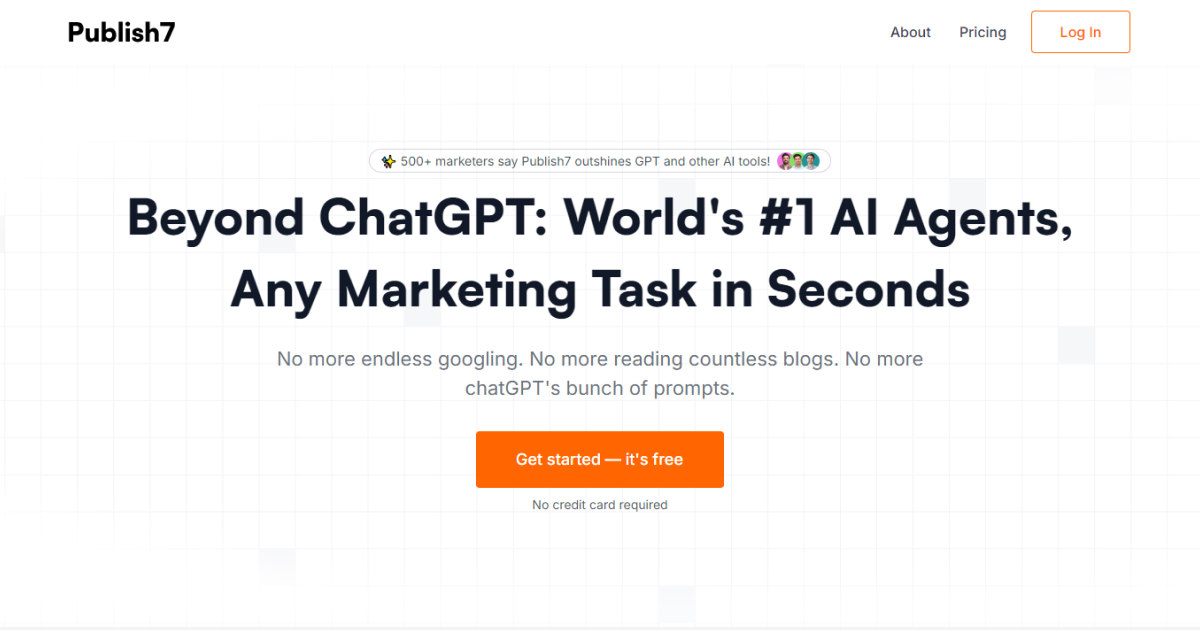

User reviews (0)