Website profiles · Technology insights · Alternatives

thelmbook.com

Andriy Burkov's third book is a hands-on guide that covers everything from machine learning basics to advanced transformer architectures and large language models (LLM). It explains AI fundamentals, text representation, count-based models, recurrent neural networks, and transformers. This book is ideal for ML practitioners and engineers focused on text-based applications

No paid content found
Visit website
Profile views 5 Outbound visits 1 Normal
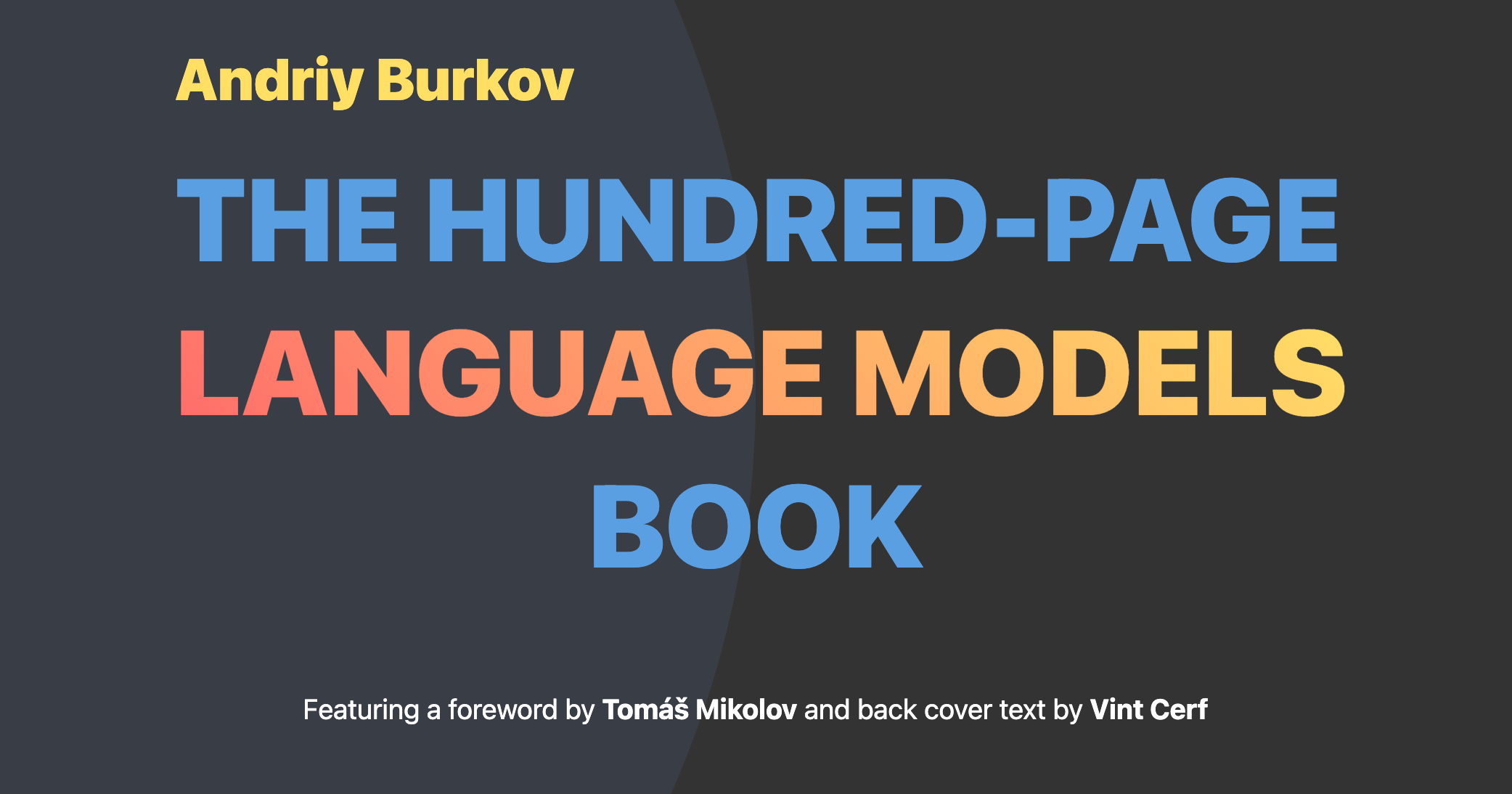
The Hundred-Page Language Models Book by Andriy Burkov Full homepage screenshot

At a glance

Category
Artificial Intelligence
Language
English
Paid-content signal
No paid content foundObserved
Registered
2024
Hosting
thelmbook.comInferred
HTTPS certificate trusted
PassedObserved
Last updated

Website review

This review may include AI-generated content and is not individually verified. Domain, certificate and other facts come from the observed data on this page.

What is The Hundred-Page Language Models Book?

The Hundred-Page Language Models Book is Andriy Burkov's hands-on guide to how language models work, built as a step-by-step path from machine-learning fundamentals to modern transformer architectures and large language models. According to the book's page, it deliberately avoids jumping straight into transformers, which can feel overwhelming, and instead develops understanding from simple count-based methods through recurrent neural networks to today's architectures. Each concept is paired with mathematical explanation and working Python code, with PyTorch implementations and Jupyter notebooks available on GitHub.

What it covers

The chapter sequence on the site runs:

  • Machine Learning Basics
  • Language Modeling Basics
  • Recurrent Neural Networks
  • Transformers
  • A large chapter on large language models, covering prompt engineering and finetuning models to follow instructions

The stated goal is practical: getting consistent outputs through prompting and adapting models to your own needs through finetuning.

Who it suits

The page names technical leaders, engineering managers, software developers, data scientists and machine-learning engineers as the intended audience. In practice, that means readers who want both the theory and the implementation skills, and who are comfortable with Python. Someone entirely new to programming would likely find the code-heavy approach steep; someone who already builds transformers daily may find the early chapters a refresher rather than new material.

Formats and extras

The book is sold as a set-your-price e-book, a hardcover, a paperback and a "Dark Edition," and buyers of a hard copy can request a free PDF. Purchasers can also claim $150 in free GPU credits on Lambda by emailing proof of purchase, per the page. The book carries a foreword by Tomáš Mikolov, and the site quotes back-cover text by Vint Cerf.

A useful next step

If you are deciding whether to buy, read the chapter list against your current knowledge: if count-based models and RNNs are already familiar, the value sits in the transformer and LLM chapters and the finetuning notebooks. If you are moving into text-based ML work for the first time, the early chapters are the reason to start at page one rather than skip ahead. The author's earlier book, The Hundred-Page Language Models Book by Andriy Burkov, is the title discussed here; Burkov's better-known machine-learning primer is documented separately at The Hundred-Page Machine Learning Book.

Should I buy this book if I already know basic machine learning but have never built a transformer?

Yes. The book is aimed exactly at your situation: it assumes machine learning basics and builds language models step by step—count-based methods, then recurrent networks, then transformers—rather than starting with transformers. The page describes each concept as grounded in math and illustrated with working Python/PyTorch code and Jupyter notebooks, so you can implement what you read instead of only reading theory.

How to decide

  • Choose it if you learn best by following a short, structured path with code you can run, and you want the transformer chapter to arrive after you understand what problem it solves.
  • Look elsewhere if you already want depth on training large models at scale, distributed systems, or research-level architecture variants; a hundred-page format is a guided tour, not a reference.
  • Check the chapter list first. The page shows the progression from machine learning basics through language modeling, RNNs, and transformers, with the largest chapter on LLMs covering prompt engineering and finetuning. If those later chapters match your goals, the early ones will be quick review for you.

A practical next step: skim the sample notebooks linked from the chapters section and try the transformer chapter's code. If the explanations around the code answer the "why" questions you have, buy it; if you find yourself wanting more than the book's pace allows, pair it with a longer treatment such as Deep Learning for background or Hugging Face documentation for hands-on transformer tooling.

One trade-off worth naming: a compact book gets you to working transformers fast, but you will likely need supplementary material for production concerns like evaluation, data pipelines, and deployment. Treat it as the on-ramp, not the whole road.

How does this book differ from other LLM books in its step-by-step approach from count-based models to transformers?

The difference is sequencing: rather than opening with transformers, the book builds language modeling from machine learning fundamentals, through count-based methods and recurrent neural networks, and only then reaches transformer architectures. Each stage is paired with mathematical explanation and working Python code (PyTorch, with Jupyter notebooks per topic), so the "step-by-step" claim is about a continuous implementation thread, not just chapter order.

Where this matters in practice

  • Readers who find transformer-first books opaque. If attention mechanics feel like memorized formulas, the earlier chapters supply the contrast: what a count-based model can and cannot do, why fixed context hurts, what recurrence fixes and what it costs. Attention then reads as a response to specific limits rather than an opening assumption.
  • Engineers who need to debug rather than cite. Because each concept has a runnable implementation, you can reproduce a small model's behavior, break it, and observe the failure. That is different from a survey that presents architectures without executable counterparts.
  • Technical leaders and managers. The book's stated audience includes engineering managers and technical leaders, not only ML engineers. The gradual build suits people who need to reason about model choices and trade-offs without starting from research papers.

The trade-off

The gradual route costs time. A reader who already knows RNNs and only wants modern fine-tuning and prompt engineering will find the early chapters redundant and may prefer a transformer-centric text. Conversely, someone who wants breadth across vision, multimodal and agentic systems will find this book's scope narrower: it is oriented toward text-based language models, with the largest chapter devoted to LLMs, prompt engineering and instruction fine-tuning.

Decision criterion: choose this book if your gap is foundations and implementation continuity; choose a transformer-first or survey book if your gap is current architecture breadth. A practical next step is to skim the chapter list and the notebooks for Chapters 2–4 before buying: if those implementations look like review, the book's main value is behind you.

For a complementary, more mathematically formal treatment, Deep Learning by Goodfellow, Bengio and Courville covers the underlying methods in greater depth, though it predates modern LLM practice.

What practical skills will I gain from the Python and PyTorch code and Jupyter notebooks included in the book?

The code is designed to make language-model concepts runnable rather than purely theoretical. According to the book's own description, every chapter combines theory, illustrations, and code, with complete Python/PyTorch implementations on GitHub and a Jupyter notebook for each topic. The practical skills you can expect to build:

  • Implementing models from scratch in PyTorch. You work through count-based language models, then recurrent neural networks, then transformer architectures, so you learn how each is wired up in code rather than only reading about them.
  • Running and modifying experiments in Jupyter notebooks. Each topic has an accompanying notebook, which lets you step through training and generation interactively and change parameters to see what happens.
  • Fine-tuning LLMs to follow instructions. The large-language-model chapter covers adapting a pretrained model to arbitrary instructions, a skill that transfers directly to applied work.
  • Prompt engineering for consistent outputs. The same chapter covers techniques for getting reliable, repeatable results from models without retraining.
  • Reading and reproducing reference implementations. Working from the GitHub repository teaches you to navigate and adapt someone else's PyTorch code, which is close to what practitioners do daily.

Who benefits most

A software developer or data scientist moving into text-based ML gets the most value: the progression from simple models to transformers means you can start coding in Chapter 2 without prior deep-learning depth. An ML engineer already comfortable with transformers will find the early chapters largely review and may prefer to jump to the LLM chapter. Engineering managers and technical leaders can use the notebooks to build intuition but will get less from the implementation detail.

A practical next step

Pick one skill you need soon—say, fine-tuning a model on your own instruction dataset—and check whether the corresponding chapter and notebook exist in the repository before buying. If you can read the notebook and follow the training loop, the book's level matches yours; if it looks opaque, plan to work through the earlier chapters first. The book also mentions $150 in GPU credits on Lambda for purchasers, which is relevant if you lack local hardware for the training exercises.

Is this book suitable for engineering managers or technical leaders who need to understand LLMs without deep coding?

Yes—with one caveat: the book is written for people who want to understand the mechanics, not just the vocabulary. Andriy Burkov positions it for "technical leaders, engineering managers, software developers, data scientists, or machine learning engineer[s]," and the page's structure backs that up: it builds from machine learning basics through count-based models and recurrent networks to transformers, rather than opening with architecture diagrams. For a manager, that ordering is the main selling point—you get the why behind each step before the how.

Where it fits a non-coding reader

  • The math is explained, not assumed. The page describes "mathematical foundations with intuitive explanations," which matters if your last statistics course was a while ago.
  • Code is an illustration, not a prerequisite. Python/PyTorch implementations and Jupyter notebooks exist for each topic, but they sit alongside theory and diagrams rather than replacing them. A leader can read the prose and skip the cells.
  • The LLM chapter is the largest. It covers prompt engineering and fine-tuning to follow instructions—the two levers your team will actually debate in planning meetings.

The honest trade-off

A manager who wants a purely conceptual overview may find the code and derivations more than needed, and someone who wants to evaluate vendors won't get buying guidance here—this is a foundations book, not a market survey. If your goal is to challenge your engineers' design choices and read a model card without bluffing, the depth is the point. If your goal is a two-hour briefing before a board meeting, it's heavier than required.

A practical next step

Skim Chapter 2 (language modeling basics) and the LLM chapter first; if the count-based-to-transformer progression clicks, read straight through, and treat the notebooks as optional labs you can hand to a junior engineer as a paired exercise. For a second, complementary perspective on the broader ML landscape, The Hundred-Page Machine Learning Book by the same author covers the surrounding territory at similar length.

How do I claim the $150 in free GPU credits on Lambda after purchasing the book?

Email proof of purchase to [email protected] to claim the $150 in free GPU credits on Lambda. The book's page states that this offer applies when you purchase the book, and that the credits are claimed by sending your proof of purchase to that address.

Before you send

  • Use the email address exactly as listed on The Hundred-Page Language Models Book.
  • Attach or forward a receipt or order confirmation that clearly shows the purchase.
  • Send from an address you can access later, since Lambda credit setup will likely involve follow-up.

Practical note

Keep the confirmation email and any reply from the author until the credits appear in your Lambda account. If you buy a hard copy, the page also says you can request a free PDF copy, so you can mention that in the same message if you want both.

Related questions

More questions →
What Formats of The Hundred-Page Language Models Book Can I Buy?

You can buy The Hundred-Page Language Models Book by Andriy Burkov in four formats through the "Buy the Book" section of thelmbook.com: an e-book at a price you set yourself, a hardcover for $65, a paperback for $47, and a "Dark Edition" for $55. If you buy a hard copy, you can also request a free PDF copy. All prices and format details below come from the book's official site.

Format Comparison at a Glance

Format Price Notes
E-book Set your own price Digital edition; you choose what to pay
Hardcover $65 Physical copy; free PDF available on request
Paperback $47 Physical copy; free PDF available on request
Dark Edition $55 Separate edition listed alongside the other formats

The site does not describe what distinguishes the Dark Edition from the standard hardcover or paperback, so treat it as a distinct listing rather than assume a specific difference.

How to Choose

  • Want the lowest upfront cost: The e-book is the only format where you set the price, so it fits readers who want the content without paying a fixed amount.
  • Want a physical reference and a digital copy: A hard copy (hardcover or paperback) lets you request the free PDF, giving you both. The paperback at $47 is the cheaper physical option; the hardcover at $65 costs more.
  • Interested in the Dark Edition: It sits between the paperback and hardcover in price at $55. Because the site doesn't explain the difference, check the listing itself before buying if the distinction matters to you.

What You Get With Any Purchase

The book covers machine learning basics, text representation, count-based models, recurrent neural networks, and transformers, building up to a large chapter on large language models that includes prompt engineering and finetuning. Each chapter combines theory, illustrations, and Python code, with complete PyTorch implementations and Jupyter notebooks available on GitHub.

Buyers can also claim $150 in free GPU credits on Lambda by emailing proof of purchase to [email protected], according to the site.

Where to Buy

Purchases go through the "Buy the Book" section of thelmbook.com. The site lists the four formats and prices there; it does not mention other retailers or payment platforms, so start from that page to see current options.

What Topics Does The Hundred-Page Language Models Book Cover?

The book covers the path from machine learning fundamentals to modern large language models (LLMs): machine learning basics, language modeling basics, recurrent neural networks, transformers, and a large LLM chapter that includes prompt engineering and finetuning. Each topic combines mathematical explanation, illustrations, and working Python code, with PyTorch implementations and Jupyter notebooks available on GitHub. It is written for technical leaders, engineering managers, software developers, data scientists, and machine learning engineers who want both theoretical depth and practical implementation skills.

Chapter-by-Chapter Topics

The book deliberately builds understanding step by step rather than starting with transformers, which the author notes can feel overwhelming.

Chapter Topic
Foreword By Tomáš Mikolov
Preface —
Chapter 1 Machine Learning Basics
Chapter 2 Language Modeling Basics (with notebooks)
Chapter 3 Recurrent Neural Networks (with notebook)
Chapter 4 Transformers
Largest chapter Large Language Models

The progression runs from simple count-based methods through recurrent neural networks to modern architectures, so each concept rests on clear mathematical foundations established earlier.

What the Large Language Model Chapter Adds

The LLM chapter is the book's largest. It covers two practical skills:

  • Prompt engineering techniques for getting consistent outputs from models.
  • Finetuning models to follow arbitrary instructions.

These are presented as hands-on material, not just theory, so readers can adapt models to their own needs.

Practical Materials Included

  • Complete Python implementations with PyTorch on GitHub.
  • Practical Jupyter notebooks for each topic.
  • Theory, illustrations, and code combined in every chapter.
  • A free PDF copy available on request when you buy a hard copy.

Bonus: GPU Credits

Purchasing the book includes $150 in free GPU credits on Lambda. To claim them, email your proof of purchase to [email protected].

Who Should Read It

The book suits readers who need to work with text-based applications and want to understand how language models function internally. According to the site, it provides both the theoretical depth and practical implementation skills essential for working with language models, making it relevant for practitioners and engineers focused on text-based applications.

How to Claim the $150 in Free GPU Credits with The Hundred-Page Language Models Book

To claim the $150 in free GPU credits on Lambda, buy a copy of The Hundred-Page Language Models Book, then email your proof of purchase to [email protected]. The offer is described on thelmbook.com as available to book purchasers, and the site states that the credits are provided on Lambda. The page does not specify an expiration date, a minimum purchase format, or a turnaround time for receiving the credits, so treat those details as unconfirmed until you hear back by email.

Before You Start

  • A completed purchase. The site presents the credit offer in connection with buying the book, so you need an order to point to.
  • Proof of purchase. This is the item the site explicitly asks you to send. A typical proof of purchase is an order confirmation or receipt showing the book and the purchase. The site does not define an exact accepted format, so include the clearest record you have.
  • An email account you can send from. The claim is made by email, not through an account dashboard or a form on the site.

Step-by-Step Claim

  1. Buy the book. The site lists these purchase options:

    Format Price
    E-Book Set your price
    Hardcover $65
    Paperback $47
    Dark Edition $55

    The site also notes that when you buy a hard copy, you can request a free PDF copy.

  2. Save your proof of purchase. Keep the receipt or order confirmation you received when you bought the book. This is what you will attach or describe in your email.

  3. Email [email protected]. State that you are claiming the $150 in free GPU credits on Lambda and include your proof of purchase. The site's instruction is simply to email your proof of purchase to that address to claim your credits.

  4. Watch for a reply. The site does not state how long the process takes or what the reply will contain. If you do not hear back, follow up at the same address.

  5. Redeem on Lambda. The credits are described as being on Lambda. The site does not publish redemption steps, so the instructions for applying the credits to a Lambda account should come with the response to your claim.

What the Offer Covers and What It Doesn't

  • Confirmed by the site: $150 in free GPU credits on Lambda; available to book purchasers; claimed by emailing proof of purchase to [email protected].
  • Not stated on the site: whether every format (including the set-your-price e-book) qualifies, whether there is a deadline, how long fulfillment takes, and whether the credits have an expiration once issued. Do not assume any of these; ask in your claim email if they matter to you.

Common Snags

  • Sending a screenshot instead of a receipt. A screenshot may not show enough detail. Send the actual order confirmation or receipt if you have it.
  • Forgetting to name the offer. Say clearly in the email that you are claiming the $150 Lambda GPU credits so the request is not mistaken for a general inquiry.
  • Expecting an automatic credit. The site describes an email-based claim, not an automatic deposit, so the credits depend on sending your proof of purchase.

Is the Book a Fit for the Credits?

The credits are tied to a book purchase, so it helps to know what you are buying. The book is a hands-on guide that moves from machine learning basics through count-based models and recurrent neural networks to transformers and large language models, with Python code and PyTorch implementations on GitHub plus Jupyter notebooks for each topic. The site describes it as suited to technical leaders, engineering managers, software developers, data scientists, and machine learning engineers. If you plan to use the Lambda credits for hands-on work with the book's code, the two fit together; if you only want the credits, the book purchase is still the stated condition.

What Is thelmbook.com?

thelmbook.com is the official website for The Hundred-Page Language Models Book by Andriy Burkov. It serves as the book's information and purchase hub: you'll find the book description, a full chapter list, endorsements from AI figures, author background, and buying options. It's aimed at machine learning practitioners and engineers building text-based applications who want both the theory and working code behind language models.

What the Book Covers

The book builds understanding step by step rather than jumping straight to transformers. According to the site, the progression runs from machine learning fundamentals through count-based language models and recurrent neural networks to modern transformer architectures and large language models. Each concept is paired with mathematical explanations and working Python code.

The site lists these chapters:

Chapter Topic
Foreword By Tomáš Mikolov
Preface —
1 Machine Learning Basics
2 Language Modeling Basics (with notebooks)
3 Recurrent Neural Network (with notebook)
4 Transformers (and beyond, per the excerpt)

The largest chapter covers large language models, including prompt engineering techniques and how to finetune models to follow arbitrary instructions.

What's Included Beyond the Text

  • Complete Python implementations with PyTorch, hosted on GitHub
  • Practical Jupyter notebooks for each topic
  • Theory, illustrations, and code combined in every chapter
  • A free PDF copy if you buy a hardcover
  • $150 in free GPU credits on Lambda — claimed by emailing proof of purchase to [email protected]

Who It's For

The site names its audience directly: technical leaders, engineering managers, software developers, data scientists, and machine learning engineers. If you already work with text-based ML applications and want to understand how language models work under the hood — or need to finetune and prompt them reliably — the book is positioned for you. Complete beginners may find the pace brisk given the mathematical grounding.

Buying Options

The site lists three formats:

  • E-Book: set your own price
  • Hardcover: $65
  • Paperback: $47
  • Dark Edition: $55

Hardcover buyers can request a free PDF copy. The page does not mention regional availability, shipping terms, or whether the e-book has any access restrictions, so check the purchase page for those details before buying.

Endorsements and Credibility

The book features a foreword by Tomáš Mikolov (known for word2vec and early RNN language modeling work) and back-cover text by Vint Cerf. The site also includes a "What AI Leaders Say" section with endorsements, which you can read in full on the page.

Bottom Line

If you want a compact, code-heavy path from ML basics to transformer-based LLMs — with notebooks you can run and GPU credits to run them on — thelmbook.com gives you the full contents, sample material context, and purchase links in one place. Start with the chapter list to confirm the scope matches your level, then pick a format; the hardcover plus free PDF is the most flexible combination if you want both a physical reference and searchable code-adjacent text.

Who Is The Hundred-Page Language Models Book For?

Thelmbook.com is the official site for The Hundred-Page Language Models Book by Andriy Burkov. It is written for people who need to understand how language models work, not just use them: technical leaders, engineering managers, software developers, data scientists, and machine learning engineers. The book starts from machine learning fundamentals and builds step by step to transformers and large language models, so you do not need prior transformer experience—but you should be comfortable with technical material and Python code.

Who gets the most out of it

The site names five reader types, and the fit differs by role:

Reader What the book offers What to expect
Technical leaders and engineering managers Conceptual grounding in how LLMs process and generate information Enough depth to evaluate and direct LLM work, without hands-on implementation
Software developers Working Python code and complete implementations with PyTorch A path from ML basics to building and adapting models
Data scientists Mathematical foundations with intuitive explanations Theory tied to runnable notebooks
Machine learning engineers End-to-end progression from count-based models to modern architectures Practical finetuning and prompt engineering in the LLM chapter

A common thread: the book is aimed at practitioners working on text-based applications, not at general readers seeking a non-technical overview.

What background you need

The book deliberately does not open with transformers, which the site describes as overwhelming when presented first. Instead it builds understanding incrementally:

  1. Machine learning basics
  2. Language modeling basics, including count-based methods
  3. Recurrent neural networks
  4. Transformers
  5. Large language models, including prompt engineering and finetuning to follow instructions

Each concept is grounded in mathematical foundations and illustrated with working Python code. That means some mathematical comfort helps, but the starting point is fundamentals rather than advanced prerequisites. If you already know transformers in depth, the early chapters will be review.

What you actually practice

The book is hands-on rather than purely conceptual:

  • Complete Python implementations with PyTorch, available on GitHub
  • Practical Jupyter notebooks for each topic
  • Theory, illustrations, and code combined in every chapter
  • A largest chapter on LLMs covering effective prompt engineering and finetuning models to follow arbitrary instructions

The stated goal is getting consistent outputs and adapting models to your needs—skills you can apply directly rather than only understand in theory.

Extras and purchase options

The site lists these formats and prices:

  • E-book: set your own price
  • Hardcover: $65
  • Paperback: $47
  • Dark Edition: $55

Hard copy buyers can request a free PDF copy. Purchasers can also claim $150 in free GPU credits on Lambda by emailing proof of purchase to [email protected]. The book features a foreword by Tomáš Mikolov and back cover text by Vint Cerf.

When it is not the right choice

Skip it if you want a non-mathematical introduction, if you are looking for a reference on deploying LLMs in production systems, or if you already work confidently with transformer architectures and only need advanced material. The book's value is in the step-by-step build-up, which is wasted if you have already climbed those steps.

Website Overview

Several search or sharing settings need attention. Together they may make snippets, preview images or preferred URLs less consistent across platforms. An active inbound-mail setup with incomplete authentication may leave the domain more open to impersonation. Provider hosting alone does not close that gap.

Domain and Registration

Transfer-protection status is present, helping reduce the risk of unauthorized domain transfers. The domain has about 2 years of registration history; its current configuration provides more context than age alone. The registrar is GoDaddy.com, LLC, a widely used domain service provider. The domain uses the common .com extension, which is not an independent safety signal.

DNS and Email

The observed email authentication setup is incomplete: DMARC is missing. Nameservers are provided by GoDaddy, indicating managed DNS hosting. MX records point to the Zoho Mail email service. DNSSEC signatures were not detected, so this additional DNS authenticity protection is not confirmed. The lowest observed DNS TTL is 600 seconds.

TLS and Certificates

The certificate uses an RSA 2048-bit public key, offering broad client compatibility. The server supplied a complete certificate chain. No organization name is present in the certificate; the available fields are consistent with domain validation. The certificate was issued by Let's Encrypt, commonly associated with automated certificate services. The certificate's total validity is about 89 days, consistent with a short renewal cycle.

HTTP and Browser Security

The checked browser-security headers were not detected, leaving fewer explicit browser-side safeguards. No X-Powered-By header was found, reducing one common source of backend fingerprinting information. No obvious internal addresses or debug information were found in the headers. The Server header identifies Apache without an exact version. No explicit CDN or WAF marker was found in the response headers.

Technology Stack Analysis

The public page identifies Google Analytics, Apache without precise versions, leaving fewer clues for version-specific scanning.

Search and Social Sharing

The meta description has 373 characters and may be shortened in search results. No homepage canonical URL was detected. If duplicate URLs exist, consolidation may be less explicit. Twitter Card metadata is configured. The title has 54 characters, within a common display range. The observed directives allow indexing and link following.

Hosting and Email

DNSGoDaddy
Hostingthelmbook.com
EmailZoho Mail
Approximate IP geolocation (inferred; a CDN or proxy may differ from the origin server) United States flagUnited States Inferred 107.180.113.137

Registration details

RDAP / WHOIS

RegistrarGoDaddy.com, LLC
Registered2024-06-24
Expires2027-06-24
Domain statusclient delete prohibited、client renew prohibited、client transfer prohibited、client update prohibited
Nameserversns07.domaincontrol.com、ns08.domaincontrol.com
DNSSECunsigned

DNS records

DNS

TypeNameValueTTLPriority
Athelmbook.com107.180.113.13710800—
MXthelmbook.commx.zohocloud.ca60010
MXthelmbook.commx2.zohocloud.ca60020
MXthelmbook.commx3.zohocloud.ca60050
NSthelmbook.comns07.domaincontrol.com3600—
NSthelmbook.comns08.domaincontrol.com3600—
TXTthelmbook.comv=spf1 include:dc-8e814c8572._spfm.thelmbook.com ~all3600—
CNAMEwww.thelmbook.comthelmbook.com10800—

TLS and certificates

TLS / SSL

AssessmentNormal configuration
Supported protocolsTLSv1.2
Negotiated protocolTLSv1.2
Certificate subjectwebdisk.thelmbook.com
IssuerLet's Encrypt
Valid until2027-01-12T02:52 · Remaining when checked: 82 days
Verification detailsCertificate trust: Passed · Hostname match: Passed

HTTP response headers

HTTP

HeaderValue
content-typetext/html
serverApache

Identified technologies

Google AnalyticsApache

Pages, Search and Sharing

Meta descriptionAndriy Burkov's third book is a hands-on guide that covers everything from machine learning basics to advanced transformer architectures and large language models (LLM). It explains AI fundamentals, text representation, count-based models, recurrent neural networks, and transformers. This book is ideal for ML practitioners and engineers focused on text-based applications
Canonical URLNot detected
LanguageEnglish (default)
Twitter Cardsummary_large_image

No robots.txt found

No sitemaps found

User reviews (0)

  • No reviews yet.