
 简体中文
 English

Website review
This review may include AI-generated content and is not individually verified. Domain, certificate and other facts come from the observed data on this page.
What is TOPofART?
TOPofART is an online studio and catalogue for hand-painted oil reproductions of famous paintings and masterpieces, based on its own description of its work. According to the site, every reproduction is painted by hand in oil on linen canvas by academy-trained artists, rather than being a mechanical print or a poster. The catalogue is organised around artists (van Gogh, Degas, Monet, Renoir, Klimt, and many others), museums, art movements, and genres such as still lifes, landscapes, portraits, and animals, with curated entry points like a Top 100 list and a recently added paintings index. The site also states that it has over 25 years of experience, works with a small in-house team, and does not offer tiered quality levels.
The practical difference is what you are buying. A hand-painted reproduction is a new painting made in the style and composition of an existing work, so it can be sized to your wall and finished the way you want, but it is not an original and it will differ from the museum picture in brushwork and colour. A canvas print, which the site also lists for some works, is cheaper and more consistent but flat in surface. Framing and display choices matter as much as the painting itself, and the site publishes framing advice for that reason.
Who it suits
- Someone furnishing a home or office who wants the look of a Monet, Renoir, or Klimt at a scale that fits a specific wall.
- A buyer who wants a specific painting, artist, or museum collection and prefers searching by name rather than browsing generic wall art.
- A gift-giver choosing a recognisable masterpiece rather than an unknown contemporary piece.
Who should look elsewhere
- Collectors seeking original works, signed editions, or investment pieces.
- Buyers who need a guaranteed exact colour match to a specific museum canvas; hand painting cannot promise that.
- Anyone who wants the lowest possible price for wall decoration, where a print is usually the cheaper route.
How to choose
- Start from the painting you actually want, then check whether it appears in the catalogue.
- Decide between a hand-painted oil reproduction and a canvas print based on budget and how closely you will look at the surface.
- Note the original dimensions where the site lists them, and pick a size that suits your room rather than copying the museum scale.
- Plan the frame before ordering, since framing changes how a reproduction reads on the wall.
As a next step, look up one specific artist or painting you have in mind on TOPofART and compare the listed options for that work, including size and whether a print version exists, before deciding.
How are TOPofART's oil painting reproductions made?
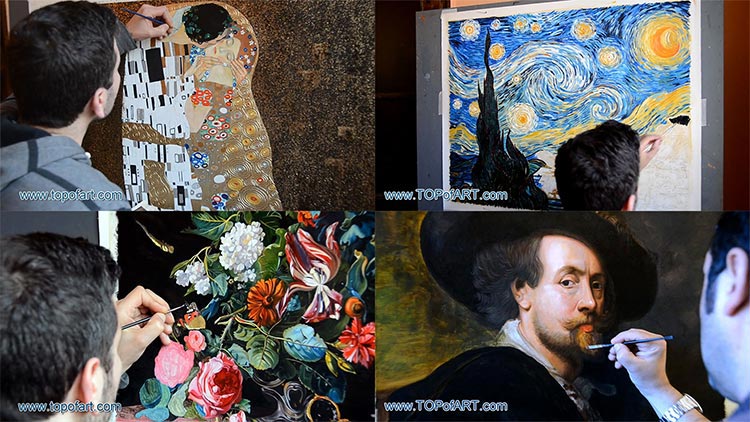
TOPofART makes its reproductions as hand-painted oil paintings on blank linen canvas, not as prints or machine copies. According to the site, each work is painted by academy-trained artists who reproduce the drawing, color and detail of a known masterpiece while also aiming to capture its spirit and human touch. The studio says it has recorded video of hundreds of reproductions being painted, which you can watch to judge the quality of the brushwork and process for yourself.
What this means in practice
- You are commissioning a painter, not buying a poster. Expect visible brush and canvas texture and slight variation between any two copies of the same painting.
- The reference is the original museum work, so composition and palette follow the source painting rather than a designer's reinterpretation.
- The site lists paintings by artist, movement, museum and subject — still lifes, landscapes, portraits, nudes and animals — so you can start from a favorite painter or a specific museum piece.
- It also offers framing advice, and some works appear with a canvas-print alternative alongside the oil version.
A useful next step
If you are considering a reproduction, pick two or three candidate paintings and watch the studio's process videos for those works before deciding. Look for how edges, glazes and fine detail are handled, and compare that with the original in a museum catalog or the museum's own site. Then ask what canvas size, framing and finish you want, since those choices affect how close the result feels to the original in your room.
Trade-off to weigh
A hand-painted reproduction gives you the texture and presence of an oil painting, but it is an interpretation by another artist, not the original, and it will not match the original exactly. If you need a precise, repeatable image at low cost, a print is the more practical route; if you want a one-of-a-kind painted canvas for a home or office, the hand-painted approach is the reason to choose this studio.
Can I request a custom reproduction of a painting not listed on TOPofART?
Yes. TOPofART is built around made-to-order oil reproductions, and its site explicitly invites requests for works beyond the catalogue—if you can supply a clear image and size, the studio can quote a hand-painted copy. The page describes every piece as hand-painted in oil on linen canvas by academy-trained artists, so a custom request follows the same production route as a listed painting.
How to make the request work
- Send the artist, title, and a high-resolution image of the original if you have one.
- State the finished size you want, in centimetres or inches, plus orientation.
- Say whether you want a framed or unframed canvas; the site publishes framing guidance and sells framing separately.
- Ask about the expected completion time before committing, since hand-painting a large canvas takes longer than a small one.
- Confirm the return or approval policy in writing before payment.
What to weigh
| Your situation | Practical implication |
|---|---|
| You have a good reference image | Higher chance of close colour and detail matching |
| Only a low-resolution photo exists | Expect interpretation; details and brushwork will be approximated |
| The work is still in copyright | The studio may decline or require proof of permission |
| You need it by a fixed date | Ask for a delivery estimate first; custom work is slower |
The trade-off is straightforward: a custom reproduction gives you access to paintings the catalogue does not carry, but you lose the ability to judge a finished photo of that exact piece beforehand. For a listed painting, you can often preview the studio's process videos; for a custom order, you are trusting the artist's interpretation.
A useful next step: gather your reference image and preferred dimensions, then contact the studio directly with those details and ask for a quote and timeline before ordering.
What is the difference between an oil painting reproduction and a canvas print on TOPofART?
On TOPofART, the difference is mainly in how the picture is made and what you are buying: an oil painting reproduction is a hand-painted work on canvas, while a canvas print is a printed reproduction on canvas.
Oil painting reproduction
- Hand-painted with oil on linen canvas, according to the site's description.
- Made by artists the studio describes as academy-trained and experienced in reproducing old-master styles.
- The studio says each piece aims to capture drawing, colour, detail and something of the original's character, rather than being a mechanical copy.
- It is the option for someone who wants a one-off painted object and is willing to pay more and wait longer.
Canvas print
- A printed image on canvas, not a hand-painted original.
- The site lists both formats for some works, with the print priced far lower than the oil painting. For example, a Church painting is listed at $1,886 as an oil painting and $62.11 as a canvas print; a Kirchner work is $1,422 as an oil painting and $71.71 as a canvas print.
- It suits a buyer who wants the look of a famous painting at a much lower cost, or who needs a decorative piece for a home or office where a hand-painted reproduction would be excessive.
The practical trade-off is cost and uniqueness versus budget and speed. If you want the closest thing to a painted masterpiece and are commissioning a specific size or subject, choose the oil reproduction. If you mainly want the image on a wall and are not concerned with brushwork or surface texture, the canvas print is the sensible choice.
A useful next step is to open a specific painting you like on TOPofART and compare the two listed options side by side. Check whether the size you need is available in both formats, and note the price gap, since that will tell you quickly whether the painted version is worth it for your purpose. For broader context on the studio and its catalogue, see TOPofART.
How long does it take to receive a reproduction from TOPofART?
TOPofART does not state a single delivery time on the page evidence provided. What the page does show is that every reproduction is hand-painted to order in oil on linen canvas, so the timeline has two parts: painting time in the studio, then shipping. The company says it has over 25 years of experience and works with a small team of artists, and it notes that it has recorded videos of hundreds of reproductions being created in its studio — useful if you want to gauge how much work goes into one piece before it ships. For a firm timeline, the practical next step is to ask TOPofART directly, quoting the specific painting and size you want, and to request the current production and shipping estimate in writing before you order.
H3 What affects the wait
- Painting complexity and size. A large, detailed canvas such as a multi-figure scene takes longer than a small still life.
- Studio queue. A small team means orders are worked through in sequence, so demand at busy periods can add time.
- Shipping method and destination. Time in transit depends on where you are and which service is used; customs can add delay for international orders.
- Framing or finishing options. If you add framing or other finishing, that step adds time before dispatch.
H3 A realistic reader scenario Suppose you want a Monet or Renoir reproduction for a living room and you have a date in mind, such as a birthday or a room reveal. Work backwards: ask for the estimated painting time plus shipping time, then add a buffer of a few weeks. If the date is tight, choose a smaller or simpler composition, or ask whether a canvas print version of the same image is available — the page lists canvas prints alongside oil paintings for some works, and those are produced far faster because no hand-painting is involved.
H3 Decision criteria
- Need it by a fixed date? Confirm the total timeline in writing first, and prefer a simpler or smaller piece, or a print.
- Want the closest match to the original? Accept a longer wait for a hand-painted oil reproduction, since that is the whole point of the service.
- Comparing options? It is reasonable to check how other reproduction studios describe their lead times, but treat any estimate as specific to that studio and that painting. For general context on the artists involved, see National Gallery of Art or The Metropolitan Museum of Art.
If you tell TOPofART the exact painting title and dimensions, they can give you the most accurate estimate — that single question resolves most of the uncertainty.
Are TOPofART reproductions suitable for investment or resale?
TOPofART reproductions are hand-painted copies, not originals or limited editions, so they should not be treated as investment assets. Their resale value is generally limited to what another buyer will pay for decorative art, not the appreciation you might expect from an authenticated original, a signed limited print, or a documented contemporary edition.
The studio itself describes its works as oil-on-linen reproductions of museum masterpieces, painted by academy-trained artists, with no mention of edition numbering, certificates of authenticity tied to an artist's estate, or secondary-market documentation. Those are the kinds of things that support resale value in the art market. Without them, a reproduction is essentially a commissioned decorative object.
Where reproductions do make sense
- Filling a large wall in a home, office, hotel, or restaurant where the look of a Monet, Renoir, or Klimt matters more than provenance.
- Replacing a print or poster with something that has visible brushwork and canvas texture.
- Creating a specific size or subject match when an original is unavailable, unaffordable, or too fragile to hang.
Where they do not
- Buying as a store of value, an appreciating asset, or part of an estate plan.
- Expecting to resell at or above the purchase price through an auction house or gallery.
- Passing the work off as an original or as an investment-grade edition.
If resale matters to you, compare with these official sources before deciding: TOPofART for the reproduction option, Christie's or Sotheby's for how the auction market treats originals and editions, and Tate for general guidance on what makes art collectible versus decorative.
A practical decision rule: if you would still be happy owning the painting if it were worth nothing on resale, it can be a reasonable purchase. If your plan depends on recovering or growing your money, put that budget toward an original work by a living artist, a signed limited edition, or a documented print instead.
 DigitalOcean, LLC
 Google Workspace

User reviews (0)