

 Visit website
 Updated: 2026-10-08 20:39
 Language: English (default)
 Access: Normal
 Profile views 7
  Outbound visits 0
 Website Review
What is WeKraft?
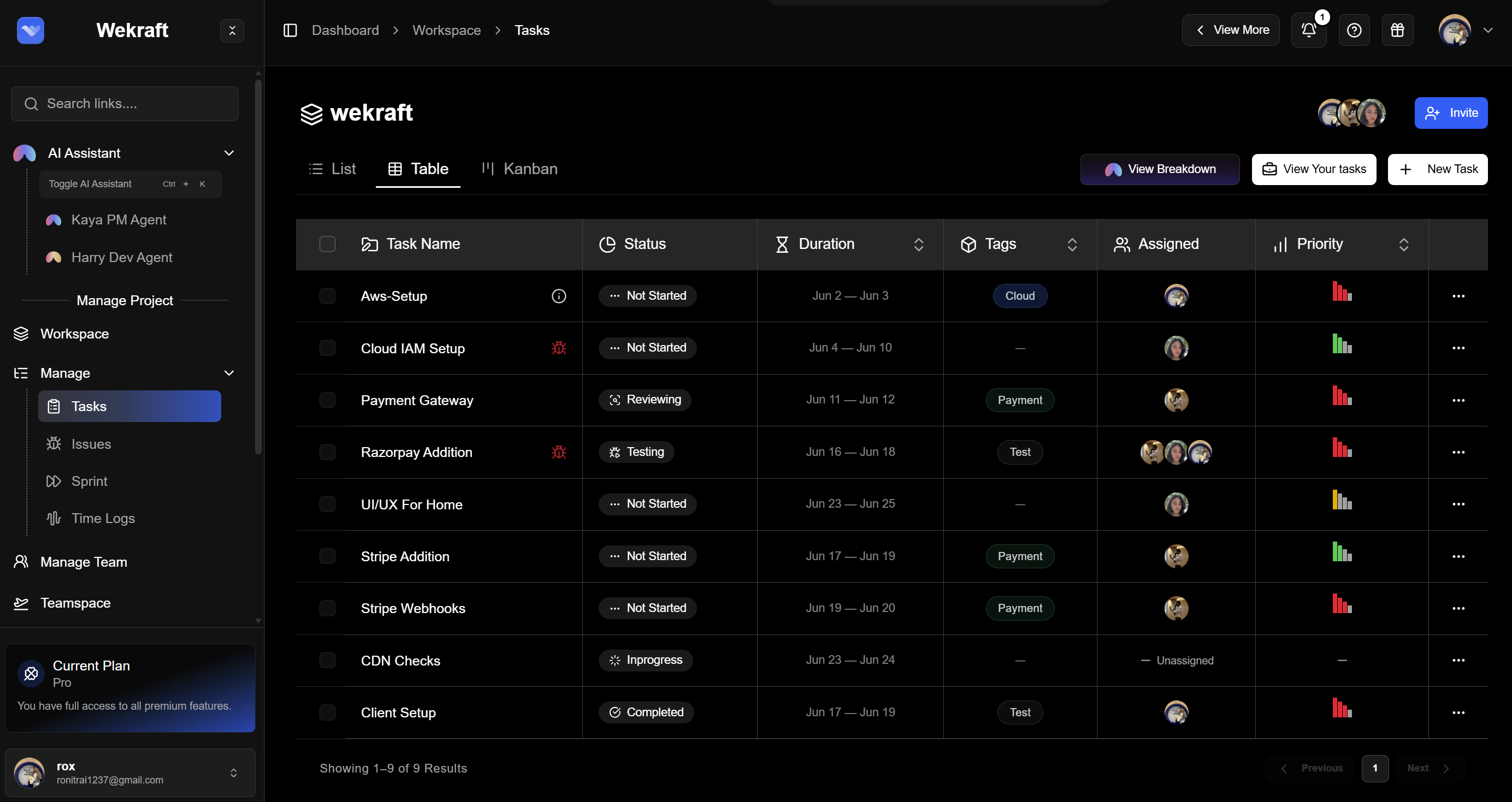
WeKraft is an AI-first project management platform and collaborative workspace aimed at software teams. Its pitch is that it helps teams plan sprints, track to-do lists, manage developer capacity, and coordinate complex projects, with the emphasis on execution rather than administration.
What it is meant to do
- Sprint and project planning for software development work.
- Task tracking through to-do lists and project views.
- Capacity management so you can see what developers can realistically take on.
- Coordination across complex projects, where dependencies and multiple workstreams tend to create overhead.
Who it is for
It is best suited to modern software teams that already run some form of sprint or iterative planning and want AI assistance folded into planning and tracking. If your team is small and informal, a lightweight task board may be enough; WeKraft's value shows up more when capacity, dependencies, and coordination become recurring problems.
What to weigh
AI-first project tools can reduce manual planning work, but they still depend on accurate task and capacity data. The practical test is whether the AI suggestions match how your team actually plans, and whether the workspace replaces tools rather than adding another place to update. Teams comparing options often look at established alternatives such as Atlassian for Jira and Confluence, Linear for fast issue tracking, or Asana for cross-functional project coordination.
Next step
Pick one real sprint and try running it in WeKraft: enter the backlog, set each developer's available capacity, and see whether the AI-assisted planning output is something your team would accept without heavy editing. That single-sprint trial will tell you more than a feature list.
How does WeKraft's AI-first approach change project management for software teams?
WeKraft positions itself as an AI-first project management and workspace platform for software teams, with a stated focus on sprint planning, to-do tracking, developer capacity management, and coordinating complex projects. The "AI-first" framing suggests the product is designed around automation and assistance rather than treating AI as a bolt-on feature. However, the page evidence available is thin — it shows only a heading, a short tagline, and a redirect notice — so the specific AI capabilities and how deeply they are integrated cannot be confirmed from this source alone.
What AI-first tends to change in practice
For a software team, an AI-first approach usually shifts effort away from manual coordination work. Concrete examples include:
- Sprint planning: drafting candidate sprint scopes from a backlog, estimating effort, and flagging items that look underspecified.
- Capacity management: surfacing overloaded developers or mismatched skills before work is committed, rather than after a deadline slips.
- To-do and task hygiene: auto-summarising status, grouping related tasks, or converting meeting notes into actionable items.
- Project coordination: detecting dependencies and risks across workstreams and suggesting re-sequencing.
These are general patterns for AI-first tools, not confirmed features of WeKraft.
How this compares with conventional tools
| Aspect | Conventional PM tool | AI-first approach (typical) |
|---|---|---|
| Planning | Manual backlog grooming and estimation | Draft plans and estimates generated for review |
| Status updates | Team members write updates | Summaries derived from activity data |
| Risk detection | Relies on leads noticing issues | Pattern-based flagging of blockers and overload |
| Team role | Tool records decisions | Tool proposes options for humans to approve |
Practical trade-offs
AI-first tools can reduce administrative overhead, but they introduce new questions: how much the team trusts automated estimates, whether AI suggestions fit an existing workflow, and how much setup or data the tool needs before its suggestions become useful. Teams with stable, well-documented processes tend to benefit most; teams with fast-changing or highly custom workflows may spend more time correcting suggestions than saving time.
Next step
If you are evaluating WeKraft, start with a single sprint: run your normal planning session and compare the tool's proposed scope and capacity picture against your own. That gives you a concrete read on whether its AI-first design matches how your team actually works. For a broader comparison, established options such as Linear and Asana also target software teams, though with different balances of automation and manual control.
Can WeKraft replace tools like Jira, Trello, or Asana for sprint planning and task tracking?
WeKraft is positioned as an AI-first project management platform for software teams, covering sprint planning, to-do lists, developer capacity, and complex project coordination. On paper, that overlaps with the core jobs most teams use Jira, Trello, or Asana for. Whether it can replace them depends less on the feature list and more on how much process structure and integration depth your team depends on.
Where a replacement is realistic
- Small to mid-sized software teams that plan sprints in one place and don't need heavy custom workflows.
- Teams that want capacity and workload visibility alongside task tracking, rather than bolting on a separate resource tool.
- Groups willing to let AI assistance handle parts of planning, triage, or summarization, and who value that over a large marketplace of add-ons.
Where it gets harder
Jira, Trello, and Asana each carry years of ecosystem depth: hundreds of integrations, granular permission schemes, automation builders, and reporting that finance or compliance may expect. If your sprint process relies on custom issue types, complex dependency chains, or CI/CD and code-host hooks, switching means re-creating that glue. Trello suits lightweight kanban; Asana leans toward cross-functional work management; Jira leans toward engineering-grade traceability. A newer AI-first tool typically competes best where the process is simpler and the team is smaller.
A practical way to decide
Run one real sprint in parallel. Take your current backlog, mirror it in WeKraft, and compare three things: how long setup took, whether capacity planning matched reality, and whether anyone missed information that lived in your old tool. If the parallel sprint runs cleanly and the team stops opening the old tool, replacement is viable. If people keep switching back for reports or integrations, keep both and use WeKraft for planning while the incumbent stays the system of record.
For context on what the incumbents do well, see Atlassian for Jira and Trello, and Asana for its work-management model.
How does WeKraft help manage developer capacity and balance workloads across a team?
WeKraft is positioned as an AI-first project management and workspace platform for software teams, and its stated focus is on sprint planning, to-do tracking, developer capacity management and coordinating complex projects. On capacity and workload balancing specifically, the page evidence describes the intent ("manage developer capacity") but does not detail the mechanics, so treat the workflow below as the practical pattern such a tool supports rather than a verified feature list.
What capacity balancing usually involves
- A single view of who is doing what. Workload balancing starts with one place where every assigned task, sprint item and to-do is visible per person, so you can see overload before it becomes a missed deadline.
- Sprint planning against real availability. When planning a sprint, the useful input is each developer's realistic available time (minus meetings, support, leave), not a flat headcount. AI assistance tends to help most at this step: summarising past velocity, flagging items that look oversized, or suggesting a distribution.
- Early overload signals. The value is catching an imbalance mid-sprint — one person with three critical items and another with none — rather than discovering it in the retrospective.
- Reassignment without losing context. Moving work between people should keep the task's history, dependencies and status intact.
A concrete scenario
A five-person team plans a two-week sprint. One backend developer is already carrying an on-call rotation, and a second is partway through a large migration. If planning only counts open tickets, both look equally available. A capacity-aware workspace lets the lead mark reduced availability for those two, then redistributes incoming work to the remaining three — or trims the sprint scope. That single adjustment is usually the difference between a sprint that finishes and one that rolls over.
Decision criteria
| If your main problem is… | Look for… |
|---|---|
| Uneven ticket counts | Per-person workload views and filtering by assignee |
| Sprints that consistently overrun | Velocity history plus availability-aware planning |
| Hidden bottlenecks | Dependency and blocked-item visibility |
| Constant manual rebalancing | AI suggestions for assignment or scope trimming |
Next step
Run one sprint with explicit availability entered for every developer, then compare planned versus actual load at the end. If the gaps cluster around two or three people, that is your signal to make capacity a standing input to planning rather than an afterthought. For teams wanting a broader comparison of established options, Linear and Asana are commonly used reference points, though their capacity features differ from what WeKraft describes.
What does 'execute not only manage' mean in WeKraft's workflow?
"Execute not only manage" is WeKraft's positioning statement: the product is meant to be where work actually gets done, not just where work gets tracked. Traditional project tools often stop at status columns and dashboards — you record that a task exists, then leave the tool to do the task. WeKraft's framing, based on its own page description, is that planning, sprint tracking, to-do lists and developer capacity management sit alongside execution in the same workspace, so the act of moving work forward and the act of recording it are the same activity.
What this looks like in practice
For a small software team, the difference shows up in small moments:
- A standup happens inside the workspace, and updating a task's state is the standup, rather than a separate note-taking step afterward.
- Sprint planning pulls from the same to-do lists developers already work from, so the plan reflects real capacity instead of a spreadsheet maintained in parallel.
- Capacity and workload signals come from the work itself, not from a weekly manual reconciliation.
Who benefits, and who doesn't
Teams that feel the pain of "double bookkeeping" — updating a tracker after doing the work — are the natural audience. Teams with a heavy compliance or reporting layer, where a dedicated PMO owns the tool and developers are occasional visitors, may find the execution-first framing less relevant; their bottleneck is governance, not workflow friction.
How to judge whether it fits
Ask one question of your current setup: how many steps happen between deciding to do a piece of work and that work being visible to the rest of the team? If the answer involves switching apps or a manual update ritual, an execution-oriented workspace is worth evaluating. If your tasks and your work already live in one place, the gain is likely marginal.
A practical next step is to take one real sprint and map each handoff: idea, estimate, assignment, code, review, done. Count how many of those steps require leaving your current tool. That count is the concrete thing WeKraft's "execute not only manage" claim is aimed at reducing.
How much does WeKraft cost and is there a free plan or trial?
WeKraft's page as provided does not list pricing tiers, a free plan, or a trial. The only substantive content is a name, a tagline about being an "AI-first PM platform where you execute, not only manage," and a redirect notice. There are no pricing links or payment platforms to check, so any specific figure would be a guess.
What you can do instead
Treat pricing as an open question and get it from the source. The most reliable path is to open WeKraft's official site, WeKraft, and look for a Pricing or Plans link in the header or footer. If none exists, the product may be in early access, invite-only, or quote-based.
Questions to ask on a sales or demo call
- Is there a free tier, and what limits it — seats, projects, or AI credits?
- Is a trial time-boxed, and does it require a card?
- How is billing structured: per user per month, per active contributor, or a flat team rate?
- What happens to your data and history if you downgrade or the trial ends?
- Are AI features metered separately from the core planning tools?
How to judge the answer
Compare the model against how your team actually works. A per-seat price is predictable for a stable headcount but punishing for contractors and seasonal contributors. Usage-based AI pricing can be cheap for light planning and expensive for teams that lean on automated summaries and task generation. If WeKraft positions itself as execution-focused rather than admin-focused, the value test is whether it replaces a tool you already pay for, not whether it adds another subscription.
For context on what similar tools charge, official pricing pages are the only dependable reference — for example Linear, Asana, and ClickUp all publish tiers and free-plan limits directly. Use those as a benchmark, then ask WeKraft to explain where it sits and why.
 Hosting and Email
 vercel-dns.com
 Hosting
 Zoho Mail
 Location
 United States
 Pages, Search and Sharing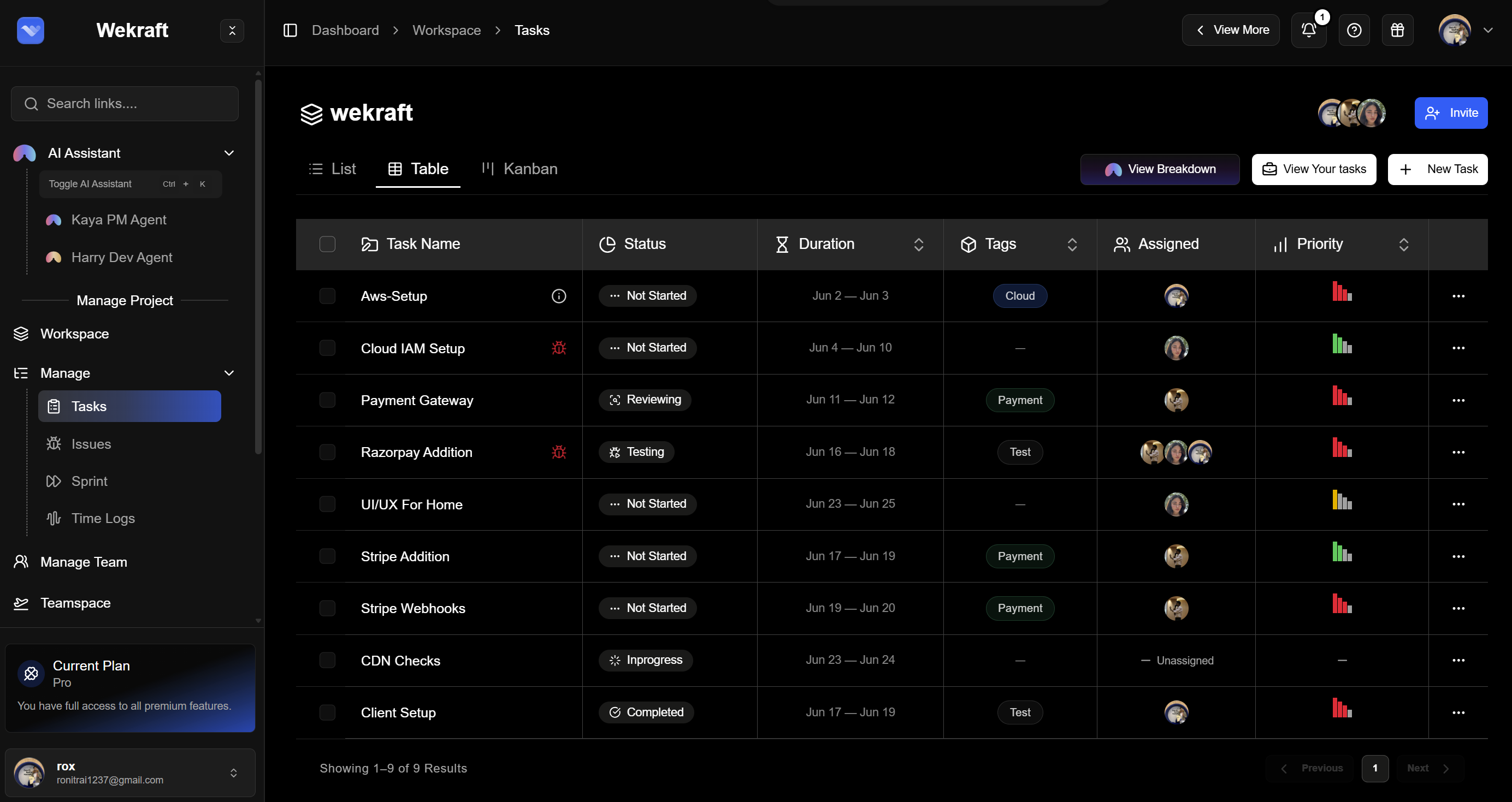


 Registration details

 Identified technologies
User reviews (0)