Website profiles · Technology insights · Alternatives

windage.online

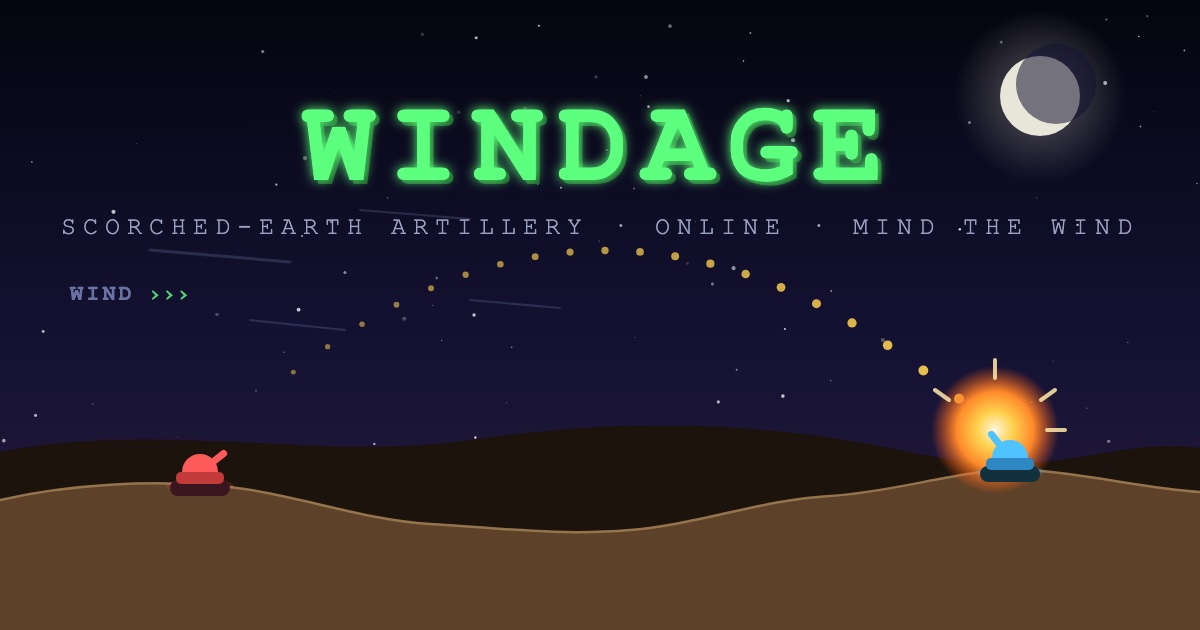
Windage is Scorched Earth online — free in your browser. Destructible terrain, wind, nukes, an arms shop, CPU tanks and 2–6 player battles. No download, no sign-up.

No paid content found
Visit website
Profile views 1 Outbound visits 10 Normal
Windage Full homepage screenshot

At a glance

Category
Games & Board Games
Language
English
Paid-content signal
No paid content foundObserved
Registered
2026
Hosting
Fly.io, Inc.Inferred
HTTPS certificate trusted
PassedObserved
Last updated

Website review

This review may include AI-generated content and is not individually verified. Domain, certificate and other facts come from the observed data on this page.

What is Windage?

Windage is a free browser remake of the classic artillery game Scorched Earth, playable at Windage with no download or sign-up. You take turns lobbing shells across destructible terrain, adjusting each shot for shifting wind — the game's name comes from the word for the wind's force on a projectile and the act of compensating for it. Between shots you buy weapons and gear from an arms shop.

How you can play

  • Single player: a one-off quick game against 1–5 CPU tanks (Easy, Normal or Hard), or a campaign that climbs through progressively tougher opponents.
  • Hot seat: 2–6 humans passing one device, optionally mixed with CPU opponents.
  • Online multiplayer: 2–6 players over the internet.

Setup is unusually granular for a browser game. You choose the map (rolling hills, mountains, plateaus, islands, flatlands), what happens at the map edges (shells fly off, wrap around, bounce, kick back or stop), turn order, turn mode (sequential, or everyone locks in and fires simultaneously), physics such as low/high gravity and steady wind, a fixed-price or free market, weather including storms, and whether aiming assistance is allowed. A "Basic" style strips things down to one missile with no aim help; "Standard" gives the full arsenal, shop and aim assist.

Who it suits

It fits people who want a quick, tactical turn-based match in a browser tab — on desktop or mobile — and groups who remember Scorched Earth or Worms-style play. The many toggles reward tinkerers; anyone wanting a single obvious "play" button may find the options screen busier than expected.

Next step: if you're new, start a quick single-player game on Easy with the Standard style and default settings to learn wind compensation and the shop, then try hot seat with a friend before moving online.

How do I play Windage against friends online or in hot-seat mode?

Windage supports both: online multiplayer for 2–6 players over the internet, and hot-seat pass-and-play on a single device. Neither requires a download or sign-up — you open Windage in a browser and pick the mode from the main menu.

Online multiplayer

Choose MULTIPLAYER → ONLINE. The setup screen lets you configure the match before anyone fires: game style (Basic with a single missile and no aiming help, or Standard with the full arsenal, shop and aim-assist), map type (rolling hills, mountains, plateaus, islands, flatlands), wall behaviour (open, wraparound, rubber, spring, concrete, random or erratic), turn order, turn mode, scoring, number of rounds, physics and market type. Agree on these with your friends first — a Standard match with the shop and aim-assist is friendlier for newcomers, while Basic suits quick, low-fuss duels.

One setup choice matters most for online play: turn mode. Sequential means players take turns one at a time; Synchronous means everyone locks in a shot and fires together, which keeps faster-paced groups engaged and reduces waiting. If your group tends to chat between shots, sequential is more relaxed.

Hot-seat

Choose MULTIPLAYER → HOT SEAT for pass-and-play on one device. You can set 2–6 human players and add 0–4 CPU opponents at Easy, Normal or Hard, so a mixed group of people and bots works fine. The same map, wall, physics and game-style options apply. Hot-seat is the better choice for a couch session or a single phone passed around, since it avoids connection issues entirely.

A practical first match

For a mixed-skill group of four, try Standard style, rolling hills, 5 rounds, normal physics and steady wind, with sequential turns. Terrain is fully destructible and wind shifts each round, so encourage players to reposition rather than repeat the same angle — the wind gauge is the skill ceiling in this genre.

For solo practice before inviting friends, SINGLE PLAYER → QUICK GAME (one-off battle with your settings) or CAMPAIGN (a ladder of increasingly tough foes) lets you learn the aiming and wind compensation without an audience.

Is Windage really free to play without downloading or signing up?

Yes. Windage is free to play directly in a browser, with no download and no sign-up. The site describes it as a modern remake of Scorched Earth, and its menus open straight into play modes rather than an account flow.

What that means in practice

  • No install: you can start a match from a desktop or mobile browser.
  • No account: the page presents single-player, hot-seat and online multiplayer options without a sign-up step.
  • What you get for free: turn-based artillery on destructible terrain, with wind affecting shots, an arms shop, 2–6 players, CPU opponents, and settings for maps, walls, physics, rounds and scoring.

A practical example: if you have ten minutes and one device, choose hot-seat pass-and-play and hand the phone or laptop between players. If friends are remote, use the online multiplayer mode instead. The site also offers a campaign for solo play against progressively tougher foes.

The main trade-off is that this is a browser game built around short artillery rounds, not a large downloadable title. Its variety comes from match settings—wind, gravity, wall behaviour, CPU difficulty and turn order—rather than from a long single-player story. For a quick test, start with a standard match against one CPU tank before adjusting those settings.

How does the wind mechanic affect aiming and shots in Windage?

In Windage, wind is the variable you adjust for on every shot: the game frames itself around "windage," the force the wind exerts on a shell and the act of compensating for it. Shots follow a lobbed trajectory, so a crosswind pushes the shell sideways over its flight, and you correct by aiming into the wind rather than straight at the target. Because the terrain is fully destructible, a shot that drifts can still be useful—it may carve new ground, open a line of fire or drop a tank—so wind affects positioning as much as raw accuracy.

What the site does and does not pin down:

  • Wind shifts: the page calls the wind "shifting," implying it changes between turns, so a correction that worked last round may not hold. Re-read the wind before each shot.
  • Wind settings: the battle setup includes a "Steady wind" physics option alongside normal, low/high gravity and thick air, so you can reduce the guesswork if you want a more predictable match.
  • Magnitude and indicators: the site does not specify wind strength values or how the wind is displayed on screen; check the in-game indicator when you play.

Practical approach

Use the first round to calibrate: fire one shot at a known aim point, watch how far it drifts, and scale your next correction from that. On rolling hills and islands, favour higher arcs that spend less time in the wind's path, and treat near-misses as terrain work. If you are learning the game or playing with newcomers, start on Basic style (one missile, no aiming help) with steady wind, then move to Standard with the full arsenal and shop once corrections feel natural.

For a concrete scenario: two players pass-and-play on one device, stormy sky and shifting wind. The first player over-corrects and lands short; the second reads the drift and aims slightly upwind, hitting the ridge above the target and collapsing the ground beneath it. That is the core skill—treating wind as a constant input, not an occasional nuisance.

What weapons and items can I buy in the Windage arms shop?

The page confirms there is an arms shop and that "Standard" play uses the "full arsenal, shop & aim-assist," but it does not list the individual weapons or items for sale. So the honest answer is: the shop exists and matters in Standard mode, but the specific inventory isn't documented in the material available here.

What the page does establish

  • Shop availability depends on game style. In "Basic," you get one missile and no aiming help; in "Standard," the full arsenal and shop are in play. If you enter a Basic match expecting to buy gear, you won't find it.
  • Purchasing is tied to economy settings. The setup screen offers a Market option (Fixed prices vs. Free market) and Scoring options including Greedy (net worth), which suggests money and purchases feed into how a match is judged.
  • Weapons imply terrain destruction. Destructible terrain is central, so expect purchases to interact with the map rather than just dealing damage.

How to find the actual inventory

The page references a "How to play · Weapons & gear guide." That guide is the right place to check before committing to a strategy — it should list what's purchasable and what each item does.

Practical decision criterion

If you want the shopping layer, choose Standard style and a Fixed prices market for predictable budgeting; pick Free market only if you're comfortable with prices shifting mid-match. For a quick, shop-free duel, Basic is the cleaner choice.

For the classic artillery formula Windage remakes, the original reference point is Scorched Earth, though its item lists won't match Windage's exactly.

How does the single-player campaign in Windage progress and get harder?

The campaign is a ladder of tougher CPU opponents: you start a level, win to advance, and each new rung is meant to be harder than the last. The page presents it as the structured solo mode, separate from a one-off "Quick Game" where you set your own match options, so progress is tied to climbing that ladder rather than to a single configurable skirmish.

What the setup options suggest about difficulty

The game's match settings hint at where the pressure comes from as you climb. In single player you can choose 1–5 CPU opponents, Easy/Normal/Hard difficulty, map type (rolling hills, mountains, plateaus, islands, flatlands), wall behaviour (open, wraparound, rubber, spring, concrete), turn order, physics (low/high gravity, thick air, steady wind), market type and whether aiming help is allowed. A harder rung plausibly stacks several of these at once — more CPU tanks, a tougher difficulty, awkward terrain and less forgiving physics — rather than just adding one enemy. That is inference from the option list, not a published level-by-level breakdown.

Practical expectations

  • Basic vs Standard style: Basic is one missile with no aiming help; Standard gives the full arsenal, shop and aim-assist. Basic-style levels will punish misjudged wind and elevation more, since you can't buy your way out of a bad position.
  • Wind is the core skill: the game is named for compensating for wind, so expect later levels to reward reading it precisely rather than spraying shots.
  • Shop and market matter: with fixed prices you can plan purchases; a free market makes economy management part of the challenge.

A useful way to judge progress

If a level feels stuck, change one variable at a time rather than restarting blindly — drop CPU count, switch to a flatter map, or enable aiming help to isolate whether the problem is aim, economy or terrain. For the classic this remakes, see Scorched Earth.

Related questions

More questions →
How Wind Affects Aiming in Windage

Wind pushes your shells in flight, so every shot in Windage has to be aimed with the wind in mind rather than straight at the target. The game's own definition makes this the core of play: windage is "the force exerted by the wind on an object, or the act of compensating for it," and the tagline is "Mind the windage. Make the shot." Before you fire, read the wind indicator, then adjust your angle or power so the shell lands where you want.

What the wind does to a shot

Windage is a turn-based artillery game: you lob shells across destructible terrain, and the shell travels through the air for a while before it lands. During that flight, the wind acts on the shell and drifts it off the line you aimed along. The longer the shell is in the air, the more time the wind has to push it, so high, arcing shots are affected more than flat, direct ones.

That creates the basic trade-off of the game:

  • Aim into the wind to cancel the drift, or aim with it to let the wind carry the shell further.
  • Shorten the flight time (flatter, more powerful shots) when the wind is strong and you don't want to fight it.
  • Re-check after every shot, because the wind is part of each turn, not a fixed setting for the whole match.

The name is the mechanic: you are always compensating for the wind rather than ignoring it.

Reading the wind before you fire

Each turn, check the wind indicator before choosing your angle and power. The indicator tells you the direction and strength the shell will face in flight; your job is to translate that into an adjustment. A practical routine:

  1. Note the wind direction — which way it will push the shell.
  2. Estimate the drift from how strong it is and how long your shot will be in the air.
  3. Adjust your aim against the drift (or with it, if you want the extra carry).
  4. Fire, then watch the impact and correct on your next turn using what you saw.

Because terrain is fully destructible, a shot that drifts can still be useful — it may carve a new path or drop a tank — but if you need a precise hit, compensate first.

Wind settings you can choose

Wind isn't one fixed condition. In the single-player and hot-seat setup screens, the physics options include a Steady wind setting alongside Normal, Low gravity, High gravity, and Thick air. Steady wind keeps the wind consistent, which makes it easier to learn how much a given strength drifts your shell — useful for practice or for players who want the aiming challenge without the wind changing under them. The default physics is Normal, where wind behaves as the standard variable condition.

The setup screens also let you change the map (Rolling hills, Mountains, Plateaus, Islands, Flatlands) and wall behavior (Open, Wraparound, Rubber, Spring, Concrete, and others), all of which change how far a shell travels and where a drifted shot ends up. Wind is one variable among these, so a strong wind on an open map plays differently from the same wind on a walled one.

Why it matters in a match

Wind is what separates Windage from a pure aim-and-fire game. Two players with the same tank and the same target can get different results because one read the wind and the other didn't. In online battles of 2–6 players, in hot-seat pass-and-play, or against CPU tanks, the player who compensates consistently lands more shots — and in a game where terrain is destructible and rounds are scored, that consistency is the difference between winning and losing rounds.

If you're new, start with Steady wind and the Basic game style (one missile, no aiming help) to feel how much a given wind moves a shell, then move to Standard (full arsenal, shop, and aim-assist) once the compensation becomes instinct.

What Is Windage? A Free Browser Remake of Scorched Earth

Windage is a free, browser-based remake of the classic Scorched Earth artillery game. You take turns lobbing shells across destructible terrain, adjust for shifting wind, buy weapons from an arms shop, and fight 2–6 players — online, in hot-seat pass-and-play, or against CPU tanks. It runs in any modern browser on desktop or mobile with no download and no sign-up. It's a good fit if you want short, turn-based matches with light physics and strategy rather than real-time action.

How a match works

Each round is turn-based. On your turn you pick a weapon, set an angle and power, and fire. The wind pushes your shell in flight, so the same shot can land differently from round to round — the name itself refers to the force the wind exerts on a projectile, or the act of compensating for it. Terrain is fully destructible, so craters change the map and can drop tanks.

The site offers two game styles that change how much is going on:

  • Basic — one missile, no aiming help. Good for quick, stripped-down duels.
  • Standard — full arsenal, the arms shop, and aim-assist.

Game modes

Mode What it is Best for
Single Player Quick game vs 1–5 CPU tanks, or a Campaign ladder of tougher foes Learning the game or solo play
Multiplayer Online Play over the internet with 2–6 players Playing with friends remotely
Hot Seat Pass-and-play on one device with 2–6 humans (plus optional CPUs) Same-room sessions

Settings you can tune before a battle

The lobby exposes a fair number of options, so matches can range from simple to chaotic:

  • Maps: rolling hills, mountains, plateaus, islands, flatlands
  • Walls: open (shells fly off), wraparound, rubber (bounce), spring (kick back), concrete (stop), random per round, erratic per shot
  • Turn order: random, losers first, winners first, round-robin
  • Turn mode: sequential (take turns) or synchronous (everyone locks in and fires together)
  • Physics: normal, low gravity, high gravity, thick air, steady wind
  • Market: fixed prices or free market
  • Sky: clear or stormy (with lightning)
  • Scoring: standard (round wins), basic (wins only), greedy (net worth)
  • Rounds: 3 or 5
  • Aiming help: allowed or disabled

CPU difficulty can be set to Easy, Normal, or Hard.

Is it actually free, and do I need an account?

Yes — the site states Windage is completely free, with no download and no sign-up. You open it in your browser and play. The site does not list any pricing tiers or payment options, and no login is described, so you can start a match immediately.

What to expect in practice

  • Short sessions. Turn-based rounds with a handful of players suit a quick break; a 5-round match with several tanks takes longer than a 3-round duel.
  • Wind is the core skill. Reading and compensating for wind matters more than raw aim, especially with "steady wind" or "thick air" enabled.
  • Terrain is a weapon. Destroying ground under an opponent is a legitimate tactic, so expect maps to degrade as a match goes on.
  • Mobile works, but aiming is finer with a mouse. The game is playable on mobile browsers; precise angle and power tweaks are easier on desktop.

If you want a no-install artillery game to play solo against CPUs or pass a laptop around with friends, Windage covers that directly. If you specifically want real-time multiplayer or a persistent account with progression, this isn't that kind of game — the campaign is a ladder of CPU opponents, not an online ranked system.

What Settings Can You Customize Before a Windage Battle?

Before a battle starts, Windage lets you configure game style, map and walls, physics and market, turn order and turn mode, scoring and rounds, and aiming help. The exact options depend on the mode you pick: Single Player (Quick Game or Campaign) and Hot Seat expose the full setup screen, while online multiplayer uses the same battle rules but is organized around joining a 2–6 player match. All of this is free in the browser with no download or sign-up.

Game style: Basic or Standard

The first choice is how much game you want.

Style What you get Best for
Basic One missile, no aiming help Fast, simple duels and new players
Standard Full arsenal, arms shop, and aim-assist Longer matches with shopping and variety

If you want the shop and the wider weapon set, you must choose Standard — Basic strips both out along with aiming help.

Map and walls

You pick the terrain and how shots behave at the edges.

  • Maps: Rolling hills, Mountains, Plateaus, Islands, Flatlands. Terrain is fully destructible in all of them, so cover erodes as the match goes on.
  • Walls: Open (shells fly off the map), Wraparound, Rubber (bounce), Spring (kick back), Concrete (stop), Random (per round), Erratic (per shot).

Walls matter more than they look: on a small map, Rubber or Spring can turn a near miss into a hit, while Concrete rewards precise aim because nothing bounces back in.

Physics and market

These change how shells fly and how the shop prices work.

  • Physics: Normal, Low gravity, High gravity, Thick air, Steady wind. Gravity and thick air alter shell arcs; Steady wind removes the shifting-wind guesswork that defines the game.
  • Market: Fixed prices or Free market. Free market makes shop prices move, so buying early versus saving becomes a real decision.

Turn order, turn mode, scoring, and rounds

  • Turn order: Random, Losers first, Winners first, Round-robin.
  • Turn mode: Sequential (take turns) or Synchronous (everyone locks in and fires together).
  • Scoring: Standard (round wins), Basic (wins only), Greedy (net worth).
  • Rounds: 3 or 5.

Synchronous turn mode is the biggest change to how a match feels — it removes the wait-and-react rhythm of sequential play and rewards reading the wind before anyone else fires.

Aiming help

Aiming help can be Allowed or Disabled. Disabling it is the cleaner test of skill, since you must judge elevation and wind yourself. Note that Basic style already has no aiming help regardless of this setting.

Opponents and player count

  • Single Player: choose 1–5 CPU tanks and difficulty (Easy, Normal, Hard). Quick Game is a one-off battle with your settings; Campaign is a ladder of tougher foes.
  • Hot Seat: 2–6 human players on one device, with 0–4 CPU opponents added.
  • Online Multiplayer: 2–6 players over the internet, versus humans or CPU.

A practical setup to start with

If you are new, pick Standard, Rolling hills, Open walls, Normal physics, Fixed prices, Sequential turns, 3 rounds, and aiming help Allowed. Once comfortable, switch walls to Rubber and disable aiming help — that combination sharpens both your wind reading and your precision without changing the core rules.

The one setting to decide first is game style, because it determines whether the arms shop and full arsenal are part of your match at all.

What the Arms Shop Adds to a Windage Match

The arms shop is the between-rounds buying step in Windage's Standard game style: you spend on weapons and gear before firing, and the Market setting you pick at setup decides how prices behave. If you choose Basic instead, there is no shop — you get one missile and no aiming help. So the shop only matters if you are playing Standard, whether that is solo against CPU tanks, hot-seat, or online.

Where the shop sits in a match

Windage is a turn-based artillery game: lob shells across destructible terrain, account for wind, and outlast 2–6 players. The shop is the layer that turns a single shot type into a loadout decision. In Standard you get the full arsenal plus aim-assist, and the shop is where you stock up from. Basic strips all of that away, which makes it the better choice for a quick, pure-aiming duel.

The practical effect: in Standard, your round-to-round choices are not just angle and power, but also what you bring into the next exchange.

The Market setting changes how you buy

Two Market options appear in the battle setup:

Market setting What it means for the shop
Fixed prices Costs stay the same, so you can plan purchases predictably
Free market Prices move, so timing and budgeting matter more

Pick Fixed prices when you want the shop to be a straightforward budgeting step. Pick Free market when you want buying decisions to carry their own risk.

How the shop fits each mode

  • Single player (quick game or campaign): the shop is part of your Standard loadout management against 1–5 CPU tanks on Easy, Normal, or Hard. In Campaign you climb a ladder of tougher foes, so what you buy compounds across levels.
  • Hot seat: 2–6 humans pass and play on one device; the shop becomes a shared, visible decision point.
  • Online multiplayer: 2–6 players over the internet, with the same Standard arsenal and shop.

Settings that interact with your loadout

The shop does not exist in isolation — these setup choices shape how much it matters:

  • Game style: Basic (one missile, no shop, no aim-assist) vs Standard (full arsenal, shop, aim-assist).
  • Walls: Open, Wraparound, Rubber, Spring, Concrete, Random, or Erratic — bounce and kick-back walls change which weapons are worth buying.
  • Physics: Normal, low gravity, high gravity, thick air, or steady wind — heavy gravity and thick air shorten trajectories; steady wind removes the wind guesswork.
  • Sky: Clear or Stormy (lightning).
  • Rounds: 3 or 5, with scoring by round wins, wins only, or net worth (Greedy). Net-worth scoring makes purchases directly count toward your result.
  • Turn mode: Sequential (take turns) or Synchronous (lock in and fire together).

Where to learn the weapons themselves

The site points to a Weapons & gear guide for the arsenal details. Use it to match purchases to your map and physics settings rather than buying blind — for example, bounce-friendly walls reward different choices than Concrete walls that stop shots.

Quick decision guide

  • Want a fast, no-economy duel? Choose Basic.
  • Want loadout strategy and are fine with prices? Choose Standard + Fixed prices.
  • Want buying to be part of the tension? Choose Standard + Free market.
  • Playing a 5-round match with Greedy scoring? Treat the shop as part of your score, not just your firepower.

Open Windage in your browser, pick a mode, and set Game style to Standard to see the shop in action — no download or sign-up needed.

Windage Game Modes: Solo, Campaign, Online, and Hot-Seat Play

Windage offers four ways to play, and the right one depends on who you want to fight and where. Single Player is a one-off battle against 1–5 CPU tanks at Easy, Normal, or Hard difficulty. Campaign is a ladder of increasingly tough opponents. Multiplayer Online puts 2–6 players in a match over the internet. Hot Seat is pass-and-play for 2–6 humans on one device. All four run in the browser with no download or sign-up, on desktop or mobile.

Single Player: Quick Game vs. Campaign

Both solo options are under the SINGLE PLAYER menu, but they serve different goals.

Quick Game

A one-off battle where you set the terms. From the game setup screen you choose:

  • Game style: Basic (one missile, no aiming help) or Standard (full arsenal, shop, and aim-assist)
  • Opponents: 1 to 5 CPU tanks
  • CPU difficulty: Easy, Normal, or Hard
  • Map: Rolling hills, Mountains, Plateaus, Islands, or Flatlands
  • Walls: Open (fly off), Wraparound, Rubber (bounce), Spring (kick back), Concrete (stop), Random (per round), or Erratic (per shot)
  • Turn order: Random, Losers first, Winners first, or Round-robin
  • Turn mode: Sequential (take turns) or Synchronous (lock in, fire together)
  • Scoring: Standard (round wins), Basic (wins only), or Greedy (net worth)
  • Rounds: 3 or 5
  • Physics: Normal, Low gravity, High gravity, Thick air, or Steady wind
  • Market: Fixed prices or Free market
  • Sky: Clear or Stormy (lightning)
  • Aiming help: Allowed or Disabled

Pick Quick Game when you want a single match with your own rules, or when you are learning the wind and trajectory mechanics before committing to a longer run.

Campaign

Campaign is a ladder: you climb through progressively tougher foes, with START LEVEL and RESTART CAMPAIGN controls. Choose it when you want a sense of progression rather than a one-off match. The page does not specify how many levels the ladder contains, so treat the length as something you discover by playing.

Multiplayer Online: 2–6 Players Over the Internet

Online multiplayer supports 2–6 players and is described as playable over the internet. The setup screen shows a "reconnecting..." state, which suggests the game handles connection drops, but the page does not document matchmaking, room codes, or invite mechanics. If you plan a session with friends, expect to sort out how you join each other inside the game itself.

Choose online play when your opponents are not in the same room. The trade-off is that you depend on everyone's connection; hot seat avoids that entirely.

Hot Seat: Pass-and-Play on One Device

Hot seat supports 2–6 human players on a single device, with the same setup options as other modes:

  • Human players: 2, 3, 4, 5, or 6
  • CPU opponents: 0 to 4, so you can mix humans and bots
  • CPU difficulty, map, walls, turn order, turn mode, scoring, rounds, physics, market, sky, and aiming help: same choices as Single Player

Choose hot seat for couch play or a shared tablet. Because turns are sequential by default, players pass the device between shots — the "pass & play" label on the menu reflects this.

Which Mode Fits Your Situation

Your situation Best mode Why
Playing alone, want a quick match Single Player → Quick Game Full control over opponents, difficulty, and rules
Playing alone, want progression Single Player → Campaign Ladder of tougher foes instead of one-off battles
Friends in different locations Multiplayer Online 2–6 players over the internet
Friends in the same room, one device Multiplayer Hot Seat 2–6 humans, pass-and-play, no connection needed
Mixing humans and bots locally Hot Seat CPU opponents can be set from 0 to 4

Settings That Apply Across Modes

Most setup options are shared, so learning them once carries over. Two are worth calling out because they change how a match feels:

  • Turn mode — Synchronous: players lock in their shots and fire together rather than taking visible turns. This rewards reading the wind without seeing opponents' adjustments.
  • Walls — Wraparound or Rubber: shots that leave the screen return or bounce instead of flying off, which changes how you use the map edges.

Windage is free to play in the browser with no download and no sign-up, so you can try each mode without committing to one. Start with Quick Game to learn the wind, move to Campaign for a challenge curve, and use Online or Hot Seat when friends are involved.

Website Overview

An active inbound-mail setup with incomplete authentication may leave the domain more open to impersonation. Provider hosting alone does not close that gap.

Domain and Registration

The domain was registered less than a year ago and has limited historical evidence to assess. Transfer-protection status is present, helping reduce the risk of unauthorized domain transfers. The registrar is NameCheap, Inc., a widely used domain service provider. The domain uses the common .online extension, which is not an independent safety signal.

DNS and Email

The observed email authentication setup is incomplete: DMARC is missing. Nameservers are provided by Namecheap, indicating managed DNS hosting. MX records point to the registrar-servers.com email service. No CNAME was found; the observed records resolve directly to addresses. TXT records include verification markers for Google. Such markers may also remain after a service stops being used.

TLS and Certificates

The public key uses EC with 256 bits. The server supplied a complete certificate chain. No organization name is present in the certificate; the available fields are consistent with domain validation. The certificate was issued by Let's Encrypt, commonly associated with automated certificate services. The certificate's total validity is about 89 days, consistent with a short renewal cycle.

HTTP and Browser Security

X-Powered-By exposes backend information: Express. The checked browser-security headers were not detected, leaving fewer explicit browser-side safeguards. The via response header indicates a CDN or caching proxy in the delivery path. No obvious internal addresses or debug information were found in the headers. The Server header contains the custom value Fly/331937a822 (2026-10-23).

Technology Stack Analysis

The public page identifies Google Analytics, Express without precise versions, leaving fewer clues for version-specific scanning.

Search and Social Sharing

The meta description has 164 characters and may be shortened in search results. Twitter Card metadata is configured. JSON-LD includes Product or Offer data, potentially supporting eligible product search features. The title has 55 characters, within a common display range. The observed directives allow indexing and link following.

Hosting and Email

DNSNamecheap
HostingFly.io, Inc.
Emailregistrar-servers.com
Approximate IP geolocation (inferred; a CDN or proxy may differ from the origin server) United States flagMississippi, United States Inferred 66.241.124.98

Registration details

RDAP / WHOIS

RegistrarNameCheap, Inc.
Registered2026-06-12
Expires2027-06-12
Domain statusclient transfer prohibited
Nameserversdns1.registrar-servers.com、dns2.registrar-servers.com
DNSSECunsigned

DNS records

DNS

TypeNameValueTTLPriority
Awindage.online66.241.124.981799—
AAAAwindage.online2a09:8280:1::127:c17c:01799—
MXwindage.onlineeforward1.registrar-servers.com180010
MXwindage.onlineeforward2.registrar-servers.com180010
MXwindage.onlineeforward3.registrar-servers.com180010
MXwindage.onlineeforward4.registrar-servers.com180015
MXwindage.onlineeforward5.registrar-servers.com180020
NSwindage.onlinedns1.registrar-servers.com1800—
NSwindage.onlinedns2.registrar-servers.com1800—
TXTwindage.onlinegoogle-site-verification=6p8CxmAhGxjafOUoKnlTlKNwazCvdbSrAO6ly-6pnT01799—
TXTwindage.onlinev=spf1 include:spf.efwd.registrar-servers.com ~all1799—

TLS and certificates

TLS / SSL

AssessmentNormal configuration
Supported protocolsTLSv1.2、TLSv1.3
Negotiated protocolTLSv1.3
Certificate subjectwindage.online
IssuerLet's Encrypt
Valid until2027-01-08T23:35 · Remaining when checked: 73 days
Verification detailsCertificate trust: Passed · Hostname match: Passed

HTTP response headers

HTTP

HeaderValue
content-typetext/html; charset=UTF-8
cache-controlpublic, max-age=0
serverFly/331937a822 (2026-10-23)

Identified technologies

Google AnalyticsExpress

Pages, Search and Sharing

Meta descriptionWindage is Scorched Earth online — free in your browser. Destructible terrain, wind, nukes, an arms shop, CPU tanks and 2–6 player battles. No download, no sign-up.
Canonical URLhttps://windage.online/
LanguageEnglish (default)
Twitter Cardsummary_large_image
All bots 1 allowed · 0 disallowed
  • Allow/

Recent Updates

  • Website images
  • Screenshots

User reviews (0)

  • No reviews yet.