
 简体中文
简体中文 English
Website review
This review may include AI-generated content and is not individually verified. Domain, certificate and other facts come from the observed data on this page.
What is ExamVeda?
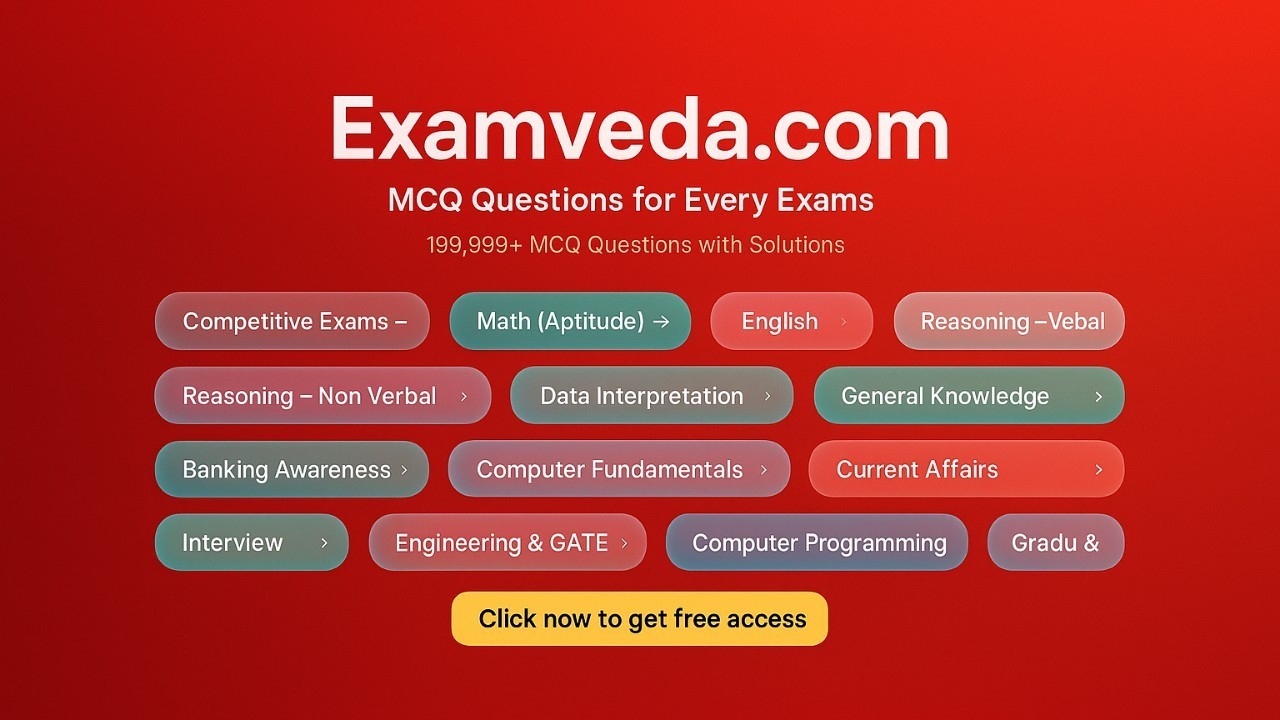
ExamVeda is a free practice-question website for competitive exams, built around multiple-choice questions (MCQs) with answers and explanations. Its focus is breadth: a single place to drill aptitude, English, reasoning, general knowledge, computer science, and engineering subjects, plus exam-specific sections for Indian competitive exams such as SSC CGL, SSC CHSL, Railway Group D, and RRB roles.
What you can practice
- Core exam subjects: Aptitude, English, Verbal and Non-Verbal Reasoning, General Knowledge, General Science, Computer Fundamentals, Data Interpretation, Banking Awareness, Current Affairs.
- Programming and computer topics: C, C++, Java, Python, JavaScript, SQL, databases, networking, data science, machine learning, cloud computing.
- Engineering and GATE subjects: Computer Science, Electronics & Communication, Mechanical, Civil, Electrical, Chemical, Automobile, Biotechnology, Mining, plus Engineering Mathematics, Physics, and Chemistry.
- Exam-wise tracks: SSC and Railway exams, with subjects, practice sets, and study material grouped by exam.
Who it suits
- Candidates doing quick, repeated MCQ drills before an exam and wanting an explanation when they get something wrong.
- Learners revising a technical subject (say, SQL or networking) who want short questions rather than long tutorials.
- Anyone who needs a single site covering many subjects, rather than one deep course.
Trade-offs
- It is a question bank, not a structured course: you choose what to practice, so a plan matters more than the site does.
- Explanations are typically short, which is fine for recall but weak for learning a topic from scratch.
- Breadth means depth varies by subject; treat it as a supplement to a textbook or video course.
A useful next step: pick your target exam, list its subjects, and work through one topic at a time — attempt the MCQs first, then read the explanation only for the ones you miss. If you want structured video lessons alongside practice, pair it with ExamVeda for questions and a dedicated course platform for teaching.
Which competitive exams can I prepare for on ExamVeda?
ExamVeda organises its practice material around two broad categories: individual subjects and specific exams. You can prepare for the exams it lists directly, and you can also drill any subject that overlaps with an exam you are targeting elsewhere.
Exam-wise tracks named on the site
- SSC exams: SSC CGL, SSC CHSL, SSC MTS
- Railway exams: Railway Group D, RRB ALP, RRB Technician, RRB Section Controller
The site also groups these under broader "SSC Exams," "Railway Exams" and "All Exams" entry points, so the exam list is likely to grow beyond the four railway and three SSC tracks shown.
Subject-wise practice, which is where the volume is
- Aptitude and reasoning: Arithmetic Aptitude, Verbal Reasoning, Non-Verbal Reasoning, Data Interpretation
- Language and awareness: English, General Knowledge, General Science, Banking Awareness, Current Affairs
- Computing: Computer Fundamentals, Networking, Database, SQL, C, C++, Java, Python, JavaScript, Data Science, Machine Learning, Cloud Computing
- Engineering and GATE: Computer Science, Electronics & Communication, Mechanical, Civil, Electrical, Chemical, Automobile, Biotechnology, Mining, plus Engineering Mathematics, Physics and Chemistry
How to decide if it fits you
If you are preparing for SSC or railway recruitment, the exam-labelled tracks map most directly onto your syllabus. If you are preparing for banking, GATE, state exams or campus placements, the subject tracks are the more useful entry point — banking aspirants get a dedicated Banking Awareness section, GATE candidates get the engineering subjects, and programming or data-science learners get the technical MCQs.
A practical next step: open the exam page for your target exam first, note which subjects it lists, then use the subject pages to drill your weakest topic rather than working through every category. If your exam is not named on the site, treat the subject pages as a question bank that supplements your main syllabus, not as an exam-specific guide.
For a fuller picture of official syllabi and exam calendars, cross-check with the conducting bodies themselves, such as Staff Selection Commission and Indian Railways.
Does ExamVeda provide answer explanations for its practice questions?
Yes. ExamVeda presents its practice sets as multiple-choice questions with answers and explanations, not just an answer key. The page describes each subject area as "Practice MCQ Questions and Answers," and the site's own summary states the questions come "with easy explanations."
What that looks like in practice
- Subjects are organised into separate practice banks: Aptitude, English, Verbal and Non-Verbal Reasoning, General Knowledge, General Science, Computer Fundamentals, Data Interpretation, Banking Awareness and Current Affairs.
- Exam-wise sections cover SSC CGL, SSC CHSL, SSC MTS, Railway Group D, RRB ALP, RRB Technician and RRB Section Controller, alongside broader SSC and Railway exam categories.
- Technical banks include Computer Fundamentals, Networking, Database, SQL, C, C++, Java, Python, JavaScript, Data Science, Machine Learning and Cloud Computing.
- Engineering and GATE topics span Computer Science, Electronics & Communication, Mechanical, Civil, Electrical, Chemical, Automobile, Biotechnology, Mining, Engineering Mathematics, Physics and Chemistry.
How to use the explanations well
Treat the explanation as the actual study material, not the score. After answering, read why the correct option works and why each distractor fails — that is where most competitive-exam value sits, especially in reasoning and aptitude where the method matters more than the answer.
A practical routine: attempt a timed block, mark every question you got right by guessing, then read only those explanations plus your wrong ones. That targets the gaps a score alone hides.
A decision criterion
If you need structured concept teaching — full theory chapters, worked derivations, video lectures — a question bank with explanations will feel thin on its own. If you already have a syllabus or textbook and need volume plus quick feedback, this format fits. Use the subject and exam lists to check coverage for your specific target exam before committing, since breadth across many exams does not guarantee depth in any single one.
For a second opinion on a topic, general reference sources such as Wikipedia can help clarify a concept, but they are not exam-style practice.
Can I practice subject-wise MCQs like English, reasoning, or computer programming on ExamVeda?
Yes. ExamVeda is built around subject-wise multiple-choice practice, and the subject list on the page covers exactly the areas you mention: English, verbal and non-verbal reasoning, quantitative aptitude, general knowledge, general science, computer fundamentals, data interpretation, banking awareness and current affairs.
For computer programming specifically, the site goes beyond fundamentals into networking, databases, SQL, C, C++, Java, Python, JavaScript, data science, machine learning and cloud computing. There is also a separate engineering and GATE section with computer science, electronics, mechanical, civil, electrical and other branches, plus engineering mathematics, physics and chemistry. Exam-wise tracks such as SSC CGL, SSC CHSL, SSC MTS, Railway Group D, RRB ALP and RRB Technician sit alongside the subject categories.
How to use it well
- Start from the exam, not the subject, if you have a fixed date. Pick your target exam track first, then work through the subjects it lists. That keeps your practice aligned with what the paper actually tests.
- Use subject pages for weak-area repair. If English or reasoning is dragging your score down, a dedicated subject set lets you drill one topic without mixing in unrelated material.
- Treat the explanations as the main value. The page describes answers with explanations, so after each set, review why the wrong options were wrong rather than just checking your score.
- Do mixed sets after topic sets. Once individual subjects feel comfortable, switch to exam-wise practice to get used to switching between aptitude, reasoning and language questions under time pressure.
A practical scenario
Suppose you are preparing for a railway or SSC-level exam and your arithmetic is fine but your English and non-verbal reasoning are inconsistent. A sensible week is: two short English sets and two reasoning sets on alternating days, each followed by a review of every missed question, then one full exam-wise set at the weekend to check whether the improvement holds when subjects are mixed.
Where to look next
If you want a second source for comparison or extra question volume, IndiaBIX is a long-established aptitude and reasoning practice site, and GeeksforGeeks covers programming and computer science topics in more depth than a pure MCQ bank. For official exam patterns and syllabi, always check the conducting body's own site rather than a practice portal, since question banks can lag behind format changes.
Is ExamVeda free to use, or does it require a paid subscription?
ExamVeda is presented as a free practice portal: the page describes open MCQ practice with answers and explanations, and there are no pricing or subscription signals on the page. That means the core activity — browsing questions, checking answers and reading explanations — is intended to be usable without paying.
What “free” covers here
- Subject-wise MCQ practice: aptitude, English, verbal and non-verbal reasoning, general knowledge, general science, computer fundamentals, data interpretation, banking awareness and current affairs.
- Exam-wise resources: SSC CGL, SSC CHSL, SSC MTS, Railway Group D, RRB ALP, RRB Technician and RRB Section Controller, plus SSC and Railway exam hubs.
- Technical and engineering sets: computer science, programming languages (C, C++, Java, Python, JavaScript), networking, databases, SQL, data science, machine learning, cloud computing, and GATE-oriented engineering subjects.
Practical trade-off
Free MCQ banks are good for volume and quick self-testing; they rarely replace a structured syllabus, timed mock exams or personalised feedback. If your exam has negative marking or sectional timing, use the site for topic drilling and pair it with full-length timed mocks elsewhere.
Next step
Pick one weak topic, attempt a timed set, and note every wrong answer with the reason. If the explanations are enough to correct your reasoning, keep using the free sets; if you need exam-day simulation, add a timed mock source. For Indian government exam practice, compare with National Portal of India for official notifications, and Staff Selection Commission or Indian Railways for exam-specific updates.
How is ExamVeda different from other online MCQ practice platforms?
ExamVeda is a broad, free-to-browse MCQ drill site rather than a structured course platform. Its distinguishing trait is the sheer spread of subjects in one place: aptitude, English, verbal and non-verbal reasoning, general knowledge, general science, computer fundamentals, data interpretation, banking awareness and current affairs sit alongside programming topics (C, C++, Java, Python, JavaScript, SQL, databases, networking, data science, machine learning, cloud computing) and engineering/GATE subjects such as electronics, mechanical, civil, electrical, chemical, automobile, biotechnology, mining, engineering mathematics, physics and chemistry. It also organizes material exam-wise, for example SSC CGL, SSC CHSL, SSC MTS, Railway Group D, RRB ALP, RRB Technician and RRB Section Controller.
Where it tends to differ from typical alternatives
- Breadth over depth of structure. Many competitors are either exam-specific (banking, civil services) or subject-specific (coding interview prep). ExamVeda's overlap of school-level GK, government-exam aptitude and technical MCQs is unusual in a single catalog.
- Answers with explanations as the core unit. The site's own framing is "questions with answers and explanations," so the value is in checking reasoning after an attempt, not in video teaching or adaptive learning paths.
- Exam-tagged navigation. You can start from a target exam or from a subject, which suits candidates preparing for multiple similar exams at once.
What that means in practice
A typical user is a government-exam aspirant who wants quick timed sets of aptitude, reasoning and GK, or an engineering student revising GATE-style technical questions. If you need full syllabi, live classes, mentor feedback or performance analytics, a dedicated coaching platform will fit better; ExamVeda is best treated as a question bank to supplement whatever you already use.
How to decide
- Pick one weak topic and one target exam.
- Attempt 20–30 questions there and check whether the explanations actually resolve your doubt.
- Compare the effort against a focused alternative for that same topic, such as IndiaBIX for aptitude and reasoning, GeeksforGeeks for programming and CS fundamentals, or Khan Academy if you need conceptual teaching rather than drilling.
If the explanations on ExamVeda clear your doubts faster than those alternatives, use it as your default drill bank; if not, keep it only for the subjects where its coverage is widest.
 GoDaddy
 Singapore

User reviews (0)