Website profiles · Technology insights · Alternatives

fullstackdeeplearning.com

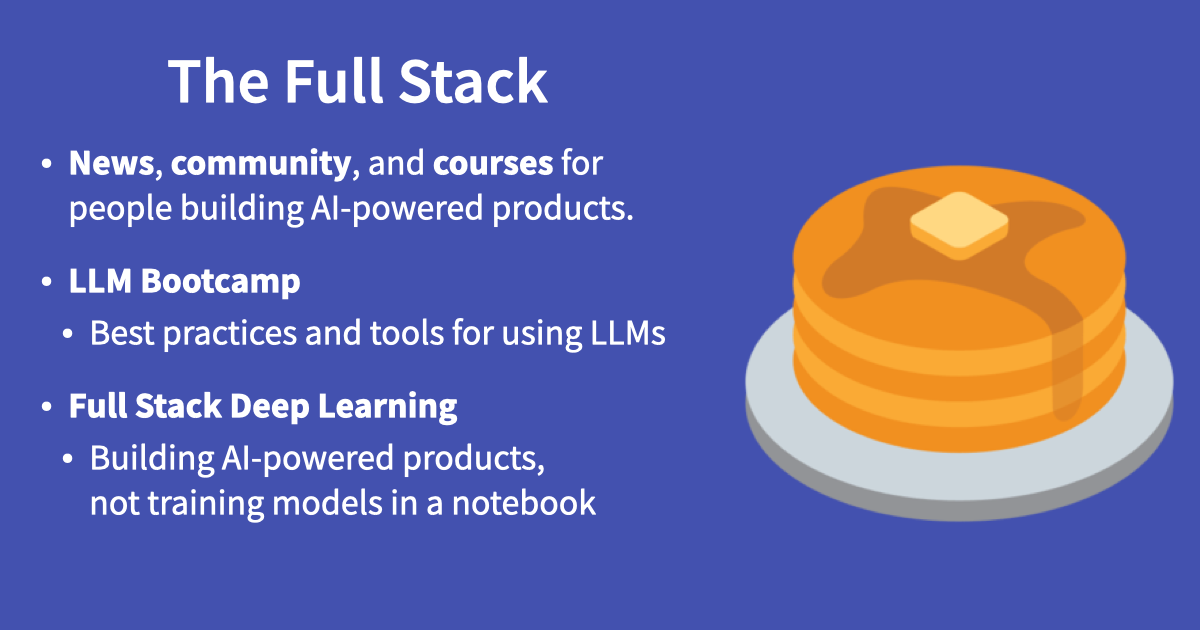
News, community, and courses for people building AI-powered products.

No paid content found
Visit website
Profile views 12 Outbound visits 14 Normal
The Full Stack Full homepage screenshot

At a glance

Category
Artificial Intelligence
Language
English
Paid-content signal
No paid content foundObserved
Registered
2018
Hosting
FastlyInferred
HTTPS certificate trusted
PassedObserved
Last updated

Website review

This review may include AI-generated content and is not individually verified. Domain, certificate and other facts come from the observed data on this page.

What is The Full Stack?

The Full Stack is an education and community hub for people building AI-powered products, rather than a place to train a single model. Its stated focus spans the whole product lifecycle: framing the problem, choosing a GPU or foundation model, deploying to production, supporting continual learning and designing the user experience.

It is best suited to developers, technical founders, product engineers and ML practitioners who need to ship an application, not just understand a model in isolation. The content is organised into two main course tracks:

  • Large Language Models Bootcamp (2023): an LLM-focused path covering LLM foundations, prompt engineering, augmented language models, a project walkthrough, UX for language interfaces, LLMOps and what comes next.
  • Deep Learning Course (2022): a broader application-building path from course vision and development infrastructure through data management, deployment, continual learning, foundation models, ML teams and ethics.

There are also older course archives, a blog and a community element, so the site works as a reference library as well as a course platform. A practical way to choose: if you are building an LLM feature or product, start with the LLM Bootcamp; if you need the wider engineering and operational foundations around a deep learning product, start with the 2022 course.

For a concrete next step, pick the track that matches your current project and work through it alongside your own build rather than as passive viewing. If you want to see how the material compares with other structured AI engineering resources, look at DeepLearning.AI for short courses and The Full Stack for the end-to-end product lifecycle framing.

How can I launch an LLM app in one hour?

The Full Stack's own course materials include a session titled "Launch an LLM App in One Hour," so the site is a reasonable place to start if you want a guided, end-to-end walkthrough rather than scattered tutorials. The broader framing on The Full Stack is that shipping an AI product involves problem definition, model or API choice, deployment, and user experience — not just prompt writing.

What "one hour" realistically covers

A one-hour launch is a prototype, not a production system. Expect to get a working loop: a user input, a model call, and a rendered response. You will not cover evaluation, cost controls, or monitoring in that window. Treat the hour as a way to validate the idea and learn the toolchain.

A practical sequence for that hour:

  1. Pick a narrow task with a single input and a single output (for example, summarize a pasted document).
  2. Choose a hosted model API instead of training anything. Training your own model is a separate, much longer project.
  3. Write the smallest possible interface — a script or a single-page form.
  4. Add one guardrail: a token or length limit, so a runaway request does not surprise you.
  5. Deploy to a simple host and share the link with one person for feedback.

Where the trade-offs sit

Choice Fast path Slower path
Model Hosted API Fine-tuned or self-hosted model
Interface Script or minimal web form Full app with accounts and history
Scope One task, one user Multi-user, multi-step workflows
Evaluation Manual spot checks Automated test sets

The fast path is right when you are testing whether the idea is useful. Move toward the slower path once real users depend on the output.

A concrete scenario

Suppose you want a tool that turns meeting notes into action items. In an hour you can wire a form to a model API, prompt it to return a list, and display the result. That is enough to show a colleague and see whether the output is good enough to trust. The next step — not part of the hour — is collecting a handful of real notes and checking where the model fails, which is where the site's emphasis on the full lifecycle becomes relevant.

Next step

Start with the "Launch an LLM App in One Hour" session on The Full Stack, then use its LLM Bootcamp material to fill in prompt engineering and operations once the prototype works. If you prefer a broader course format, the site also offers a deep learning course that builds an application from the ground up, though that is a longer commitment than an hour.

What is covered in the LLM Bootcamp course?

The LLM Bootcamp is a free, recorded course from The Full Stack (Spring 2023) aimed at developers who want to build applications on top of large language models rather than train them from scratch. It walks through the practical layers of an LLM app: foundations, prompting, augmented language models, project walkthroughs, operations, and user experience. The Full Stack

Topics in the course

  • LLM foundations — how these models work at a conceptual level before you start building.
  • Prompt engineering — the "Learn to Spell" segment treats prompting as a skill to practice deliberately.
  • Augmented language models — connecting models to external tools, retrieval, or data so they can do more than generate text.
  • Project walkthrough — an "askFSDL" example builds a working app end to end, which is useful if you learn best by following a concrete codebase.
  • LLMOps — the operational side: managing, evaluating, and running LLM-powered systems in production.
  • UX for language user interfaces — designing interactions for products where the interface is conversational or generative.
  • Guest sessions — Reza Shabani on training your own LLM and Harrison Chase on agents, plus a fireside chat with Peter Welinder.
  • What's next — a closing look at where the field and tooling are heading.

Who it suits, and how to use it

If you are a software engineer or product builder who wants to ship an LLM feature (a support assistant, a search-and-summarize tool, an internal agent) this course targets that path directly. If you are a researcher focused on model architecture or pretraining, the coverage will feel shallow on those fronts — the emphasis is application building.

A practical next step: pick the "askFSDL" walkthrough and rebuild it with your own data or API, then revisit the LLMOps and UX segments once your prototype works, since those concerns surface only after you have something running.

How do I build an AI-powered product from scratch?

Start by treating the product as a system, not a model. The Full Stack frames this directly: "Building an AI-powered product is much more than just training a model or writing a prompt," and it organizes learning around the whole lifecycle — defining the problem, choosing a GPU or foundation model, deployment, continual learning and UX. That lifecycle is the right mental model for a from-scratch build.

A practical build order

  1. Define the problem and the user job. Write down what the user is trying to accomplish and what a good output looks like. This decides whether you need an LLM, a classic ML model, or no model at all.
  2. Prototype with a foundation model. For most new products, an API-based model gets you to a testable app fastest. Prompt engineering and evaluation matter more early on than training.
  3. Build the thin slice end to end. One real user path, real data, real UI. The Full Stack's one-hour LLM app session and the askFSDL project walkthrough are examples of this "working app first" approach.
  4. Add the unglamorous layers. Data management, annotation, experiment tracking, testing, deployment and monitoring. The 2022 Deep Learning Course covers these as lectures and labs, which reflects how much of the work sits outside the model.
  5. Iterate in production. Continual learning and monitoring are where quality actually compounds.

Where to learn it

  • The Full Stack — free course materials, a community, and a newsletter for people building AI products. Its LLM Bootcamp covers LLM foundations, prompt engineering, augmented language models, LLMOps and UX for language interfaces; the Deep Learning Course goes deeper into infrastructure, data, deployment and monitoring.
  • The Full Stack is also the place to check for the Multiplayer AI Manifesto and agent-focused material if your product is collaborative or agentic.

How to choose your path

Situation Fastest route Trade-off
Validating an idea Foundation model API plus prompt engineering Less control, ongoing per-call cost, vendor dependency
Sensitive or proprietary data Open model you host or fine-tune More engineering and ops work
Clear, narrow, repeatable task Classic ML or a small fine-tuned model Needs labeled data and monitoring
Broad, open-ended task Large foundation model with retrieval Harder to evaluate, more UX work

A useful next step: pick one user-facing task, build the smallest end-to-end version this week using a hosted model, and only then decide whether training or fine-tuning is worth it. If you want structured guidance, work through the LLM Bootcamp first for app-level practice, then the Deep Learning Course for the infrastructure and lifecycle skills.

What are best practices for working with AI agents?

The Full Stack treats agent work as an engineering-lifecycle problem, not a prompt-writing trick. Its page frames building an AI-powered product as spanning problem definition, model or GPU selection, deployment, continual learning and UX — and its “Working with AI Agents” section plus an agents fireside chat sit alongside that broader curriculum. So the practical takeaway is to manage agents the way you manage any production system: define the job, instrument it, and iterate.

Practices worth adopting

  • Write down what the agent is for. Start from the user problem and the decision it supports, not from the model. The site’s framing — “much more than just training a model or writing a prompt” — is a useful check against demo-driven development.
  • Treat prompts as one component. Prompt engineering appears as a foundation, not the whole discipline; pair it with retrieval, tools and evaluation.
  • Build evaluation before scaling. If you cannot measure whether an agent’s multi-step run succeeded, you cannot safely change its prompts, tools or model.
  • Instrument and monitor in production. Continual learning and monitoring are explicit parts of the lifecycle, which matters more for agents because failures compound across steps.
  • Design the interface around uncertainty. The UX-for-language-interfaces material is relevant: users need to see what the agent did, correct it, and approve consequential actions.
  • Decide build vs. buy deliberately. The site includes a talk on training your own LLM versus using foundation models — a real trade-off in cost, control and latency.

A concrete scenario

A small team wants an agent that triages support tickets. A reasonable sequence: define the ticket categories and the escalation rules; prototype with a hosted foundation model and a retrieval layer over past tickets; log every tool call and outcome; run a labelled evaluation set before each prompt or model change; then add human approval for refunds or account changes. Only after that does training or fine-tuning a model make sense.

Choosing where to learn more

If your need is… Look at…
End-to-end LLM app foundations The Full Stack’s LLM bootcamp material
Broader ML product lifecycle Its deep learning course lectures on deployment, monitoring and data
Agent-specific discussion The agents fireside chat and Working with AI Agents pages

For adjacent perspectives, the official sites of The Full Stack host the course material itself; OpenAI and Anthropic publish agent-building guidance and tool-use documentation; LangChain documents agent frameworks and evaluation tooling. Compare their evaluation and observability advice against your own logging setup — that is usually where agent projects quietly fail.

How can I train my own LLM?

Training your own LLM usually means one of two very different projects: teaching an existing open model new behavior with your own data (fine-tuning), or training a model largely from scratch. Most individuals and small teams should start with the first.

The Full Stack is a practical fit here because its material covers the full lifecycle of an AI product — problem definition, picking a GPU or foundation model, deployment, continual learning and UX — rather than only model training. Its course catalog includes a talk titled "How to train your own LLM" and an LLM Bootcamp covering foundations, prompt engineering, augmented language models, LLMOps and project walkthroughs.

H3 What each path actually involves

  • Fine-tuning an open model: You supply a dataset of examples, choose a base model, and adjust its weights. This is the realistic route for a specific task, tone or domain vocabulary. Costs are mostly data preparation and GPU rental time.
  • Continued pre-training: You keep training a base model on a large domain corpus to shift its general knowledge. Needs far more data and compute than fine-tuning.
  • Training from scratch: You define architecture, tokenizer and data pipeline, then run a long, expensive training job. Justified mainly for research, unusual languages or domains, or strong control requirements.

H3 A concrete first project

Suppose you want a support assistant that answers from your internal documentation. Collect a few thousand question–answer pairs, fine-tune a small open-weight model, evaluate it on held-out questions, then deploy it behind a simple interface. If quality is poor, the usual cause is data, not the model — so fix examples before renting bigger GPUs.

H3 Decision criteria

Situation Sensible starting point
Narrow task, limited budget Prompting, then fine-tuning a small open model
Domain jargon or style matters Fine-tuning on curated examples
Need broad new knowledge Continued pre-training, if you have the data and compute
Research or strict control needs Training from scratch

For broader context, The Full Stack offers free course material on the surrounding engineering. You can also compare approaches with Hugging Face for open models and datasets, and PyTorch for the training framework itself.

Next step: write down your task, the data you already have, and your compute budget. If you cannot describe the task in one sentence, you are not ready to train — start with prompting and evaluation instead.

Related questions

More questions →
How to Access The Full Stack's News, Community, and Course Content

The Full Stack (fullstackdeeplearning.com) is a site for people building AI-powered products, offering news, community, and courses. You can reach its main content through the top-level navigation: Home, Working with AI Agents, LLM Bootcamp, Deep Learning Course, Blog, and Cloud GPUs. Course materials are organized by year and program, and at least some content is explicitly offered for free — the site states, "We are excited to share this course with you for free." A subscribe option also exists, but the available evidence doesn't specify what it includes or whether it costs anything.

Site Sections and What Each One Holds

Section What you'll find
Home Overview of the site's mission: learning and sharing best practices across the full lifecycle of an AI-powered product
Working with AI Agents Content on building with AI agents, including a "Multiplayer AI Manifesto"
LLM Bootcamp Spring 2023 bootcamp on LLM-powered apps
Deep Learning Course FSDL 2022 course, plus older FSDL 2021, 2020, 2019, and 2018 materials
Blog Posts such as "Introducing the Multiplayer AI Manifesto" and "Cloud GPUs"
Cloud GPUs A dedicated page on GPU options

The site frames its scope broadly: "Building an AI-powered product is much more than just training a model or writing a prompt." It covers everything from defining the problem and picking a GPU or foundation model through production deployment, continual learning, and UX design.

LLM Bootcamp (Spring 2023)

This is the entry point if you want to explore the foundations of LLM-powered apps. The listed sessions are:

  • Launch an LLM App in One Hour
  • LLM Foundations
  • Learn to Spell: Prompt Engineering
  • Augmented Language Models
  • Project Walkthrough: askFSDL
  • UX for Language User Interfaces
  • LLMOps
  • What's Next?
  • Reza Shabani: How to train your own LLM
  • Harrison Chase: Agents
  • Fireside Chat with Peter Welinder

The sequence moves from a fast first build through foundations, prompting, and tooling, then into operations and guest talks. If you're new to LLM apps, "Launch an LLM App in One Hour" followed by "LLM Foundations" is the natural starting pair.

Deep Learning Course (FSDL 2022)

The 2022 course pairs lectures with labs, so you can read a concept and then practice it. The lecture/lab structure is:

  • Lecture 1: Course Vision and When to Use ML — Lab Overview
  • Lecture 2: Development Infrastructure & Tooling — Lab 4: Experiment Management
  • Lecture 3: Troubleshooting & Testing — Lab 5: Troubleshooting & Testing
  • Lecture 4: Data Management — Lab 6: Data Annotation
  • Lecture 5: Deployment — Lab 7: Web Deployment
  • Lecture 6: Continual Learning — Lab 8: Model Monitoring
  • Lecture 7: Foundation Models
  • Lecture 8: ML Teams and Project Management
  • Lecture 9: Ethics
  • Project Showcase

Note that the lab numbering doesn't line up one-to-one with lecture numbering in the listing, so treat the labs as a separate track rather than assuming Lab 4 belongs only to Lecture 2.

Older Course Archives

If you want earlier or more foundational material, the site keeps prior years online:

  • FSDL 2021 — a synchronous online course with lectures on DL fundamentals, CNNs, RNNs, transformers, ML projects, MLOps infrastructure, troubleshooting, data management, AI ethics, testing and explainability, deployment and monitoring, research directions, and ML teams and startups. It also includes a panel discussion, "Do I need a PhD to work in ML?", and a course projects showcase.
  • FSDL 2021 (Berkeley), FSDL 2020 (UW), FSDL 2019 (Online), FSDL 2019 (Bootcamp), and FSDL 2018 (Bootcamp) are also listed.

The 2021 labs cover setup and introduction, coding a neural net, CNNs and synthetic data, RNNs, transformers, experiment management, data labeling, paragraph recognition, testing and CI, and web deployment.

News and Community

The site describes itself as offering "news, community, and courses for people building AI-powered products," and the Home page says The Full Stack "brings people together to learn and share best practices." The Blog is where news-style posts appear — for example, "Introducing the Multiplayer AI Manifesto." A subscribe option is present on the site; the available evidence doesn't say what subscribing gets you or whether it involves payment, so check the subscribe flow directly if that matters to you.

How to Decide Where to Start

  • New to LLM apps: Start with the LLM Bootcamp, beginning with "Launch an LLM App in One Hour."
  • Want the full product lifecycle: Work through the FSDL 2022 Deep Learning Course lectures and labs.
  • Need fundamentals first: Use the FSDL 2021 archive, which covers CNNs, RNNs, and transformers before moving to MLOps and deployment.
  • Just want updates: Check the Blog and the subscribe option.

One practical note: the site states that at least one course is shared for free, but free access isn't confirmed for every section. Verify on the specific course page before assuming a given program is free.

What courses and learning materials does The Full Stack offer?

The Full Stack (fullstackdeeplearning.com) offers three main tiers of learning material: a 2023 Large Language Models Bootcamp focused on LLM-powered apps, a 2022 Deep Learning Course covering the full ML product lifecycle, and older FSDL course archives from 2018–2021. The site states its materials are shared for free, and the content spans lectures, labs, and project walkthroughs. Which tier fits you depends on whether you're building LLM applications, working on broader ML systems, or looking for foundational deep learning material.

2023 Large Language Models Bootcamp

This is the most current offering and the one to start with if your goal is building LLM-powered applications. The bootcamp covers the foundations of LLM apps, and its published sessions include:

  • Launch an LLM App in One Hour — a fast, practical entry point
  • LLM Foundations — background on how these models work
  • Learn to Spell: Prompt Engineering — prompting as a skill
  • Augmented Language Models — extending LLMs with external tools and data
  • Project Walkthrough: askFSDL — a full example build
  • UX for Language User Interfaces — designing the user-facing layer
  • LLMOps — operating LLM apps in production
  • What's Next? — closing perspective on the field

There are also guest sessions: Reza Shabani on training your own LLM, Harrison Chase on agents, and a fireside chat with Peter Welinder.

Choose this if: you want to ship an LLM application and need both the engineering and UX sides, not just model theory.

2022 Deep Learning Course (FSDL 2022)

This course treats an AI product as a full lifecycle problem, not a modeling exercise. Its lecture and lab pairs walk through:

Topic Lecture Lab
Course vision / when to use ML Lecture 1 Lab Overview
Development infrastructure & tooling Lecture 2 Lab 4: Experiment Management
Troubleshooting & testing Lecture 3 Lab 5: Troubleshooting & Testing
Data management Lecture 4 Lab 6: Data Annotation
Deployment Lecture 5 Lab 7: Web Deployment
Continual learning Lecture 6 Lab 8: Model Monitoring
Foundation models Lecture 7 —
ML teams & project management Lecture 8 —
Ethics Lecture 9 —

There's also a project showcase and a course announcement.

Choose this if: you're building a broader ML-powered product and need to understand infrastructure, data, deployment, monitoring, and team process — the parts that sit around the model.

Older FSDL archives (2018–2021)

The site keeps earlier cohorts available, which is useful if you want fundamentals or a sense of how the curriculum evolved.

  • FSDL 2021 — a synchronous online course with a full lecture/lab sequence: DL fundamentals, CNNs, RNNs, transformers, ML projects, MLOps infrastructure, troubleshooting deep neural networks, data management, AI ethics, testing & explainability, deployment & monitoring, research directions, and ML teams/startups. Includes a panel discussion, "Do I need a PhD to work in ML?", plus a course projects showcase.
  • FSDL 2021 (Berkeley), FSDL 2020 (UW), FSDL 2019 (Online), FSDL 2019 (Bootcamp), and FSDL 2018 (Bootcamp) — earlier versions of the same program.

Choose this if: you want deep learning fundamentals (CNNs, RNNs, transformers) or you're working through the material in order and want the historical foundation the later courses build on.

How to decide

  • Building an LLM app now → start with the 2023 LLM Bootcamp, especially "Launch an LLM App in One Hour" and the askFSDL walkthrough.
  • Building a general ML product → the 2022 Deep Learning Course, since it covers the lifecycle from problem definition through monitoring.
  • Learning fundamentals or filling gaps → the 2021 archive for CNNs, RNNs, and transformers before moving to the newer material.
  • Just exploring → the site's blog and news sections sit alongside the courses, and the Multiplayer AI Manifesto is a short read on the site's philosophy of building AI products.

One caveat worth noting: the site's pricing signals point to a "subscribe" action, and the page states the course is shared "for free," but the material does not specify whether every resource or future offering carries the same terms. Treat the free framing as applying to the course materials described here rather than as a blanket statement about all site features.

What is The Full Stack (fullstackdeeplearning.com)?

The Full Stack is a hub for news, community, and courses aimed at people building AI-powered products. Its stated premise is that shipping an AI product involves much more than training a model or writing a prompt — the site covers the whole lifecycle, from defining the problem and choosing a GPU or foundation model through production deployment, continual learning, and user experience design. It is a good fit if you want free, structured course material on applied AI engineering rather than research papers or a single-model tutorial.

What the site actually contains

The homepage organizes its material into three course tracks plus a blog and news section:

Section What it covers Notable items
LLM Bootcamp (Spring 2023) Foundations of LLM-powered apps "Launch an LLM App in One Hour," LLM Foundations, Prompt Engineering, Augmented Language Models, a project walkthrough (askFSDL), UX for language UIs, LLMOps, "What's Next?"
Deep Learning Course (FSDL 2022) Building an AI application from the ground up Lectures on course vision and when to use ML, development infrastructure and tooling, troubleshooting and testing, data management, deployment, continual learning, foundation models, ML teams and project management, ethics
Older courses (FSDL 2021, 2021 Berkeley, 2020 UW, 2019, 2018) Earlier iterations of the same curriculum Deep learning fundamentals, CNNs, RNNs, transformers, MLOps infrastructure, data labeling, testing and CI, web deployment, research directions, panels such as "Do I need a PhD to work in ML?"

The 2022 and 2023 tracks pair lectures with labs — for example, experiment management, data annotation, web deployment, and model monitoring — so the material is oriented toward doing the work, not just reading about it.

Who it is for

The site describes its audience as people building AI-powered products, and explicitly frames the scope as broader than model training or prompt writing. In practice that means:

  • Engineers moving from a model or prototype to a shipped product, who need deployment, monitoring, and continual learning practices.
  • Teams deciding how to structure an ML project, including when to use ML at all and how to manage data and experiments.
  • People working on LLM applications, who want the 2023 bootcamp's coverage of prompting, augmented language models, and LLMOps.
  • Those weighing a career or team question, served by lectures on ML teams, project management, and startups.

It is less suited to someone looking for a single framework's API reference or a pure deep-learning theory course.

How to use it

  1. Pick the track that matches your stage: the 2023 LLM Bootcamp for LLM apps, the 2022 Deep Learning Course for end-to-end product building, or the older courses for fundamentals.
  2. Work through lectures in order and do the associated labs, since the labs are where tooling and troubleshooting practices are exercised.
  3. Use the blog and news section for updates — for example, the "Multiplayer AI Manifesto" post — and the community as a place to compare practices.

Practical notes

The site states that at least one course is shared for free ("We are excited to share this course with you for free"), and the homepage surfaces a "subscribe" option, which indicates some form of ongoing updates or membership. Pricing details beyond that are not specified on the page, so treat cost and access terms as something to confirm on the site itself rather than assuming everything is free or unrestricted.

What "Full Stack" Means for AI Products, According to The Full Stack

"Full stack" in AI product development, as framed by fullstackdeeplearning.com, means the entire lifecycle of an AI-powered product — not just the model. The site states directly that "building an AI-powered product is much more than just training a model or writing a prompt," and describes the stack as spanning "from defining the problem and picking a GPU or foundation model to production deployment and continual learning to user experience design." That definition applies whether you're building an LLM app or a more traditional ML product; the specific stages shift, but the full-lifecycle scope does not.

The stages the site names

The Full Stack's own description lists these stages as part of the lifecycle:

  • Defining the problem — deciding what the product is actually for before choosing technology
  • Picking a GPU or foundation model — the infrastructure and model-selection decision
  • Production deployment — getting the system running for real users
  • Continual learning — keeping the system improving after launch
  • User experience design — how people interact with the AI, treated as a first-class concern rather than an afterthought

The framing is deliberately broad: the site says it brings people together to "learn and share best practices across the entire lifecycle of an AI-powered product." So "full stack" here is a claim about scope — the model is one component, and the surrounding engineering, operations, and design work is where much of the difficulty lives.

What the course material covers

The site's published material maps onto that lifecycle rather than staying inside model training. Its 2023 Large Language Models Bootcamp is described as covering "the foundations of LLM-powered apps," with listed sessions including:

  • Launch an LLM App in One Hour
  • LLM Foundations
  • Learn to Spell: Prompt Engineering
  • Augmented Language Models
  • Project Walkthrough: askFSDL
  • UX for Language User Interfaces
  • LLMOps
  • What's Next?

That list is itself a compact illustration of the full-stack idea: foundations, prompting, retrieval-style augmentation, a project walkthrough, UX, and operations — with LLMOps and UX sitting alongside the modeling topics rather than after them.

The 2022 Deep Learning Course covers the same lifecycle from the deep-learning side, with lectures on development infrastructure and tooling, troubleshooting and testing, data management, deployment, continual learning, foundation models, and ML teams and project management, plus labs on experiment management, data annotation, web deployment, and model monitoring.

Why the "more than a model" framing matters

The practical implication of this definition is that evaluating an AI product effort only by model quality misses most of the work. The site's stage list points to decisions that are not modeling decisions at all: which foundation model or GPU to use, how the product behaves in production, how it keeps learning from new data, and how users actually experience it. The Full Stack also maintains a blog and news section and a community angle ("news, community, and courses"), which fits the same premise — that the hard parts are shared across teams and worth comparing notes on.

How to use this definition

If you're deciding whether the site's material is relevant to you, the test is whether your work touches more than the model. If you're choosing a model, deploying it, monitoring it, or designing the interface around it, the full-lifecycle framing matches your problem. If you only need model architecture theory, the site's own description suggests it is aiming at something wider.

One note on access: the site says of one course, "We are excited to share this course with you for free," and its pricing signals reference subscribing. Availability and any terms for specific courses are best confirmed on the site itself rather than assumed.

Website Overview

An established domain and managed infrastructure suggest continuity of operations and may support dependable delivery, although neither guarantees service quality. Page metadata, canonical configuration and social previews work together to provide more consistent search and sharing presentation.

Domain and Registration

Registered in 2018, this domain has about 8 years of history. That suggests continuity, although ownership and purpose may have changed. Transfer-protection status is present, helping reduce the risk of unauthorized domain transfers. The registrar is NameCheap, Inc., a widely used domain service provider. The domain uses the common .com extension, which is not an independent safety signal.

DNS and Email

Nameservers are provided by Cloudflare, indicating managed DNS hosting. MX records point to the Google Workspace email service. No CNAME was found; the observed records resolve directly to addresses. SPF and DMARC are configured. DKIM status is unknown. TXT records include verification markers for Google. Such markers may also remain after a service stops being used.

TLS and Certificates

The public key uses EC with 256 bits. The server supplied a complete certificate chain. No organization name is present in the certificate; the available fields are consistent with domain validation. The certificate was issued within the Google Trust Services cloud or CDN ecosystem. The certificate's total validity is about 90 days, consistent with a short renewal cycle.

HTTP and Browser Security

The checked browser-security headers were not detected, leaving fewer explicit browser-side safeguards. CORS permits any origin to read this response. This is common for public resources; sensitive responses need narrower handling. No X-Powered-By header was found, reducing one common source of backend fingerprinting information. The cf-ray, x-cache, x-served-by, via response header indicates a CDN or caching proxy in the delivery path. No obvious internal addresses or debug information were found in the headers.

Technology Stack Analysis

The public page identifies mkdocs-1.6.1, mkdocs-material-9.7.5, Google Analytics, Sentry, Cloudflare, Fastly without precise versions, leaving fewer clues for version-specific scanning.

Search and Social Sharing

The Generator tag identifies mkdocs-1.6.1, mkdocs-material-9.7.5, making the publishing system easier to fingerprint. Twitter Card metadata is configured. The title has 14 characters, within a common display range. A meta description is present, with 69 characters. The observed directives allow indexing and link following.

Hosting and Email

DNSCloudflare
HostingFastly
EmailGoogle Workspace
Approximate IP geolocation (inferred; a CDN or proxy may differ from the origin server) Location unknown Inferred 104.21.18.203

Registration details

RDAP / WHOIS

RegistrarNameCheap, Inc.
Registered2018-04-30
Expires2027-04-30
Domain statusclient transfer prohibited
Nameserverserin.ns.cloudflare.com、tim.ns.cloudflare.com
DNSSECunsigned

DNS records

DNS

TypeNameValueTTLPriority
Afullstackdeeplearning.com104.21.18.203300—
Afullstackdeeplearning.com172.67.183.85300—
AAAAfullstackdeeplearning.com2606:4700:3034::ac43:b755300—
AAAAfullstackdeeplearning.com2606:4700:3036::6815:12cb300—
MXfullstackdeeplearning.comaspmx.l.google.com3001
MXfullstackdeeplearning.comalt1.aspmx.l.google.com3005
MXfullstackdeeplearning.comalt2.aspmx.l.google.com3005
MXfullstackdeeplearning.comaspmx2.googlemail.com30010
MXfullstackdeeplearning.comaspmx3.googlemail.com30010
NSfullstackdeeplearning.comerin.ns.cloudflare.com86400—
NSfullstackdeeplearning.comtim.ns.cloudflare.com86400—
TXTfullstackdeeplearning.comgoogle-site-verification=5Ri42xpswXBxX_ImaQjEFQu-MHzPgl_vGHj2jP0Tmvc300—
TXTfullstackdeeplearning.comv=spf1 include:_spf.google.com include:servers.mcsv.net include:spf.mandrillapp.com ~all300—
DMARC_dmarc.fullstackdeeplearning.comv=DMARC1; p=none;3600—

TLS and certificates

TLS / SSL

AssessmentNormal configuration
Supported protocolsTLSv1.2、TLSv1.3
Negotiated protocolTLSv1.3
Certificate subjectfullstackdeeplearning.com
IssuerGoogle Trust Services
Valid until2026-12-18T17:46 · Remaining when checked: 77 days
Verification detailsCertificate trust: Passed · Hostname match: Passed

HTTP response headers

HTTP

HeaderValue
content-typetext/html; charset=utf-8
cache-controlmax-age=600
servercloudflare
access-control-allow-origin*

Identified technologies

mkdocs-1.6.1, mkdocs-material-9.7.5Google AnalyticsSentryCloudflareFastly

Pages, Search and Sharing

Meta descriptionNews, community, and courses for people building AI-powered products.
Canonical URLhttps://fullstackdeeplearning.com/
LanguageEnglish (default)
Twitter Cardsummary_large_image

No rules found

User reviews (0)

  • No reviews yet.