Website profiles · Technology insights · Alternatives

goldmineai.io

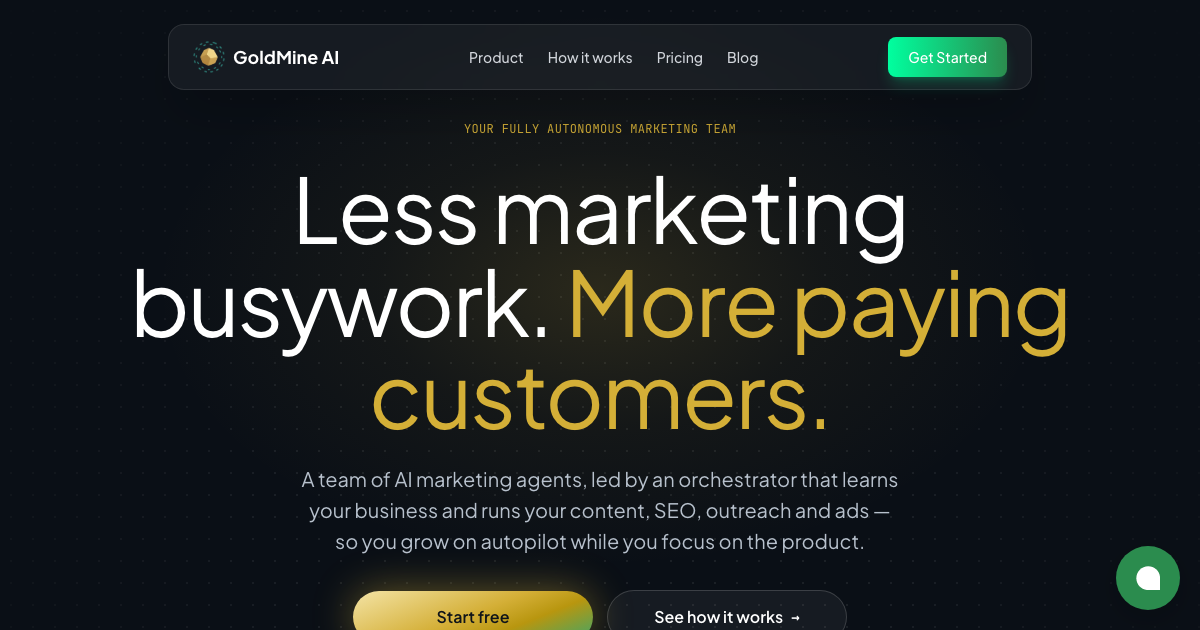
GoldMine AI gives solopreneurs and small teams a fully autonomous online marketing agent — one business brain (your Cortex) that learns over time. You manage by vibing, approving, and deciding.

No paid content found
Visit website
Profile views 10 Outbound visits 2 Normal
GoldMine AI Full homepage screenshot

At a glance

Category
Marketing
Language
English
Paid-content signal
No paid content foundObserved
Registered
2025
Hosting
VercelInferred
HTTPS certificate trusted
PassedObserved
Last updated

Website review

This review may include AI-generated content and is not individually verified. Domain, certificate and other facts come from the observed data on this page.

What is GoldMine AI?

GoldMine AI is an autonomous online marketing agent aimed at solopreneurs and small teams. Rather than a bundle of separate tools for content, SEO and campaigns, it is presented as one "business brain" — called your Cortex — that learns about your business over time and runs marketing work on your behalf. The intended working style is hands-off execution with you in a supervisory role: you set direction, review what it produces, and approve or reject decisions.

What that means in practice

  • One shared context instead of re-explaining your business to every tool.
  • Ongoing learning, so outputs should reflect your positioning more accurately as you correct and approve them.
  • A manager's role rather than an operator's: less drafting and scheduling, more judging and deciding.
  • A fit for people who can define their offer clearly but don't want to run marketing as a daily task.

Where the trade-offs sit

Autonomy concentrates risk. If the agent misreads your audience or tone, it can produce a steady stream of plausible but off-target work, and errors compound faster than they would with a tool you drive manually. A single brain also means less granular control than a stack of specialised apps, and less ability to swap out one function you dislike.

A useful test before committing: give it one narrow, measurable job — say, a month of search-focused content for a single service — and check whether the drafts need light editing or wholesale rewriting. If you're rewriting everything, the learning loop isn't working for you; if you're mostly approving, it is.

You can review the product's own description at GoldMine AI.

How does GoldMine AI differ from hiring a human marketing team or using standard AI writing tools?

GoldMine AI positions itself as a middle path: more autonomous than a standard AI writing tool, but without the cost and coordination overhead of a human marketing team. The core idea from its own description is a single "business brain" (called Cortex) that learns over time and runs marketing as an agent, with you managing by "vibing, approving, and deciding."

H3 Where the three options actually differ

Dimension GoldMine AI Human marketing team Standard AI writing tools
Scope Described as a fully autonomous online marketing agent Broad, but split across specialists Usually one task, e.g. drafting copy
Learning A shared "Cortex" that learns over time Learns from you and from market feedback Mostly stateless per prompt; limited memory
Your role Approve and decide Manage, brief, review Prompt, edit, publish
Best fit Solopreneurs and small teams Funded teams needing strategy and accountability Anyone needing fast drafts

H3 What this means in practice

A solopreneur launching a product typically juggles SEO, content, and social posts alone. A human team solves that but adds hiring, onboarding, and management time. A standard AI writer helps you draft faster, yet you still decide what to write, where to publish, and how to adapt over weeks. GoldMine AI's claim is that the agent handles that ongoing loop, while you stay in an approval role.

The trade-off is control and judgment: an autonomous agent can move faster across channels, but you are trusting its learning and its output quality. A human team brings accountability and strategic nuance that a single system may not match, and a plain AI writer keeps you fully in charge at the cost of doing more work yourself.

Next step: list the marketing tasks you currently do weekly. If most are repetitive execution (drafting, scheduling, optimizing), an autonomous agent is worth testing. If they are relationship- or strategy-heavy, a human team or a drafting tool will likely serve you better. You can review the product's own framing at GoldMine AI.

How does the Cortex learning system adapt to my specific business over time?

GoldMine AI describes its Cortex as a single "business brain" that accumulates context about your business and improves as you use it, rather than treating each campaign as a fresh start. You stay in the loop by reviewing, approving, or rejecting what the agent proposes; those decisions are the main way the system learns your preferences.

In practice, that means the value compounds: early outputs may need heavy correction, and later ones should need less. The adaptation is driven by your feedback and decisions, not by a static setup questionnaire.

H3 What "learning over time" likely affects

  • Voice and positioning: which phrasings, claims and angles you accept versus reject.
  • Audience assumptions: who your content is aimed at and what they respond to.
  • Channel priorities: where the agent spends effort based on what you approve.
  • Content patterns: formats, lengths and topics that survive your review.

H3 Practical way to judge it

Pick one narrow goal for the first month, such as a single content channel or one audience segment. Log how often you accept the agent's drafts unchanged in week one versus week four. If acceptance rises and edits shrink, the learning loop is working for your business. If it plateaus, your feedback may be too vague to be useful — specific rejections ("too salesy," "wrong audience," "off-brand claim") teach more than a simple no.

H3 Who this suits

Solopreneurs and small teams without a dedicated marketer benefit most, because the review-and-approve workflow matches how a founder already makes decisions. Teams with strict brand governance or regulated claims should expect to keep a human in the approval step regardless.

To go further, compare how other autonomous marketing tools handle memory and feedback, such as Jasper or HubSpot, and check whether their learning is per-brand or per-campaign.

What specific marketing tasks can GoldMine AI handle autonomously, such as SEO, content creation, or social media?

GoldMine AI is positioned as an autonomous marketing agent for solopreneurs and small teams, organized around a single "Cortex" business brain that learns over time. Based on that framing, the tasks it is built to take on are the recurring, research-and-production-heavy parts of online marketing rather than one-off creative direction.

Likely autonomous work

  • SEO: keyword and topic research, on-page recommendations, and ongoing optimization of existing pages.
  • Content creation: drafting blog posts, landing page copy, and other written assets from your positioning and past material.
  • Social media: generating and scheduling posts, plus adapting one piece of content into several platform-specific versions.
  • Campaign support: email sequences, ad copy variants, and repurposing content across channels.

Where you stay in the loop The product describes its management model as "vibing, approving, and deciding," which suggests a human-in-the-loop pattern: the agent proposes and executes, you review and approve. Expect to own strategy, brand voice, and final judgment calls.

A practical next step Pick the single channel where you already have some traction, run the agent there for two to three weeks, and compare its output against what you would have produced manually. That tells you quickly whether the time savings justify the oversight.

For a useful comparison, look at how established platforms frame similar capabilities: HubSpot for integrated CRM-plus-marketing workflows, Surfer for SEO content optimization, and Buffer for social scheduling. If your need is narrow, a specialist tool may fit better; if you want one agent coordinating several channels, a unified system is the stronger bet.

What level of involvement or oversight do I need to provide as a solopreneur using GoldMine AI?

You stay in a manager’s role: you set direction, review work, and make final calls, while the agent handles the ongoing execution.

GoldMine AI describes the setup as a “business brain” (your Cortex) that learns over time, with you managing by “vibing, approving, and deciding.” In practice, that means involvement comes in three modes:

  • Direction: You define what the business is, who it serves, and what outcomes matter. The agent can’t infer your positioning or risk tolerance from nothing.
  • Approval: You review and sign off on content, campaigns, or decisions before they go live. This is the main recurring time cost.
  • Decisions: When the agent surfaces options or trade-offs, you pick. You’re not writing the work; you’re choosing between paths.

The trade-off is straightforward. More upfront direction and tighter approval gates mean more predictable output but more of your time. Looser oversight saves time but raises the risk of off-brand or off-strategy work reaching your audience. The “learns over time” framing suggests your feedback during approvals is what improves future output, so early involvement pays off later.

A practical way to scope it: start with a single channel and a small batch of work, approve everything for the first two weeks, and note how often you change the agent’s output. If you’re mostly approving as-is, you can widen its autonomy. If you’re rewriting constantly, the direction needs work before you loosen the reins.

How much does GoldMine AI cost and is there a free trial available?

I can't give you GoldMine AI's pricing or confirm whether it offers a free trial. The information available to me about GoldMine AI describes it as an autonomous AI marketing agent for solopreneurs and small teams — a single "Cortex" business brain that learns over time, with you managing by reviewing, approving, and deciding — but it contains no pricing figures, plan tiers, or trial details. I won't invent numbers or guess at a trial that may not exist.

How to find the real answer

Go to the official site and look for a Pricing or Plans link in the main navigation or footer. If there's no pricing page, that usually means one of three things:

  • Pricing is quote-based, so you'd need to contact sales or book a demo.
  • There's a single plan with a signup flow that reveals cost at checkout.
  • The product is in early access or waitlist mode, where terms are set individually.

Check the signup or "Get started" flow too — the point where a card is requested is where trial terms and billing cadence typically appear. Read any linked Terms of Service for renewal and cancellation language.

A practical way to decide

For an autonomous marketing tool aimed at solo operators, the cost question matters less than the cost-per-outcome. Before paying anything, ask:

What to check Why it matters for your decision
Billing period and cancellation terms Monthly flexibility is worth more than a small discount if you're testing fit
What "autonomous" includes Whether content, SEO, and scheduling are all covered or metered separately
Approval workflow If you must review everything, your time is part of the true cost
Trial limits Whether a trial caps outputs, channels, or seats

Next step: if the site has no public pricing, contact the team directly and ask three specific questions — the monthly cost, what's included at that price, and whether a trial or refund window exists. Those answers will tell you more than any comparison page.

For context on how this category is typically priced, established marketing platforms publish tiers openly — for example HubSpot and Mailchimp — which can help you sanity-check whatever figure GoldMine AI quotes.

Related questions

More questions →
What Is Solopreneur Marketing and How Do You Actually Run It?

Solopreneur marketing is everything a single founder does to attract, convert, and retain customers without a marketing team: choosing a position, publishing content, distributing it, capturing leads, and following up. It works when you pick one or two channels you can sustain for months and automate the repetitive parts, and it fails when you spread across five channels, publish sporadically, and never capture or measure leads.

What "marketing" actually means when you're the only person

For a solo founder, marketing is not a department — it's a set of recurring jobs you own end to end:

  • Positioning: who you serve, what problem you solve, why you instead of the alternative.
  • Content: writing, recording, or generating the assets that carry your message.
  • Distribution: getting those assets in front of people (search, email, social, communities).
  • Lead capture: turning attention into a contact you can follow up with.
  • Follow-up: email sequences, replies, demos, or DMs that move a lead toward a purchase.
  • Measurement: knowing which channel produced which customer.

The constraint isn't ideas — it's hours. Every channel you add multiplies the work, so the job is really prioritization plus repetition, not doing everything.

The four channels a solo founder can realistically sustain

Channel What it costs you Best when Main risk
SEO / content Long ramp, compounding returns You can publish consistently and your buyers search for the problem Months before traffic; easy to quit early
Email Needs a list first, then low effort per send You already capture leads or have an audience No list = no channel
Social High frequency, fast feedback Your buyers hang out on one platform Algorithm dependence, burnout
Referrals / partnerships Relationship time, low volume Your product is high-trust or high-price Doesn't scale without systems

Pick one primary channel to build demand and one secondary to capture or nurture it — for example, SEO content as primary and email as the capture layer. Adding a third channel before the first two run on a routine is the most common way solo marketing stalls.

Where automation and AI agents fit

Automation should absorb the repetitive layer, not the judgment layer. In practice that means:

  • Offload: drafting content, repurposing one piece into several formats, scheduling posts, tagging leads, sending follow-up sequences, pulling weekly numbers.
  • Keep human: positioning, what to publish, tone, which leads to pursue, pricing, and final approval before anything goes out.

This is the model behind tools like GoldMine AI, which describes itself as giving solopreneurs "a fully autonomous online marketing agent — one business brain (your Cortex) that learns over time," with the founder managing "by vibing, approving, and deciding." The useful takeaway isn't the product name — it's the division of labor: the agent handles volume and repetition, you handle decisions and approval. If a tool can't show you what it did and let you approve before publishing, it's a liability for a one-person brand.

A weekly routine you can actually keep

  1. Monday — decide (30 min). Pick the one topic or offer for the week. Write the angle in a sentence.
  2. Tuesday — produce (60–90 min). Create the core asset (article, video, or email). Let automation draft or repurpose if you use it; edit for voice.
  3. Wednesday — distribute (30 min). Publish to your primary channel, then adapt to your secondary.
  4. Thursday — capture and follow up (30 min). Check new leads, reply to comments and DMs, send the next email in sequence.
  5. Friday — measure (15 min). Record one number per channel: visitors, subscribers, replies, or sales. Compare to last week.

The point of the routine is that each step has a fixed time box, so marketing doesn't expand to fill your whole week.

Common failure points

  • No consistent publishing. One post a month doesn't compound. Consistency beats polish at this stage.
  • No lead capture. Traffic that leaves without becoming a contact is rented attention. Put an email capture or a clear next step on every asset.
  • No measurement. If you can't name which channel produced your last three customers, you can't cut the ones that don't work.
  • Too many channels. Two channels run well beat five run badly.
  • Automating judgment. Letting an agent publish without review risks your voice and your reputation — the one asset a solo founder can't easily rebuild.

Quick self-check

Before adding a channel or a tool, answer: Can I sustain this for 90 days? Does it feed a capture step? Will I know within a month whether it's working? If any answer is no, fix that before expanding.

What Is an AI Content Agent and What Can It Actually Do?

An AI content agent is a system that plans, drafts, and iterates on content with limited human input — not a single prompt that returns one block of text. It fits workflows where you want a repeatable content pipeline (research → brief → draft → edit → publish → learn) rather than one-off generation, and where you're willing to stay in the loop for direction and approval. If you only need a paragraph rewritten once, a plain AI writer is enough; an agent earns its keep when content is ongoing and tied to your brand and channels.

Agent vs. plain AI writer

The difference is not output quality on a single task. It's what surrounds the generation step.

Dimension Plain AI writer AI content agent
Memory None between sessions Retains brand voice, past work, and results
Workflow One prompt, one output Multi-step: research, brief, draft, edit, publish
Human role Write the prompt, take the text Set direction, review, approve
Feedback loop None Learns from what you approve and what performs
Channel connection Copy-paste Connects to where content gets published

A plain writer answers "write me a post about X." An agent answers "keep this channel supplied with on-brand content about X, and get better at it." The second requires memory, sequencing, and a place for you to intervene.

The typical content pipeline

Most agents map to some version of this sequence. The value is that each stage feeds the next instead of you restarting from scratch.

  • Research — gathers source material, angles, and competitor or keyword context.
  • Brief — turns that into a structured plan: audience, angle, format, key points.
  • Draft — produces the first version against the brief and your brand voice.
  • Edit — tightens, checks consistency, and flags anything needing a human call.
  • Publish — pushes to the connected channel (blog, social, email).
  • Learn — records what you approved and how it performed, then adjusts future output.

You don't have to use every stage. Many teams start with brief → draft → approve and add publishing once the output is trustworthy.

Where the human still matters

An agent reduces the blank-page and first-draft work. It does not remove judgment. Expect to stay involved in:

  • Direction — what topics, angles, and priorities the agent should pursue.
  • Approval — signing off before anything goes live.
  • Brand and factual calls — claims, tone edge cases, and anything sensitive.
  • Strategy — deciding whether the content is working, not just whether it shipped.

If a tool promises zero involvement, treat that as a claim to test, not a feature. The realistic model is "you manage by approving and deciding," with the agent handling the repetitive middle.

How to tell whether one fits your workflow

Run these checks before committing. They separate an agent from a dressed-up text generator.

  1. Does it learn your brand voice? Give it samples of your existing content. If output still reads generic after that, the memory isn't real.
  2. Does it connect to your channels? An agent that can't publish or hand off cleanly just moves the copy-paste problem.
  3. Is there an approval step? You want a clear point to review and reject, not an all-or-nothing autopilot.
  4. Does it improve over time? Ask what it does with your approvals and rejections. "Nothing" is a valid but disqualifying answer.
  5. Can you see the pipeline? If you can't tell what stage produced what, you can't debug bad output.

Common failure modes

  • Generic output — no brand context, so everything sounds like the default model voice.
  • No feedback loop — the agent repeats the same mistakes because nothing records your corrections.
  • No brand context — it doesn't know your audience, offers, or tone, so drafts need full rewrites.
  • Autopilot without approval — content publishes before anyone can catch a factual or tone problem.
  • Disconnected publishing — the agent drafts well but you still manually move everything, so the time savings shrink.

If you see two or more of these, the tool is closer to a writer than an agent.

A quick decision guide

  • Choose an agent if you publish regularly, have a defined brand voice, and want a repeatable pipeline with you approving rather than writing.
  • Stick with a plain AI writer if your content is occasional, highly custom, or you enjoy drafting and only want help at specific steps.
  • Start small either way: run one channel through the agent for a few weeks, watch whether output needs less editing over time, and expand only if it does.
What Is an AI Marketing Team and How Does It Work?

An AI marketing team is a set of autonomous agents that handle marketing work — content, SEO, and campaigns — under one shared business context, rather than a single chatbot you prompt task by task. It fits solopreneurs and small teams who want marketing to run with less manual execution, but it only works if you're willing to review and decide rather than hand over full control. GoldMine AI describes this model as "one business brain (your Cortex) that learns over time," managed by "vibing, approving, and deciding."

What "AI marketing team" actually means

The phrase describes a division of labor, not one tool. Instead of asking a single assistant to write a blog post and then separately asking it to optimize a page, you get distinct agents with distinct jobs that share what they know about your business.

A typical setup covers:

  • A content agent — drafts posts, pages, or campaign copy
  • An SEO agent — handles keyword targeting, on-page structure, and optimization
  • A campaign layer — coordinates what gets published and when

The defining trait is that these agents operate on their own initiative within boundaries you set. You're not the one triggering every action.

How it differs from standalone AI tools

Most people already use AI writing assistants or social schedulers. Those are single-purpose and stateless — each session starts fresh unless you re-explain your business.

Dimension Standalone AI tool AI marketing team
Scope One task (writing, scheduling) Multiple functions (content, SEO, campaigns)
Memory Resets per session Persists across work
Initiative You prompt each step Agents act, you approve
Your role Operator Reviewer and decision-maker
Learning None unless you re-feed context Improves as context accumulates

The practical difference shows up over weeks, not minutes. A writing tool produces a good draft today and an equally generic one next month. A system with a persistent memory layer should produce work that reflects your positioning, audience, and past decisions — because that context never left.

The role of a central "business brain"

This is the mechanism that separates an AI marketing team from a bundle of disconnected tools. GoldMine AI calls it a Cortex — a shared knowledge layer that every agent reads from and writes to.

Here's how it works in practice:

  1. You supply context — what you sell, who buys it, your tone, your goals.
  2. Agents draw on that context when drafting content or choosing keywords.
  3. Outcomes feed back in — what performed, what you rejected, what you approved.
  4. Future work reflects that history, so you correct the same mistake once instead of every time.

Without a shared memory layer, "AI marketing team" is just marketing language for several tools in separate tabs. The memory is what makes the team behave like a team.

What you actually do

The human role shifts from doing to directing. In GoldMine AI's framing, you manage by "vibing, approving, and deciding." Concretely, that means:

  • Setting direction — goals, audience, positioning, constraints
  • Approving — reviewing drafts and campaigns before they go live
  • Deciding — choosing between options the agents surface
  • Correcting — flagging what's off so the system adjusts

If you want zero involvement, this model won't deliver that. If you want to stop writing every post and picking every keyword yourself, it's the intended trade.

Where it fits — and where it doesn't

Good fit:

  • Solopreneurs who need consistent output but can't hire a team
  • Small teams where one person owns all of marketing
  • Businesses with a clear offer and audience that can be described once

Poor fit:

  • Highly regulated industries needing expert review at every step
  • Brands with no defined positioning — the agents have nothing solid to learn from
  • Anyone expecting fully hands-off publishing with no review

How to judge whether it suits you

Ask these before committing:

  1. Is my business describable? If you can't articulate your offer and audience, no memory layer can compensate.
  2. Will I review output? The model depends on your approval loop.
  3. Do I need multiple functions? If you only need drafting, a single tool is simpler.
  4. Do I value compounding context? The payoff comes from the system learning over time — if you'll reset it constantly, you lose the advantage.

An AI marketing team is worth it when you want leverage on execution while keeping judgment in your hands. It's the wrong choice when you want either full automation or a single narrow tool.

What Are Autonomous Marketing Agents and How Do They Work?

Autonomous marketing agents are AI systems that plan, produce, and coordinate marketing work across channels with minimal step-by-step input, using a persistent store of business context to decide what to do next. They differ from single-purpose AI tools (a copy generator, an SEO checker, a chatbot) in that they own a goal over time rather than a single task. You can run one if you can supply three things: a clear description of your business and audience, access to the channels where the work happens, and a review habit for anything that publishes under your name. If you can't yet describe your positioning in a few paragraphs, an agent will mostly amplify the ambiguity.

What makes an agent "autonomous"

The word gets applied loosely, so it helps to separate levels:

Level Behavior Human role
Single-purpose tool Generates one asset on request Prompt and edit
Assistant Suggests next steps, drafts on demand Direct each task
Autonomous agent Sets its own task queue toward a goal, executes across channels, revises based on results Set goals, approve, correct

The distinguishing feature is the loop: an agent observes results (traffic, rankings, engagement), updates its plan, and acts again without you re-prompting it. GoldMine AI describes this as "one business brain (your Cortex) that learns over time," with the user managing by "vibing, approving, and deciding" — a useful framing of where the human sits: at the decision layer, not the task layer.

The core components

Four parts have to exist for the loop to close.

1. Shared business context (memory)

A single source of truth about what you sell, who buys it, your tone, your differentiators, and past performance. This is what keeps a blog post, an ad, and an email sounding like the same company. If context lives in five disconnected tools, output drifts.

2. Planning

The agent turns a goal ("grow organic signups") into a sequence: which topics, which channels, in what order, on what schedule. Planning is where an agent earns the "autonomous" label — it's choosing the work, not just doing it.

3. Execution across channels

Content drafting, SEO-oriented page structure, social scheduling, email sequences, campaign timing. Breadth matters here: an agent that only writes blog posts is a content tool with a marketing label.

4. Feedback loop

Results feed back into the plan. A post that underperforms should change what the agent tries next, not just sit in a report.

What a typical workflow looks like

A concrete example, since the abstraction hides the useful detail:

  1. You give the agent a goal and a target segment.
  2. It proposes a content plan — say, six articles mapped to search intent, plus a distribution schedule.
  3. It drafts each piece using your stored context.
  4. Drafts land in a queue for your approval; you edit or approve.
  5. Approved pieces publish and get scheduled across channels.
  6. The agent tracks performance and adjusts the next batch — doubling down on formats that worked, dropping ones that didn't.

The step most people underestimate is 4. Approval queues are not a limitation to route around; they're where brand judgment enters the system.

Where humans still have to be involved

  • Approval before publishing. Anything public-facing should pass a human check, at least until you trust the agent's calibration on your brand.
  • Guardrails. Define what the agent may never do: claim certifications, quote prices you haven't set, contact customers directly, or touch regulated topics.
  • Brand checks. Tone drift is gradual. Review a sample weekly rather than assuming the context store is holding.
  • Strategy changes. New positioning, new pricing, new market — these are decisions, not tasks. Feed them in deliberately.

What you need before an agent can operate

  • Business context: positioning, audience, offers, tone, examples of writing you like.
  • Channel access: connections to wherever the work publishes (site, social, email).
  • A goal with a measurable signal: "more organic traffic" needs a source of truth for traffic.
  • A review routine: who approves, how often, against what standard.

Missing any of these doesn't make the agent useless — it makes it generic. A thin context store produces thin output.

Common failure modes

  • Stale context. You changed your offer six weeks ago; the agent is still writing about the old one. Fix: schedule context reviews, not just content reviews.
  • Off-brand output. Usually a symptom of vague tone guidance or no examples in the context store.
  • Runaway actions. An agent with publish access and no approval gate can ship something you'd never sign off on. Keep publishing behind a human until you've watched the agent's judgment hold up over many cycles.
  • Optimizing the wrong metric. If the goal is signups but the agent is rewarded for pageviews, it will produce pageview-shaped content. Pick the metric you actually care about.

How to decide if this fits you

Autonomous marketing agents suit solopreneurs and small teams who have clear positioning but limited execution time — the bottleneck is doing the work, not deciding what the work is. They fit poorly if your positioning is still shifting weekly, if your market requires heavy compliance review, or if you want to personally craft every word. In those cases, a single-purpose tool plus your own judgment is the better setup.

What Is an AI SEO Agent and What Can It Actually Do?

An AI SEO agent is a software system that takes on recurring search optimization work — keyword research, on-page edits, technical checks, internal linking, content briefs, and rank tracking — and runs it continuously with some level of autonomy. It differs from a general AI content agent or chatbot in one key way: it is wired to search data and site signals, not just to a conversation. You should consider one if you have a site with enough pages that manual SEO upkeep has become a bottleneck, and you are willing to review its output rather than publish it blind.

How an AI SEO agent differs from a content agent or chatbot

System Primary input Primary output Autonomy
Chatbot Your prompt Text answers None — you drive every turn
AI content agent Briefs, brand voice, topics Drafts, edits, repurposing Medium — runs a content pipeline
AI SEO agent Search data, crawl data, site signals Prioritized tasks and applied changes Higher — monitors and acts on its own schedule

A content agent asks "what should we write?" An SEO agent asks "what is already ranking, what is slipping, and what change moves it?" The overlap is real — most SEO agents produce content briefs — but the feedback loop is search performance, not publishing volume.

Concrete SEO tasks an AI SEO agent can run

  • Keyword research and clustering — pulling seed terms, grouping them by intent, and mapping clusters to existing or missing pages.
  • On-page optimization — title tags, meta descriptions, heading structure, and internal anchor text, applied to a page or queued for approval.
  • Technical audits — crawling for broken links, redirect chains, missing canonicals, thin pages, and indexation problems.
  • Internal linking — suggesting or inserting links between related pages to spread authority to underperforming URLs.
  • Content briefs — outlining what a page needs to cover to compete, based on what currently ranks.
  • Rank monitoring — tracking positions over time and flagging drops or gains that need a response.

What it generally cannot do reliably: guarantee rankings, judge whether a page is genuinely useful to a reader, or know your business constraints without being told.

The human-in-the-loop workflow

The realistic division of labor is that the agent does the volume work and you do the judgment calls.

Approve: new page targets, title and meta rewrites on high-traffic pages, any change that touches money pages or legal/compliance copy.

Edit: briefs before they go to a writer, anchor text that reads awkwardly, meta descriptions that drift from brand voice.

Override: anything based on data you know is wrong — a seasonal spike, a tracking bug, a competitor that just exited the market.

A useful rule: let the agent act freely on low-stakes, reversible changes (internal links, meta descriptions on low-traffic pages) and require approval for anything that changes what a visitor sees on a page that converts.

Limits and risks to watch for

  • Hallucinated data. An agent can state a search volume or difficulty score that does not match your actual data source. Always check numbers against the tool of record.
  • Outdated SERP information. Search results shift; an agent trained or cached on old data may optimize for a layout that no longer exists.
  • Over-optimization. Applying every suggestion at once — exact-match anchors everywhere, keyword-stuffed headings — can read as manipulation. Stage changes and watch for volatility.
  • Silent drift. Autonomous edits accumulate. Without a changelog you cannot tell why a page moved.
  • False confidence. A clean technical audit is not the same as a page that deserves to rank.

A practical starting checklist

  1. Pick one site. Do not run an agent across a portfolio on day one. One domain gives you a clean before/after.
  2. Connect your data sources. Search Console, your rank tracker, and a crawler at minimum. An agent without real data is guessing.
  3. Set guardrails. Define which pages are off-limits (checkout, legal, pricing), which changes need approval, and how often the agent can act.
  4. Baseline your metrics. Record current rankings, organic traffic, and indexed page count before the agent touches anything.
  5. Run in suggest-only mode first. Review a batch of recommendations for a week or two. If the quality holds, loosen the reins on low-stakes changes.
  6. Measure against the baseline. Compare at 30 and 90 days. Attribute carefully — algorithm updates and seasonality move numbers too.
  7. Keep a changelog. Every applied change, dated, with the reason. This is what lets you reverse a bad call.

If you are a solopreneur or small team, the value of an AI SEO agent is not that it replaces an SEO specialist — it is that it keeps the routine work moving when no one has time to do it manually. Start narrow, keep approval on anything that matters, and treat its output as a first draft from a fast but occasionally careless assistant.

Website Overview

The available information shows a mix of normal operation and configuration gaps. Depending on how the website is used, these gaps may affect secure access or the consistency of its public presentation.

Domain and Registration

The domain was registered less than a year ago and has limited historical evidence to assess. Transfer-protection status is present, helping reduce the risk of unauthorized domain transfers. The registrar is GoDaddy.com, LLC, a widely used domain service provider. The domain uses the common .io extension, which is not an independent safety signal.

DNS and Email

Nameservers are provided by Cloudflare, indicating managed DNS hosting. No CNAME was found; the observed records resolve directly to addresses. No MX record was found. A conventional explicit inbound-mail route is not configured. TXT records include verification markers for Google. Such markers may also remain after a service stops being used. DNSSEC signatures were not detected, so this additional DNS authenticity protection is not confirmed.

TLS and Certificates

The public key uses EC with 256 bits. The server supplied a complete certificate chain. No organization name is present in the certificate; the available fields are consistent with domain validation. The certificate was issued by Let's Encrypt, commonly associated with automated certificate services. The certificate's total validity is about 89 days, consistent with a short renewal cycle.

HTTP and Browser Security

The response lacks these common security headers: Permissions-Policy. CORS permits any origin to read this response. This is common for public resources; sensitive responses need narrower handling. No X-Powered-By header was found, reducing one common source of backend fingerprinting information. The cf-ray response header indicates a CDN or caching proxy in the delivery path. No obvious internal addresses or debug information were found in the headers.

Technology Stack Analysis

The public page identifies Cloudflare, Vercel without precise versions, leaving fewer clues for version-specific scanning.

Search and Social Sharing

The meta description has 193 characters and may be shortened in search results. Twitter Card metadata is configured. JSON-LD includes Organization data, helping describe the organization as an entity. The title has 36 characters, within a common display range. The observed directives allow indexing and link following.

Hosting and Email

DNSCloudflare
HostingVercel
EmailUnknown
Approximate IP geolocation (inferred; a CDN or proxy may differ from the origin server) Location unknown Inferred 104.21.68.52

Registration details

RDAP / WHOIS

RegistrarGoDaddy.com, LLC
Registered2025-10-25
Expires2026-10-25
Domain statusclientDeleteProhibited https://icann.org/epp#clientDeleteProhibited、clientRenewProhibited https://icann.org/epp#clientRenewProhibited、clientTransferProhibited https://icann.org/epp#clientTransferProhibited、clientUpdateProhibited https://icann.org/epp#clientUpdateProhibited
Nameservershenrik.ns.cloudflare.com、vita.ns.cloudflare.com
DNSSECunsigned

DNS records

DNS

TypeNameValueTTLPriority
Awww.goldmineai.io104.21.68.52300—
Awww.goldmineai.io172.67.186.222300—
AAAAwww.goldmineai.io2606:4700:3030::6815:4434300—
AAAAwww.goldmineai.io2606:4700:3031::ac43:bade300—
NSgoldmineai.iohenrik.ns.cloudflare.com86400—
NSgoldmineai.iovita.ns.cloudflare.com86400—
TXTgoldmineai.iogoogle-site-verification=qT37XXG1xNll59h932xRiUONBHuSys95s_MbwIoQUtU300—
DMARC_dmarc.goldmineai.iov=DMARC1; p=quarantine; adkim=r; aspf=r; rua=mailto:[email protected];300—

TLS and certificates

TLS / SSL

AssessmentNormal configuration
Supported protocolsTLSv1.2、TLSv1.3
Negotiated protocolTLSv1.3
Certificate subjectgoldmineai.io
IssuerLet's Encrypt
Valid until2026-10-25T08:50 · Remaining when checked: 31 days
Verification detailsCertificate trust: Passed · Hostname match: Passed

HTTP response headers

HTTP

HeaderValue
content-typetext/html; charset=utf-8
cache-controlpublic, max-age=0, must-revalidate
servercloudflare
strict-transport-securitymax-age=63072000
content-security-policydefault-src 'self'; script-src 'self' https://datafa.st https://static.hotjar.com https://script.hotjar.com https://cdn.gpteng.co https://us-assets.i.posthog.com https://app.chatwoot.com https://static.cloudflareinsights.com; style-src 'self' 'unsafe-inline' https://fonts.googleapis.com; font-src 'self' data: https://fonts.gstatic.com; img-src 'self' data: blob: https:; media-src 'self' data: blob: https:; connect-src *; frame-src 'self' https://*.hotjar.com https://app.chatwoot.com; worker-src 'self' blob:; child-src 'self' blob:; object-src 'none'; base-uri 'self'; form-action 'self'; frame-ancestors 'none'; upgrade-insecure-requests
x-content-type-optionsnosniff
referrer-policystrict-origin-when-cross-origin
access-control-allow-origin*

Identified technologies

CloudflareVercel

Pages, Search and Sharing

Meta descriptionGoldMine AI gives solopreneurs and small teams a fully autonomous online marketing agent — one business brain (your Cortex) that learns over time. You manage by vibing, approving, and deciding.
Canonical URLhttps://www.goldmineai.io/
LanguageEnglish (default)
Twitter Cardsummary_large_image
googlebot 1 allowed · 8 disallowed
  • Allow/
  • Disallow/auth
  • Disallow/dashboard
  • Disallow/settings
  • Disallow/onboarding
  • Disallow/chat
  • Disallow/chat-workflow
  • Disallow/projects
  • Disallow/internal-dashboard-x7k9p2
bingbot 1 allowed · 8 disallowed
  • Allow/
  • Disallow/auth
  • Disallow/dashboard
  • Disallow/settings
  • Disallow/onboarding
  • Disallow/chat
  • Disallow/chat-workflow
  • Disallow/projects
  • Disallow/internal-dashboard-x7k9p2
twitterbot 1 allowed · 0 disallowed
  • Allow/
facebookexternalhit 1 allowed · 0 disallowed
  • Allow/
chatgpt-user 1 allowed · 0 disallowed
  • Allow/
perplexitybot 1 allowed · 0 disallowed
  • Allow/
anthropic-ai 1 allowed · 0 disallowed
  • Allow/
applebot 1 allowed · 0 disallowed
  • Allow/
All bots 1 allowed · 8 disallowed
  • Allow/
  • Disallow/auth
  • Disallow/dashboard
  • Disallow/settings
  • Disallow/onboarding
  • Disallow/chat
  • Disallow/chat-workflow
  • Disallow/projects
  • Disallow/internal-dashboard-x7k9p2

User reviews (0)

  • No reviews yet.