Website profiles · Technology insights · Alternatives

greenville.edu

Discover Greenville University, a Christian liberal arts college in Illinois. Explore programs, campus life, and a faith-based education that equips students for meaningful lives of character and service.

No paid content found
Visit website
Profile views 7 Outbound visits 1 Normal
Greenville University Christ-Centered Education in Illinois Full homepage screenshot

At a glance

Category
Education & Learning
Language
English
Paid-content signal
No paid content foundObserved
Registered
Unknown
Hosting
Rackspace HostingInferred
HTTPS certificate trusted
PassedObserved
Last updated

Website review

This review may include AI-generated content and is not individually verified. Domain, certificate and other facts come from the observed data on this page.

What is Greenville University?

Greenville University (GU) is a private Christian liberal arts university in Greenville, Illinois, associated with the Free Methodist Church. It describes itself as Christ-centered and emphasizes connecting students to service and purpose, combining academic study with faith formation and practical experience. Its athletic teams are known as the Panthers.

What it offers, based on its own materials

  • Faith-based liberal arts education: GU frames learning around character, service, and a "life of purpose," so chapel, campus ministry, and faith-integrated coursework are part of the experience rather than an add-on.
  • Experiential learning: The site highlights an Experiential Learning Institute and the idea of graduating with "a degree, a resume of experience, and a network" — internships, service, and applied projects are presented as core, not optional.
  • Campus life: Student activities, organizations, and residential community are promoted through student stories and events such as Homecoming and Family Weekend.
  • Visit and application paths: Prospective students are directed to apply, visit campus, or request information — the standard admissions funnel for a small residential university.

Who it tends to suit

A student who wants a small, religiously affiliated campus where faith and learning are deliberately linked, and who values structured opportunities to build a resume through service and internships. It is likely a weaker fit for someone seeking a large research university, a secular environment, or a purely online, self-paced degree.

Next step

If you are considering GU, check two things against your own goals: whether your intended major is offered and how it handles internships or clinical placements, and what the campus visit feels like on a normal weekday rather than an admissions event. For an independent comparison of faith-based options in the region, see Greenville University alongside other Christian liberal arts colleges you are weighing.

What academic programs and majors does Greenville University offer?

Greenville University is a Christian liberal arts college in Illinois, and its site presents academics as preparation for "a life of purpose," with an emphasis on experiential learning alongside the degree. The homepage highlights the Experiential Learning Institute and describes the GU experience as "a degree, a resume of experience, and a network," suggesting that internships, service and applied projects are treated as part of the academic program rather than extras.

The page evidence does not list individual majors or departments, so the specific catalog of programs is not something to state from this source. What it does support:

  • Academic framing: liberal arts education with a faith-based, Christ-centered mission.
  • Experiential component: the Experiential Learning Institute, positioned as central to how students build experience before graduating.
  • Audience: prospective undergraduates and their families looking for a Christian college environment, plus students interested in service and purpose-driven work.
  • Outcome language: character, service and meaningful lives, rather than a purely pre-professional pitch.

If you are comparing programs, treat the homepage as a values and structure signal, not a program list. A practical next step for a prospective student: open the Academics section of Greenville University and look for the majors/minors list, then check whether your intended field appears with a named department and faculty. If you want a broader benchmark, compare the same field at another Christian liberal arts college such as Wheaton College or a public option like Illinois State University, and note differences in program depth and required internships.

How does Greenville University integrate Christian faith into its curriculum and campus life?

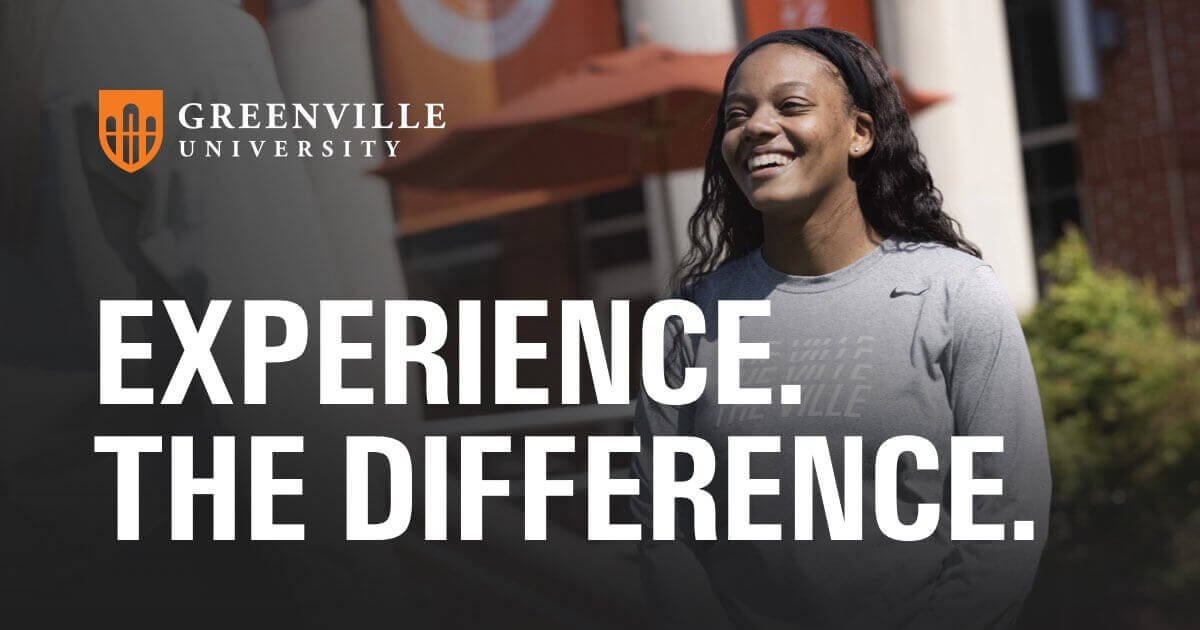
Greenville University presents faith as the frame around the whole student experience rather than a single required course. Its own description calls it a Christian liberal arts college, and the homepage language ties that identity to outcomes: “Connecting students to service & purpose,” “Prepared with passion for a life of purpose,” and “Experience. the Difference.” The recurring emphasis is on character, service, and purpose, which suggests faith is meant to shape why students study and how they live, not just what they believe.

Where faith shows up in the curriculum

  • A liberal arts foundation: The Christian liberal arts model typically means students take general education across humanities, sciences, and social sciences, with faith perspectives woven into how those subjects are taught.
  • Service and purpose language: The homepage connects students to “service & purpose,” which points to coursework and co-curricular requirements that link learning to Christian calling.
  • Experiential learning: “A degree, a resume of experience, and a network” and the Experiential Learning Institute suggest faith is applied through internships, service, and real-world work rather than kept in the classroom.

Where faith shows up in campus life

  • Student life and organizations: The page highlights “Explore Life Around Campus” and “Student Activities & Organizations,” the usual setting for chapel, ministry groups, and service teams.
  • Community events: Homecoming and Family Weekend and the @greenvilleuniv social feed show a campus culture built around shared traditions and belonging.
  • Student stories: “Write your story here” and “Student Stories” frame campus life as a place where faith and personal formation are meant to be lived out together.

A practical way to judge the fit

If you want a faith-based education, ask how much of it is required versus optional. Look for the number of chapel credits, whether faith is integrated into majors or mostly confined to campus ministry, and whether service is built into graduation requirements. A student who wants faith to shape career preparation should look closely at the Experiential Learning Institute and service opportunities; a student who wants a primarily academic experience with optional religious life may find the emphasis heavier than expected.

Next step

Request information or visit campus, then ask current students two concrete questions: “How does faith come up in your major classes?” and “What does a normal week of chapel and student organizations look like?” Those answers will tell you more than any viewbook. You can start at Greenville University.

What is the admissions process and what are the requirements for applying to Greenville University?

Greenville University's admissions process is a standard undergraduate application: apply, then submit supporting materials, and the university positions campus visits and requests for information as the first steps. The official site's own calls to action are "Apply," "Visit Campus," and "Request Info," with "Become a Panther today!" as the application prompt.

What the university's page evidence shows is the framing rather than a checklist. It emphasizes experiential learning—"A degree, a resume of experience, and a network"—and a Christ-centered liberal arts education. Expect the admissions office to weigh fit with that mission alongside academic preparation, which is typical for a private Christian liberal arts college.

What you'll generally need

Most U.S. private liberal arts colleges ask for:

  • A completed application (the university's own or a shared application)
  • High school transcripts or a transcript from your current institution
  • An essay or personal statement
  • Letters of recommendation
  • Test scores, if required or optionally submitted
  • For transfer students, college transcripts; for international students, proof of English proficiency and financial documentation

Treat this as general guidance, not as Greenville University's confirmed list.

A practical next step

Because requirements, deadlines, and test-optional policies change yearly, confirm them directly. Start with Greenville University, then compare with a shared application platform such as Common App if the university accepts it. If cost is a deciding factor, ask the admissions office about merit scholarships and need-based aid at the same time you ask about deadlines—at schools like this, the two are often reviewed together.

Decision criterion

If you want a faith-integrated education with required chapel or service components, ask how those fit your intended major before applying; if you're undecided, ask what the first-year advising and exploration process looks like. That answer will tell you more about fit than any brochure line.

What experiential learning opportunities, such as internships or service programs, are available at Greenville University?

Greenville University presents experiential learning as a core part of its identity rather than an add-on. Its own wording emphasizes pairing "a degree, a resume of experience, and a network," and it maintains an Experiential Learning Institute to organize that side of education. The page also highlights "Connecting students to service & purpose" and a student-life section, which points to service and campus involvement as expected parts of the experience.

What the university itself emphasizes

  • Experiential Learning Institute — named on the page as the hub for experience-based learning, suggesting internships, practicums, or similar placements are coordinated through it.
  • Service and purpose — framed as a central theme, consistent with a Christian liberal arts mission that treats service as part of education.
  • Student life and organizations — activities and organizations are presented as ways students build experience alongside coursework.
  • Student stories — the page points to student narratives, which are often where specific internship and service placements are described in detail.

How to judge fit

The page describes the categories but not individual placements, so treat it as a starting point. If you are comparing schools, ask each one:

Question Why it matters
Are internships required, optional, or credit-bearing? Required placements guarantee experience; optional ones depend on your initiative.
Who finds the placement — the institute or the student? Determines how much support you actually receive.
Are service programs local, national, or international? Affects cost, travel, and the kind of service you do.
Can you see recent student placements by major? Concrete examples reveal whether your field is well served.

Next step

Request information or plan a campus visit, and ask specifically for the Experiential Learning Institute's list of recent internship and service placements by major, plus whether any are required for graduation. That single request will tell you more than the general descriptions on the homepage.

For broader context on the university, see Greenville University.

What is campus life like at Greenville University, including housing, student activities, and events?

Campus life at Greenville University is framed around faith, service and hands-on experience rather than a big-university social scene. The university's own pages emphasize "connecting students to service & purpose," student activities and organizations, and an experiential learning institute that pairs a degree with a resume of experience and a network. Events are part of the rhythm too — the calendar lists occasions such as Homecoming and Family Weekend.

H3 Housing The supplied page information does not detail residence halls, room types or housing requirements, so treat those as questions to confirm directly. What it does show is that campus living is presented as part of a "Write your story here" student-life experience, with life around campus treated as a core part of the education rather than an afterthought. If you are comparing schools, ask each admissions office about guaranteed housing, whether students may live off campus after a certain year, and how roommates are assigned.

H3 Student activities The page highlights student activities and organizations as a main pillar of campus life. At a small Christian liberal arts college, that typically means clubs, ministry and service groups, intramurals and student leadership carry more weight than large-scale Greek life or big-time athletics. The "service & purpose" framing suggests volunteer and mission-oriented involvement is prominent.

H3 Events Homecoming and Family Weekend appears on the events calendar, which points to a campus culture where families and alumni return for shared traditions. Smaller colleges often build their social calendar around chapel, athletics, theater and seasonal community events.

H3 A practical scenario A prospective student who wants a tight-knit faith community and regular service opportunities will likely feel at home here. Someone seeking a large, anonymous campus with a heavy party or Greek scene should weigh that difference carefully. The best next step is to visit, sit in on a class, attend a chapel or student event, and ask current students what a typical week actually looks like. You can start with Greenville University.

Related questions

More questions →
How Greenville University Prepares Students for Life After Graduation

Greenville University (GU) describes its approach as combining three things: a degree, a resume of experience, and a network. That framing comes directly from the university's own site, which pairs its academic programs with an Experiential Learning Institute and a stated focus on preparing students for "meaningful lives of purpose." If you are evaluating GU, the practical question is what that actually looks like between enrollment and graduation — and the site gives a few concrete anchors to work from.

The three-part model: degree, experience, network

GU's homepage summarizes its preparation model in a single line: "A degree, a resume of experience, and a network." Read literally, that means the university positions classroom credentials as only one of three components. The other two are:

  • Experience — hands-on work tied to the student's field, organized through the Experiential Learning Institute.
  • Network — relationships with alumni, employers, and community partners that students can draw on after graduation.

This is a useful lens for comparing GU against schools that emphasize academics alone. It also tells you what to ask about during a visit: how many students actually complete an internship or practicum, and how the alumni network is activated for current students.

The Experiential Learning Institute

The Experiential Learning Institute is the named structure GU uses for its hands-on learning component. The site lists it alongside the degree-and-resume framing, which suggests it functions as the coordinating hub for internships, field experience, and similar opportunities rather than a single course.

Because the public homepage does not detail specific programs, formats, or requirements, treat the following as questions to bring to an admissions contact rather than confirmed facts:

  • Which majors require an internship, practicum, or field placement, and which make it optional?
  • Does the Experiential Learning Institute place students, or does it support students who find their own placements?
  • Are experiences local to the Greenville, Illinois area, or can they be completed elsewhere?

Service, purpose, and the faith-based framing

GU describes itself as a Christian liberal arts college, and its homepage language centers on "service & purpose" and "meaningful lives of character and service." That framing matters for fit: if you are looking for a school where vocational preparation is explicitly tied to a faith-based mission, GU states that connection openly. If you want a purely secular career-preparation model, the mission language is a signal about the campus culture you would be joining.

The site's student-facing sections — "Student Stories," "Student Life," and "Explore Life Around Campus" — are where individual outcomes are presented. These are the best place to look for evidence of what graduates actually do, since the homepage itself stays at the level of themes rather than named outcomes.

What the site does not tell you

The homepage excerpt does not include graduation rates, job placement statistics, average starting salaries, or a list of employer partners. It also does not specify costs, aid, or admission requirements. If those numbers matter to your decision — and for a career-preparation question they usually do — you will need to request them directly or look for GU's institutional research and career services pages rather than relying on the marketing summary.

How to verify the preparation claim yourself

  1. Request information through the "Request Info" link on the homepage, and ask specifically for career outcomes data by major.
  2. Visit campus using the "Visit Campus" option, and ask to speak with someone from the Experiential Learning Institute rather than only a general admissions counselor.
  3. Read the student stories on the site and note which ones describe internships, placements, or job offers — those are the concrete examples of the model in action.
  4. Ask about the network — how alumni are matched with students, and whether that continues after graduation.

The honest summary: GU publicly commits to a degree-plus-experience-plus-network model and names the Experiential Learning Institute as its vehicle for the experience piece. Whether that model delivers for your specific field is a question the homepage cannot answer, so the next step is a direct conversation with the people who run it.

What Is Greenville University's Official Website?

The official website of Greenville University is greenville.edu. It is the web presence of a Christian liberal arts university in Illinois, and it is built primarily to introduce the school to prospective students and visitors—covering academics, campus life, admissions, and events. If you are trying to confirm whether a page belongs to the university, or you want to know what you can actually do on the site before you invest time in it, this is the domain to start from.

What the site is

Greenville University describes itself as a Christian liberal arts college in Illinois offering a faith-based education. The homepage frames that identity around a few recurring ideas:

  • Service and purpose — "Connecting students to service & purpose."
  • Experience alongside the degree — "A degree, a resume of experience, and a network."
  • A Christ-centered, character-focused education — equipping students "for meaningful lives of character and service."

So the site is not a general information portal or a news outlet. It is an institutional site whose job is to explain what the university is, what it offers, and how to take the next step toward attending.

Main sections you'll find

Based on the site's own navigation and headings, the content clusters into a few areas:

Section What it covers
Academics Programs and the academic experience, framed around being "prepared with passion for a life of purpose"
Experiential learning The "Experience First" emphasis and the Experiential Learning Institute
Campus life Student life, activities and organizations, and "life around campus"
Admissions Applying to GU, plus the "Become a Panther today!" call to action
Events A calendar, including items such as Homecoming and Family Weekend
Student stories First-person accounts from current students

The recurring "Panther" references are the university's mascot and identity, so you'll see that language throughout admissions and campus-life pages.

What you can do on the site

The homepage surfaces a small set of primary actions:

  • Apply — start an application to the university.
  • Visit Campus — arrange an in-person visit.
  • Request Info — ask for more details before deciding.
  • Give — donate to the university.

There is also a social presence referenced as @greenvilleuniv, and an events calendar for dated items like Homecoming and Family Weekend.

When this site is the right place to look

Use greenville.edu when you want to:

  • Confirm the school's identity, mission, and Christian liberal arts positioning.
  • Browse academic programs and the experiential-learning angle.
  • Understand campus life and student organizations.
  • Begin or research the admissions process.
  • Check dated events such as homecoming.

If you need something the site doesn't obviously provide—such as current tuition figures, specific deadlines, or financial aid terms—treat those as details to verify directly through the admissions or request-info path rather than assuming them from the homepage. The site's stated purpose is introducing the school and moving prospective students toward applying, visiting, or requesting information, so those are the most reliable next steps for anything not spelled out on the page itself.

How to Apply or Visit Greenville University

Greenville University (greenville.edu) gives prospective students three direct entry points on its homepage: Apply, Visit Campus, and Request Info. If you already know you want to attend, start with Apply. If you are still deciding, use Visit Campus or Request Info first. The site frames the end goal as "Become a Panther today!" — Panther is the university's mascot and the shorthand it uses for enrolled students.

The three main entry points

Action Best for What it leads to
Apply Students ready to submit an application The application process for admission to GU
Visit Campus Students and families comparing schools or wanting to see the campus in person An in-person campus visit in Illinois
Request Info Anyone who wants details before committing to an application or trip Follow-up information from the university

All three appear together in the homepage navigation, so you do not need to hunt through menus to find them.

Applying to Greenville University

The Apply link is the starting point for admission. The homepage pairs it with the phrase "Become a Panther today!", which signals that this is the step that moves you from interested to enrolled.

Before you apply, it helps to know what you are applying to. GU describes itself as a Christian liberal arts college in Illinois, and its academics messaging centers on being "Prepared with passion for a life of purpose." The university also emphasizes experiential learning — its own summary of the GU experience is "A degree, a resume of experience, and a network," delivered through an Experiential Learning Institute. In practical terms, that means you can expect your program to combine classroom work with hands-on experience and professional connections, so it is worth checking how your intended major fits that model before submitting.

Visiting campus

Visit Campus is the option for seeing GU in person. A campus visit is the most reliable way to judge fit on the things a website cannot show you: class size and feel, residence life, dining, the surrounding town, and the general campus culture.

The homepage highlights student life under the banner "Connecting students to service & purpose" and points to "Student Activities & Organizations" and "Life Around Campus." If service, faith life, and student organizations matter to you, ask about them during your visit rather than relying on the marketing pages alone.

A practical approach for a first visit:

  1. Pick a date that fits your schedule and check the events calendar — GU lists events such as Homecoming and Family Weekend, which can be a good time to see campus at its most active.
  2. Register through the Visit Campus link so the admissions office knows you are coming.
  3. Come with two or three specific questions (your major, financial aid process, housing) instead of general ones.
  4. Walk the parts of campus you would actually use — not just the tour route.

Requesting information

Request Info is the lowest-commitment step. Use it if you are early in your search, want materials sent to you, or want an admissions contact before deciding whether to apply or visit. It is also the sensible first move for parents who are gathering options for a student.

Suggested order of steps

  • Just starting your search: Request Info, then Visit Campus.
  • Already comparing final schools: Visit Campus, then Apply.
  • Ready to commit: Apply, and treat the visit as a confirmation step if you have not been to campus yet.

Common sticking points

  • Confusing the entry points. Apply, Visit Campus, and Request Info do different things. Applying does not schedule a visit, and requesting info does not start an application.
  • Skipping the visit because the website looks good. The homepage sells the experience; only a visit shows you the day-to-day reality.
  • Not checking the events calendar. Timing a visit around an event like Homecoming and Family Weekend gives you a fuller picture than a quiet weekday.
  • Assuming you know the cost. The homepage does not publish tuition or aid figures. Ask about costs and financial aid directly through Request Info or during your visit rather than estimating from the site.

For current deadlines, application requirements, and visit scheduling, use the Apply, Visit Campus, and Request Info links on greenville.edu — those are the authoritative entry points, and details can change between admission cycles.

What Is Student Life Like at Greenville University?

Student life at Greenville University (GU) centers on a Christ-centered residential campus in Illinois where activities, organizations, and service are woven into daily student experience. The university frames this as "connecting students to service & purpose," with campus life, student activities and organizations, and events like Homecoming and Family Weekend forming the core of the student experience. If you're considering GU or supporting a student who is, the sections below cover what the university itself highlights about life outside the classroom.

Campus Life and Residential Experience

Greenville University is a Christian liberal arts college, and its campus life messaging emphasizes a faith-based community where students are "prepared with passion for a life of purpose." The university's student life section invites students to "write your story here," suggesting an emphasis on individual growth within a shared residential community.

The campus is located in Greenville, Illinois, and the university promotes an "explore life around campus" theme, pointing to the surrounding community as part of the student experience rather than treating campus as an isolated bubble.

Student Activities and Organizations

GU highlights Student Activities & Organizations as a distinct part of campus life. While the homepage does not list individual clubs or groups, the structure of the site indicates that organizations are a formal, supported part of student life rather than an afterthought.

For prospective students, the practical takeaway is that GU offers organized ways to get involved beyond academics. If you want specifics—like which clubs exist, how to start a new organization, or what intramural or ministry groups operate—those details would come from the Student Life section of the official site or from a campus visit.

Experiential Learning and the "Experience First" Model

One of GU's clearest student-life differentiators is its Experiential Learning Institute, described on the homepage as offering "a degree, a resume of experience, and a network." This means student life at GU isn't only social—it's also built around gaining real experience before graduation.

The university's tagline "Experience. the Difference." and its "Experience First" framing suggest that hands-on learning, internships, and service are treated as part of the student experience, not separate from it. This matters if you're comparing GU to schools where student life and career preparation feel disconnected.

Events: Homecoming and Family Weekend

GU's event calendar shows campus-wide programming that brings students, families, and alumni together. One example from the calendar:

Event Date Format
Homecoming and Family Weekend Oct 15, 2026 All Day

Homecoming and Family Weekend is a signature event where families visit campus and alumni return. For current students, it's a social highlight; for prospective students, it's a good time to visit and see the community in action.

Following Campus Updates

GU maintains an active social media presence, with the homepage directing followers to @greenvilleuniv. This is the most direct way to see day-to-day student life—events, activities, and campus moments—without visiting in person.

What This Means for You

  • If you're a prospective student: Student life at GU combines residential community, organized activities, service, and experiential learning. A campus visit—especially during an event like Homecoming and Family Weekend—gives the clearest picture.
  • If you're a parent: The university emphasizes a faith-based, purpose-driven environment with structured activities and family-inclusive events.
  • If you want specifics: The homepage gives the framework, but details on individual organizations, housing, and daily schedules come from the Student Life section of greenville.edu or from contacting the university directly.

The best next step is to explore the Student Life pages on the official site or follow @greenvilleuniv to see campus life as it happens.

What Kind of Education Does Greenville University Offer?

Greenville University (greenville.edu) describes itself as a Christian liberal arts college in Illinois offering a Christ-centered, faith-based education. Its stated aim is to equip students for "meaningful lives of character and service," combining academics with experiential learning, campus life, and a network built around purpose. This overview fits readers who want a faith-integrated liberal arts experience and are evaluating whether the school's values and emphasis on service align with their goals.

Faith-Based Liberal Arts Foundation

The university positions itself explicitly as Christ-centered. Its homepage language centers on connecting students to "service & purpose" and on preparing graduates "with passion for a life of purpose." This signals that faith is not a peripheral feature but the framing for the whole educational model — a liberal arts approach in which character formation and service are treated as outcomes of the degree, not extras.

If you are looking for a secular institution or one where religion is incidental, this orientation is the key mismatch to weigh early.

Experiential Learning as a Core Promise

A recurring theme on the site is that students leave with more than a credential. The university summarizes its value as:

"A degree, a resume of experience, and a network"

That triad is tied to an Experiential Learning Institute, which suggests structured opportunities to apply classroom work in real settings. The practical implication for a prospective student: ask how experiential learning is built into your intended major — whether through internships, service placements, or applied projects — rather than assuming it is automatic across all programs.

Service, Purpose, and Student Life

The site frames campus life around the same values as academics. Headings such as "Connecting students to service & purpose" and "Write your story here" sit alongside student activities and organizations, and the university highlights Student Stories as a way to show how current students shape their own paths. The message is that co-curricular life is meant to reinforce the service-and-purpose theme rather than run parallel to it.

For a prospective student, the useful move is to read a few of those student stories in fields close to your interests and check whether the experiences described match what you want from college.

Programs and Campus

The homepage references exploring programs, campus life, and a faith-based education, and it invites prospective students to Apply, Visit Campus, and Request Info. It also lists events such as Homecoming and Family Weekend, and points to social updates at @greenvilleuniv. Specific majors, costs, and admission requirements are not detailed in the homepage material, so those details need to be confirmed directly through the university's program and admissions pages.

Who This Education Suits

Your priority Fit with Greenville University
Faith-integrated learning Strong alignment — Christ-centered identity is central
Character and service emphasis Strong alignment — stated throughout
Experiential, applied learning Aligned — highlighted via the Experiential Learning Institute
Liberal arts breadth Aligned — described as a Christian liberal arts college
Secular or faith-neutral setting Poor fit — faith is the organizing framework
Detailed program/cost comparison Needs direct verification — not covered in homepage material

The clearest next step is to request information or schedule a campus visit, then compare the specific program you want against the experiential and service opportunities the university advertises.

Website Overview

Several search or sharing settings need attention. Together they may make snippets, preview images or preferred URLs less consistent across platforms.

Domain and Registration

Unknown

DNS and Email

Nameservers are provided by Cloudflare, indicating managed DNS hosting. MX records point to the Microsoft 365 email service. SPF, DKIM and DMARC records were found, with DMARC policy quarantine. Together they can help recipients reject impersonated messages. No CNAME was found; the observed records resolve directly to addresses. TXT records include verification markers for Apple. Such markers may also remain after a service stops being used.

TLS and Certificates

The certificate uses an RSA 2048-bit public key, offering broad client compatibility. The server supplied a complete certificate chain. No organization name is present in the certificate; the available fields are consistent with domain validation. The certificate was issued by Let's Encrypt, commonly associated with automated certificate services. The certificate's total validity is about 89 days, consistent with a short renewal cycle.

HTTP and Browser Security

The response lacks these common security headers: CSP, X-Content-Type-Options, Permissions-Policy. No X-Powered-By header was found, reducing one common source of backend fingerprinting information. No obvious internal addresses or debug information were found in the headers. The Server header identifies nginx without an exact version. Cookie security attributes are unknown.

Technology Stack Analysis

The public page identifies Google Tag Manager, Google Analytics, nginx without precise versions, leaving fewer clues for version-specific scanning.

Search and Social Sharing

The meta description has 204 characters and may be shortened in search results. No homepage canonical URL was detected. If duplicate URLs exist, consolidation may be less explicit. The title has 59 characters, within a common display range. The observed directives allow indexing and link following. No Generator meta tag is publicly exposed.

Hosting and Email

DNSCloudflare
HostingRackspace Hosting
EmailMicrosoft 365
Approximate IP geolocation (inferred; a CDN or proxy may differ from the origin server) United States flagUnited States Inferred 146.88.104.32

Registration details

RDAP / WHOIS

Unknown

DNS records

DNS

TypeNameValueTTLPriority
Awww.greenville.edu146.88.104.32300—
MXgreenville.edugreenville-edu.mail.protection.outlook.com3000
NSgreenville.edulex.ns.cloudflare.com86400—
NSgreenville.edustephane.ns.cloudflare.com86400—
TXTgreenville.eduOAH5FGHUTPXXO55G65C8ME3WBEG0S4KEB7XRNBGMH120—
TXTgreenville.eduZOOM_verify_PxQnEcyQQpauLxfq6M4tXQ120—
TXTgreenville.edu_0jv345hvfv7mqdzor29gsstdmlx89l5120—
TXTgreenville.edu_xset63odh9tj685fuk2ht30onn2z9n0120—
TXTgreenville.edu_ziq6qxy6zh731awazic67txz7j7k8pw120—
TXTgreenville.eduadobe-idp-site-verification=cdbbc96960c16e43a9f870e8ef61438398d4cb04250520a7139717d1b67c83c8120—
TXTgreenville.eduapple-domain-verification=YfJlhGNDxklHIYSU120—
TXTgreenville.eduduo_sso_verification=6bZLyeKQKpe6MVYBJTRDLYGlrBXFm8tzL2jGoWizaXfUMMTCDNQyDKSeTANjSeHc120—
TXTgreenville.eduhave-i-been-pwned-verification=7679cd1ad8698ec8d1534e51fa67bb8c120—
TXTgreenville.edumandrill_verify.w-KoxEJW5LC6L8OUpOY90g120—
TXTgreenville.edup72bs5t45y0f2xq71zdft92xkmw6r4rf120—
TXTgreenville.edustripe-verification=FBDE923851B2D32A4AACEAC1D28C53A8757D810C2AAA0A164280C794465714C0120—
TXTgreenville.eduv=DKIM1; k=rsa; p=MIGfMA0GCSqGSIb3DQEBAQUAA4GNADCBiQKBgQCrLHiExVd55zd/IQ/J/mRwSRMAocV/hMB3jXwaHH36d9NaVynQFYV8NaWi69c1veUtRzGt7yAioXqLj7Z4TeEUoOLgrKsn8YnckGs9i3B3tVFB+Ch/4mPhXWiNfNdynHWBcPcbJ8kjEQ2U8y78dHZj1YeRXXVvWob2OaKynO8/lQIDAQAB;120—
TXTgreenville.eduv=spf1 ip4:216.125.80.0/24 ip4:216.147.212.20/30 ip4:64.74.237.230/31 include:brightspace.com include:technolutions.net include:blackbaud.com include:spf.protection.outlook.com include:spf.mandrillapp.com include:outboundmail.blackbaud.net include:a._spf.brightspace.com include:risgroup.com include:spf.topdesk.net ~all120—
DMARC_dmarc.greenville.eduv=DMARC1; p=quarantine; rua=mailto:[email protected];300—

TLS and certificates

TLS / SSL

AssessmentNormal configuration
Supported protocolsTLSv1.2、TLSv1.3
Negotiated protocolTLSv1.3
Certificate subjectgreenville.edu
IssuerLet's Encrypt
Valid until2026-11-25T14:14 · Remaining when checked: 52 days
Verification detailsCertificate trust: Passed · Hostname match: Passed

HTTP response headers

HTTP

HeaderValue
content-typetext/html; charset=UTF-8
cache-controlno-store, no-cache, must-revalidate
servernginx
strict-transport-securitymax-age=63072000; includeSubdomains
x-frame-optionsSAMEORIGIN, SAMEORIGIN
x-content-type-optionsnosniff, nosniff
referrer-policystrict-origin-when-cross-origin, strict-origin-when-cross-origin
set-cookieRedacted

Identified technologies

Google Tag ManagerGoogle Analyticsnginx

Pages, Search and Sharing

Meta descriptionDiscover Greenville University, a Christian liberal arts college in Illinois. Explore programs, campus life, and a faith-based education that equips students for meaningful lives of character and service.
Canonical URLNot detected
LanguageEnglish (default)
Twitter CardNot detected
All bots 1 allowed · 0 disallowed
  • Allow/
  • IntervalCrawl delay 3 seconds

User reviews (0)

  • No reviews yet.