Website profiles · Technology insights · Alternatives

hopsworks.ai Paid content

Categories: Artificial Intelligence

Build, deploy, and scale production ML systems with Hopsworks. The Feature Store and MLOps platform for real-time AI, trusted by leading teams.

Visit website

Updated: 2026-10-01 15:01 Language: English (default) Access: Normal

Profile views 0 Outbound visits 0
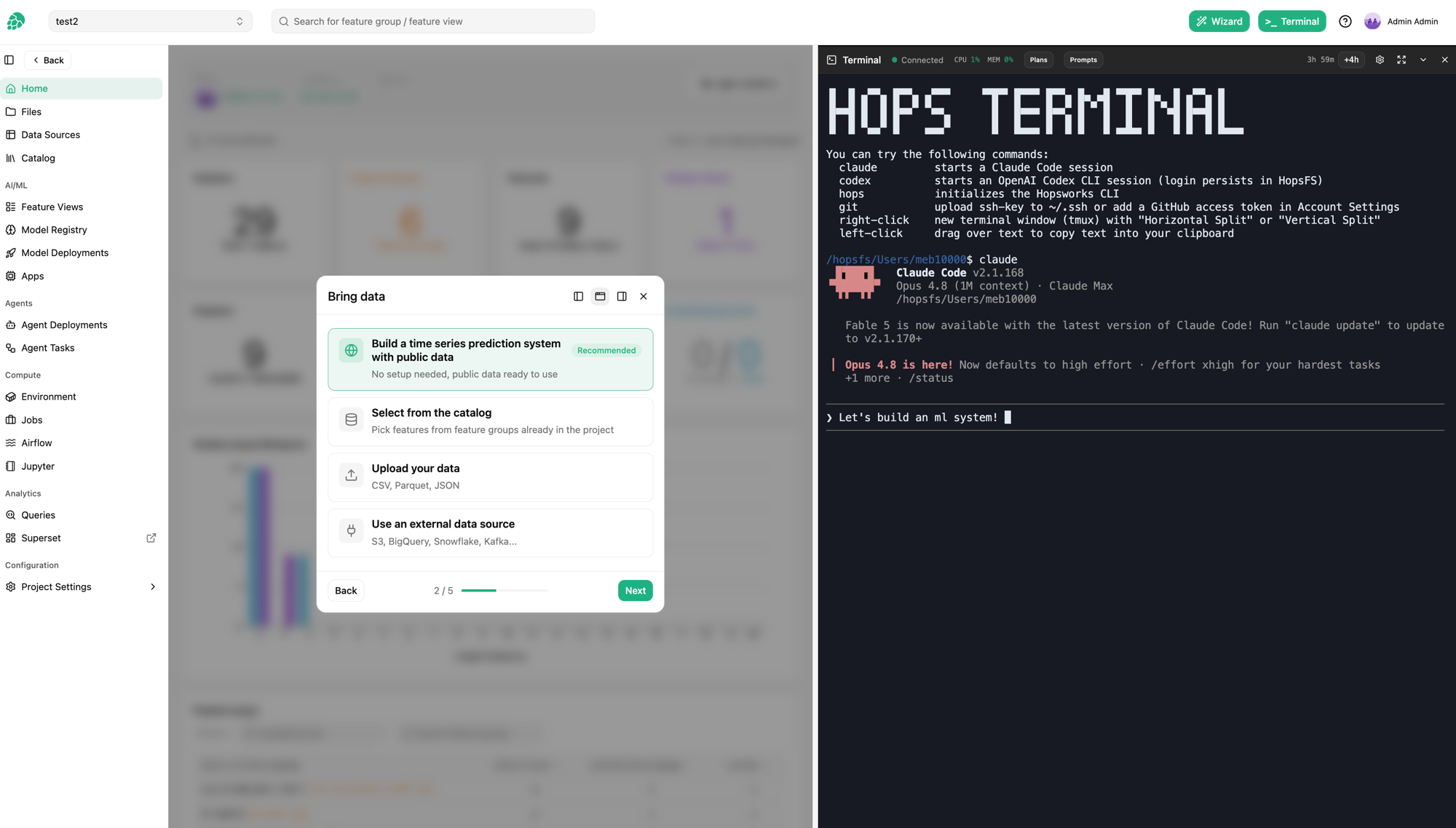
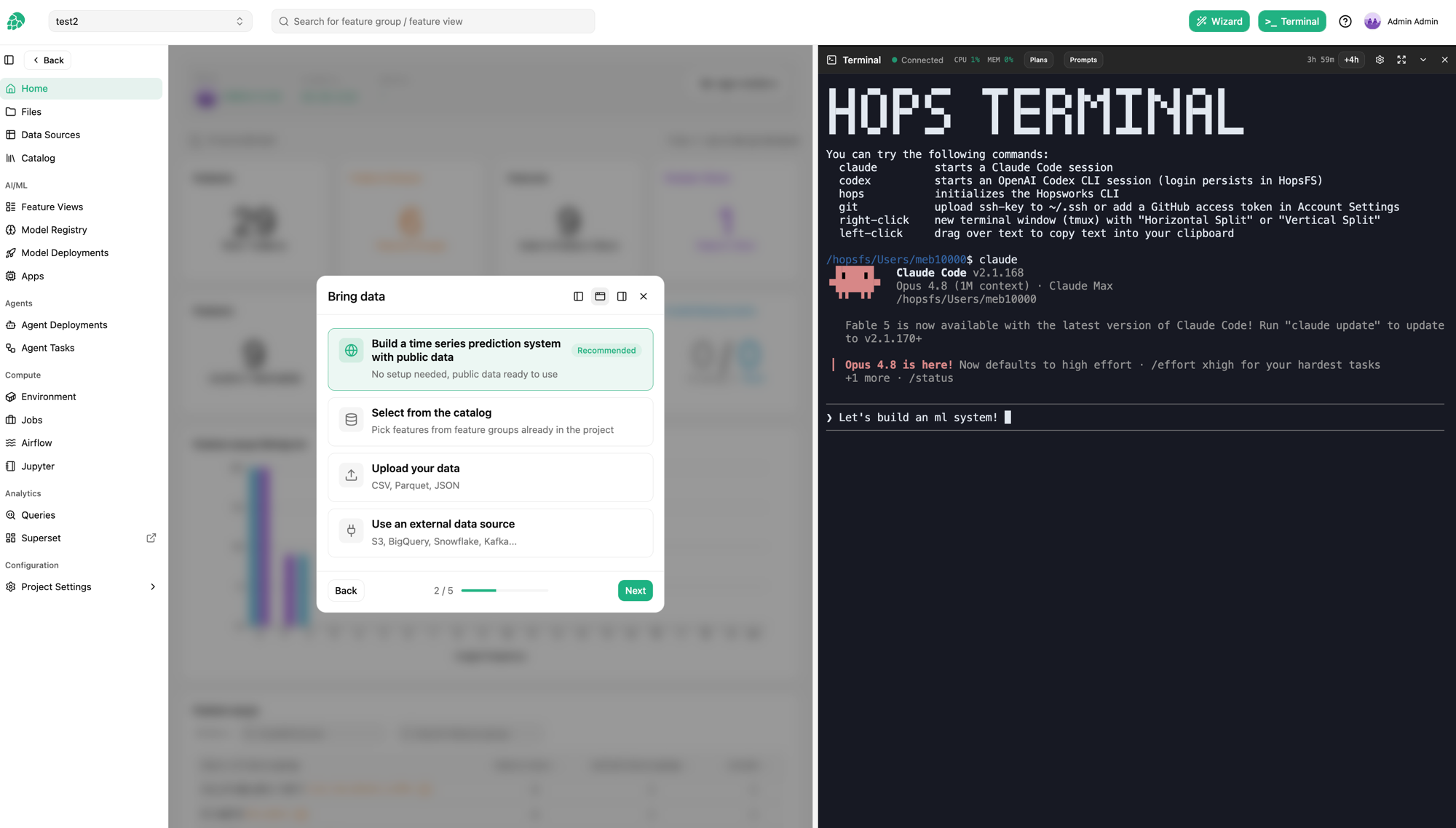
Hopsworks Full homepage screenshot
Editorial Review

Website Review

What is Hopsworks?

Hopsworks is a platform for building and running machine learning systems in production, rather than a tool for experimentation alone. Its core components cover the feature store, the data layer, and the MLOps lifecycle, so teams can train, deploy and monitor models in one place.

What it does

  • Feature store — a central repository for feature data with sub-millisecond retrieval, so the same features can be reused across many models instead of rebuilt per project.
  • AI lakehouse — works directly with Delta, Iceberg and Hudi tables, with no migration or conversion step, and a Python-native query engine.
  • MLOps — experiment tracking, a model registry and deployment pipelines for moving from prototype to production.
  • Compute and serving — GPU scheduling and quota management, training with Ray, serving with KServe or vLLM.
  • Deployment options — cloud, on-premises, hybrid or air-gapped for teams that need to keep data under their own control.

Who it suits

Teams that already have models in notebooks and are hitting the hard part: keeping training and serving features consistent, serving predictions at low latency, and reusing work across models. Hopsworks cites Zalando using it for real-time personalization and Clicklease for real-time fraud detection and credit decisioning — both cases where a slow or inconsistent feature pipeline directly costs money.

It is a heavier choice than a notebook-and-script setup. If you are still validating whether a model is worth shipping, a lighter stack will get you there faster. The platform earns its place when you have several models in production, shared features, and a latency or governance requirement.

A practical next step

Pick one model you already run and trace where its features come from. If the training pipeline and the serving path build those features differently, or if each new model rebuilds features that already exist elsewhere, that is the gap a feature store closes. Hopsworks offers a free tier to start building, with pricing details on its site: Hopsworks. For background reading on batch, real-time and LLM systems, the O'Reilly title referenced on the page is a useful companion.

How does Hopsworks's feature store enable real-time ML with sub-millisecond latency?

Hopsworks's feature store is a central repository for feature data designed for sub-millisecond retrieval, powered by RonDB, an open-source key-value store. The idea is that online inference reads features directly from this low-latency store rather than recomputing them from raw data, so a model receives fresh feature values within the same request path.

What makes the latency claim plausible

  • Key-value serving layer: RonDB is built as an in-memory key-value store, which is the standard architecture for online feature serving. Point lookups by entity key avoid the scan-and-join work of a warehouse query.
  • Separation of offline and online stores: Features are computed once (batch or streaming) and written to both a training store and a low-latency serving store. Training uses the historical store; inference uses the online one.
  • Feature reuse: The page cites Meta's observation that its top 100 features are used across more than 100 models. A shared store means teams don't rebuild the same aggregations per model, which reduces both latency risk and cost — Hopsworks claims up to 80% cost reduction from reuse and streamlined development.
  • Benchmark framing: The site cites SIGMOD 2024 benchmarks showing roughly 10x lower latency than SageMaker and Vertex. Treat vendor benchmarks as directional: they depend on payload size, batch size, network topology and whether the comparison used equivalent instance types.

Where the real-time story matters

A concrete scenario: a fraud or credit decisioning service must score a transaction in a few milliseconds. The request arrives with an entity key (customer ID, card ID). The model needs recent aggregates — transaction count in the last hour, average ticket size, device novelty. If those are computed on the fly from a lake, the request misses its budget. If they are precomputed into an online store and fetched by key, the model gets them in well under a millisecond of store time, leaving the rest of the latency budget for the model itself.

Clicklease is cited on the page as moving from a microservice architecture with training–production skew to a streamlined platform for real-time fraud detection and credit decisioning — the classic case where online/offline consistency matters as much as raw speed.

Trade-offs to weigh

Concern Practical implication
Freshness vs. cost Sub-millisecond serving typically means memory-resident data; large feature sets get expensive, so you must decide which features truly need online serving
Consistency The value of a feature store depends on the same transformation logic feeding training and serving; without that, skew returns
Operational footprint RonDB plus the lakehouse and MLOps layers is a real platform to run — attractive for teams with many models, heavier than a single model needs
Benchmark portability Latency numbers won't transfer directly to your workload; validate with your own entity cardinality and feature width

Next step

If you're evaluating this, run a narrow proof: pick one production model, list the features it needs at inference time, and measure end-to-end p99 latency with the feature store in the path versus your current approach. If the store isn't the bottleneck and you have only one or two models, a simpler cache may suffice. If you have many models sharing overlapping features, the reuse argument is where the platform earns its place.

For the full lifecycle picture — experiment tracking, model registry, deployment pipelines, and support for Iceberg, Delta and Hudi tables — see Hopsworks.

What are the key differences between Hopsworks and Databricks for building production ML systems?

Hopsworks and Databricks overlap in the "data plus machine learning" space, but they lead with different strengths. Hopsworks is presented as an AI lakehouse with a feature store at its core, oriented around real-time production ML. Databricks is a broader data intelligence platform built around Apache Spark, Delta Lake and its lakehouse architecture, with MLflow and model serving layered on top.

Where the two differ most

Dimension Hopsworks Databricks
Primary emphasis Feature store and real-time ML serving Unified data engineering, analytics and ML
Data formats Open tables: Delta, Iceberg, Hudi Delta Lake is the native format; Iceberg supported
Feature reuse Central feature registry with sub-millisecond retrieval Feature Engineering in Unity Catalog / Feature Store
Real-time serving RonDB-backed online store, low-latency lookups Online tables and model serving, latency depends on setup
Deployment Cloud, on-premises, air-gapped, hybrid Primarily cloud; some on-prem options via partners
Best fit Teams whose bottleneck is feature freshness and online inference Teams whose bottleneck is large-scale data processing and analytics

What this means in practice

If your hardest problem is training-serving skew — the same feature value must be available both in batch training and at millisecond latency during inference — Hopsworks' feature-store-first design is the more direct fit. The page cites sub-millisecond retrieval and feature reuse as its headline claims, and customer stories like Zalando and Clicklease describe real-time personalization and fraud/credit decisioning.

If your hardest problem is processing and governing large, varied datasets across engineering, analytics and ML teams, Databricks is generally the stronger starting point because that is the centre of its design. Its feature store and model serving are capable, but they sit within a much wider platform.

A practical decision criterion: ask which failure hurts more — stale or inconsistent features at inference time, or an inability to process and govern data at scale. The first points toward Hopsworks, the second toward Databricks. Teams already standardised on Delta Lake and Spark often stay with Databricks for continuity; teams deploying air-gapped or on-premises and needing low-latency online features often look at Hopsworks.

For a concrete test, pick one model that needs fresh features at inference, implement it on both platforms' free tiers, and measure feature retrieval latency and the effort to keep training and serving consistent. Compare the pricing pages directly: Hopsworks and Databricks.

How can I deploy Hopsworks in an air-gapped or on-premises environment for sovereign AI?

Hopsworks supports sovereign AI through air-gapped, on-premises, and hybrid deployment options, giving you full control over your data and AI operations. This matters most for organizations in regulated industries, defense, healthcare, finance, or any team with data-residency requirements that rule out public cloud ML platforms.

What "sovereign" means here

The platform is designed so your data and compute stay inside your own infrastructure. You choose the deployment mode, and Hopsworks runs the full ML lifecycle—feature store, AI lakehouse, and MLOps—inside that boundary. For air-gapped setups, the practical implication is that all dependencies must be available offline, so plan for a local artifact repository and a mirrored container registry.

A realistic starting point

If you are evaluating this for a bank or public-sector team, a sensible first step is a single-node or small-cluster pilot on your own hardware, loaded with the frameworks you already use (Spark, Flink, Pandas, DuckDB are all named as supported). Validate that your existing Iceberg, Delta, or Hudi tables can be read in place without migration—the platform claims no migrations or conversions needed, which is the main operational cost saver in on-prem environments.

Decision criteria

  • Data residency rules: if data legally cannot leave your network, air-gapped is the only viable mode.
  • Existing table formats: if you already run Iceberg/Delta/Hudi, in-place reads avoid a costly migration.
  • GPU constraints: on-prem GPU capacity is fixed, so smart scheduling and quota management matter more than in cloud.
  • Operational burden: air-gapped means you own upgrades, patching, and offline dependency management.

For official deployment details, sizing, and support terms, check Hopsworks directly, since air-gapped installs typically require vendor guidance.

What are the pricing options for Hopsworks?

Hopsworks does not publish a simple per-seat or per-GB price list on its main page; it points to a dedicated pricing page and offers a free "Start Building" tier alongside a "Book a Demo" path. The practical takeaway: expect a free entry point for prototyping, and a sales-led quote for production.

H3 What the page signals

  • A free build option is advertised, so you can evaluate the platform before committing.
  • A demo request is the main route for teams with production requirements.
  • The product is positioned for enterprise and sovereign deployments, including air-gapped, on-premises and hybrid setups — these are typically custom-quoted because they depend on infrastructure and support terms.

H3 How to choose

If you are… Likely path What to confirm
An individual testing the feature store Free build tier Limits on compute, storage and users
A small team moving to production Demo, then quote Per-node vs. usage pricing, support tier
An enterprise with data-residency rules Sales conversation On-prem/air-gapped licensing and GPU costs

Next step: open Hopsworks and check the pricing page for current tiers, then request a demo with your expected data volume, latency target and deployment model (cloud, hybrid or on-prem) so the quote reflects your real workload.

How does Hopsworks support MLOps from experiment tracking to production deployment?

Hopsworks covers the MLOps loop in a single platform rather than stitching together separate tools for tracking, registry, deployment and monitoring. According to the site, that lifecycle management is presented as one unified platform, with experiment tracking, a model registry and deployment pipelines sharing the same environment as the Feature Store and the lakehouse tables.

What the platform actually provides

  • Experiment tracking and model registry — the MLOps layer is described as end-to-end: train, deploy, monitor, with a 10x faster deployment claim. The registry is the handoff point where a tracked run becomes a versioned artifact you can promote.
  • A feature store as the shared substrate — features live in a central repository with sub-millisecond retrieval (the site cites RonDB and a SIGMOD 2024 benchmark claiming roughly 10x lower latency than SageMaker and Vertex). The point for MLOps is reuse: the same feature definition feeds training and serving, which is the usual fix for training–production skew.
  • Serving and compute — training at scale with Ray, serving with KServe/vLLM, plus GPU scheduling and quota management. This matters because deployment is rarely just "push a model" — it is capacity, routing and versioning.
  • Deployment targets — air-gapped, on-premises and hybrid options are offered, which changes the MLOps calculus for regulated or data-sovereign teams.

A concrete scenario

A team building a fraud-scoring model would register features once, train against them, track the run, promote the model through the registry, then serve it while monitoring drift — and, crucially, reuse those same features in the next model instead of rebuilding a pipeline. The site's Clicklease story describes exactly this shift: from a fragmented microservice setup with training–production skew to a platform supporting real-time fraud detection and credit decisioning. That is the vendor's customer narrative, not an independent audit, so treat the outcome as illustrative.

Trade-off to weigh

A single platform reduces integration work but concentrates dependency. If your stack is already standardized on a cloud-native tracker and registry, the migration cost may outweigh the consolidation benefit. The open-table support (Iceberg, Delta, Hudi) is the mitigating factor: it means your data is not locked into a proprietary format even if the orchestration layer is Hopsworks.

Next step: list the three handoffs that currently cost you the most time — feature reuse, model promotion or serving rollout — and check which of those the platform's registry and feature store would actually replace before booking a demo.

Related questions

More questions →
What Is Machine Learning and How Do Models Learn from Data?

Machine learning is a way of building software that learns patterns from data instead of following rules a person wrote by hand. You use it when the relationship between input and output is too complex or too variable to specify directly — recognizing objects in photos, ranking search results, or predicting whether a transaction is fraudulent. The core idea: show the system many examples, let it adjust internal parameters to reduce its errors, then check whether it works on examples it has never seen.

Learning from data vs. hand-coded rules

In traditional programming, a developer writes explicit logic: if the email contains these words, mark it spam. In machine learning, you supply labeled examples and the model derives its own decision boundary. The trade-off is that the model's behavior depends on the data it saw — change the data, and the behavior changes.

The three main learning paradigms

Paradigm What the model gets What it learns Concrete example
Supervised learning Inputs paired with correct answers A mapping from input to output Predicting house prices from size, location, and age
Unsupervised learning Inputs only, no labels Structure or groupings in the data Grouping customers by purchasing behavior
Reinforcement learning A reward signal from acting in an environment A policy that maximizes cumulative reward Training a model to solve multi-step reasoning tasks

Supervised learning covers most everyday applications. Unsupervised learning is used for clustering, compression, and anomaly detection. Reinforcement learning is harder to stabilize but is the approach behind recent work on scaling language-model reasoning — for instance, Qwen's GSPO research explicitly targets "stable and robust training dynamics" for RL at scale, noting that existing algorithms such as GRPO "exhibit severe instability issues during" training.

The core training loop

Every supervised model follows roughly the same cycle:

  1. Collect and split data. Divide examples into a training set and a held-out test set.
  2. Define a model. Choose an architecture with adjustable parameters (weights).
  3. Measure error with a loss function. The loss quantifies how far predictions are from the correct answers.
  4. Adjust parameters. An optimization algorithm nudges the weights to reduce the loss.
  5. Repeat. Iterate over the data many times until the loss stops improving.
  6. Evaluate on unseen data. Measure performance on the test set, not the training set.

The input is the data and the model definition; the action is repeated parameter updates; the expected result is a model whose error on new data is acceptably low.

Overfitting, underfitting, and why splits matter

  • Underfitting: the model is too simple to capture the pattern — it performs poorly on both training and test data.
  • Overfitting: the model memorizes the training examples, including their noise — it performs well on training data but poorly on test data.

This is why you never judge a model by its training accuracy. A held-out test set (or cross-validation) simulates the real world: data the model has not seen. If training error keeps falling while test error rises, you are overfitting.

Where deep learning and large language models fit

Deep learning is machine learning using neural networks with many layers. It is not a separate field — it is a subcategory that excels when data is abundant and patterns are hierarchical (images, audio, text).

Large language models are deep learning models trained on massive text corpora, usually with a self-supervised objective: predict the next token. That objective needs no human labels, which is why it scales. The Qwen family illustrates the breadth of the umbrella — its releases include a 20B image foundation model (Qwen-Image) for text rendering and editing, a safety classifier (Qwen3Guard) fine-tuned for prompt and response moderation, and RL research (GSPO) for training dynamics. All of these are machine learning systems; they differ in data, objective, and architecture, not in kind.

How to tell the paradigms apart in practice

Ask two questions:

  1. Does the training data include the correct answer? If yes, it is supervised (or self-supervised, where the answer is derived from the data itself).
  2. Does the model learn by taking actions and receiving feedback? If yes, it is reinforcement learning.

If neither applies and you are only looking for structure, it is unsupervised. Most real systems combine these — a language model may be pretrained with self-supervision, fine-tuned with supervised examples, and refined with reinforcement learning.

How Do Enterprise Teams Adopt Specialist AI Agents Without Disrupting Existing Workflows?

Enterprise teams can adopt specialist AI agents without disruption by starting with one narrow, high-volume workflow, running it as a bounded pilot with human review, measuring against a baseline, and only then expanding. The key is to treat agents as new team members with defined scopes rather than as a replacement for existing tools or a sweeping platform migration. This article explains what specialist agents are, where they fit across common team functions, and a phased approach you can follow.

What Makes an Agent "Specialist" Rather Than General-Purpose

A general-purpose assistant responds to open-ended prompts across many topics. A specialist agent is scoped to one job: it has a defined goal, a limited set of tools and data sources, and a clear definition of "done."

That scoping matters for enterprise teams for three practical reasons:

  • Predictability. A narrow agent produces more consistent outputs, which makes it easier to review and trust.
  • Permission control. You can grant access only to the systems that specific task needs, rather than broad data access.
  • Measurable value. When an agent owns one workflow, you can compare its output against a manual baseline.

A useful rule of thumb: if you cannot describe the agent's job in one sentence with a clear input and output, it is still too broad to deploy safely.

Mapping Team Functions to Agent Use Cases

Most enterprise teams have a handful of repetitive, rules-plus-judgment tasks that are good first candidates. The table below shows typical starting points.

Team Candidate agent task Why it fits
Sales Research and enrich inbound leads before handoff High volume, structured output, easy to verify
Customer success Draft responses to common account questions Repetitive, benefits from consistency
Marketing Repurpose long-form content into channel variants Clear brief, reviewable drafts
HR Screen and summarize applications against criteria High volume, needs audit trail
Operations Triage and route incoming requests Rule-based with clear routing logic

Notice that none of these replace a person's judgment. They compress the repetitive portion so the human spends time on exceptions and decisions.

A Phased Adoption Approach: Pilot, Measure, Expand

Phase 1: Pick one workflow and define success

Choose a task that is high-volume, low-risk, and currently a bottleneck. Write down:

  • The current process, step by step
  • The baseline metric (time per task, volume per week, error rate)
  • What "good output" looks like, with two or three examples
  • Who reviews the agent's work

Phase 2: Run a bounded pilot

Keep the agent inside the existing workflow rather than beside it. For example, the agent drafts; the human sends. Set a review gate so nothing leaves the team unreviewed. Run for a fixed period, such as four to six weeks, with a small group.

Phase 3: Measure against the baseline

Compare the same metrics you recorded in Phase 1. Look for time saved, consistency gained, and — importantly — where the agent failed. Failures tell you whether the scope was right.

Phase 4: Expand deliberately

Only widen scope after the pilot shows a clear, repeatable gain. Expand in one of two directions: more volume of the same task, or an adjacent task with the same data and review pattern. Avoid expanding into a new function and a new data source at the same time.

Handling Workflow Integration Concerns

Data access

Give each agent the minimum access its task requires. Prefer read access plus a single write action over broad permissions. Document which systems it touches so security and IT can review.

Handoffs

Define exactly where the agent stops and a human begins. A simple handoff rule works well: the agent completes the task and flags anything outside its defined scope for a person. Ambiguous handoffs are the most common source of friction.

Human oversight

Decide the review level up front:

  • Full review for anything customer-facing or high-stakes
  • Spot check for internal, low-risk outputs
  • Exception-only review once the agent has a track record

Start stricter than you think you need, then relax as evidence accumulates.

How Roles and Responsibilities Shift

Adopting agents rarely removes roles; it redistributes effort. Expect these shifts:

  • Reviewers become editors. People spend less time producing first drafts and more time improving and approving them.
  • Process owners become agent owners. Someone needs to maintain the agent's instructions, examples, and scope as the business changes.
  • New quality checks appear. Teams need a lightweight way to catch drift — for example, a weekly sample review.

Be explicit about who owns the agent after launch. An unowned agent degrades quietly.

Practical Criteria for Choosing Where to Start

Score candidate workflows against these questions:

  1. Volume: Does it happen often enough to matter?
  2. Risk: What is the cost of a wrong output, and can a human catch it?
  3. Structure: Is the input and output reasonably consistent?
  4. Baseline: Can you measure the current state today?
  5. Ownership: Is there a person who will own the agent after launch?

A workflow that scores well on all five is a strong first pilot. A high-volume task with no clear owner is a poor start, no matter how repetitive it is.

A Simple Pilot Template

You can copy this structure to scope your first agent:

  • Task: [one sentence]
  • Current baseline: [time/volume/error rate]
  • Agent scope: [what it does, what it does not do]
  • Data access: [systems, read/write]
  • Handoff rule: [when it escalates to a human]
  • Review level: [full / spot / exception]
  • Owner: [name]
  • Pilot length: [weeks]
  • Success metric: [target]

Bottom Line

Disruption comes from adopting too much at once, not from agents themselves. Start with one scoped task, keep humans in the loop, measure against a real baseline, and expand only when the evidence supports it. Platforms built around specialist agents — such as Relevance AI, which offers agents for sales, customer success, marketing, and HR — are designed for exactly this kind of task-by-task rollout, so you can add capability without rebuilding your team's existing processes.

Website Overview

An established domain and managed infrastructure suggest continuity of operations and may support dependable delivery, although neither guarantees service quality. Page metadata, canonical configuration and social previews work together to provide more consistent search and sharing presentation.

Domain and Registration

Registered in 2018, this domain has about 8 years of history. That suggests continuity, although ownership and purpose may have changed. Transfer-protection status is present, helping reduce the risk of unauthorized domain transfers. The registrar is NameCheap, Inc., a widely used domain service provider. Registration contact information is publicly available through RDAP. The domain uses the common .ai extension, which is not an independent safety signal.

DNS and Email

Nameservers are provided by Namecheap, indicating managed DNS hosting. MX records point to the Google Workspace email service. SPF and DMARC are configured. DKIM status is unknown. TXT records include verification markers for Google, Microsoft. Such markers may also remain after a service stops being used. DNSSEC signatures were not detected, so this additional DNS authenticity protection is not confirmed.

TLS and Certificates

The certificate uses an RSA 2048-bit public key, offering broad client compatibility. The server supplied a complete certificate chain. No organization name is present in the certificate; the available fields are consistent with domain validation. The certificate was issued by Let's Encrypt, commonly associated with automated certificate services. The certificate's total validity is about 89 days, consistent with a short renewal cycle.

HTTP and Browser Security

The response lacks these common security headers: CSP. CORS permits any origin to read this response. This is common for public resources; sensitive responses need narrower handling. No X-Powered-By header was found, reducing one common source of backend fingerprinting information. No obvious internal addresses or debug information were found in the headers. The Server header contains the custom value Vercel.

Technology Stack Analysis

The public page identifies Next.js, Vercel without precise versions, leaving fewer clues for version-specific scanning.

Search and Social Sharing

Twitter Card metadata is configured. JSON-LD includes Organization data, helping describe the organization as an entity. The title has 45 characters, within a common display range. A meta description is present, with 143 characters. The observed directives allow indexing and link following.

Hosting and Email

DNSNamecheap
HostingVercel
EmailGoogle Workspace
Location United States flagUnited States 216.150.1.129

User reviews (0)

  • No reviews yet.

Pages, Search and Sharing

Meta descriptionBuild, deploy, and scale production ML systems with Hopsworks. The Feature Store and MLOps platform for real-time AI, trusted by leading teams.
Canonical URLhttps://www.hopsworks.ai
LanguageEnglish (default)
Twitter Cardsummary_large_image
All bots 1 allowed · 0 disallowed
  • Allow/

Registration details RDAP / WHOIS

RegistrarNameCheap, Inc.
Registered2018-09-17
Expires2028-09-17
Domain statusclient transfer prohibited
Nameserversdns1.registrar-servers.com、dns2.registrar-servers.com
DNSSECunsigned

DNS records

TypeNameValueTTLPriority
A5fff5f5b949eb4cd.vercel-dns-016.com216.150.1.129300—
A5fff5f5b949eb4cd.vercel-dns-016.com216.150.16.129300—
MXhopsworks.aiaspmx.l.google.com17991
MXhopsworks.aialt1.aspmx.l.google.com17995
MXhopsworks.aialt2.aspmx.l.google.com17995
MXhopsworks.aialt3.aspmx.l.google.com179910
MXhopsworks.aialt4.aspmx.l.google.com179910
NShopsworks.aidns1.registrar-servers.com1800—
NShopsworks.aidns2.registrar-servers.com1800—
TXThopsworks.aiMS=E76A04AB54E1517CA5F61A20404C8D98CD869D7B1799—
TXThopsworks.aidetectify-verification=9555f4657e1b2eb91a89bd74bcdd12021799—
TXThopsworks.aigoogle-site-verification=1ZdLBy3RvKpqA-6L8_1Wc4P9E0CHVHnkki36LesPCY41799—
TXThopsworks.aigoogle-site-verification=FG026U9x4zUB2gEjIV4EN8fQxThoS5UPTOZ70wNBfhc1799—
TXThopsworks.aigoogle-site-verification=eTc7wkl7rHbv7R76noWNJsYu9A65j0iZLBWKpVdlqkg1799—
TXThopsworks.aigoogle-site-verification=kotPNYm3Yq6yKgOd01Lq7s4J5Ze8_qyL7jzp3fn8UCI1799—
TXThopsworks.aiv=spf1 include:amazonses.com include:5524414.spf10.hubspotemail.net include:_spf.google.com ~all1799—
CNAMEwww.hopsworks.ai5fff5f5b949eb4cd.vercel-dns-016.com1799—
DMARC_dmarc.hopsworks.aiv=DMARC1; p=quarantine; rua=mailto:[email protected]; fo=11799—

TLS and certificates

AssessmentNormal configuration
Supported protocolsTLSv1.2、TLSv1.3
Negotiated protocolTLSv1.3
Certificate subjectwww.hopsworks.ai
IssuerLet's Encrypt
Valid until2026-12-13T08:32 · Remaining when checked: 72 days
Verification detailsCertificate trust: Passed · Hostname match: Passed

HTTP response headers

HeaderValue
content-typetext/html; charset=utf-8
cache-controlpublic, max-age=0, must-revalidate
serverVercel
strict-transport-securitymax-age=63072000
x-frame-optionsSAMEORIGIN
x-content-type-optionsnosniff
referrer-policystrict-origin-when-cross-origin
permissions-policycamera=(), microphone=(), geolocation=()
access-control-allow-origin*

Identified technologies

Next.jsVercel