Website profiles · Technology insights · Alternatives

itdoeswhatnow.com

dallery.gallery was an early guide to DALL·E 2 and home of the DALL·E 2 Prompt Book. Its address now points here; this page preserves the book and the site it came from.

Paid content
Visit website
Profile views 7 Outbound visits 1 Normal
DALL·Ery GALL·Ery (2022) • It Does What Now? Full homepage screenshot

At a glance

Category
Artificial Intelligence
Language
English
Paid-content signal
Paid contentObserved
Registered
2025
Hosting
CloudflareInferred
HTTPS certificate trusted
PassedObserved
Last updated

Website review

This review may include AI-generated content and is not individually verified. Domain, certificate and other facts come from the observed data on this page.

What is It Does What Now?

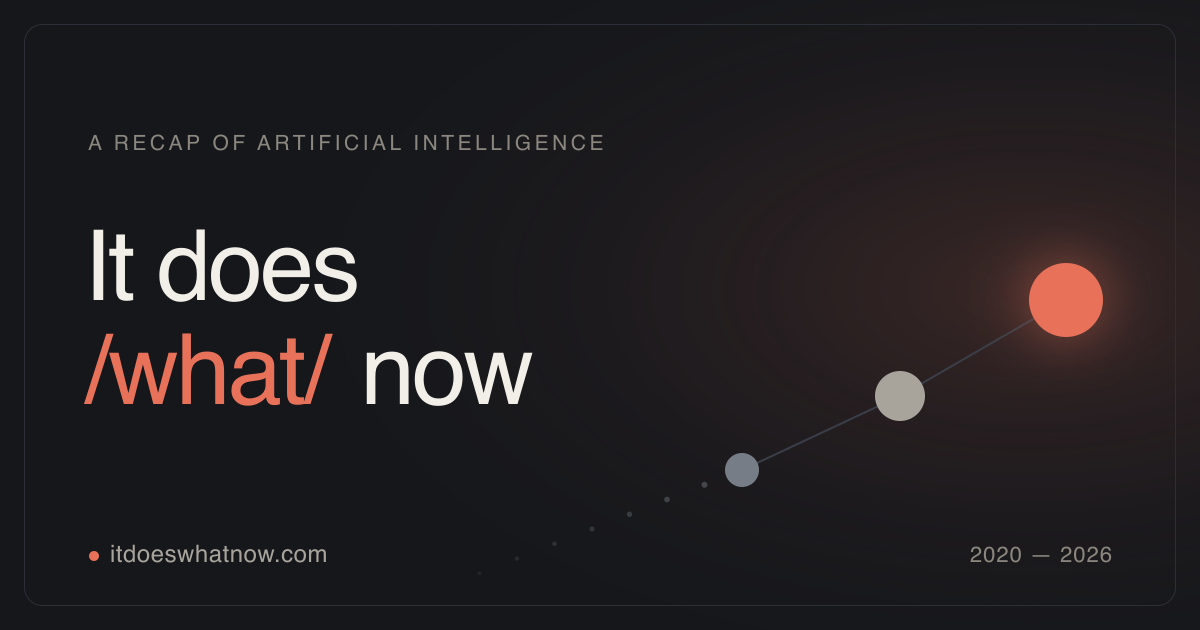
It Does What Now? is a chronological news timeline of artificial intelligence from January 2020 onward, published at itdoeswhatnow.com. Instead of explaining how AI works, it records what happened: model releases, funding, policy fights, court cases, and accidents, each as a short brief with links to the original reporting. The homepage headline frames it as "What's happening right now with AI — and how we got here."

Its organising idea is that the story is easier to follow in order than as a stream of separate headlines. Entries are grouped by year (2020 through 2026) and tagged by track, so you can read straight through or filter down to one thread. The tracks listed on the page include Models & capabilities, Benchmarks & progress, Labs & people, Safety & alignment, Security & misuse, Government & policy, Courts & copyright, Money & business, Compute & infrastructure, Ideas & essays, Open weights & ecosystem, and Culture & impact.

Who it suits

  • Someone who wants the background to a current AI story without reading a dozen separate explainers.
  • Researchers, students, or writers assembling a dated sequence of events who need a starting point for sources.
  • Anyone who has been ignoring AI news for a year and wants a catch-up rather than a tutorial.

It is less useful if you want technical depth, hands-on reviews, or a single opinionated argument. The briefs are described as neutral summaries, and the site separates that from a commentary section, where outside writers' takes are collected under their own names — for example items attributed to Don't Worry About the Vase, Transformer, and Epoch AI. That split is the most useful thing about the format: facts in one column, argument in another, so you can tell which you are reading.

A practical way to use it

Suppose a headline says a company pulled a model for safety reasons. Open the timeline at that date, read the brief, follow its source links, then step back a year in the same track — Safety & alignment or Labs & people — to see whether this is a new pattern or a recurring one. The filtering is what makes that possible; a plain reverse-chronological blog would not.

For the wider landscape, a general technology news outlet such as Ars Technica covers AI daily, and MIT Technology Review runs longer analysis. Use this timeline for sequence and sourcing, and those for depth.

Note the pricing signal on the page: the only subscription link points to a newsletter hosted on Substack, so the timeline itself appears readable without an account.

How can I use It Does What Now? to track recent AI developments?

It Does What Now? works as a reverse-chronological news log for AI, so the fastest way to use it is as a timeline you scan rather than a site you read front to back.

Start with the newest entries. The homepage opens on the current year and lists dated briefs, newest first — for example, 29 September items on Anthropic finding a Chinese open-weight model capable of building working cyber exploits, China reporting over 700 million generative AI users, and OpenAI launching always-on personal agents at DevDay. Each item is a short neutral summary with links to its original sources, so you can skim headlines and open only the ones that matter to you.

Then use the filters to narrow by interest. The page exposes a set of tracks you can filter by, which is the site's main advantage over a general news feed:

  • Models & capabilities
  • Benchmarks & progress
  • Labs & people
  • Safety & alignment
  • Security & misuse
  • Government & policy
  • Courts & copyright
  • Money & business
  • Compute & infrastructure
  • Ideas & essays
  • Open weights & ecosystem
  • Culture & impact

You can also adjust how much detail appears — the page offers Headlines, Major, Notable and Everything views — and jump to a specific year from 2020 through 2026.

Use the commentary section for the argument, not the event. A separate stream collects outside writing and opinion from across the period, with named sources and dates. That is where you go when you already know what happened and want to know how people are reacting.

A practical routine: check the Headlines view weekly for events, switch to a single track when a topic becomes relevant to your work, and use the year links when you need to reconstruct how a debate started. If you want a second timeline to compare coverage against, Epoch AI publishes research on AI trends and compute, and arXiv is where many of the underlying papers the briefs cite actually live.

What are the key AI events covered from 2020 to now?

The site is a chronological AI timeline running from January 2020 through September 2026, organised by year and tagged by track. Its value is breadth plus ordering: instead of a single narrative, it logs the models, funding, policy fights, lawsuits and accidents as dated briefs, each linked to an original source. That makes it useful for two different readers — someone catching up on the last few years, and someone checking what happened in a specific month.

H3 What the timeline actually tracks

The filter list shows the scope: Models & capabilities, Benchmarks & progress, Labs & people, Safety & alignment, Security & misuse, Government & policy, Courts & copyright, Money & business, Compute & infrastructure, Ideas & essays, Open weights & ecosystem, and Culture & impact. A separate commentary stream collects outside voices, such as It Does What Now?'s own timeline entries sitting alongside posts from outlets like Don't Worry About the Vase, Transformer and Epoch AI.

H3 Representative entries

From the page, the recent end of the timeline includes:

  • Anthropic finding that a Chinese open-weight model could build working cyber exploits.
  • China reporting more than 700 million generative AI users.
  • OpenAI launching always-on personal agents at DevDay, alongside a cheaper model tier.
  • A US executive order changing official terminology to "super intelligence" and launching a government chatbot portal.
  • AI firms and building unions forming an alliance on data-centre standards.
  • AMD agreeing to buy Fei-Fei Li's World Labs.

Earlier years follow the same pattern: scaling papers and early model releases in 2020–2021, the generative-AI breakout and copyright fights in 2022–2023, then regulation, compute buildout and safety arguments through 2024–2026.

H3 How to use it

Pick your entry point by purpose. If you want the arc, read the year-in-brief summaries in order. If you are checking a claim or writing something, use the track filters to isolate one thread — policy, say, or compute — and follow it across years without wading through model releases. The headline/detail toggle lets you skim first and expand only what matters.

One caveat worth knowing before you rely on it: dated news briefs reflect the framing of their moment, and fast-moving stories get superseded. Treat each entry as a pointer to its linked source rather than a settled account, especially for anything from the current month.

How does It Does What Now? organize AI news by categories like models, money, and policy?

It Does What Now? organizes AI news as a single dated timeline, then lets readers slice that timeline by track. The homepage shows the newest briefs first, each a short neutral entry with links to original sources, and the same archive extends back to January 2020.

How the categories work

Each entry is tagged to one or more tracks. The page lists these tracks with running counts, so you can see where the archive is heaviest:

Track What it covers Count shown
Models & capabilities New models and what they can do 524
Benchmarks & progress Measured gains and evaluations 161
Labs & people Companies, researchers, org changes 106
Safety & alignment Alignment work and concerns 267
Security & misuse Exploits, abuse, security incidents 181
Government & policy Regulation, agencies, official action 232
Courts & copyright Lawsuits and legal rulings 126
Money & business Funding, deals, acquisitions 268
Compute & infrastructure Chips, data centres, capacity 154
Ideas & essays Commentary and analysis 127
Open weights & ecosystem Open models and tooling 212
Culture & impact How AI lands socially 196

The counts are a useful signal in themselves: models and capabilities dominate, money and business is close behind, and courts and copyright is the smallest major track — so a reader interested in law will find a thinner but more focused stream.

Practical ways to use it

  • Follow one thread over time. Filter to Government & policy, then read down the years to see how regulation moved from proposals to orders.
  • Check the depth setting. Detail levels range from Headlines through Major and Notable to Everything, so you can skim a week or read the full record.
  • Jump by year. Year sections (2020 through 2026) let you start at a period rather than scrolling the whole archive.
  • Read the commentary separately. Opinion and essays sit alongside the neutral briefs, attributed to their authors, so you can tell reporting from argument.

A concrete scenario: you are preparing a briefing on AI security and want recent examples rather than a general overview. Filter to Security & misuse, set detail to Major, and read the last few months — the 29 September entry on Anthropic finding a Chinese open-weight model capable of building working cyber exploits is exactly the kind of item that track is for. Then cross-check the same date under Government & policy to see the official response.

Next step: pick one track that matches your interest, set the detail level to Major, and scan a single year before widening out. If you want a second dated source to compare framing, the timeline format is also used by Epoch AI, whose research notes pair well with the benchmarks and compute tracks here.

What sources does It Does What Now? use for its AI briefs?

It Does What Now? describes its briefs as "short neutral" entries that link to their original sources. Rather than relying on a single outlet, it aggregates the news of the AI era into a dated timeline and points each item back to the primary reporting or announcement it came from.

What that looks like in practice

  • Each entry is a brief with a date and a link to its original source, so you can trace a claim rather than take the summary on faith.
  • The timeline runs from January 2020 onward and is organised by year, with tracks such as Models & capabilities, Safety & alignment, Government & policy, Courts & copyright, and Money & business.
  • Alongside the news entries, it carries a separate commentary section that names the writers and publications being quoted — for example Don't Worry About the Vase, Transformer, and Epoch AI.

Why the sourcing matters for how you use it

If you are writing a briefing, teaching a course, or trying to reconstruct when a particular argument or policy shift happened, a dated timeline with per-item links is more useful than a single explainer, because you can jump from the summary to the underlying document. The trade-off is that a brief is only as good as the link behind it: the site tells you what happened and where it came from, but the depth and framing of each item vary with the source it points to.

A practical next step

Pick one entry that affects your work — a policy order, a model release, a court ruling — and follow its link to the primary source before citing the timeline itself. For a second opinion on the same event, check whether the brief points to an official announcement or only to press coverage, and compare it against a general news outlet such as Reuters.

Is there a newsletter or subscription for updates from It Does What Now?

Yes. The site links to a newsletter on Substack, and that is the main way to get updates rather than checking the timeline page manually.

What the newsletter is for

It Does What Now? is a running, sourced timeline of AI news from January 2020 onward, organised into tracks such as models and capabilities, safety and alignment, government and policy, money and business, and compute and infrastructure. New entries are added as events happen. The newsletter is the natural companion: it pushes new entries to you instead of you scrolling the timeline.

How to decide

  • Subscribe if you want a chronological, source-linked record of AI developments and would rather receive updates than revisit the site.
  • Skip it if you only need occasional reference — the site itself is browsable by year and by track, and the "story so far" view covers the whole era in one sitting.
  • Check the pricing page before committing, since the linked page is the subscription sign-up and terms may change.

Next step

Open It Does What Now? and use the newsletter link near the footer to see current options, then compare that against simply bookmarking the timeline if you prefer reading on your own schedule.

Related questions

More questions →
Is It Does What Now? a Reliable and Up-to-Date Source for AI News?

It Does What Now? is best understood as a sourced index rather than a primary authority. It describes itself as keeping "the whole story in order," with each entry written as "a short neutral brief with links to its original sources." That combination — neutral summaries plus links out — makes it useful for orientation and for checking claims yourself, but it is not a substitute for the original reporting, papers, or announcements it points to.

What the site actually is

The site presents itself as "a timeline of artificial intelligence, 2020 to now," covering "the models, the money, the arguments, the laws and the accidents." Its stated scope runs from January 2020 onward, and the page evidence shows entries dated into late September 2026, with the framing "January 2020 — September 2026, and counting."

Two design choices matter for judging reliability:

  • Neutral briefs, not analysis. The site says it does not editorialize in its timeline entries. Commentary is separated into its own section, where named writers and outlets are quoted or linked (for example, "Don't Worry About the Vase," "Transformer," "Forethought," and "Epoch AI").
  • Links to original sources. Each brief is meant to point back to the source it summarizes, so a reader can verify the claim rather than trust the summary.

How it is organized

The timeline is filterable, which helps you judge coverage rather than just recency. The page lists these tracks with entry counts:

Track Entries
Models & capabilities 524
Safety & alignment 267
Money & business 268
Government & policy 232
Open weights & ecosystem 212
Culture & impact 196
Security & misuse 181
Benchmarks & progress 161
Compute & infrastructure 154
Courts & copyright 126
Ideas & essays 127
Labs & people 106

There is also a detail control (Headlines / Major / Notable / Everything) and a year filter spanning 2020 through 2026, plus a "Commentary" view with 2,193 items. This structure is what makes it usable as a look-back tool: you can narrow to one track and one year instead of reading the whole era.

Is it up to date?

The evidence supports "yes, within the site's own cadence." The most recent entries shown are dated 29 September, and the site states that "new entries are added as the news happens." The 2026 section is presented as "the year in brief," with monthly groupings (for example, September 2026) and dated items inside them.

One caveat: the site is a running log, so the newest items are the least likely to have been revised or contextualized. A same-day entry is a pointer, not a settled account.

Where it is strong, and where it is not

Strong for:

  • Getting the sequence of events straight when you have lost track of how a story developed.
  • Finding the original source behind a claim you half-remember.
  • Scanning a single track (say, courts and copyright) across several years.

Weak for:

  • Original reporting or exclusive information — it aggregates rather than breaks news.
  • Deep technical or legal analysis — the briefs are short by design.
  • Deciding what a development means — that judgment is left to you or to the linked commentary.

A practical way to use it

  1. Pick the track closest to your question (for example, "Government & policy").
  2. Set the year filter to the period you care about.
  3. Read the brief, then follow its link to the primary source before repeating the claim.
  4. If you want interpretation rather than sequence, switch to the Commentary section and note who is arguing what.

Used this way, It Does What Now? works as a map with citations. Treat the briefs as signposts and the linked sources as the ground truth.

Does It Does What Now? Require Payment or a Subscription?

No. The timeline at itdoeswhatnow.com is presented as a free, publicly readable record of AI developments from January 2020 onward. The only subscription signal on the page is a footer link to a Substack newsletter, which appears to be an optional way to receive updates rather than a gate on the timeline itself. The available page evidence shows no paywall, no login requirement, and no pricing for the timeline content.

What the page actually offers

The site describes itself as a chronological record of "the models, the money, the arguments, the laws and the accidents," running from January 2020 to the present week. Each entry is a short brief with links to original sources, and new entries are added as news happens.

The page also exposes a fairly deep set of filters and tracks, which suggests the free timeline is the core product:

Track Entries shown
Models & capabilities 524
Safety & alignment 267
Money & business 268
Government & policy 232
Open weights & ecosystem 212
Culture & impact 196
Security & misuse 181
Benchmarks & progress 161
Compute & infrastructure 154
Courts & copyright 126
Ideas & essays 127
Labs & people 106

There are also detail levels (Headlines, Major, Notable, Everything) and a commentary section aggregating outside writing, with a running total of 2,193 items. None of this is described as restricted.

Where the subscription link appears

The only payment-adjacent element in the page evidence is a footer link labeled "Newsletter" pointing to promptresponse.substack.com/subscribe. That is a standard Substack subscribe URL. Two things follow from this:

  • It is a newsletter signup, not a paywall on the site.
  • The page evidence does not state whether that newsletter is free or paid, so you should treat its terms as unknown until you check the Substack page directly.

How to decide whether you need to subscribe

You can use the timeline without subscribing if your goal is to look up what happened in a given period, browse a specific track, or follow links to primary sources. Subscribing makes sense only if you want updates pushed to you rather than checking the site, or if the newsletter carries material the site does not.

A practical check before subscribing: open the Substack link and look for a paid-tier prompt or a free/paid toggle. If none appears, the newsletter is free to join. If one appears, the timeline on itdoeswhatnow.com remains readable either way.

Common points of confusion

  • A newsletter link is not a paywall. The presence of a subscribe URL in the footer does not mean the site's content is behind it.
  • No pricing is listed for the site itself. The page evidence contains no price, no account requirement, and no stated limit on how much of the timeline you can read.
  • "Free to read" is not the same as "free of cost forever." The site could change its model later; the current evidence only describes what is on the page now.
How It Does What Now? Organizes Its AI Timeline

It Does What Now? is a chronological, source-linked timeline of artificial intelligence from January 2020 to the present, organized in two layers: a year-by-year spine (2020 through 2026) with dated entries inside each year, and a set of topic "tracks" you can use to filter those entries. Every brief links to its original source, and you can switch between detail levels to control how much you read. It suits anyone who wants to look up what happened in a given year or follow one thread — models, money, policy, accidents — without reading the whole era in order.

The two organizing axes

1. Time: years, then dates

The main structure is strictly chronological. The page shows year sections from 2020 to 2026, and within each year, entries are listed by date, newest first at the top of the current year. The site describes its scope as "January 2020 — September 2026, and counting," with new entries added as news happens.

Each entry is a short brief rather than an article. For example, the 29 Sep 2026 entries include:

  • Anthropic finds a Chinese open-weight model can build working cyber exploits
  • China says its generative AI users passed 700 million
  • OpenAI launches always-on personal agents at its DevDay conference
  • Trump orders agencies to call AI "super intelligence" and launches an AI government portal
  • AI firms and building unions form an alliance on data-centre standards
  • AMD agrees to buy Fei-Fei Li's World Labs for $8.2bn

So a single day can carry several unrelated stories, each tagged and linked separately.

2. Topic: filterable tracks

Alongside the timeline, entries are classified into tracks. The site lists these with entry counts, which tells you both what categories exist and roughly how much material sits in each:

Track Entries
Models & capabilities 524
Safety & alignment 267
Money & business 268
Government & policy 232
Open weights & ecosystem 212
Culture & impact 196
Security & misuse 181
Benchmarks & progress 161
Compute & infrastructure 154
Ideas & essays 127
Courts & copyright 126
Labs & people 106

The counts are a snapshot, not fixed values — they grow as entries are added. A "Filter by track" control lets you narrow the timeline to one or more of these categories, so you can, for instance, read only policy developments across all years, or only safety and alignment items.

Controlling how much detail you see

The page offers several density levels rather than one fixed view:

  • Headlines — the shortest form
  • Major
  • Notable
  • Everything — the fullest view

There is also a separate Commentary stream (labeled "what people are saying"), which collects opinion and analysis pieces rather than news briefs. The page shows commentary items with their publication and date, for example:

  • Don't Worry About the Vase · 29 Sep — "Astra 6.1 Pulled As Insufficiently Aligned Transformer"
  • Forethought · 28 Sep — "A Thousand AI Constitutions: A Short Defense"
  • Epoch AI · 28 Sep — "AI is getting cheaper faster than any other transformative technology"

Commentary is a distinct layer from the dated news entries, so you can choose between "what happened" and "what people argued about it."

How to actually use it

If you want a specific year: use the year sections (2020–2026) and read down the dated entries. Each year also has a "year in brief" summary, which is the fastest way to get the shape of a year before drilling into individual days.

If you want a specific theme: apply the track filter first, then read across years. This is the better route for questions like "how has copyright litigation developed" (Courts & copyright) or "what has happened in compute buildout" (Compute & infrastructure), because those stories are spread across the whole period.

If you want to verify something: follow the source link attached to each brief. The site states each entry is "a short neutral brief with links to its original sources," so the timeline is a finding aid, not the primary record.

If you're new: the page suggests scrolling "the story so far — the whole era in one sitting," which means reading the timeline from the beginning at a lower detail level rather than jumping to the latest entries.

What it is not

It is a timeline and index, not an analysis or ranking. Entries are dated briefs with links; the interpretive material lives in the separate Commentary stream. The site also links to a newsletter (hosted on Substack) in its footer, but the timeline itself is browsable without an account — nothing in the page evidence indicates the timeline content is gated.

What Else Is on It Does What Now? Besides the AI News Timeline

It Does What Now? is not only a dated news feed. Alongside its main timeline of AI events from January 2020 onward, the site also carries a Commentary section that indexes outside opinion pieces, and year-in-brief summaries that condense a single year into a short overview. If you want the news, use the timeline; if you want to see how people argued about that news, use the Commentary index.

The Commentary section

The site describes Commentary as "what people are saying," and it runs "2020 to now" — the same span as the main timeline. Entries are dated and attributed to an author or publication, and each links out to its original source.

Examples visible on the page:

Date Source Piece
29 Sep Don't Worry About the Vase Astra 6.1 Pulled As Insufficiently Aligned Transformer
29 Sep Forethought A Thousand AI Constitutions: A Short Defense
28 Sep Epoch AI AI is getting cheaper faster than any other transformative technology

The pattern is consistent: a date, a named writer or outlet, a headline, and a link. The site frames these as commentary rather than neutral briefs, which is the key distinction from the timeline itself.

Year-in-brief summaries

Each year heading carries a "The year in brief" link — for example, "2026 The year in brief →" sits directly under the 2026 heading. These act as compressed recaps, useful when you want the shape of a year without scrolling every entry.

How the content is organized overall

The page exposes two layers:

  • Neutral briefs — the main timeline, described as "each a short neutral brief with links to its original sources," covering "the models, the money, the arguments, the laws and the accidents."
  • Commentary — a separate index of external opinion, dated and sourced the same way.

Both are filterable. The page shows a track filter with counts, including Models & capabilities (524), Safety & alignment (267), Money & business (268), Government & policy (232), Open weights & ecosystem (212), and others, plus a total of 2,193 entries. You can also switch detail level between Headlines, Major, Notable, and Everything.

What this means for using the site

If your goal is to track what happened, stay in the timeline. If your goal is to understand the debate around a development, the Commentary index is the faster route — it points you to the original argument rather than summarizing it. The year-in-brief pages are the right entry point when you need context for a period rather than a single event.

One caveat: the Commentary entries are links to other people's work, so their reliability and framing are the source's, not the site's. Treat them as a reading list, not as verified reporting.

Website Overview

Several search or sharing settings need attention. Together they may make snippets, preview images or preferred URLs less consistent across platforms.

Domain and Registration

Transfer-protection status is present, helping reduce the risk of unauthorized domain transfers. The domain has about 1 years of registration history; its current configuration provides more context than age alone. The registrar is GoDaddy.com, LLC, a widely used domain service provider. The domain uses the common .com extension, which is not an independent safety signal.

DNS and Email

Nameservers are provided by Cloudflare, indicating managed DNS hosting. MX records point to the Cloudflare Email Routing email service. No CNAME was found; the observed records resolve directly to addresses. SPF and DMARC are configured. DKIM status is unknown. TXT records include verification markers for Google. Such markers may also remain after a service stops being used.

TLS and Certificates

The public key uses EC with 256 bits. The server supplied a complete certificate chain. No organization name is present in the certificate; the available fields are consistent with domain validation. The certificate was issued within the Google Trust Services cloud or CDN ecosystem. The certificate's total validity is about 90 days, consistent with a short renewal cycle.

HTTP and Browser Security

The checked browser-security headers were not detected, leaving fewer explicit browser-side safeguards. No X-Powered-By header was found, reducing one common source of backend fingerprinting information. The cf-ray response header indicates a CDN or caching proxy in the delivery path. No obvious internal addresses or debug information were found in the headers. The Server header identifies cloudflare without an exact version.

Technology Stack Analysis

The public page identifies Cloudflare without precise versions, leaving fewer clues for version-specific scanning.

Search and Social Sharing

The title has 70 characters and may be truncated in search results. The meta description has 168 characters and may be shortened in search results. Twitter Card metadata is configured. JSON-LD includes Organization data, helping describe the organization as an entity. The observed directives allow indexing and link following.

Hosting and Email

DNSCloudflare
HostingCloudflare
EmailCloudflare Email Routing
Approximate IP geolocation (inferred; a CDN or proxy may differ from the origin server) Location unknown Inferred 104.21.93.223

Registration details

RDAP / WHOIS

RegistrarGoDaddy.com, LLC
Registered2025-09-19
Expires2028-09-19
Domain statusclient delete prohibited、client renew prohibited、client transfer prohibited、client update prohibited
Nameserversluke.ns.cloudflare.com、sloan.ns.cloudflare.com
DNSSECunsigned

DNS records

DNS

TypeNameValueTTLPriority
Aitdoeswhatnow.com104.21.93.223300—
Aitdoeswhatnow.com172.67.216.79300—
AAAAitdoeswhatnow.com2606:4700:3034::ac43:d84f300—
AAAAitdoeswhatnow.com2606:4700:3035::6815:5ddf300—
MXitdoeswhatnow.comroute1.mx.cloudflare.net30025
MXitdoeswhatnow.comroute3.mx.cloudflare.net30026
MXitdoeswhatnow.comroute2.mx.cloudflare.net30077
NSitdoeswhatnow.comluke.ns.cloudflare.com86400—
NSitdoeswhatnow.comsloan.ns.cloudflare.com86400—
TXTitdoeswhatnow.comgoogle-site-verification=83KlrbQw5DUXfeqkcV7AJdUiUKf0vGOqkbYp66io-Bs300—
TXTitdoeswhatnow.comv=spf1 include:_spf.mx.cloudflare.net ~all300—
DMARC_dmarc.itdoeswhatnow.comv=DMARC1; p=quarantine; adkim=r; aspf=r; rua=mailto:[email protected];300—

TLS and certificates

TLS / SSL

AssessmentNormal configuration
Supported protocolsTLSv1.2、TLSv1.3
Negotiated protocolTLSv1.3
Certificate subjectitdoeswhatnow.com
IssuerGoogle Trust Services
Valid until2026-11-11T17:32 · Remaining when checked: 38 days
Verification detailsCertificate trust: Passed · Hostname match: Passed

HTTP response headers

HTTP

HeaderValue
content-typetext/html
cache-controlpublic, max-age=0, must-revalidate
servercloudflare

Identified technologies

Cloudflare

Pages, Search and Sharing

Meta descriptionWhat artificial intelligence has been up to, from January 2020 to this week — the models, the money, the arguments, the laws and the accidents, in short sourced briefs.
Canonical URLhttps://itdoeswhatnow.com/
LanguageEnglish (default)
Twitter Cardsummary_large_image
All bots 1 allowed · 0 disallowed
  • Allow/

User reviews (0)

  • No reviews yet.