
 简体中文
简体中文 English
Website review
This review may include AI-generated content and is not individually verified. Domain, certificate and other facts come from the observed data on this page.
What is Black & White Landscape Photography by Jay Wesler?
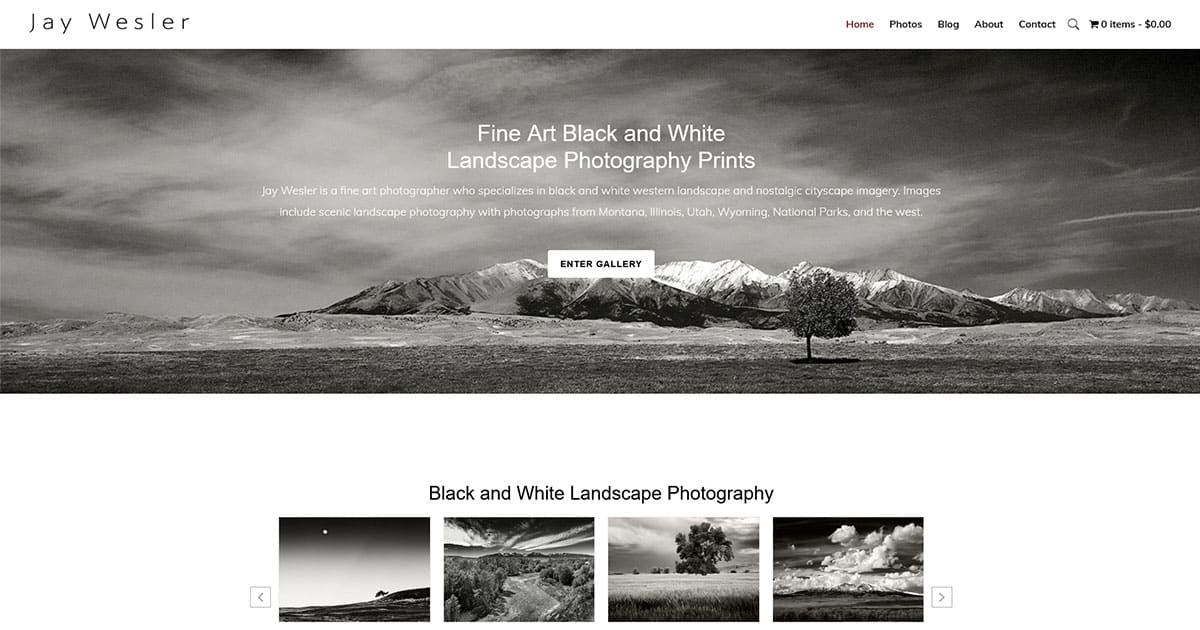
A portfolio and print shop for Jay Wesler’s fine-art black-and-white landscape photographs, focused on Montana and the American West, with some urban and coastal scenes. The work favors minimal compositions, high contrast, and traditional zone-system printing, which produces deep blacks and carefully separated midtones. The site is structured around a “Selected Work” gallery and a “View All Work” archive, with individual titles and locations such as Mammoth Hot Springs, Emigrant Peak and the Yellowstone River, and Golden Gate Bridge.
Who it suits
- Collectors of Western landscape prints who want a restrained, high-contrast look rather than color.
- Interior designers or homeowners seeking large-format monochrome pieces with a specific regional subject.
- Photographers studying minimalist composition and zone-system tonal control.
How to use it Start with “Selected Work” to get the strongest examples and the geographic range, then open “View All Work” if you want to compare specific locations or years. If you are buying for a particular room, note the location and orientation of candidates first, since subject matter often matters more than subtle tonal differences at a distance.
For a broader comparison of print portfolios, LensCulture and Magnum Photos show how other photographers present landscape and documentary work, while National Gallery of Art offers context on photography as a collecting category.
How can I purchase prints from Jay Wesler's collection?
Jay Wesler's site is a portfolio-style gallery rather than a shop: it presents the photographs and directs visitors to "View the Collection" and "View All Work," but the page evidence does not show a cart, checkout, or listed print prices. So the practical route is to treat the collection pages as the catalog and contact the photographer directly to arrange a purchase.
A workable approach
- Browse Selected Work and the full collection to note the titles you want — for example Mammoth Hot Springs 1, Yellowstone National Park 2009, Emigrant Peak and Yellowstone River, Montana 2006, or Akaka Falls, Hawaii 2018.
- Use the site's contact option (typically a contact page or email link in the site footer or navigation) to ask about availability, print sizes, paper or framing options, edition sizes, and shipping.
- Ask explicitly whether the image is available as a print and whether it is signed or limited — the page notes the work has appeared in fine art publications and galleries, which often means limited editions, but that is not stated as a purchase term here.
- Confirm total cost including shipping and any taxes before paying, and request the payment method the photographer accepts.
What to decide before you write
- Format: unframed print, matted, or fully framed. Framed work costs more to ship and limits your own framing choices.
- Size relative to your wall: a minimalist, high-contrast black and white image often works best with generous surrounding wall space and a simple frame.
- Edition: if you want long-term collectible value, ask whether a certificate or edition number is provided.
- Subject match: Montana and Yellowstone scenes suit a western or natural-history interior; the Chicago and Golden Gate images suit urban settings.
If Jay Wesler's own site does not offer a direct purchase path, comparable fine-art landscape photography is sold through established print marketplaces such as Magnum Photos for documentary work or Artsy for gallery-listed editions — useful as a reference point for how editioned photography is normally priced and documented, though the specific terms for Wesler's prints come only from him.
A sensible next step: open the collection, shortlist two or three images, and send one email listing the titles, your preferred size, and your shipping city so you can get a single clear quote.
What locations and subjects are featured in Jay Wesler's black and white photographs?
Jay Wesler's black and white photographs center on landscapes of Montana and the American West, with additional work from other parts of the United States and Hawaii. The site groups selected pieces by place and subject rather than by date or theme.
Locations and subjects shown
- Montana and the West: Emigrant Peak and Yellowstone River, "Golden Gate Bridge Big Clouds," "Cool Breeze," and other Montana scenes. These are the core of the collection.
- National parks and natural landmarks: Mammoth Hot Springs 1 in Yellowstone National Park (2009) and Akaka Falls, Hawaii (2018).
- Other American places: Covered Bridge, Indiana (2004), plus Chicago subjects such as "Solitude" (1998) and "Three Stiffs" (1998).
The mix suggests two overlapping interests: wide natural scenery and quieter, more graphic urban or architectural moments. The Montana work is the strongest fit if you are looking for Western landscapes; the Chicago and Indiana images show a different, more observational side.
Style and how the work is presented
According to the site, many photographs follow a minimalist approach with high-contrast printing and zone system techniques, and the work has appeared in fine art publications and galleries. In practice, that means you should expect strong tonal separation, simplified compositions, and a print-first presentation rather than casual snapshots.
A useful next step
If you are browsing for a specific place, start with the Montana and Yellowstone images, then check the "View All Work" section for the Chicago, Indiana, and Hawaii pieces. If you are choosing a print for a room, compare a wide landscape such as Emigrant Peak and Yellowstone River against a tighter composition like "Solitude" to see which scale and contrast level suits the space.
What is the minimalist style and zone system technique used in these black and white photos?
Minimalist style here means stripping a landscape down to a few strong elements—open sky, a single ridge line, water, or one dominant form—so contrast and shape carry the image instead of color or busy detail. The zone system is a black-and-white exposure and printing method that maps tones from deep black to pure white into controlled steps, letting a photographer decide in advance how bright or dark each part of the scene should render. Together they explain the look described on the site: high-contrast prints where a small number of tones do most of the work.
On this site, the page states that many of the photographs follow a minimalist style and use high-contrast printing and zone system techniques. That is a description of the photographer's approach, not a step-by-step tutorial.
What each term actually covers
- Minimalism is a composition choice: fewer subjects, more negative space, simple horizons, and deliberate placement of one focal point.
- Zone system is a tonal control method: previsualizing the final print, then exposing and developing so shadows, midtones, and highlights land where you want them.
- High-contrast printing is the visible result: bright whites and deep blacks with relatively few midtones, which can make a plain scene feel graphic and dramatic.
How to judge it in a photograph
Ask whether your eye goes to one place immediately, whether the midtones are doing unnecessary work, and whether detail survives in both the darkest and lightest areas. A minimalist zone-system print usually feels calm and structured rather than flat; if the blacks turn into empty patches or the whites lose all texture, the tonal control has gone too far.
A practical next step is to look through the selected work and pick two images from the same region, such as the Montana photographs, then compare how each handles sky and foreground tone. If you want wider context on the method, see Wikipedia on the zone system and The Met for black-and-white landscape examples.
Where have Jay Wesler's photographs been exhibited or published?
Jay Wesler's site says his black and white photographs "have been represented in numerous fine art publications and galleries for photography." That is the extent of the exhibition and publication record given on the page: it confirms gallery and print-publication exposure but does not name specific galleries, magazines, books, or dates.
What the page does document is the work itself. The selected images span locations and years, including Mammoth Hot Springs in Yellowstone National Park (2009), Emigrant Peak and the Yellowstone River in Montana (2006), Golden Gate Bridge Big Clouds in Montana (2009), Akaka Falls in Hawaii (2018), a covered bridge in Indiana (2004), and Chicago scenes from 1998. Montana and the American West dominate, which suggests the gallery and publication placements likely sit within regional fine-art photography circles rather than national museum exhibitions.
If you need verifiable exhibition credits—for a purchase decision, a loan request, or a collector's provenance file—treat the site's claim as a starting point and ask the photographer directly for the specific venue names and publication issues. A useful request: "Which galleries have shown the Montana work, and in which publications did those images appear?" That turns a general statement into a checkable list.
Can I commission Jay Wesler for custom black and white landscape photography?
The site presents Jay Wesler as a fine art black and white landscape photographer whose work is shown in galleries and publications, but it does not advertise commissioned or custom shoots. The visible content is built around an existing collection of prints: selected images from Montana and the American West, plus locations such as Yellowstone, Chicago, Indiana, and Hawaii. That points to a print-and-gallery practice rather than a client-booking service.
For a custom request, the practical next step is to ask directly rather than assume. A short message that states the location, approximate dates, intended use (wall print, editorial, gift), preferred print size, and whether you want a one-off image or a series will get a faster and more useful reply than a general enquiry.
If the answer is no, you still have workable alternatives:
- License an existing image if your location or subject is already covered, such as Montana landscapes or Yellowstone.
- Buy a print when the goal is a finished piece for a home or office wall.
- Hire a local landscape photographer when the location itself is the point and you need a specific date.
A useful decision test: commission when the photograph must show a place, time, or viewpoint that does not yet exist in the portfolio; buy or license when an existing frame already matches the mood and subject you want.
For comparison, established landscape photographers who do take commissions often list a contact form, usage terms, and turnaround information. You can see how a gallery-oriented practice presents its collection at Black & White Landscape Photography by Jay Wesler.
User reviews (0)