
 简体中文
简体中文 English
Website review
This review may include AI-generated content and is not individually verified. Domain, certificate and other facts come from the observed data on this page.
What is Langint?
Langint is a website for English speakers who want to learn Russian from the beginning. It presents itself as a set of connected learning tools rather than a single course: a textbook, an interactive online course, and dictionaries. The stated goal is to take learners from no prior knowledge of Russian toward reading, listening, speaking and grammar, with the Cyrillic alphabet and pronunciation as early steps.
Its main components are:
- Resonance — a textbook aimed at beginners.
- CORRUS — an interactive online course, suited to learners who want exercises and structured practice alongside or instead of a printed book.
- LexTutor dictionaries — English–Russian reference tools for looking up vocabulary while studying.
The material is designed for English-speaking learners, so explanations and comparisons are likely pitched at that audience. Langint says its tools are used in more than 30 countries, which suggests a self-study audience as well as possibly classroom use.
As a trade-off, a multi-part system gives flexibility: you can follow the textbook in order, use the online course for drills, or consult the dictionaries as needed. The same structure may feel less streamlined to someone who prefers one single app with a fixed path. Pricing and full feature details are not specified in the available information, so those should be checked on the site itself.
What resources does Langint offer for learning Russian?
Langint is a Russian-learning site aimed at English-speaking beginners. Its materials are organised into three connected tools, so learners can move between structured study, interactive practice and reference lookups.
Main resources
- Resonance textbook – a written beginner course that introduces the Cyrillic alphabet, pronunciation and core grammar in a sequenced way. Suited to learners who want a linear path they can work through at their own pace.
- CORRUS interactive course – an online component for practising what the textbook covers, typically with exercises and feedback. Useful for reinforcing alphabet recognition, grammar patterns and vocabulary between reading sessions.
- LexTutor dictionaries – English–Russian reference tools for checking words and meanings while studying or reading. Best treated as a companion to the course rather than a standalone learning method.
Who it fits
The combination works well for self-study beginners who want a textbook spine plus digital practice, and for learners who prefer explicit grammar explanations over purely conversational apps. The site states its materials are used in more than 30 countries, though that figure describes reach rather than a quality guarantee.
Trade-offs
A textbook-led approach gives clear structure but less spontaneous speaking practice than live tutoring or conversation-focused platforms. Dictionary tools help with comprehension, not fluency. Pricing is not indicated in the supplied information, so check the site directly before committing.
How does the Resonance textbook help beginners learn Russian?
How the Resonance textbook supports beginners
Resonance is positioned as a structured starting point for learners with no prior Russian. It is designed to build from the Cyrillic alphabet and pronunciation toward grammar and reading, so beginners are not expected to already know the script or sound system.
What it typically covers
- Alphabet and pronunciation: early work on recognising and sounding out Cyrillic letters, which is usually the first barrier for English speakers.
- Grammar foundations: explanations and exercises that introduce cases, verb forms and sentence patterns in sequence rather than all at once.
- Vocabulary in context: words and phrases presented alongside the grammar they illustrate, rather than as isolated lists.
How it fits with the wider site
Resonance is one of several tools on Langint. The CORRUS interactive course may suit learners who want online practice, while LexTutor dictionaries are useful for looking up words and checking forms. A beginner could work through the textbook for a clear path, then use the course for repetition and the dictionaries for reference.
Trade-offs
A textbook format gives a stable, ordered curriculum and works well for self-study or classroom use, but it depends on the learner keeping a regular pace. Those who prefer immediate feedback or spoken interaction may want to combine it with online exercises or conversation practice.
What is the CORRUS interactive course?
CORRUS is Langint's interactive online course for learning Russian, designed to sit alongside the same site's Resonance textbook and LexTutor dictionaries. Where a printed textbook typically presents explanations and exercises in a fixed order, an interactive course usually adds immediate feedback, repeatable drills and self-paced progression, which suits beginners who want to practise between lessons or without a teacher present.
Likely audience and use
- Self-study learners starting from the Cyrillic alphabet who need structured practice rather than open-ended browsing.
- Students using Resonance as a main text who want extra grammar, vocabulary and pronunciation repetition.
- English speakers, since the course is described as being built for learners in 30+ countries with English-language support materials.
How it fits with the other resources
| Resource | Typical role |
|---|---|
| Resonance textbook | Core explanations and sequenced lessons |
| CORRUS course | Interactive practice and reinforcement |
| LexTutor dictionaries | Reference for vocabulary and translation |
The trade-off is familiar: an interactive course offers convenience and instant correction, but it may not replace the depth of a full textbook or the guidance of a tutor. Beginners often combine all three, using CORRUS for daily practice and the dictionary for quick lookups.
See Langint for the course itself and its companion materials.
How do LexTutor dictionaries assist in learning Russian?
LexTutor dictionaries on Langint are positioned as companion tools for learners working through the same Russian material as the Resonance textbook and CORRUS course. Rather than serving as standalone reference works, they are typically used alongside structured lessons, so vocabulary and grammar encountered in study can be checked and reinforced in context.
For beginners, the main value lies in bridging the gap between recognising Cyrillic letters and actually using words:
- Looking up an unfamiliar word while reading or completing exercises
- Confirming meaning and usage when a textbook gloss is too brief
- Revisiting vocabulary from earlier lessons during review
- Checking English–Russian equivalents when composing simple sentences
Because the dictionaries sit within the same learning ecosystem as the course and textbook, terminology and examples may align more closely with what learners meet in their lessons than a general-purpose dictionary would. That consistency can reduce confusion for people who are still building confidence with the alphabet and basic grammar.
The trade-off is specialisation: a learner-focused dictionary may offer fewer entries, rarer senses or technical terms than a large general dictionary. Advanced learners or those reading literature and news outside the course may therefore need an additional reference. For English speakers starting from scratch, however, LexTutor is best understood as a study aid that supports the wider beginner programme at Langint rather than a replacement for it.
Is Langint suitable for complete beginners in Russian?
Yes — Langint is explicitly aimed at learners starting from zero. Its materials are designed for English speakers who need to build Russian from the alphabet upward, and the site reports use by learners in more than 30 countries.
H3 What beginners get
- Resonance textbook — a structured starting point that typically introduces Cyrillic, pronunciation and core grammar in sequence.
- CORRUS interactive course — online practice suited to self-study, with exercises that reinforce what the textbook covers.
- LexTutor dictionaries — English–Russian reference tools for looking up words while reading or doing exercises.
H3 Who it fits best
The combination of a textbook plus an online course suits learners who want a guided path rather than random browsing. If you prefer a single app with gamified drills, this mix of book and course may feel more formal. If you want a clear progression from the alphabet to basic grammar, it is a reasonable fit.
H3 Trade-offs to consider
Starting from scratch means committing to regular practice; no tool removes that. Also, the site does not display pricing on the pages described here, so check current access terms directly before relying on it.
Related options include Duolingo for casual daily practice and RussianLessons.net for free grammar explanations.
 Amazon Route 53
 Microsoft 365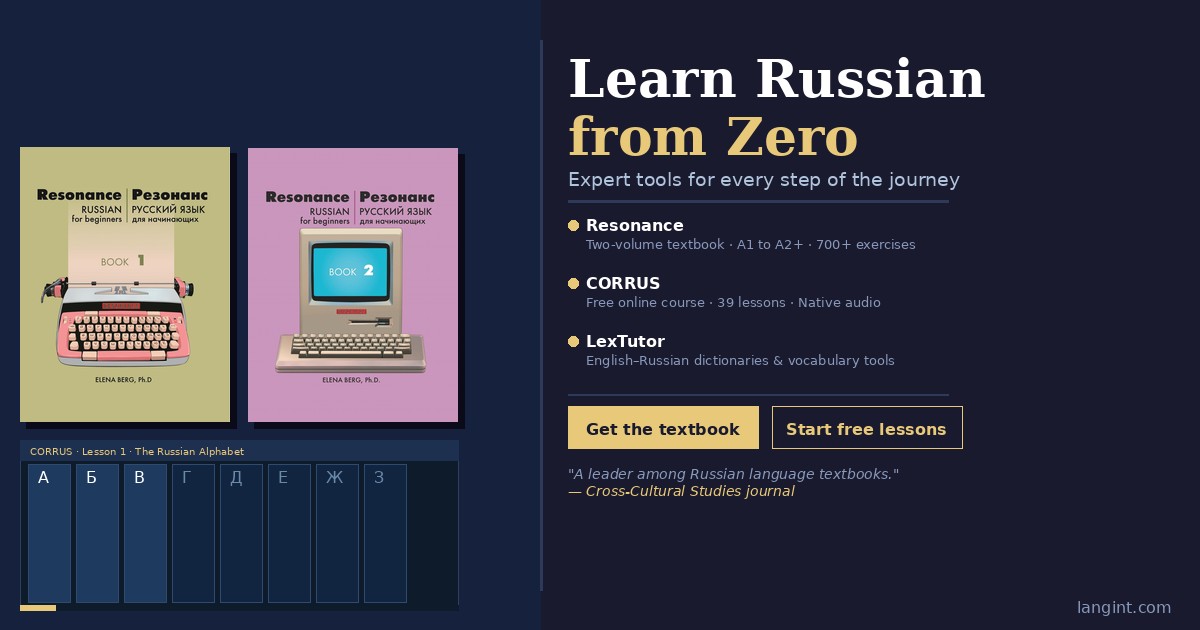

User reviews (0)