Website profiles · Technology insights · Alternatives

musicle.fun

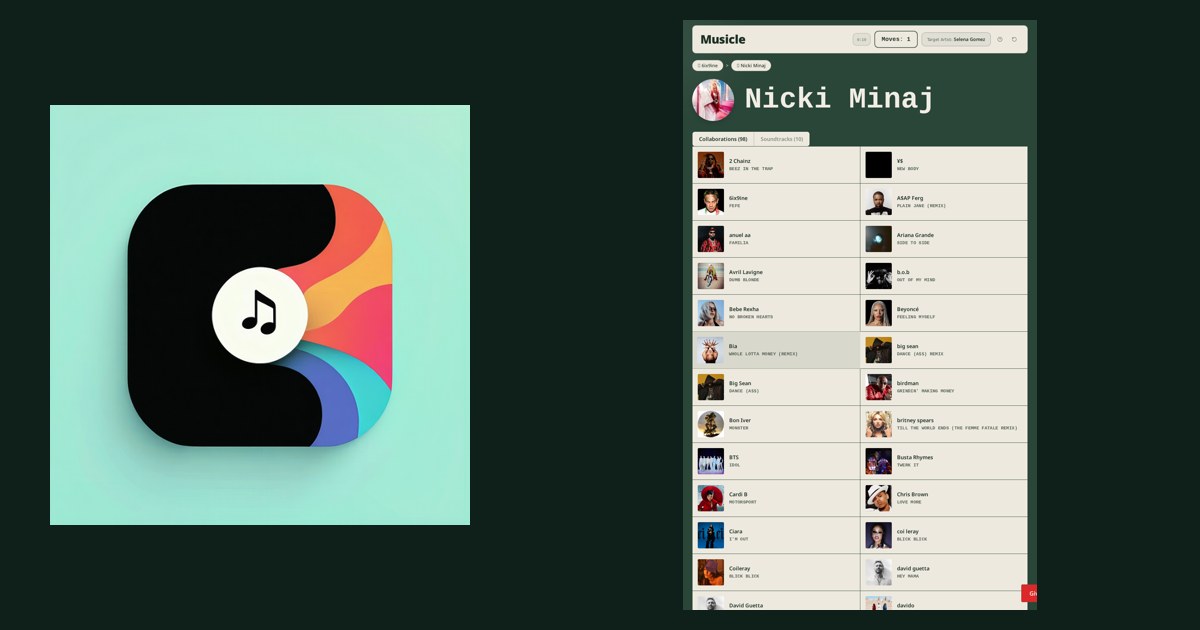
Connect music artists through real collaborations in this daily music puzzle game. Reach the target artist in the fewest moves

No paid content found
Visit website
Profile views 1 Outbound visits 10 Normal
Musicle Full homepage screenshot

At a glance

Category
Games & Board Games
Language
English
Paid-content signal
No paid content foundObserved
Registered
2026
Hosting
VercelInferred
HTTPS certificate trusted
PassedObserved
Last updated

Website review

This review may include AI-generated content and is not individually verified. Domain, certificate and other facts come from the observed data on this page.

What is Musicle?

Musicle is a daily puzzle game where you connect one music artist to another through real collaborations, aiming to reach the target artist in the fewest moves. It works like a music-specific chain game: each step must be a genuine collaboration between artists, so your music knowledge—not guesswork—drives the solution.

How it plays out

Say you're given a starting artist and a target. You might link them through a featured verse, a joint single, or a credited duet, building a chain until you hit the target. Fewer moves means a better result, which rewards players who know cross-genre and cross-era connections.

Who it suits

  • Music trivia fans who enjoy recalling features and side projects.
  • Daily-puzzle players who like a short, repeatable challenge in the Wordle mold.
  • Casual listeners looking to discover how artists they like are linked.

The trade-off is that the game leans on real collaboration data, so obscure artists or genres with fewer documented features can be harder to chain—depth of catalog matters more than raw popularity.

A useful next step: before your first attempt, pick two artists you know well and mentally trace a two- or three-step path between them. That warm-up shows whether your instincts match how collaborations are counted, which is the main skill the puzzle tests.

How do you play a round of Musicle?

A round of Musicle is a daily music puzzle where you start from one artist and try to reach a target artist by chaining real collaborations. The goal, as the site describes it, is to reach the target in the fewest moves, so each round tests both your music knowledge and your ability to find short, efficient paths.

The basic loop

  1. You're given a starting artist and a target artist for the day.
  2. You enter an artist who has genuinely collaborated with your current artist.
  3. That collaborator becomes your new current artist, and you continue from there.
  4. You keep building the chain until you reach the target, aiming to use as few links as possible.

Because the links must reflect actual collaborations, guessing a plausible-sounding pairing won't help — you need connections you can genuinely justify.

A concrete example

Imagine the target is a modern pop star. A strong player might think backward: which well-connected artists bridge genres? Someone with credits across rock, hip-hop and pop can often shorten a chain dramatically. A weaker player tends to move one familiar name at a time and ends up with a longer route. The scoring rewards the planner, not the fastest typist.

Who gets the most from it

  • Music trivia fans who enjoy recalling features, remixes and guest verses.
  • Daily-puzzle players who like a short, repeatable challenge in the Wordle mould.
  • People with broad taste, since crossing genres is usually the key skill.

If you only listen to one narrow genre, expect some rounds to be hard — that's a knowledge gap, not a flaw in the puzzle.

Practical tips for a better round

  • Work backward from the target as well as forward from the start.
  • Look for "hub" artists with many credited collaborations.
  • Before committing, ask whether the pairing is a real recorded collaboration, not just a shared tour or label.

To get started, open Musicle and play the current daily round; treat your first attempt as a scouting run, then aim to beat your move count on the next day's puzzle.

How does Musicle decide which artist collaborations are valid connections?

Musicle's page describes the puzzle as connecting artists through real collaborations, but it does not explain the exact rule set it uses to decide whether a given pairing counts as a valid connection. So the honest answer is: the site presents connections as real-world collaborations, and the specific validation criteria aren't documented in the available page details.

What this means in practice

If you're playing and a link you expected to work gets rejected, the likely causes are about how "collaboration" is defined rather than about the artists being unrelated:

  • Featured versus credited roles. A guest verse, a production credit, a remix, or a sample may be treated differently. A producer credit is a working relationship but not necessarily a "collaboration" in the puzzle's sense.
  • Direct versus indirect links. Two artists on the same compilation or the same festival lineup are connected in a loose sense but may not share a track.
  • Source of truth. Collaboration data usually comes from a music database or streaming catalogue, so a pairing that exists only in liner notes, a live performance, or an unofficial release may not appear.

A useful next step

Before committing to a guess, ask whether the two artists appear together on a single released track with both credited as performers. That is the most conservative reading of "real collaboration," and it is the safest assumption when the rules aren't spelled out. If you want to verify a link, a discography-focused database such as Discogs shows full credit lists, including who played on or produced a release, which helps you tell a genuine joint track from a shared scene.

For context on comparable daily music puzzles and how they frame their rules, see Spotify for catalogue-based artist and feature data.

Does Musicle use Discogs or Spotify data, and what does that mean for which artists and collaborations appear?

Musicle's page does not say which database it draws on. The only names tied to the game are its own topic tags, which list both Discogs and Spotify, so the page gives no confirmation that either one supplies the artist and collaboration data. Treat the sourcing as unstated rather than settled.

What that means in practice

  • Coverage: if the game is built on Discogs-style credits, the pool likely leans toward artists with documented releases and detailed session and production credits. If it leans on Spotify-style data, expect more emphasis on streaming-era acts and featured-artist tags.
  • Which collaborations count: a credited guest verse, a production credit, a remix and a sample are different kinds of link. The page's phrase "real collaborations" suggests documented joint work, but it does not define the boundary, so a puzzling rejection is a rules question, not proof of a bad database.
  • How to test it yourself: try a chain through an older, credit-heavy artist and another through a current chart act. Whichever route feels richer tells you more about the underlying catalogue than the tags do.

For a next step, check whether the game shows a source note or an explanation after a failed connection; that is the quickest way to learn which credits it accepts. For background on how each catalogue classifies artists and credits, see Discogs and Spotify.

How is the daily Musicle puzzle different from other music guessing games like Heardle or Wordle-style trivia?

Musicle is a connection puzzle rather than a guessing game: you link music artists through real collaborations and try to reach a target artist in the fewest moves. The challenge is building a correct chain, not identifying a hidden song from audio or guessing a word from letter clues.

How it differs in practice

Game type What you do What makes it hard
Musicle Connect artists via real collaborations to reach a target Knowing which artists have actually worked together, and finding a short route
Heardle-style Identify a song from progressively longer audio clips Recognizing the track quickly
Wordle-style trivia Guess a word or answer using letter or category feedback Narrowing options from limited clues

A concrete example: if the target is a veteran producer, a strong player might link a current pop star to a featured rapper, then to an artist who has worked with that producer. The skill is discography knowledge and route-finding, so fans of liner notes and feature credits tend to have an edge over players who mainly recognize hit intros.

A useful next step

If you already play Heardle or Wordle-style games, treat Musicle as a separate daily habit: before your first move, sketch two or three possible short chains from well-connected artists you know. That planning habit matters more here than speed of recognition, because a shorter route usually beats a faster but longer one.

Can I practice Musicle puzzles from previous days or play unlimited rounds outside the daily challenge?

Musicle is built around a single daily puzzle, and the supplied page information does not describe an archive of past days or an unlimited practice mode. So you should expect one fresh connection challenge per day rather than a back catalogue to replay.

If you want more practice than the daily round provides, two approaches work well:

  • Recreate the format yourself. Pick two artists you know and try to link them through real collaborations in as few steps as possible. A streaming service's "appears on" credits or a discography site can confirm whether a connection is genuine.
  • Use the daily puzzle as a warm-up. Treat each day's round as a short session and note which genres or eras trip you up, then read up on those scenes between rounds.

For a sense of how the daily format works, see Musicle. If replaying old puzzles matters to you, check the site itself for any archive or practice option before committing to a daily habit, since the available description covers only the daily challenge.

Related questions

More questions →
What Is the Artist Connections Music Puzzle and How Do You Play It?

Artist connections is a daily music puzzle in which you link a starting artist to a target artist through real collaborations, trying to reach the target in the fewest moves. Musicle is one example of this format: its stated goal is to "connect music artists through real collaborations in this daily music puzzle game" and to "reach the target artist in the fewest moves." You can play it if you know popular music collaborations reasonably well and are willing to check links rather than guess.

How the puzzle works

Each puzzle gives you two endpoints: a starting artist and a target artist. You build a chain between them. Every link in the chain must be a genuine musical collaboration between the two artists it joins — for example, a featured verse, a joint single, or a credited duet. The puzzle counts your moves, and the aim is to use as few as possible.

Element What it means in play
Start artist The fixed first name in your chain
Target artist The name you must reach
A move Adding one artist who has a real collaboration with the previous artist
Move count The number of links you add; fewer is better
Valid link A documented collaboration, not a shared genre, label, or tour

The site describes the game as daily and collaboration-based, and lists Discogs and Spotify among its keywords — a signal that collaboration data is the backbone of the puzzle. Treat any specific link as valid only if you can point to an actual joint credit.

A basic strategy for short chains

The shortest path usually runs through artists who collaborate widely — producers, featured artists, and genre-spanning performers. A practical approach:

  1. Name the target's frequent collaborators. Think of who has appeared on the target's records or brought the target onto theirs.
  2. Look for a bridge artist. Find someone who has worked with both your start and someone close to the target.
  3. Prefer hubs over favorites. An artist with many credited collaborations gives you more exits than a niche act you like.
  4. Verify before you commit. If you cannot recall a specific joint track or credit, the link is probably wrong.

For example, if your start is a rock act and your target is a pop singer, a producer or a featured vocalist who has credits across both worlds is often a one- or two-move bridge. The same logic applies in reverse: work backward from the target and meet your forward chain in the middle.

Common beginner mistakes

  • Guessing unverified connections. Assuming two artists "must have worked together" because they share a scene leads to invalid links.
  • Confusing proximity with collaboration. Shared genre, label, festival lineup, or remix credit by a third party is not the same as a direct collaboration.
  • Taking long detours. Chaining through artists you know well feels safe but inflates your move count; aim for hubs instead.
  • Ignoring featured credits. Many short links exist only as guest features, which are easy to overlook.
  • Not planning backward. Building only from the start artist can leave you stranded far from the target.

When this puzzle suits you

This format rewards broad listening and memory for credits rather than deep knowledge of one genre. If you enjoy daily word-and-trivia puzzles and can recall who has worked with whom, you will get more out of it than someone who mostly follows a single artist. If you are unsure about a link, the safe play is to choose a different, verifiable collaborator — a slightly longer chain you can defend beats a short one built on a guess.

What Is Music Trivia and How Can You Use It to Play Music Games Better?

Music trivia is knowledge about songs, artists, albums, and the relationships between them—release years, chart facts, who wrote or produced a track, and who has recorded together. You use it to play music games better by recalling verified facts instead of guessing: in a guessing quiz it narrows the answer space, and in a connection puzzle like Musicle it lets you pick a next artist who actually shares a real collaboration with your current one, so you reach the target in fewer moves. The main condition is that your trivia must come from checkable sources, not rumor.

What counts as music trivia

Music trivia covers several kinds of facts, and each supports a different game style:

  • Release and chart facts — year, album, peak position, era. Useful for timeline and "higher or lower" games.
  • Credits — songwriters, producers, featured artists. Useful for quizzes that ask "who wrote this?"
  • Collaboration links — two artists who appear on the same track or release. This is the core of connection puzzles.
  • Artist identity facts — genre, origin, active years, band membership.

A quick way to tell games apart: a knowledge quiz asks you to state a fact ("Which year was this released?"), while a connection puzzle asks you to use facts as moves ("Which artist connects these two?"). Musicle sits in the second category: its stated goal is to connect music artists through real collaborations and reach a target artist in the fewest moves.

How trivia changes your play in each game type

Song-guessing quizzes

Trivia reduces the number of guesses because each fact eliminates options. If you know a track's decade, genre, and whether the vocalist is male or female, you can usually skip the broad early guesses and go straight to a shortlist. The mistake to avoid is treating a half-remembered detail as certain—one wrong "fact" can send you down a whole wrong branch.

Artist-connection puzzles (Musicle-style)

Here trivia works as a routing tool. Each move should be an artist you can justify with a real collaboration. The skill is not knowing the most facts overall, but knowing which facts create short paths to the target. A player who knows a handful of well-connected artists—producers, frequent featured guests, cross-genre collaborators—often beats a player with broader but less connected knowledge.

Timeline and ranking games

Release years and chart history are the whole game. Precision matters more than breadth: knowing that two albums came out in the same year is less useful than knowing which came first.

Building trivia you can actually use

Collect facts in the shape the game needs, not as a random pile.

  1. Start from collaborations, not biographies. For each artist you like, note who they have recorded with. This directly builds connection-puzzle routes.
  2. Anchor facts to releases. "Artist A and Artist B appear on this track" is verifiable; "Artist A and Artist B are friends" is not useful in a puzzle.
  3. Track a few hub artists. Producers and frequent featured artists tend to connect many otherwise distant names—useful shortcuts in connection games.
  4. Check before you store. Confirm credits and features against a database or official release information rather than a comment thread.
  5. Review by playing. After a game, note which fact you were missing and add it. This turns each session into a small study loop.

A concrete example: if you need to get from a pop singer to a classic rock act, knowing that a specific producer worked with both gives you a two-move route. That single fact is worth more than a dozen chart positions.

Common mistakes that cost you moves

  • Treating rumor as fact. Unconfirmed "they worked together" claims lead to invalid moves or wrong answers. If you cannot point to a release or credit, do not rely on it.
  • Ignoring direction and specificity. A collaboration is a specific link between specific artists on a specific track; a shared genre or a shared label is not a collaboration. Assuming any two artists in the same scene connect is the most common way to waste a move.
  • Optimizing for obscure facts. Deep-cut knowledge feels impressive but rarely shortens a route. Well-connected, well-documented artists usually do.
  • Guessing instead of recalling. In a move-limited puzzle, a guess you cannot justify is a lost move. If you have two candidates, pick the one whose collaboration you can actually name.

Where to start

If you want to practice, pick one game type and one habit: for quizzes, build a shortlist by decade and genre before answering; for connection puzzles like Musicle, keep a running list of verified collaborations for the artists you know best. Both turn trivia from passive knowledge into a tool that shortens the path to the answer.

What Is a Music Game and How Do Song-Guessing Quizzes Work?

A music game like Muzify's guess-the-song quiz works by playing a short clip — often around 5 seconds — and asking you to name the track before your guesses run out. It suits anyone who recognizes songs quickly and wants a scored, competitive format rather than passive listening. Muzify runs in a web browser and as a mobile app, and its core quiz is presented as free.

The core mechanic: short clip, limited guesses

The format is simple to understand and hard to master:

  1. A clip from a song starts playing.
  2. You type or select the song title.
  3. You get a limited number of attempts to get it right.

Muzify's Daily mode is described as one song a day, six guesses. The main "Guess the Song" quiz frames the challenge as naming the track within 5 seconds.

That combination is what separates a music game from ordinary listening. The clip is deliberately too short to rely on lyrics or a full chorus, so you have to recognize the track from a hook, a riff, a drum pattern, or the production style alone.

What the game actually tests

  • Recognition speed — how fast a familiar sound triggers the title.
  • Artist and catalog knowledge — knowing who made a track, not just that you've heard it.
  • Recall under pressure — producing the name before the guesses or the clip run out.

Daily challenges, streaks, and limited guesses

The daily format is the retention engine. One song per day, a fixed guess budget, and a result you can compare with others turns a 30-second activity into a habit. Because everyone gets the same song on the same day, the daily challenge also becomes a shared talking point.

Limited guesses do the balancing. Six guesses on a daily track means a lucky guess isn't enough — you need either strong recognition or a process of elimination. The 5-second framing in the main quiz adds time pressure on top of the guess limit.

Leaderboards, badges, and multiplayer

Muzify layers competition on top of the basic quiz:

Feature What it adds
Leaderboards A ranked comparison against other players
Badges Milestone rewards for progress over time
Clash multiplayer Head-to-head play instead of solo scoring
Music stats A personal record of your results to share

The site's own framing is aimed at "real fans" — the pitch is bragging rights and proving you're the biggest fan among your friends, not just passing time. Multiplayer modes like Clash change the dynamic from "did I know it?" to "did I know it faster than the other player?"

How to start playing

Muzify is available on the web and via the App Store and Play Store. The site presents the song-guessing quiz as free, and the daily challenge is playable without creating an account first — signing up or logging in is what unlocks the persistent side: stats, badges, and leaderboard position.

A practical starting order:

  1. Play the daily song to get a feel for the clip length and guess budget.
  2. Try the main 5-second quiz to test recognition speed.
  3. Create an account if you want your stats and leaderboard standing to persist.
  4. Move to Clash once solo play feels too easy.

Common sticking points

  • The app needs JavaScript enabled in the browser to run, so a blocked script will leave you with a blank page.
  • Five seconds is genuinely short. If you're used to full-song quizzes, expect a much lower hit rate at first.
  • Guessing randomly burns your budget. With six attempts, a few deliberate guesses based on genre or era beat typing titles at random.

If you recognize songs fast and want that skill scored rather than just enjoyed, the format is built for you. If you prefer longer clips or lyric-based questions, a 5-second recognition quiz will feel punishing by design.

What Is a Daily Puzzle Game and How Do You Play One?

A daily puzzle is a short puzzle that refreshes once per day, usually solvable in a few minutes, with a fixed goal such as guessing a word, connecting two items, or answering a themed question. You play it by opening the day's puzzle, reading the rules and scoring before your first move, then working within the allowed attempts or moves. Musicle, a music daily puzzle, applies this format to artist connections: you link a starting artist to a target artist through real collaborations, aiming to reach the target in the fewest moves.

What makes a puzzle "daily"

Daily puzzles share a few structural traits that separate them from unlimited practice games:

  • One shared puzzle per day. Everyone playing that day gets the same challenge, which makes results comparable.
  • A fixed reset. Once you finish (or run out of attempts), you wait for the next day's puzzle.
  • Short sessions. The format is designed for a few minutes, not a long campaign.
  • Optional stats and sharing. Many daily puzzles track streaks or let you share a spoiler-free result.

The trade-off is limited replay: if you want more practice after finishing, you generally need a different game or mode.

Common daily puzzle formats

Format Goal Typical constraint
Word guessing Find a hidden word Limited guesses, feedback per guess
Connection / linking Link a start item to a target item Limited moves, links must be valid
Trivia / quiz Answer the day's question set Fixed number of questions
Visual or logic grid Solve the day's grid or image Time or attempt limit

The format determines what "doing well" means. In word games it's usually fewer guesses; in connection games it's fewer moves.

How a connection puzzle like Musicle works

Musicle is a daily music puzzle built around artist connections. The page describes the goal directly: connect music artists through real collaborations and reach the target artist in the fewest moves.

The loop works like this:

  1. You get a starting artist and a target artist.
  2. You propose a link between the current artist and another artist who has actually collaborated with them.
  3. Each valid link counts as a move, and the chain continues from the new artist.
  4. You win when the chain reaches the target artist, with your move count as your score.

The key constraint is that links must reflect real collaborations, not just shared genres or scenes. That makes the puzzle a test of music knowledge as much as planning.

A concrete example

Suppose the start is Artist A and the target is Artist D. A direct collaboration between A and D would be a one-move solve. If none exists, you look for a bridge: A collaborated with B, and B collaborated with D, giving a two-move chain. The skill is spotting short bridges rather than wandering through loosely related artists, since every extra link raises your move count.

How to start today's puzzle

  1. Open the game and read the rules screen first. Confirm the goal, what counts as a valid link, and how moves are scored before you commit.
  2. Note the start and target artists. Think about each artist's known collaborators before making your first move.
  3. Make your first link deliberately. Prefer a collaborator who plausibly connects toward the target's world rather than a random favorite.
  4. Track your chain. Keep the current artist and move count in mind so you don't loop back or waste moves.
  5. Finish and check your result. After reaching the target, review your move count; that's your score for the day.

Common sticking points

  • Skipping the rules. Move-count scoring changes strategy: a valid but indirect link can cost you the day's best score.
  • Confusing "related" with "collaborated." Shared label, genre, or era doesn't count if the game requires real collaborations.
  • Overthinking the first move. A reasonable bridge early usually beats a perfect-but-slow search.
  • Expecting a replay. Daily puzzles typically don't reset, so a rough score stands until tomorrow.

Is a daily puzzle worth playing?

Choose a daily puzzle if you want a short, consistent ritual with a comparable daily result and a knowledge angle you enjoy—music collaborations in Musicle's case. Skip it if you want long sessions or unlimited retries; the once-a-day structure is the point, not a limitation to work around. Before your first attempt, the rules screen and the start/target pairing tell you most of what you need to plan a low-move solve.

What Spotify Data Does Kworb.net Track and How Can You Use It?

Kworb.net's Spotify section turns Spotify's own daily and weekly charts into song and artist pages, plus country-level statistics. You can use it to see where a track or artist is charting across countries and how streaming performance changes over time. It is a third-party aggregator, not Spotify itself, so treat it as a view built on top of Spotify's published chart data.

What the Spotify section is built from

Kworb.net states that Spotify is its preferred streaming service because it is "the only one who publishes detailed streaming data." The site uses Spotify's daily and weekly charts to build:

  • Song pages — a single track's chart positions and streaming statistics
  • Artist pages — an artist's overall streaming footprint
  • Country chart statistics — added detail layered onto Spotify's country charts

This matters because the underlying numbers come from Spotify's published charts, while the organization, cross-country grouping, and presentation come from Kworb.net.

What you can actually look up

Song-level data

A song page lets you see the countries where that track is charting and compare its position across markets. This is the fastest way to answer "is this song bigger in one country than another?"

Artist-level data

Artist pages give a quick overview of where a song or album is charting across countries. Kworb.net describes this as "probably kworb.net's second most popular feature," which signals it is a well-used part of the site rather than an afterthought.

Country charts

Kworb.net adds statistics to Spotify's country charts, so you can look at a single market rather than only a global view.

How to use it for a real question

Say you want to know whether a new single is performing better in the US or the UK. A practical path:

  1. Open the Spotify section on Kworb.net.
  2. Find the song page for that track.
  3. Compare its chart position and streaming figures across the countries listed.
  4. Check the artist page to see whether the pattern holds across the artist's wider catalog.

Expected result: a country-by-country comparison you can act on, rather than a single global rank.

Spotify vs. the other Kworb.net sections

Kworb.net separates its data by source, and mixing them up leads to wrong conclusions.

Section What it covers Best for
Spotify Daily and weekly streaming charts, song/artist pages, country stats Streaming performance
iTunes Top 100 per market, iTunes worldwide and European composite charts Download/store chart movement
Radio US radio airplay Whether a song is being played on US radio
YouTube Music video views, milestone tracking, regional blocking Video performance
US Sales Estimated US single sales, updated manually about twice a week Sales estimates during a tracking week

The global Artist ranking is a special case: Kworb.net says it updates every 15 minutes and combines all iTunes and Spotify charts. So if you are reading an artist rank there, you are looking at a blended metric, not a pure Spotify number.

Limits to keep in mind

  • Kworb.net is a third-party site, not Spotify. Its Spotify pages are derived from Spotify's published charts.
  • The site lists planned improvements including "Spotify country analysis, growth over time" and a "redesign of all Spotify pages, especially the artist and song pages." Until those ship, some country-level or historical views may be less developed than the core song and artist pages.
  • The US Sales section is the only manually updated part and is estimated from iTunes popularity values — do not read it as Spotify data.

Bottom line

Use Kworb.net's Spotify section when you want Spotify chart and streaming data reorganized by song, artist, and country in one place. Use the iTunes, Radio, YouTube, and US Sales sections for their own questions, and remember that the global artist ranking blends iTunes and Spotify rather than reporting Spotify alone.

Website Overview

An active inbound-mail setup with incomplete authentication may leave the domain more open to impersonation. Provider hosting alone does not close that gap.

Domain and Registration

The domain was registered less than a year ago and has limited historical evidence to assess. Transfer-protection status is present, helping reduce the risk of unauthorized domain transfers. The domain uses the common .fun extension, which is not an independent safety signal.

DNS and Email

The observed email authentication setup is incomplete: DMARC is missing. The lowest TTL is 60 seconds, supporting rapid record changes at the cost of more frequent lookups. Nameservers are provided by vercel-dns.com, indicating managed DNS hosting. MX records point to the Zoho Mail email service. CAA records restrict which certificate authorities are authorized to issue certificates.

TLS and Certificates

The certificate uses an RSA 2048-bit public key, offering broad client compatibility. The server supplied a complete certificate chain. No organization name is present in the certificate; the available fields are consistent with domain validation. The certificate was issued by Let's Encrypt, commonly associated with automated certificate services. The certificate's total validity is about 89 days, consistent with a short renewal cycle.

HTTP and Browser Security

The response lacks these common security headers: CSP, X-Content-Type-Options, Referrer-Policy, Permissions-Policy, clickjacking protection. CORS permits any origin to read this response. This is common for public resources; sensitive responses need narrower handling. No X-Powered-By header was found, reducing one common source of backend fingerprinting information. No obvious internal addresses or debug information were found in the headers. The Server header contains the custom value Vercel.

Technology Stack Analysis

The public page identifies Google Analytics, Vercel without precise versions, leaving fewer clues for version-specific scanning.

Search and Social Sharing

The canonical URL points to another host: https://musicle.fun/. Search engines may consolidate indexing signals there. Twitter Card metadata is configured. JSON-LD includes Product or Offer data, potentially supporting eligible product search features. The title has 51 characters, within a common display range. A meta description is present, with 126 characters.

Hosting and Email

DNSvercel-dns.com
HostingVercel
EmailZoho Mail
Approximate IP geolocation (inferred; a CDN or proxy may differ from the origin server) United States flagUnited States Inferred 64.29.17.1

Registration details

RDAP / WHOIS

RegistrarName.com, Inc.
Registered2026-03-10
Expires2027-03-10
Domain statusclient transfer prohibited
Nameserversns1.vercel-dns.com、ns2.vercel-dns.com
DNSSECunsigned

DNS records

DNS

TypeNameValueTTLPriority
Awww.musicle.fun64.29.17.11800—
Awww.musicle.fun64.29.17.651800—
MXmusicle.funmx.zoho.in6010
MXmusicle.funmx2.zoho.in6020
MXmusicle.funmx3.zoho.in6050
NSmusicle.funns1.vercel-dns.com86400—
NSmusicle.funns2.vercel-dns.com86400—
TXTmusicle.fungoogle-site-verification=bSwtkpH_efBah0tNhy8oSdJb_NThCDOSzS9ESRBoMlo60—
TXTmusicle.funv=spf1 include:zoho.in ~all60—
TXTmusicle.funzoho-verification=zb17076279.zmverify.zoho.in60—
CAAmusicle.fun0 issue "letsencrypt.org"60—
CAAmusicle.fun0 issue "pki.goog"60—
CAAmusicle.fun0 issue "sectigo.com"60—

TLS and certificates

TLS / SSL

AssessmentNormal configuration
Supported protocolsTLSv1.2、TLSv1.3
Negotiated protocolTLSv1.3
Certificate subject*.musicle.fun
IssuerLet's Encrypt
Valid until2027-01-14T12:29 · Remaining when checked: 83 days
Verification detailsCertificate trust: Passed · Hostname match: Passed

HTTP response headers

HTTP

HeaderValue
content-typetext/html; charset=utf-8
cache-controlpublic, max-age=0, must-revalidate
serverVercel
strict-transport-securitymax-age=63072000
access-control-allow-origin*

Identified technologies

Google AnalyticsVercel

Pages, Search and Sharing

Meta descriptionConnect music artists through real collaborations in this daily music puzzle game. Reach the target artist in the fewest moves
Canonical URLhttps://musicle.fun/
LanguageEnglish (default)
Twitter Cardsummary_large_image
googlebot 1 allowed · 0 disallowed
  • Allow/
bingbot 1 allowed · 0 disallowed
  • Allow/
twitterbot 1 allowed · 0 disallowed
  • Allow/
facebookexternalhit 1 allowed · 0 disallowed
  • Allow/
All bots 1 allowed · 1 disallowed
  • Allow/
  • Disallow/api/

User reviews (0)

  • No reviews yet.