Website profiles · Technology insights · Alternatives

replay.io

Replay QA autonomously tests every build for bugs, security flaws, and accessibility failures — then files root-caused bug reports your team can act on.

Paid content
Visit website
Profile views 7 Outbound visits 6 Normal
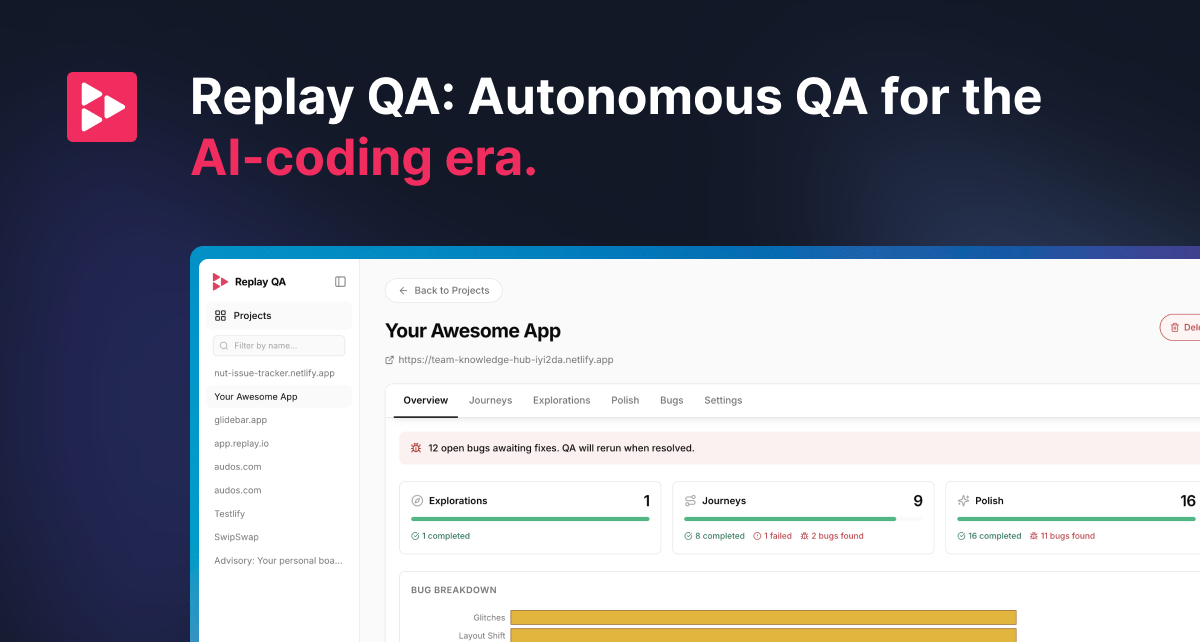
Replay QA Full homepage screenshot

At a glance

Category
Development
Language
English
Paid-content signal
Paid contentObserved
Registered
2018
Hosting
VercelInferred
HTTPS certificate trusted
PassedObserved
Last updated

Website review

This review may include AI-generated content and is not individually verified. Domain, certificate and other facts come from the observed data on this page.

What is Replay QA?

Replay QA is an autonomous QA tool for teams that ship code faster than they can manually review it. Instead of requiring you to write test flows first, it explores your application on its own, identifies user journeys worth verifying, runs tests against them in a Chromium browser, and produces bug reports aimed at coding agents — complete with root cause analysis, a suggested fix, and a deterministic runtime recording of the failing session.

What it looks for

According to the product page, its agents cover deep runtime bugs, UI glitches, accessibility issues, performance problems, and security vulnerabilities, including scanning for injection, access control, and business logic gaps. Setup is described as connecting a GitHub repo in about five minutes, with no existing test suite required.

Who it fits

The clearest audience is a team merging dozens of pull requests a week where static analysis passes but nobody clicks through each change. The scenario the page describes — checkout breaking on a user's phone days after a "fine" staging deploy — is exactly the gap between code that reads correctly and code that runs correctly.

Trade-offs to weigh

  • Autonomous exploration trades the precision of hand-written test suites for coverage you didn't have to author.
  • Reports are tuned for coding agents, so value depends on whether your workflow already routes fixes through one.
  • Runtime recordings differ from production monitoring tools; they capture what happened during a test session rather than what real users hit in production.

Next step: connect a repository and let it explore a staging build, then judge the first batch of reports on whether the root causes are specific enough to act on without an engineer reproducing them by hand. Compare pricing and integration details at Replay QA.

How does Replay QA find bugs without an existing test suite?

Replay QA doesn't wait for your team to write test cases first. It starts by exploring your running app on its own, so the "test suite" is something it builds, not something you supply.

The three-stage approach described on the site

  1. Explore — agents map the application and identify user journeys worth verifying, working through them the way a new QA hire would in their first week. No predefined flows required.
  2. Test & Record — agents write and run tests while puppeting the app in a Chromium browser, capturing deterministic runtime recordings of each session.
  3. Investigate & Report — QA agents look across bug types: deep runtime bugs, UI glitches, accessibility issues, performance problems, and security vulnerabilities (including injection, access control, and business logic gaps). Reports include a root cause, a suggested fix, and the recording.

Why this matters for a team without tests

The site frames the problem as a review bottleneck: a team shipping dozens of pull requests a week can't manually click through each change, and static analysis passes because it never runs the app. Happy-path staging checks miss the edge case a real user hits three days later. An exploratory agent that actually executes the app covers a different layer than linting or unit tests — it can catch integration and runtime behavior that only appears when the app runs.

Where it fits and where it doesn't

Situation Reasonable fit?
Fast-moving team, little or no test coverage, wants bug reports it can act on Yes — exploration replaces the missing suite
Team with a mature, curated suite and strict CI gates Possibly complementary, but you'd want to check how it coexists with existing tests
Regulated environments needing auditable, human-authored test cases Unclear from the site; verify before relying on it

Practical next step

Pick one repo with active pull request traffic and a known-flaky or under-tested area — checkout, auth, or onboarding are common. Connect that repo, let the agents explore, and judge the output on two things: whether the reported bugs are real, and whether the root-cause and suggested-fix context is specific enough for whoever (or whatever) writes the fix. If reports are vague or duplicate what your existing tests already catch, the value drops quickly.

For teams that want to compare positioning, Replay QA is the product in question; general QA platforms like Testim or Mabl take a more flow-defined approach, which is the trade-off worth weighing if you already have test authors on staff.

What kinds of issues does Replay QA detect, such as accessibility or security problems?

Replay QA is designed to surface a broad mix of runtime and quality issues rather than only functional bugs. According to the page, its QA agents look for deep runtime bugs, UI glitches, accessibility issues, performance problems, and security vulnerabilities. The security scanning specifically covers injection, access control, and business logic gaps.

That range matters for teams shipping many pull requests a week. Static analysis reads code without running the app, so it can pass while the running product is broken. Replay QA instead explores the application, writes tests, and puppets the app in a Chromium browser to capture deterministic runtime recordings. The issues it reports are therefore observed in a running build, not inferred from source alone.

A practical example: a checkout flow might pass static checks and look fine on the happy path, but fail on a mobile device. Replay QA's exploration and recording approach is aimed at catching that kind of runtime and UI problem, plus accessibility and security gaps that only appear when the app is actually exercised.

If you are deciding whether it fits, use this criterion: does your team need issue detection across functional, accessibility, performance, and security categories in one autonomous pass, with recordings and root-cause context attached? If yes, review the reported categories against your own risk areas. You can see the official details at Replay QA.

How does Replay QA's autonomous testing compare to static analysis and manual QA?

Replay QA is best understood as a third category rather than a replacement for either static analysis or manual QA. It runs your actual app in a browser, explores it like a new QA hire, and reports failures with a root cause and suggested fix. Static analysis never runs the app; manual QA runs it but depends on a human deciding what to click. Replay QA automates the running-and-exploring part.

H3 Where each approach fits

Approach What it actually does Strong at Weak at
Static analysis Reads code without executing it Fast, cheap, catches obvious code-level issues on every commit Cannot see runtime behavior; passes code that breaks only when users interact with it
Manual QA A person clicks through flows Judgment, novelty, "does this feel wrong" Doesn't scale to dozens of PRs per week; slow to reproduce and document
Replay QA Agents explore the app, run tests in a Chromium browser, capture deterministic recordings, and file root-caused reports Coverage of runtime, UI, accessibility, performance, and security issues without a pre-written test suite Still an automated system; ambiguous intent and taste-based judgments remain human work

The page frames the core problem concretely: a team shipping 47 pull requests a week where agents wrote most of the code, static analysis passes everything because it never runs the app, and the happy path looks fine in staging until a user reports checkout broken on their phone. That is the exact gap autonomous runtime testing targets — not "find more bugs," but "verify the builds nobody has time to verify."

H3 How it differs in practice

  • Starting point. Most QA tooling begins with flows your team defines. Replay QA begins by exploring the app and identifying flows worth verifying, then writes and runs tests while puppeting the app in its browser, capturing deterministic runtime recordings. No existing test suite is required.
  • Output format. Reports are built for coding agents: root cause analysis, a suggested fix, a runtime recording, and context. That is a different artifact from a static-analysis warning or a manual tester's repro notes.
  • Issue scope. The page lists deep runtime bugs, UI glitches, accessibility issues, performance problems, and security vulnerabilities, including scanning for injection, access control, and business logic gaps. Static analysis covers some of this at the code level; manual QA rarely covers all of it consistently.

H3 Choosing between them

Keep static analysis — it is cheap and fast, and Replay QA does not claim to replace linting or type checking. Use Replay QA for the runtime verification layer that neither static analysis nor a stretched QA team can cover at high PR volume. Keep humans for exploratory judgment, product intent, and deciding which reported issues actually matter.

A concrete scenario: a five-person team merges 40 PRs a week, runs ESLint and type checks in CI, and has one part-time manual tester. Static analysis goes green, the tester covers the two flows she knows, and a mobile checkout regression ships. Replay QA's explore-test-record-investigate loop is aimed squarely at that third bucket of unchecked changes.

Next step: connect a GitHub repo (the page says this takes about five minutes or less) and let it run against one active project for a week. Compare the issues it files against what your existing checks caught, and judge it on the marginal bugs it found that static analysis and manual review missed — not on total issue count. For teams already using production monitoring, note the distinction the page draws: recordings come from controlled test sessions, not live user traffic, so they are reproducible rather than observational.

Can Replay QA integrate with GitHub or my issue tracker and how long does setup take?

Yes. Replay QA connects to a GitHub repo, and its page states this takes five minutes or less. It also says bug reports can be pushed into your issue tracker, so the findings can land in the tool your team already uses rather than living only inside Replay QA.

What the integration covers

  • GitHub: connect a repo to start testing builds and pull requests. The site frames the workflow around teams shipping many PRs a week, so the value is testing each change without a human clicking through it.
  • Issue tracker: reports can be pushed into your tracker. Each report is written for coding agents and includes a root cause analysis, a suggested fix, a deterministic runtime recording and supporting context.
  • No existing test suite required: you do not need to have tests in place before connecting a repo.

Setup expectations

The five-minute figure covers connecting a GitHub repo. Treat that as the connection step, not the full rollout. A realistic sequence for a team:

  1. Connect one repo and let Replay QA explore the app.
  2. Review the first batch of bug reports to see whether the root causes and suggested fixes match your codebase.
  3. Push a few reports into your issue tracker and confirm the fields, labels and routing fit your process.
  4. Expand to more repos once the signal-to-noise ratio looks right.

Decision criterion

If your bottleneck is verifying agent-written code rather than writing it, the fast GitHub connection and agent-ready reports are the relevant features. If your team already has a mature test suite and a strict issue-tracker schema, spend the trial period checking whether the pushed reports map cleanly onto that schema before rolling it out broadly.

For general context on the tools mentioned alongside it, see GitHub and Replay QA.

How is Replay QA priced and is there a free trial available?

Replay QA lists a pricing page, but the available information doesn't include specific plan tiers, per-seat costs, or usage limits. What it does indicate is a low-friction way to evaluate the product: you can "Test Replay QA on my app" with no credit card and no existing test suite required. That reads as a free trial or free evaluation path rather than a permanent free tier.

What to check on the pricing page

  • Whether pricing is per repository, per seat, per test run, or a flat platform fee
  • What counts as a billable unit (exploration sessions, recordings, bug reports)
  • Whether the free evaluation has time or usage caps
  • How issue-tracker integrations and security scanning are bundled

Practical decision criterion

If your team ships dozens of pull requests a week and static analysis keeps passing code that breaks at runtime, the value question isn't the sticker price — it's whether autonomous exploration finds bugs your current process misses. Run the free evaluation against a repo with known problem areas and compare what Replay QA surfaces against your last month of escaped defects. If it finds nothing your team didn't already know, the pricing is irrelevant; if it catches real runtime or accessibility failures before users do, the cost is easier to justify.

For current numbers, see Replay QA pricing directly.

Related questions

More questions →
How Do Enterprise Teams Adopt Specialist AI Agents Without Disrupting Existing Workflows?

Enterprise teams can adopt specialist AI agents without disruption by starting with one narrow, high-volume workflow, running it as a bounded pilot with human review, measuring against a baseline, and only then expanding. The key is to treat agents as new team members with defined scopes rather than as a replacement for existing tools or a sweeping platform migration. This article explains what specialist agents are, where they fit across common team functions, and a phased approach you can follow.

What Makes an Agent "Specialist" Rather Than General-Purpose

A general-purpose assistant responds to open-ended prompts across many topics. A specialist agent is scoped to one job: it has a defined goal, a limited set of tools and data sources, and a clear definition of "done."

That scoping matters for enterprise teams for three practical reasons:

  • Predictability. A narrow agent produces more consistent outputs, which makes it easier to review and trust.
  • Permission control. You can grant access only to the systems that specific task needs, rather than broad data access.
  • Measurable value. When an agent owns one workflow, you can compare its output against a manual baseline.

A useful rule of thumb: if you cannot describe the agent's job in one sentence with a clear input and output, it is still too broad to deploy safely.

Mapping Team Functions to Agent Use Cases

Most enterprise teams have a handful of repetitive, rules-plus-judgment tasks that are good first candidates. The table below shows typical starting points.

Team Candidate agent task Why it fits
Sales Research and enrich inbound leads before handoff High volume, structured output, easy to verify
Customer success Draft responses to common account questions Repetitive, benefits from consistency
Marketing Repurpose long-form content into channel variants Clear brief, reviewable drafts
HR Screen and summarize applications against criteria High volume, needs audit trail
Operations Triage and route incoming requests Rule-based with clear routing logic

Notice that none of these replace a person's judgment. They compress the repetitive portion so the human spends time on exceptions and decisions.

A Phased Adoption Approach: Pilot, Measure, Expand

Phase 1: Pick one workflow and define success

Choose a task that is high-volume, low-risk, and currently a bottleneck. Write down:

  • The current process, step by step
  • The baseline metric (time per task, volume per week, error rate)
  • What "good output" looks like, with two or three examples
  • Who reviews the agent's work

Phase 2: Run a bounded pilot

Keep the agent inside the existing workflow rather than beside it. For example, the agent drafts; the human sends. Set a review gate so nothing leaves the team unreviewed. Run for a fixed period, such as four to six weeks, with a small group.

Phase 3: Measure against the baseline

Compare the same metrics you recorded in Phase 1. Look for time saved, consistency gained, and — importantly — where the agent failed. Failures tell you whether the scope was right.

Phase 4: Expand deliberately

Only widen scope after the pilot shows a clear, repeatable gain. Expand in one of two directions: more volume of the same task, or an adjacent task with the same data and review pattern. Avoid expanding into a new function and a new data source at the same time.

Handling Workflow Integration Concerns

Data access

Give each agent the minimum access its task requires. Prefer read access plus a single write action over broad permissions. Document which systems it touches so security and IT can review.

Handoffs

Define exactly where the agent stops and a human begins. A simple handoff rule works well: the agent completes the task and flags anything outside its defined scope for a person. Ambiguous handoffs are the most common source of friction.

Human oversight

Decide the review level up front:

  • Full review for anything customer-facing or high-stakes
  • Spot check for internal, low-risk outputs
  • Exception-only review once the agent has a track record

Start stricter than you think you need, then relax as evidence accumulates.

How Roles and Responsibilities Shift

Adopting agents rarely removes roles; it redistributes effort. Expect these shifts:

  • Reviewers become editors. People spend less time producing first drafts and more time improving and approving them.
  • Process owners become agent owners. Someone needs to maintain the agent's instructions, examples, and scope as the business changes.
  • New quality checks appear. Teams need a lightweight way to catch drift — for example, a weekly sample review.

Be explicit about who owns the agent after launch. An unowned agent degrades quietly.

Practical Criteria for Choosing Where to Start

Score candidate workflows against these questions:

  1. Volume: Does it happen often enough to matter?
  2. Risk: What is the cost of a wrong output, and can a human catch it?
  3. Structure: Is the input and output reasonably consistent?
  4. Baseline: Can you measure the current state today?
  5. Ownership: Is there a person who will own the agent after launch?

A workflow that scores well on all five is a strong first pilot. A high-volume task with no clear owner is a poor start, no matter how repetitive it is.

A Simple Pilot Template

You can copy this structure to scope your first agent:

  • Task: [one sentence]
  • Current baseline: [time/volume/error rate]
  • Agent scope: [what it does, what it does not do]
  • Data access: [systems, read/write]
  • Handoff rule: [when it escalates to a human]
  • Review level: [full / spot / exception]
  • Owner: [name]
  • Pilot length: [weeks]
  • Success metric: [target]

Bottom Line

Disruption comes from adopting too much at once, not from agents themselves. Start with one scoped task, keep humans in the loop, measure against a real baseline, and expand only when the evidence supports it. Platforms built around specialist agents — such as Relevance AI, which offers agents for sales, customer success, marketing, and HR — are designed for exactly this kind of task-by-task rollout, so you can add capability without rebuilding your team's existing processes.

How Replay QA Recordings Differ From FullStory, LogRocket, or Datadog

Replay QA records what happens while its own agents actively drive your app in a test environment, not what real users do in production. That single difference in when and who drives the recording changes what the recording is good for: Replay QA's deterministic runtime recordings exist to reproduce and root-cause bugs before release, while FullStory, LogRocket, and Datadog observe real user sessions after release to show impact and alert on live problems. The two are complementary, not substitutes.

The core distinction: active testing vs. passive observation

Replay QA describes itself as an "agentic testing harness that works like a swarm of QA testers." Its agents explore the app, identify flows worth verifying, then write and run tests while "puppeting your app in our Chromium browser," capturing a deterministic runtime recording of every session.

Production monitoring tools work the opposite way. They sit in a live app and record sessions that real users generate on their own. Nobody scripts the session; the tool observes whatever happens.

Dimension Replay QA Production monitoring (FullStory, LogRocket, Datadog)
When it runs Before release, on each new build After release, on live traffic
Who drives the session Replay QA agents Real users
Primary output Root-caused bug report with suggested fix Session replay, behavior analytics, alerts
Recording type Deterministic runtime recording Production session capture
Main job Find new bugs Show impact of live issues

What "deterministic runtime recording" buys you

Because Replay QA controls the session, the recording is reproducible: the same run can be replayed to investigate the failure. That is what makes root-cause analysis and a suggested fix possible — the report is built with "a detailed root cause analysis, a suggested fix, a deterministic runtime recording, and all the context needed to do the job," prepared with coding agents in mind.

A production session recording is a record of something that already happened to one user. It is excellent evidence, but it is not a repeatable test you can re-run against a fix.

What each tool is actually for

  • Replay QA: discover bugs in a new build before users hit them — deep runtime bugs, UI glitches, accessibility issues, performance problems, and security vulnerabilities (including injection, access control, and business logic gaps).
  • FullStory / LogRocket / Datadog: understand what real users experienced, quantify how many were affected, and get alerted when something breaks in production.

How to choose

Use Replay QA if your bottleneck is verification before release — for example, a team shipping dozens of pull requests a week where static analysis passes but nobody can click through every change. It connects to a GitHub repo in five minutes or less and needs no existing test suite.

Keep a production monitoring tool if you need to know how live users are affected, how widespread an issue is, or when to page someone. These answer "what is happening to users right now," which Replay QA is not designed to do.

Most teams shipping fast will want both: Replay QA to catch and root-cause bugs pre-release, production monitoring to observe impact post-release.

What Types of Issues Does Replay QA Look For?

Replay QA looks for five categories of issues: deep runtime bugs, UI glitches, accessibility failures, performance problems, and security vulnerabilities — including scanning for injection, access control, and business logic gaps. It finds them by exploring your app like a new QA hire, writing and running tests in a Chromium browser, and capturing deterministic runtime recordings of each session. That means the issues it surfaces are ones that only appear when the app actually runs, not ones a static analyzer can catch by reading code.

The five issue categories

Category What it covers
Deep runtime bugs Failures that only appear while the app is executing
UI glitches Visual and interface defects
Accessibility issues Failures that affect users who rely on assistive technology or non-default interaction
Performance problems Slow or degraded behavior under real use
Security vulnerabilities Injection, access control, and business logic gaps, found through security scanning

The security scanning is the most specific of the five. Replay QA's own description names three areas: injection flaws, access control problems, and business logic gaps. Business logic gaps are notable because they are the class of bug that static analysis and generic scanners are least equipped to find — the code can be syntactically clean and still let a user do something they shouldn't.

Why these issues specifically

The category list follows from how Replay QA works. According to the site, most QA tooling starts with flows your team defines; Replay QA instead begins by exploring the application and identifying flows worth verifying. Its three-stage process is:

  1. Explore — agents map the app, discover user journeys, and work through them the way a new QA hire would in their first week.
  2. Test & Record — agents write tests, run them while puppeting your app in a Chromium browser, and capture deterministic runtime recordings of every session.
  3. Investigate & Report — QA agents look for bugs across the categories above and deliver reports with a root cause and a suggested fix.

Because every test runs against a live browser session, the findings are runtime findings. Replay QA's own framing of the problem makes the contrast explicit: static analysis passes on code because it reads the code without ever running the app, so defects that only surface at runtime — including the ones above — slip through.

What each bug report contains

The report format matters as much as the category list, because it determines whether you can act on a finding. Each report is prepared with coding agents in mind and includes:

  • A detailed root cause analysis
  • A suggested fix
  • A deterministic runtime recording
  • The context needed to do the job

The deterministic recording is what separates this from a screenshot-and-description bug ticket. A recording that replays identically lets whoever picks up the issue — human or agent — see the failure rather than reconstruct it.

What this means for your decision

Replay QA is aimed at teams whose shipping speed has outrun their verification. The site's own framing: a team ships 47 pull requests a week, nobody can check them all, static analysis passes on all of it, and staging looks fine because the happy path is fine — until an end user reports that checkout is broken on their phone.

If your bottleneck is that class of escaped runtime defect, the five categories above are the relevant scope. Two things to check before assuming fit:

  • No existing test suite is required. The site states this explicitly, along with no credit card for the trial. If you have no tests today, that is not a blocker.
  • Setup is framed as fast. The site claims you can connect a GitHub repo in 5 minutes or less, and that it runs where your team already works.

For pricing and plan limits, check the pricing page directly — the available material does not state current prices or what the trial includes beyond the no-credit-card note.

Who Is Replay QA Designed For?

Replay QA is built for teams whose code output has outgrown their ability to verify it by hand — specifically, teams merging dozens of pull requests a week where much of the code is written by coding agents, static analysis passes cleanly, and runtime bugs still reach users. It fits best when you have no existing test suite and want autonomous QA running within minutes. It fits poorly if you already have a mature manual QA process and a delivery cadence slow enough to review every change.

The core problem it targets

Replay QA's own framing of the problem is concrete: a team ships 47 pull requests a week, nobody can check them all, and agents wrote most of that code. Static analysis passes on all of it because static analysis reads code without ever running the app. The result is that changes ship to staging, look fine — because the happy path is fine — and three days later a user reports that checkout is broken on their phone. An engineer loses an afternoon reproducing it; the fix takes twenty minutes.

If that description matches your team, Replay QA is aimed at you. The gap it addresses is not code generation speed but verification speed, which the site describes as "still the part your team does by hand."

Who it fits

Teams merging more PRs than they can review

The product is explicitly positioned around volume: "Your team ships 47 pull requests a week. Nobody can check them all." If your review process relies on a human clicking through what each PR changed, that process breaks down at this volume. Replay QA is designed to absorb that verification load.

Teams whose code is largely agent-written

The headline promise is "Bug reports your coding agent deserves." Each report is prepared with coding agents in mind — a detailed root cause analysis, a suggested fix, a deterministic runtime recording, and the context needed to act on it. If agents write your code, the reports are formatted for the same kind of consumer.

Teams where static analysis passes but runtime bugs still escape

This is the sharpest fit. The site calls out that static analysis "reads the code without ever running the app," which is why it passes on code that still breaks at runtime. Replay QA instead explores the running application, so it catches the class of issues static tooling structurally cannot.

Teams with no existing test suite

The signup path states "No existing test suite required," and the harness does not start from flows your team defines. Most QA tooling begins with flows you specify; Replay QA begins by exploring the app and identifying flows worth verifying. If you have no tests to build on, that removes the usual prerequisite.

Teams that want fast setup inside existing tools

The site claims you can "Connect a GitHub repo in 5 minutes or less," and the harness "runs where your team already works." If your workflow is GitHub-centric and you don't want to stand up new infrastructure, that's a match.

What it actually checks

Understanding the scope helps you judge fit. The QA agents look for:

  • Deep runtime bugs
  • UI glitches
  • Accessibility issues
  • Performance problems
  • Security vulnerabilities, including scanning for injection, access control, and business logic gaps

The workflow has three stages:

  1. Explore — agents map the app, discover user journeys, and work through them the way a new QA hire would in their first week.
  2. Test & Record — agents write tests and run them while puppeting your app in a Chromium browser, capturing deterministic runtime recordings of every session.
  3. Investigate & Report — agents deliver bug reports with a root cause and a suggested fix.

Note the distinction from production monitoring tools like FullStory, LogRocket, or Datadog: Replay QA's recordings are deterministic runtime recordings captured during agent-driven test sessions, not passive observation of real user traffic. That means it surfaces issues before users hit them, rather than after.

Who it does not fit

  • Teams with a mature manual QA process. If you already have a working human QA function that catches these issues, Replay QA duplicates rather than fills a gap.
  • Teams with a slow delivery cadence. If you merge a handful of PRs a week and can genuinely review each one, the volume problem the product solves doesn't exist for you.
  • Teams that need the tool to fix bugs autonomously. The site poses "Does Replay QA also fix the bugs it finds?" as a question rather than a claim — it delivers root cause and a suggested fix, so the fixing remains your team's (or your agent's) job.

How to decide

Your situation Fit
High PR volume, agent-written code, static analysis passing Strong
No test suite, GitHub-based workflow, want fast setup Strong
Runtime bugs escaping to users despite clean static checks Strong
Mature manual QA, slow cadence Weak
Expecting fully autonomous bug fixes Weak

The clearest test is whether the "47 pull requests a week, nobody can check them all" scenario describes your team. If it does, Replay QA is designed for exactly that gap. If your team can still verify every change by hand, the problem it solves isn't yours yet.

What Is Replay QA?

Replay QA is an autonomous QA tool that tests every build of your application for bugs, security flaws, and accessibility failures, then files root-caused bug reports your team can act on. It's built for teams whose code output has outgrown manual review — the site's own framing is "teams shipping faster than ever before," including teams where coding agents write most of the code. You don't need an existing test suite to use it, and you connect a GitHub repo in five minutes or less, per the site.

What problem it solves

The pitch on replay.io is specific: your team ships something like 47 pull requests a week, and nobody can check them all. Static analysis passes on all of it because static analysis reads code without ever running the app. Staging looks fine because the happy path is fine — then an end user reports that checkout is broken on their phone, and an engineer loses an afternoon reproducing a bug that takes twenty minutes to fix.

The stated gap: writing code got faster, verifying it didn't, and verification is still the manual part.

How it works

Replay QA describes itself as "an agentic testing harness that works like a swarm of QA testers." The key difference from most QA tooling: it doesn't start with flows your team defines. It starts by exploring the application and identifying flows worth verifying.

The process runs in three stages:

  1. Explore — Agents map the app, discover user journeys, and work through them the way a new QA hire would in their first week.
  2. Test & Record — Agents write tests and run them while puppeting your app in Replay's Chromium browser, capturing deterministic runtime recordings of every session.
  3. Investigate & Report — QA agents look for bugs across multiple categories and deliver reports with a root cause and a suggested fix.

What it looks for

According to the site, the agents check for:

  • Deep runtime bugs
  • UI glitches
  • Accessibility issues
  • Performance problems
  • Security vulnerabilities, including scanning for injection, access control, and business logic gaps

What a report contains

Reports are explicitly prepared with coding agents in mind. Each one includes:

  • A detailed root cause analysis
  • A suggested fix
  • A deterministic runtime recording
  • The context needed to act on the issue

That combination matters if you plan to hand the report to an AI coding agent rather than a human — the recording and root cause give the agent something deterministic to work from instead of a vague reproduction description.

Where it fits in your workflow

Replay QA runs where your team already works, and setup is a GitHub repo connection. The site states no credit card is required to test it on your app, and no existing test suite is needed.

One thing the site does not claim: that Replay QA fixes the bugs it finds. It produces the report and suggested fix; applying the fix stays with your team or your coding agent.

Who it's for

Replay QA fits teams where:

  • Pull request volume has outgrown manual review
  • Coding agents produce a large share of the code
  • Static analysis passes but runtime bugs still reach users
  • There's no maintained test suite to build on

If your team already has comprehensive end-to-end tests and a QA process that keeps up with releases, the value proposition is weaker. The tool is aimed at the gap between how fast code ships and how fast it can be verified.

For current plan details and limits, check the pricing page at replay.io/pricing — the site links to it but the input material doesn't specify tiers or costs.

Website Overview

An established domain and managed infrastructure suggest continuity of operations and may support dependable delivery, although neither guarantees service quality. Page metadata, canonical configuration and social previews work together to provide more consistent search and sharing presentation.

Domain and Registration

Registered in 2018, this domain has about 7 years of history. That suggests continuity, although ownership and purpose may have changed. The registrar is NameCheap, Inc., a widely used domain service provider. The domain uses the common .io extension, which is not an independent safety signal.

DNS and Email

Nameservers are provided by Amazon Route 53, indicating managed DNS hosting. MX records point to the Google Workspace email service. SPF and DMARC are configured. DKIM status is unknown. TXT records include verification markers for Google. Such markers may also remain after a service stops being used. DNSSEC signatures were not detected, so this additional DNS authenticity protection is not confirmed.

TLS and Certificates

The certificate uses an RSA 2048-bit public key, offering broad client compatibility. The server supplied a complete certificate chain. No organization name is present in the certificate; the available fields are consistent with domain validation. The certificate was issued by Let's Encrypt, commonly associated with automated certificate services. The certificate's total validity is about 89 days, consistent with a short renewal cycle.

HTTP and Browser Security

The response lacks these common security headers: CSP, X-Content-Type-Options, Referrer-Policy, Permissions-Policy, clickjacking protection. CORS permits any origin to read this response. This is common for public resources; sensitive responses need narrower handling. No X-Powered-By header was found, reducing one common source of backend fingerprinting information. No obvious internal addresses or debug information were found in the headers. The Server header contains the custom value Vercel.

Technology Stack Analysis

The public page identifies Next.js, Vercel without precise versions, leaving fewer clues for version-specific scanning.

Search and Social Sharing

Twitter Card metadata is configured. The title has 48 characters, within a common display range. A meta description is present, with 152 characters. The observed directives allow indexing and link following. No Generator meta tag is publicly exposed.

Hosting and Email

DNSAmazon Route 53
HostingVercel
EmailGoogle Workspace
Approximate IP geolocation (inferred; a CDN or proxy may differ from the origin server) United States flagUnited States Inferred 66.33.60.130

Registration details

RDAP / WHOIS

RegistrarNameCheap, Inc.
Registered2018-12-25
Expires2026-12-25
Domain statusok https://icann.org/epp#ok
Nameserversns-1117.awsdns-11.org、ns-1801.awsdns-33.co.uk、ns-48.awsdns-06.com、ns-681.awsdns-21.net
DNSSECunsigned

DNS records

DNS

TypeNameValueTTLPriority
Acname.vercel-dns.com66.33.60.130300—
Acname.vercel-dns.com76.76.21.61300—
MXreplay.ioaspmx.l.google.com3001
MXreplay.ioalt1.aspmx.l.google.com3005
MXreplay.ioalt2.aspmx.l.google.com3005
MXreplay.ioalt3.aspmx.l.google.com30010
MXreplay.ioalt4.aspmx.l.google.com30010
MXreplay.io57vvebyyiepunwzt6qjp3bxmmn3unocb2xdydl3uefvmoc72r3pa.mx-verification.google.com30015
NSreplay.ions-1117.awsdns-11.org21600—
NSreplay.ions-1801.awsdns-33.co.uk21600—
NSreplay.ions-48.awsdns-06.com21600—
NSreplay.ions-681.awsdns-21.net21600—
TXTreplay.iogoogle-site-verification=Fp_wxx9Ss2Rhd5dWEmTTOBEK3T9pNQBlgTtyQ3Xh5ZE300—
TXTreplay.iogoogle-site-verification=cVrOZ4bYi4P7SAxugfYcknc1V9khqKiOTGcTAppKxJw300—
TXTreplay.iostripe-verification=e543bd56526d9de85b1e125296e9e9559af66f5701dc909c5123d26086b29000300—
TXTreplay.iov=spf1 include:sendgrid.net include:_spf.google.com include:amazonses.com ~all300—
CNAMEwww.replay.iocname.vercel-dns.com3660—
DMARC_dmarc.replay.iov=DMARC1; p=none;300—

TLS and certificates

TLS / SSL

AssessmentNormal configuration
Supported protocolsTLSv1.2、TLSv1.3
Negotiated protocolTLSv1.3
Certificate subjectwww.replay.io
IssuerLet's Encrypt
Valid until2026-11-14T06:12 · Remaining when checked: 44 days
Verification detailsCertificate trust: Passed · Hostname match: Passed

HTTP response headers

HTTP

HeaderValue
content-typetext/html; charset=utf-8
cache-controlpublic, max-age=0, must-revalidate
serverVercel
strict-transport-securitymax-age=63072000
access-control-allow-origin*

Identified technologies

Next.jsVercel

Pages, Search and Sharing

Meta descriptionReplay QA autonomously tests every build for bugs, security flaws, and accessibility failures — then files root-caused bug reports your team can act on.
Canonical URLhttps://www.replay.io/
LanguageEnglish (default)
Twitter Cardsummary_large_image
All bots 1 allowed · 0 disallowed
  • Allow/
gptbot 1 allowed · 0 disallowed
  • Allow/
oai-searchbot 1 allowed · 0 disallowed
  • Allow/
chatgpt-user 1 allowed · 0 disallowed
  • Allow/
claudebot 1 allowed · 0 disallowed
  • Allow/
claude-web 1 allowed · 0 disallowed
  • Allow/
perplexitybot 1 allowed · 0 disallowed
  • Allow/
google-extended 1 allowed · 0 disallowed
  • Allow/
applebot-extended 1 allowed · 0 disallowed
  • Allow/
ccbot 0 allowed · 1 disallowed
  • Disallow/
anthropic-ai 0 allowed · 1 disallowed
  • Disallow/

User reviews (0)

  • No reviews yet.