

 Paid content
 Visit website
 Updated: 2026-10-01 17:34
 Language: English (default)
 Access: Normal
 Profile views 2
  Outbound visits 0
 Website Review
What is Slate, AI-powered Interactive Classroom?
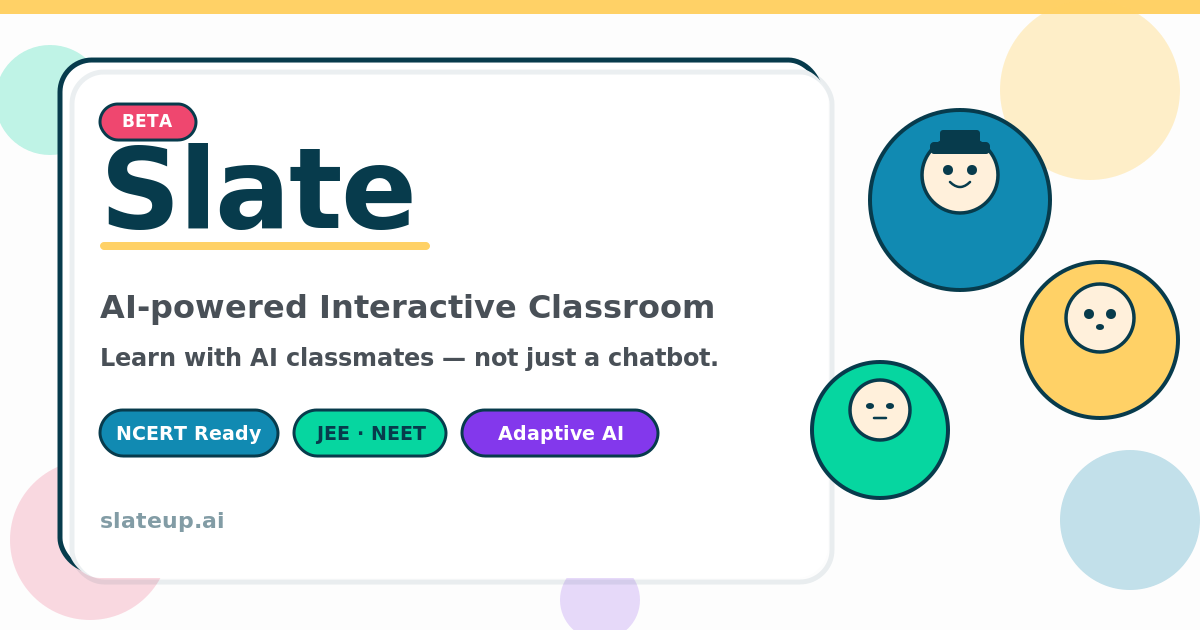
Slate is an AI-powered interactive classroom aimed mainly at Indian school and exam-prep students. Instead of a single chatbot that answers questions, it puts you in a simulated class with "AI classmates," so learning happens through discussion, questions and explanations rather than one-way Q&A. It covers school curricula such as NCERT Class 10 Mathematics and Science, and exam preparation for JEE and NEET.
What that means in practice
- AI classmates: You learn alongside AI characters, which is meant to make the experience feel like a study group rather than a private tutor session.
- Personalised explanations and instant doubt resolution: When something is unclear, you can ask immediately instead of waiting for a teacher or a forum reply.
- Adaptive courses: The material is organised into courses that adjust to your level, spanning NCERT, JEE, NEET and beyond.
Who it suits
A Class 10 student revising NCERT Science the night before a test, or a JEE/NEET aspirant drilling concepts and asking follow-up "why" questions, is the clearest fit. It is less obviously suited to learners who want a human teacher, structured live classes, or subjects outside the listed curricula.
Trade-offs to weigh
The format depends on JavaScript and an interactive browser session, so it is not a download-and-study-offline tool. The AI-classmate approach can feel engaging or gimmicky depending on how you like to learn; if you prefer quiet solo problem-solving, a plain question-answering tool may be enough.
Next step: Open the "How Slate Works" and "Features" pages on Slate before committing, and check the Pricing page, since cost and plan details are not specified here. If you are preparing for JEE or NEET, compare what Slate offers with established providers such as Khan Academy for free conceptual practice.
How do the AI classmates work during a study session?
Slate's AI classmates are presented as participants in a shared learning session rather than a single chatbot you query. The page describes them as companions you "learn with," delivering personalised explanations, instant doubt resolution, and adaptive courses. The exact mechanics of how each AI classmate behaves are not spelled out in the available page text, so treat the points below as how this format is generally meant to work, not as verified step-by-step product behaviour.
H3: What the format implies for a session
- Questions in context. Instead of one isolated prompt, you raise a doubt mid-topic and the explanation adapts to what you are currently studying.
- Multiple perspectives. Several AI classmates can take different roles — one may explain a concept from first principles, another may probe your reasoning or offer an alternative method.
- Adaptive pacing. Because the course is described as adaptive, the material can shift based on how you answer, rather than following a fixed video sequence.
- Exam-oriented framing. The listed coverage — NCERT Class 10 Mathematics and Science, and JEE/NEET preparation — suggests sessions are mapped to a syllabus, which matters if your goal is board or entrance-exam readiness.
H3: A concrete reader scenario
A Class 10 student stuck on a trigonometry identity could, in this model, ask a classmate to walk through the proof, then have another pose a variation to test whether the idea transferred. That back-and-forth is the intended difference from searching a static solution online.
H3: How to judge whether it suits you
| If you want... | This format may fit | Watch out for |
|---|---|---|
| Doubt-clearing while studying | Yes — described as instant | Depth of explanation may vary by topic |
| Structured exam prep | Yes — NCERT, JEE, NEET listed | Confirm the specific course and level before committing |
| Self-paced independence | Yes — adaptive courses | You still need the discipline to start sessions |
| A replacement for a teacher | Not necessarily | AI classmates supplement, they do not replace accountability |
H3: Next step
Open Slate and run one real session on a topic you already find hard, then note whether the explanations actually respond to your follow-up questions — that is the clearest test of whether the AI-classmate model works for you. You can also compare the approach with other structured learning platforms such as Khan Academy, which uses a more fixed, human-authored progression.
Can Slate help me prepare for JEE or NEET exams?
Yes. Slate is explicitly positioned around Indian exam preparation, with adaptive courses for NCERT, JEE and NEET listed as supported tracks. The distinguishing feature is the format: instead of a single chat window, you study alongside "AI classmates," which is meant to make explanations, doubt-clearing and practice feel more like a class session than a Q&A bot.
What that looks like in practice
A typical JEE or NEET week is a mix of concept gaps, problem sets and revision. Slate's described strengths map onto the first and third of those:
- Concept repair: Ask for a personalised explanation of a topic you keep getting wrong, such as rotational dynamics or coordination chemistry, and get it re-explained at your level rather than repeated verbatim.
- Instant doubt resolution: Useful in the middle of a problem set when a step doesn't make sense and a teacher isn't available.
- Adaptive courses: Structured NCERT-aligned material, which matters because JEE and NEET both build on the NCERT syllabus even though the exams go beyond it.
Where it fits and where it doesn't
| Your need | Slate's fit |
|---|---|
| Filling concept gaps between coaching classes | Strong — explanations and doubts on demand |
| NCERT Class 10 foundation work | Directly covered (Class 10 Maths and Science pages exist) |
| Full-length mock tests with real exam timing and ranking | Not what the site describes; keep your existing test series |
| Doubt-solving at 11pm before a test | Likely the main draw |
Slate reads as a supplement to coaching or self-study, not a replacement for timed mock exams and rank benchmarking, which is where most JEE and NEET selection pressure actually sits.
Next step
Open the "How Slate Works" and "Meet the AI Classmates" pages on Slate to see whether the interaction style suits you, then check the course list for your specific subject and class level. Access appears to run through a waitlist, and pricing is listed separately — confirm current availability and cost before planning your study schedule around it. If you're targeting JEE Advanced or NEET, test one weak chapter first and judge whether the AI-classmate format beats your usual textbook-plus-YouTube routine before committing serious hours.
How much does Slate cost and what does the pricing plan include?
Slate’s site lists a Pricing page, but the available page information does not include actual amounts or a breakdown of what each plan includes. So the honest answer is: the exact cost and plan contents are not specified here, and you should check the Pricing page directly before making a decision.
Slate, AI-powered Interactive Classroom
What the available information does show
Slate is positioned as an AI-powered interactive classroom for students, with AI classmates, personalised explanations, instant doubt resolution, and adaptive courses. The subjects and exam contexts mentioned include NCERT, JEE, NEET and beyond. The site also links to pages such as How Slate Works, Features, Meet the AI Classmates, NCERT Class 10 Mathematics, NCERT Class 10 Science, Blog, Pricing, Join the Waitlist and Contact.
That tells you what kind of product it is, but not what any tier costs or which features sit behind a paywall.
How to judge the pricing when you visit
Treat the Pricing page as the starting point, then check these practical points:
- Billing basis: Is it monthly, annual, per course, or per student? A per-course price can be cheaper for one exam subject; a subscription usually makes more sense across multiple subjects.
- What “AI classmates” and doubt resolution include: Are there limits on questions, sessions, or subjects? Unlimited doubt resolution is very different from a small monthly cap.
- Course coverage: Confirm whether your exact board or exam is included, since the site mentions NCERT, JEE and NEET specifically.
- Free or trial access: Look for a trial, free tier, or waitlist access so you can test the interactive format before paying.
- Refund and cancellation terms: These matter more than a headline price if you are committing for a full year.
A concrete way to compare
If you are choosing between Slate and another learning platform, compare the total cost for one exam cycle and divide it by the number of subjects or hours you will actually use. A platform that costs more but covers all your subjects and allows unlimited doubt-solving can work out cheaper than paying separately for each course.
For a student preparing for NCERT Class 10 Mathematics and Science, for example, the useful question is not just “what is the monthly price?” but “does one plan cover both subjects, and how many questions can I ask each month?”
Your next step: open the Pricing page, note the billing period, subject coverage and usage limits, and only then compare it with alternatives.
Does Slate cover NCERT Class 10 Mathematics and Science?
Yes. Slate lists dedicated pages for both NCERT Class 10 Mathematics and NCERT Class 10 Science among its key course links, so these two subjects are explicitly covered.
What that means in practice
- The site describes its approach as an "AI-powered interactive classroom" with AI classmates, personalised explanations, instant doubt resolution and adaptive courses — so Class 10 Maths and Science are presented as part of that interactive format rather than as static PDFs or plain video playlists.
- The broader catalogue extends to JEE, NEET and "beyond," which suggests Class 10 content sits at the foundation level of a larger exam-prep pathway.
A useful next step
Open the Class 10 Mathematics page and check whether the chapter list matches your board's syllabus order (for example, whether topics like trigonometry, circles and statistics appear in the sequence your school follows). Do the same for Science, confirming that all three streams — physics, chemistry and biology — are represented, since some platforms cover only one or two.
Decision criterion
If you mainly need structured revision aligned to school exams, verify two things before committing: that each chapter includes practice questions with worked solutions, and that the "instant doubt resolution" works for numerical problems, not just conceptual ones. For Maths especially, an AI that can follow your specific wrong step is far more useful than one that simply restates the correct answer.
For a broader look at the platform before diving into a subject, see Slate.
How is learning with AI classmates different from using a regular chatbot?
Learning with AI classmates is designed to feel like a small study group rather than a one-to-one Q&A session. On Slate, Slate, AI-powered Interactive Classroom, the classroom format means you are not just asking a single chatbot for answers; the page describes learning alongside AI classmates, with personalised explanations, instant doubt resolution and adaptive courses aimed at NCERT, JEE, NEET and similar syllabi.
The practical difference is mainly in how the interaction is structured:
| Aspect | AI classmates | Regular chatbot |
|---|---|---|
| Interaction style | Classroom or peer-like discussion, with multiple voices or roles | Direct question-and-answer with one assistant |
| Explanation | Can be framed as discussion, comparison or step-by-step teaching | Usually one response per prompt |
| Doubt resolution | Built into the learning flow, so questions arise from the current topic | You must notice the gap and ask explicitly |
| Course structure | Adaptive courses tied to a syllabus such as NCERT, JEE or NEET | Depends on the prompt; no inherent syllabus |
| Best for | Students who want guided practice and a sense of studying with others | Quick lookups, drafting, or open-ended exploration |
A concrete example: if you are stuck on a Class 10 Mathematics concept, a regular chatbot might give you a correct solution when you paste the problem. An AI-classmate setup is meant to keep you inside the lesson, so the explanation can connect to what you were already studying and let you ask follow-up doubts without leaving the course. That can reduce the “where do I even start?” problem, especially for exam preparation.
The trade-off is control. A regular chatbot is more flexible for off-syllabus questions and quick tasks, while an AI-classmate classroom is more guided and may feel slower if you already know exactly what you want. If you are preparing for a structured exam and tend to skip asking questions, the classroom format may help; if you mainly need a fast answer on any topic, a standard chatbot may be more efficient. To decide, try one topic you find difficult and see whether the AI-classmate flow makes you ask more follow-up questions or simply gives you an answer to copy.
 Hosting and Email
 GoDaddy
 Hosting
 Vercel
 Google Workspace
 Location
 United States
 Pages, Search and Sharing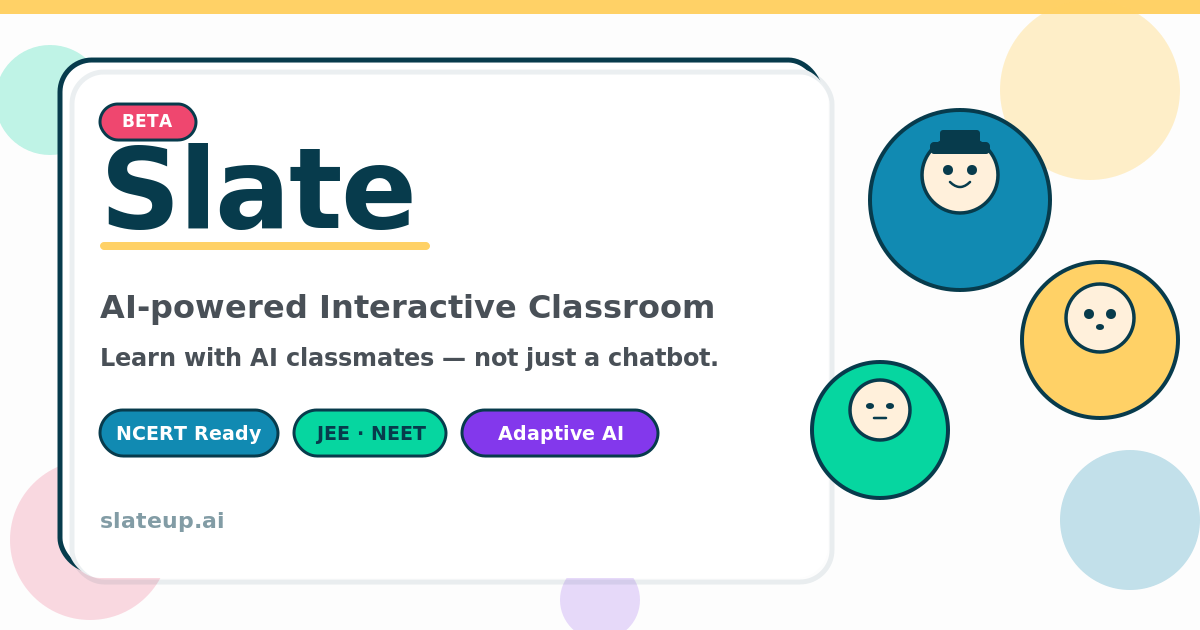



 All bots

 Registration details

 Identified technologies
User reviews (0)