


Website profiles · Technology insights · Alternatives

statt-land-song.ch

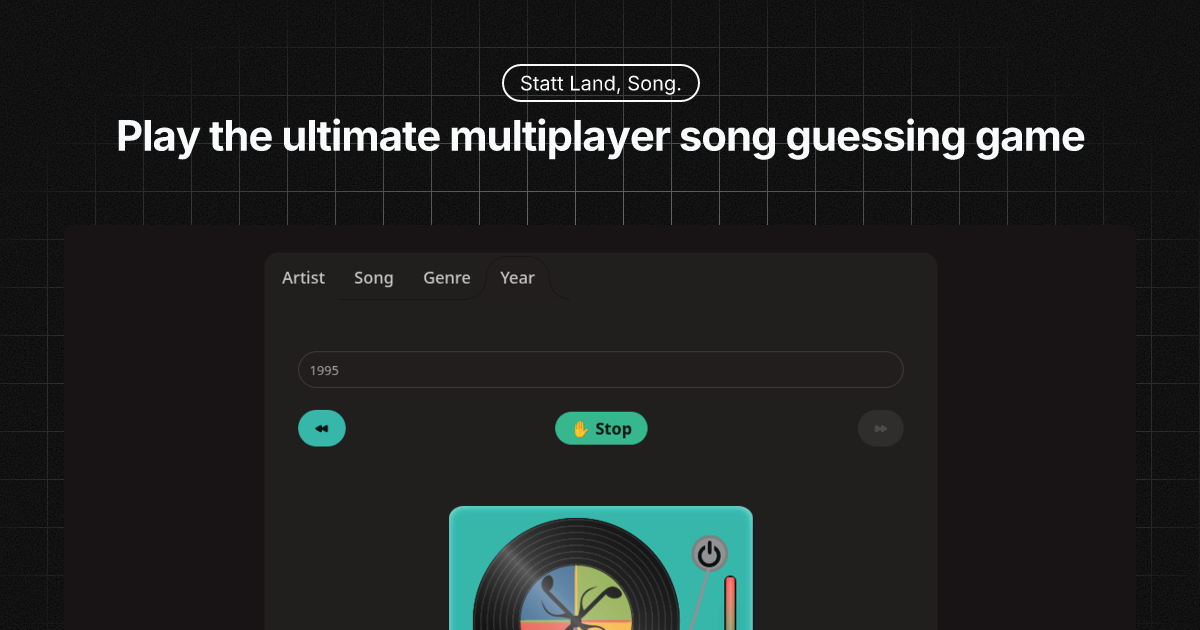
Statt Land, Song - the ultimate free online music quiz game! Guess songs by artist, title, genre, and release year, or play Songdle, the daily Wordle-style song puzzle.

No paid content found
Visit website
Profile views 2 Outbound visits 11 Normal
Statt Land, Song Full homepage screenshot

At a glance

Category
Games & Board Games
Language
English
Paid-content signal
No paid content foundObserved
Registered
Unknown
Hosting
DenoInferred
HTTPS certificate trusted
PassedObserved
Last updated

Website review

This review may include AI-generated content and is not individually verified. Domain, certificate and other facts come from the observed data on this page.

What is Statt Land, Song?

Statt Land, Song is a free online music quiz and "guess the song" party game. A short snippet of a song plays, and players race to name the artist, title, genre, and release year. The first correct submission locks the round, so speed matters as much as knowledge; near-misses like typos still count. It runs in the browser on phone, tablet, or desktop, with no login required.

Ways to play

  • Solo: practice against the clock.
  • Friends and family: share one screen and a lobby code.
  • Remote teams or public lobbies: use it as an icebreaker or jump in with strangers.
  • Songdle: a daily Wordle-style puzzle—one mystery song for everyone, guess artist, title, and year, then share an emoji result and keep a streak.
  • Albumdle (beta): a daily album-cover puzzle where you guess the artist, album, and year; hints are available but cost points.

Content is organized into curated playlists such as Bangers, Rock Classics, Billboard charts, and decade themes, with live leaderboards tracking results.

Which mode fits whom

Mode Best for Trade-off
Live quiz rounds Groups, parties, team calls Fastest player dominates; slower players get fewer chances
Solo practice Building recognition No social competition
Songdle A daily habit, sharing results One puzzle per day, so limited replay
Albumdle Visual/cover knowledge Beta; hint penalties reduce your score

As a next step, decide by occasion: for a group call, open a lobby and share the code; for a quick solo break, try today's Songdle. If you want a broader music-trivia comparison, Website Name is not needed here—start with the site itself at Statt Land, Song.

How do I play a round with friends using a lobby code?

A lobby code works like a private room key: one person creates a game lobby, shares the code it generates, and everyone who enters that code joins the same round. On Statt Land, Song, the site describes "Friends & family — one couch, one lobby code" and "Remote teams" as play modes, so the same mechanic covers both in-person and video-call groups.

What a round looks like

  1. The host opens a game and gets a lobby code.
  2. Friends enter the code on their own phone, tablet or desktop — the site says no login is needed.
  3. A short song snippet plays for everyone at once.
  4. Each player races to submit the artist, title, genre and release year.
  5. The first correct submission locks the round, so late answers are cut off.
  6. Points reward both accuracy and speed, and close guesses still count, so a small typo won't sink you.

Practical setup advice

  • Share the code in the same channel as your voice call (chat, group message, or spoken aloud) so nobody is hunting for it mid-round.
  • Agree on a rule for shouting answers if you're on a call: people who blurt the title out loud spoil the round for everyone else. Typing first, talking after, keeps it fair.
  • Expect the speed element to favour fast typists. For a mixed-skill group, treat the leaderboard as fun rather than a serious ranking.
  • Test with two devices before a big session if you're hosting a team icebreaker, so you know the code entry flow works on the phones people actually have.

Choosing between modes

Situation Best fit
Same room, shared screen or separate phones Private lobby with a code
Remote team or friends on a video call Private lobby with a code, muted mics during guessing
Solo practice Play against the clock, no lobby needed
Playing with strangers Public lobbies

If you want a warm-up before the group arrives, the daily puzzle Songdle gives everyone the same mystery song each day, which makes for an easy shared talking point once the lobby fills. More background on how songs perform with players is on Statt Land, Song.

What is Songdle and how is it different from the main music quiz?

Songdle is a daily, single-puzzle song game in the Wordle style, while the main quiz on Statt Land, Song is a fast, competitive "guess the song" round. The simplest way to see the split: Songdle is a short daily ritual you play alone at your own pace; the main quiz is a timed race against other players.

How they differ

Songdle Main music quiz
Format One mystery song per day, the same for everyone A short snippet plays and players race to answer
What you identify Artist, title and release year Artist, title, genre and release year
Pacing Untimed, one puzzle a day Fast rounds; the first correct submission locks the round
Opponents Just the puzzle and your streak Friends, family, remote teams or public lobbies
Sharing An emoji result you can share and a streak to keep Live leaderboards during play

What this means in practice

If you have five minutes over coffee, Songdle fits: you get one puzzle, no lobby to fill, and a streak worth protecting. If you want a social evening or a team icebreaker, the main quiz is the better fit, because its scoring rewards speed as well as accuracy and its lobby format works with a group in one room or on a video call.

A useful decision rule: choose Songdle when you want a consistent daily habit and a shareable result; choose the main quiz when the fun comes from competing with other people in the moment. The site also lists Albumdle, a daily album-cover puzzle where hints cost points, as a third option if cover art is more your strength than song snippets.

For a concrete start, play today's Songdle first to gauge how well you know artist and year details, then host a main-quiz lobby with friends and see whether speed or recall is your stronger suit.

How does the scoring work, including speed bonuses and close guesses?

Scoring rewards being right and fast, and it forgives near-misses. A snippet plays; players race to name artist, title, genre and release year. The first correct submission locks the round for everyone else, so hesitation costs you the chance to score at all. Points come from accuracy plus speed, and close guesses still count, so a small typo or a slightly off title won't wipe out the round.

What that means in practice

  • Speed matters twice. Submitting early both ends the round for others and earns the speed portion of your points. A correct answer typed late may score less than a quick, nearly correct one.
  • Partial credit is real. Because close guesses count, it pays to submit your best guess immediately rather than waiting to be certain. In a four-player couch game, the player who types "Bohemian Rapsody" fast usually beats the one who waits to spell it perfectly.
  • Four fields, one clock. Artist, title, genre and year are separate answers, so a player who knows the year but not the genre still banks something. Decide before you play whether your group treats genre as a serious field or a throwaway.
  • Daily puzzles score differently. Songdle is a one-song-per-day puzzle where you name artist, title and year, then share an emoji result and keep a streak — it's about solving, not racing. Albumdle, the album-cover variant, deducts points for hints.

Choosing how to play

If your goal is a party icebreaker, the lock-out rule creates the tension; pick a lobby code with friends or a public lobby and accept that fast typists have an edge. If you want a fair solo benchmark, play against the clock rather than comparing leaderboard positions across sessions.

A useful next step: play one round and note whether your losses came from slow typing or missing knowledge. Slow typing suggests shorter, more familiar playlists; missing knowledge suggests decade-themed lists where the era narrows the year field. For a different daily format, Spotify and Billboard are handy for checking release years and chart eras between rounds.

Can I play solo without an account, and what modes are available?

Yes. You can play solo without creating an account, and the site says no login is needed to start.

Solo play

  • Live quiz rounds: A short song snippet plays and you race the clock to name the artist, title, genre, and release year. Points reward being right and fast, and close guesses still count, so small typos won't sink a round. Solo mode is practice against the clock rather than against other players.
  • Songdle: A daily Wordle-style puzzle with one mystery song per day, the same for everyone. You identify the artist, title, and release year, then share an emoji result and keep a streak.
  • Albumdle (beta): A daily album-cover puzzle with the title and artist name removed. You guess the artist, album, and release year; hints are available but cost points.

Modes at a glance

Mode Format Best for
Live quiz Snippet-based rounds, timed, scored Quick solo practice or party play
Songdle One song per day, shared puzzle A short daily habit and streaks
Albumdle (beta) One cover per day, hints cost points Visual/album knowledge

The same quiz format also supports multiplayer: one couch with a lobby code, remote teams as an icebreaker, or public lobbies with players worldwide, with live leaderboards. Playlists cover categories such as Bangers, Rock Classics, Billboard charts, and decades.

Next step: If you want a five-minute daily routine, start with Songdle; if you want to test speed and breadth across genres and years, use the live quiz solo against the clock. Begin at Statt Land, Song.

Which song genres and playlists are included in the game?

The game organizes its music into curated playlists rather than a fixed, published genre list. The playlists named on the site are Bangers, Rock Classics, Billboard charts, and decades-based collections, with weekly playlist updates. So you can expect a mix of contemporary hits, rock, chart pop, and era-themed rounds, but the site does not spell out every genre it covers. If a specific genre matters to you—say jazz, hip-hop, or country—check the playlist menu after starting a game, since the lineup changes weekly.

What this means in practice

  • Casual groups can default to Bangers or Billboard for broadly familiar songs.
  • Rock fans have a dedicated Rock Classics playlist.
  • Theme nights work well with decade playlists, which suit players with shared nostalgia.
  • Songdle and the beta Albumdle use one mystery song or cover per day for everyone, so their genre varies daily rather than following a chosen playlist.

A useful next step: open Statt Land, Song and scan the playlist picker before inviting friends, so you can match the round to your group's taste.

Related questions

More questions →
What Is a Song Guessing Game and How Does a Round Work?

A song guessing game is a music quiz format where a short audio snippet plays and players race to identify the song — typically naming the artist, title, genre, and release year. On Statt Land, Song, the first player to submit a correct answer locks the round, and points reward both accuracy and speed. It's free to play, requires no login, and works on phone, tablet, or desktop, so you can jump in solo, with friends in a private lobby, or against players in public lobbies.

The Core Loop: Hear, Guess, Race

Every round follows the same structure:

  1. A snippet plays. You hear a short clip of a song — no title, artist, or cover art shown.
  2. You submit your guess. Depending on the mode, you enter some or all of: artist, title, genre, and release year.
  3. The first correct submission locks the round. Once someone nails it, everyone else has to hurry — late answers earn less or nothing.
  4. Points are awarded for being right and being fast. Close guesses still count, so a small typo won't cost you the round.

That last point matters for new players: you don't need perfect spelling to stay competitive, but you do need to answer quickly once you recognize the track.

What You Actually Submit

Field What it tests Notes
Artist Name recognition Close guesses accepted
Title Song familiarity Close guesses accepted
Genre Broader music knowledge Part of the standard round
Release year Era awareness Rewards listeners with wide-ranging taste

Submitting all four fields is the standard format on Statt Land, Song. If you only know the artist but not the year, it's still worth answering fast — speed is scored alongside correctness.

How Round Flow and Scoring Work Together

The lock mechanic is what makes the game feel like a race rather than a quiz. Consider a typical round: a snippet from a well-known rock classic plays. One player recognizes the guitar riff immediately and submits the artist and title within a few seconds, locking the round. Everyone else who was still typing loses the chance to score full points on that round — even if they would have gotten it right a moment later.

This creates two skills to practice:

  • Fast recognition — spotting a song from a few seconds of audio
  • Fast recall — getting the artist and title typed before anyone else

The "close guesses still count" rule softens the pressure: if you type "Led Zepplin" instead of "Led Zeppelin," you're not penalized for the typo.

Play Modes: Solo, Private Lobby, and Public

The game supports several ways to play, and the right one depends on your situation:

  • Solo practice — play against the clock to sharpen recognition without competition pressure. Good for learning the format before joining others.
  • Friends and family — one couch, one lobby code. Everyone joins the same private room, which makes it a natural party game.
  • Remote teams — the same lobby-code setup works as a video-call icebreaker.
  • Public lobbies — jump in with players worldwide if you want a leaderboard challenge without organizing anyone.

Live leaderboards run across modes, so you can see how you stack up regardless of how you play.

Daily Puzzle Variants: Songdle and Albumdle

If you prefer a slower, once-a-day format, the site offers two Wordle-style puzzles:

  • Songdle — one mystery song per day, the same for everyone. You name the artist, title, and release year, then share an emoji result and keep a streak going. The site reports over 500,000 Songdle puzzles solved.
  • Albumdle (beta) — one mystery album cover per day with the title and artist removed. You guess the artist, album, and release year; hints are available but cost points.

These suit players who like a daily ritual rather than a live race. The streak mechanic is the hook — miss a day and your run resets.

Practical Basics Before You Start

  • Cost: The site describes the game as 100% free with no paywalls.
  • Login: No login needed — you can play instantly.
  • Devices: Works on phone, tablet, or desktop.
  • Content: Curated playlists cover categories like Bangers, Rock Classics, Billboard charts, and decade-based lists, with weekly playlist updates.
  • Scale: The site reports over 100,000 games played weekly.

Common Stumbles for New Players

  • Waiting too long to submit. The lock mechanic punishes hesitation more than imperfect answers. If you're fairly sure, answer.
  • Skipping fields you don't know. Answer what you can, fast — partial credit beats a locked-out round.
  • Expecting perfect spelling to matter. It doesn't; close guesses count.
  • Confusing live rounds with Songdle. Songdle is one puzzle per day with a shareable result; live rounds are continuous and competitive.

If you want to test whether the format suits you, start with a solo round to learn the pacing, then try a private lobby with friends — the lobby-code setup is the fastest way to turn it into a group activity.

What Is a Music Quiz and How Do Song-Guessing Games Work?

A music quiz is a game where you identify a song from a short audio clip, usually by typing or selecting the track title and artist. The most common format gives you a few seconds of playback and a limited number of guesses. Muzify is one example: its site describes a free song-guessing game built around a 5-second clip, with daily quizzes, leaderboards, and a multiplayer mode called Clash. You can play in a browser, and the site also points to iOS and Android apps.

The core format: guess the song from a clip

Most song-guessing games follow the same loop:

  1. A clip plays — often 5 seconds, sometimes longer or shorter depending on difficulty.
  2. You submit a guess (song title, artist, or both).
  3. The game tells you if you're right, and often how close you were.
  4. You either move to the next round or run out of attempts.

The 5-second window is the defining constraint. It rewards recognition speed over deep knowledge — you either know the track instantly or you don't. That's different from trivia formats where you can reason your way to an answer.

Common mechanics to expect

Mechanic How it works Why it matters
Timed clips Audio plays for a fixed short duration Tests instant recall, not analysis
Limited guesses You get a set number of attempts per song Adds pressure and scoring stakes
Daily challenge One song per day, same for all players Creates a shared, recurring habit
Leaderboards Scores ranked against other players Turns solo play into competition
Multiplayer Real-time head-to-head modes Tests speed against another person
Badges/achievements Unlockables for milestones Gives long-term progression

Muzify's site specifically mentions a daily format — "one song a day, six guesses" — alongside leaderboards and the Clash multiplayer mode. It also claims "1000s of artists," which matters if you want variety beyond top-40 hits.

How to start playing

For a browser-based quiz like Muzify:

  1. Open the site in your browser.
  2. If prompted, enable JavaScript — the page evidence shows the app requires it to run.
  3. Choose a mode: daily quiz, free play, or multiplayer.
  4. Listen to the clip and enter your guess.
  5. Check your result and move on, or review your score.

For the app version, the site lists availability on the App Store and Google Play. Downloading the app may give you a smoother experience than the browser, particularly for audio playback and multiplayer.

What makes a quiz good for real music fans

Not all music quizzes are built for people who actually listen closely. A few things separate a solid one from a shallow one:

  • Artist range — if it's all chart pop, it gets old fast. Look for genre and era spread.
  • Difficulty curve — easy rounds should give way to genuinely obscure tracks.
  • Recognition vs. trivia — a good clip quiz tests whether you know the song, not whether you memorized release dates.
  • Multiplayer depth — head-to-head modes need fair matching, not just random opponents.
  • Daily consistency — a daily song gives you a reason to come back without grinding.

Muzify's positioning — "built for real fans," badges, stats, leaderboards — suggests it's aiming at the recognition-focused end rather than general trivia.

Common pitfalls

  • JavaScript required — the browser version won't run without it, so a disabled script blocker will leave you staring at a blank page.
  • App vs. browser — some features (multiplayer, audio quality) may work better in the app. If the browser feels limited, try the app.
  • Account needed for some features — the site shows Sign up and Login options, so leaderboards and stats likely require an account.
  • 5 seconds is genuinely short — if you're used to longer clips, expect a steep adjustment. That's the point, but it's not for everyone.

If you want a quick, free way to test your song recognition and compete on leaderboards, a browser or app quiz like Muzify fits that need. If you prefer slower, more analytical trivia, a 5-second format will likely frustrate you.

What Is a Multiplayer Music Quiz and How Do You Play With Friends?

A multiplayer music quiz is a shared game lobby where every player hears the same short song snippet and races to name the artist, title, genre, and release year. The first player to submit a correct answer locks the round, so speed matters as much as knowledge. On Statt Land, Song, you can play this way with friends on one couch using a lobby code, with remote friends or teammates, or in public lobbies with players worldwide — no login or download required, and it works on phone, tablet, or desktop.

How a Multiplayer Round Works

Each round follows the same short loop:

  1. A snippet plays. Everyone in the lobby hears the same clip at the same time.
  2. Players race to answer. You submit the artist, title, genre, and release year.
  3. The first correct submission locks the round. Once someone gets it right, everyone else has to hurry — or the round is over.
  4. Points reward accuracy and speed. Being right earns points; being fast earns more.

Two details make this friendlier than a strict trivia night. Close guesses still count, so a typo won't cost you the round. And a live leaderboard updates as you play, so the group can see who actually knows their music.

Ways to Play Together

Setup How it works Best for
Local couch play One shared screen or device, one lobby code Friends and family in the same room
Remote friends or teams Everyone joins the same lobby from their own device Video calls, remote teams, icebreakers
Public lobbies Jump in with players worldwide Solo players who want live competition

The game also supports solo play against the clock if you want to practice before challenging others.

What You Need to Start

  • A device with sound. Phone, tablet, or desktop all work.
  • A lobby code or a public lobby. For private games, share the code with your group; for open play, join a public lobby.
  • No account and no download. The site states you can jump in and play instantly, with no login needed.

Beyond the Standard Quiz

The same site offers two daily puzzles if your group wants a slower, shared challenge:

  • Songdle — one mystery song per day, the same for everyone. Name the artist, title, and release year, then share an emoji result and keep your streak alive.
  • Albumdle (beta) — a daily album-cover puzzle with the title and artist removed. Guess the artist, album, and release year; hints are available but cost points.

Both are useful as a warm-up or a between-games ritual, since everyone sees the same puzzle each day and results are easy to compare.

Practical Tips for a Smooth Game Night

  • Test audio first. Since the whole game depends on hearing snippets, have everyone confirm sound works before the first round.
  • Agree on a lobby code ahead of time. For remote groups, paste the code into the call chat so late joiners can hop in.
  • Expect close answers to count. Don't argue over small spelling differences — the game tolerates them.
  • Use the leaderboard for bragging rights, not rulings. It settles who's ahead; the round-lock rule settles who was fastest.

Ready to test your group's music knowledge? Start a lobby, share the code, and let the leaderboard settle the argument.

What Is Music Trivia and How Can You Use It to Play Music Games Better?

Music trivia is knowledge about songs, artists, albums, and the relationships between them—release years, chart facts, who wrote or produced a track, and who has recorded together. You use it to play music games better by recalling verified facts instead of guessing: in a guessing quiz it narrows the answer space, and in a connection puzzle like Musicle it lets you pick a next artist who actually shares a real collaboration with your current one, so you reach the target in fewer moves. The main condition is that your trivia must come from checkable sources, not rumor.

What counts as music trivia

Music trivia covers several kinds of facts, and each supports a different game style:

  • Release and chart facts — year, album, peak position, era. Useful for timeline and "higher or lower" games.
  • Credits — songwriters, producers, featured artists. Useful for quizzes that ask "who wrote this?"
  • Collaboration links — two artists who appear on the same track or release. This is the core of connection puzzles.
  • Artist identity facts — genre, origin, active years, band membership.

A quick way to tell games apart: a knowledge quiz asks you to state a fact ("Which year was this released?"), while a connection puzzle asks you to use facts as moves ("Which artist connects these two?"). Musicle sits in the second category: its stated goal is to connect music artists through real collaborations and reach a target artist in the fewest moves.

How trivia changes your play in each game type

Song-guessing quizzes

Trivia reduces the number of guesses because each fact eliminates options. If you know a track's decade, genre, and whether the vocalist is male or female, you can usually skip the broad early guesses and go straight to a shortlist. The mistake to avoid is treating a half-remembered detail as certain—one wrong "fact" can send you down a whole wrong branch.

Artist-connection puzzles (Musicle-style)

Here trivia works as a routing tool. Each move should be an artist you can justify with a real collaboration. The skill is not knowing the most facts overall, but knowing which facts create short paths to the target. A player who knows a handful of well-connected artists—producers, frequent featured guests, cross-genre collaborators—often beats a player with broader but less connected knowledge.

Timeline and ranking games

Release years and chart history are the whole game. Precision matters more than breadth: knowing that two albums came out in the same year is less useful than knowing which came first.

Building trivia you can actually use

Collect facts in the shape the game needs, not as a random pile.

  1. Start from collaborations, not biographies. For each artist you like, note who they have recorded with. This directly builds connection-puzzle routes.
  2. Anchor facts to releases. "Artist A and Artist B appear on this track" is verifiable; "Artist A and Artist B are friends" is not useful in a puzzle.
  3. Track a few hub artists. Producers and frequent featured artists tend to connect many otherwise distant names—useful shortcuts in connection games.
  4. Check before you store. Confirm credits and features against a database or official release information rather than a comment thread.
  5. Review by playing. After a game, note which fact you were missing and add it. This turns each session into a small study loop.

A concrete example: if you need to get from a pop singer to a classic rock act, knowing that a specific producer worked with both gives you a two-move route. That single fact is worth more than a dozen chart positions.

Common mistakes that cost you moves

  • Treating rumor as fact. Unconfirmed "they worked together" claims lead to invalid moves or wrong answers. If you cannot point to a release or credit, do not rely on it.
  • Ignoring direction and specificity. A collaboration is a specific link between specific artists on a specific track; a shared genre or a shared label is not a collaboration. Assuming any two artists in the same scene connect is the most common way to waste a move.
  • Optimizing for obscure facts. Deep-cut knowledge feels impressive but rarely shortens a route. Well-connected, well-documented artists usually do.
  • Guessing instead of recalling. In a move-limited puzzle, a guess you cannot justify is a lost move. If you have two candidates, pick the one whose collaboration you can actually name.

Where to start

If you want to practice, pick one game type and one habit: for quizzes, build a shortlist by decade and genre before answering; for connection puzzles like Musicle, keep a running list of verified collaborations for the artists you know best. Both turn trivia from passive knowledge into a tool that shortens the path to the answer.

What Is a Guess the Song Game and How Does It Work?

A guess the song game plays a short audio clip and asks you to name the track — usually the title, sometimes the artist. On Muzify, the format is a 5-second clip, and the site also runs a separate daily mode with six guesses. You can play in a browser or through the iOS/Android app. The main requirement is working audio output and, for the web version, JavaScript enabled.

The core loop

Every round follows the same basic sequence:

  1. A clip plays — on Muzify, five seconds of a track.
  2. You submit an answer (song title, and in some modes the artist).
  3. The game tells you whether you're right, and typically moves you to the next track or ends the round.

What makes it a game rather than a lookup is the constraint: the clip is short enough that recognition has to be fast, and wrong answers usually cost you something — a guess, a streak, or points.

Common rule variations

Different modes change what "winning" means:

Rule element How it can work
Clip length Fixed short clip (Muzify: 5 seconds) or clips that grow longer with each miss
Guesses per song One shot, or several attempts (Muzify Daily: six guesses)
Daily vs. endless One song per day, or a continuous run of tracks
Answer type Title only, or title plus artist
Scoring Points, streaks, or just right/wrong

Muzify's daily mode is the clearest example of the constrained version: one song a day, six guesses. The main quiz mode is built around the 5-second clip.

Solo play vs. multiplayer

Muzify describes two broad ways to play:

  • Solo quiz — work through tracks on your own, with stats and badges tracking your progress.
  • Clash multiplayer — head-to-head play against another person.

The site also mentions leaderboards, so results feed into a ranking rather than staying private. If your goal is casual practice, solo mode is the lower-pressure entry point; if you want direct competition, Clash is the mode to look for.

Incentives: leaderboards and badges

Muzify frames progression around three things: bragging rights, leaderboard position, and badges unlocked over time. These don't change how a round works, but they explain why the game rewards consistency — a daily habit and a long streak matter more than one lucky guess.

How to start playing

  1. Pick your platform. The web version runs at muzify.com; the app is listed on the App Store and Google Play.
  2. Enable what's needed. The web app requires JavaScript. Make sure your device isn't muted and the volume is up.
  3. Choose a mode. Daily (one song, six guesses) if you want a short fixed session; the main 5-second quiz if you want to keep playing; Clash if you want a live opponent.
  4. Listen, then answer. The clip plays automatically; type or select your answer and submit.
  5. Check the result. Correct answers advance you; wrong ones consume a guess or end the round depending on the mode.

Signing up or logging in is presented as an option on the site, so you can expect account features (stats, leaderboards, badges) to be tied to a logged-in profile.

When it doesn't work

  • No sound. Check device volume first, then browser tab muting, then system audio permissions.
  • Blank page on desktop. The web app needs JavaScript — a script blocker or strict privacy setting will stop it loading.
  • App not behaving. Try the web version, or vice versa; the two are separate builds.
  • Stuck on a track. In a multi-guess mode, use your remaining guesses on different candidates rather than repeating one. In a single-guess mode, the round is simply lost — move on.

The short version: a guess-the-song game tests recognition under a time or guess limit, and Muzify's version does it with 5-second clips, an optional daily puzzle, and a competitive multiplayer mode layered on top.

Website Overview

An advisory match combined with missing browser safeguards may increase exposure if the affected component is active. Deployment-specific verification and remediation deserve priority. Identifiable technologies and additional version or configuration signals make the service easier to fingerprint, which may help targeted scanners narrow their checks.

Domain and Registration

Unknown

DNS and Email

The observed email authentication setup is incomplete: DMARC is missing. Nameservers are provided by hostpoint.ch, indicating managed DNS hosting. MX records point to the hostpoint.ch email service. No CNAME was found; the observed records resolve directly to addresses. TXT records include verification markers for Google. Such markers may also remain after a service stops being used.

TLS and Certificates

The public key uses EC with 256 bits. The server supplied a complete certificate chain. No organization name is present in the certificate; the available fields are consistent with domain validation. The certificate was issued by Let's Encrypt, commonly associated with automated certificate services. The certificate's total validity is about 89 days, consistent with a short renewal cycle.

HTTP and Browser Security

The checked browser-security headers were not detected, leaving fewer explicit browser-side safeguards. Debug-related headers are present: x-deno-trace-id. Check whether they are needed in production. No X-Powered-By header was found, reducing one common source of backend fingerprinting information. The via response header indicates a CDN or caching proxy in the delivery path. The Server header contains the custom value deno, deployd.

Technology Stack Analysis

The public page identifies Astro 5.17.3, with exact versions exposed for 1 technologies. These details can narrow vulnerability checks, although exposure alone is not a vulnerability. The advisory source OSV places Astro 5.17.3 in the affected range of GHSA-26w7-cxv4-gfx2, GHSA-2pvr-wf23-7pc7, GHSA-376h-93r7-7g6f, GHSA-4g3v-8h47-v7g6, GHSA-7pw4-f3q4-r2p2 等 10 项. Verify the deployed version and relevant configuration before drawing conclusions about exploitability. Updating affected components should be a priority.

Search and Social Sharing

The meta description has 168 characters and may be shortened in search results. The Generator tag identifies Astro v5.17.3, making the publishing system easier to fingerprint. Twitter Card metadata is configured. JSON-LD includes Product or Offer data, potentially supporting eligible product search features. The title has 46 characters, within a common display range.

Hosting and Email

DNShostpoint.ch
HostingDeno
Emailhostpoint.ch
Approximate IP geolocation (inferred; a CDN or proxy may differ from the origin server) United States flagUnited States Inferred 69.67.170.170

Registration details

RDAP / WHOIS

Unknown

DNS records

DNS

TypeNameValueTTLPriority
Astatt-land-song.ch69.67.170.170300—
AAAAstatt-land-song.ch2602:f70f::1300—
MXstatt-land-song.chmx1.mail.hostpoint.ch360010
MXstatt-land-song.chmx2.mail.hostpoint.ch360010
NSstatt-land-song.chns.hostpoint.ch3600—
NSstatt-land-song.chns2.hostpoint.ch3600—
NSstatt-land-song.chns3.hostpoint.ch3600—
TXTstatt-land-song.chgoogle-site-verification=3-nXwVQMg-gBYF9AuDLtVBMcFZj2Vu2Vm1P8xDwMwkU300—
TXTstatt-land-song.chv=spf1 redirect=spf.mail.hostpoint.ch300—
DSstatt-land-song.ch58737 13 2 2ec900c39ed4a95f17e2249984a9c384228c027531df481c42eb254112d24cbe3600—
DSstatt-land-song.ch58737 13 4 15ee70c5b4a77335226d220d50ce4cff8dc74277d188d159d77724dcfc47a0efce85538b3184df54f79f70b7f3ad8dfb3600—

TLS and certificates

TLS / SSL

AssessmentNormal configuration
Supported protocolsTLSv1.2、TLSv1.3
Negotiated protocolTLSv1.3
Certificate subjectstatt-land-song.ch
IssuerLet's Encrypt
Valid until2027-01-15T15:11 · Remaining when checked: 82 days
Verification detailsCertificate trust: Passed · Hostname match: Passed

HTTP response headers

HTTP

HeaderValue
content-typetext/html; charset=UTF-8
serverdeno, deployd

Identified technologies

Astro 5.17.3

Pages, Search and Sharing

Meta descriptionStatt Land, Song - the ultimate free online music quiz game! Guess songs by artist, title, genre, and release year, or play Songdle, the daily Wordle-style song puzzle.
Canonical URLhttps://statt-land-song.ch/
LanguageEnglish (default)
Twitter Cardsummary_large_image
All bots 1 allowed · 1 disallowed
  • Allow/
  • Disallow/api/
googlebot 0 allowed · 0 disallowed
  • IntervalCrawl delay 0 seconds
bingbot 0 allowed · 0 disallowed
  • IntervalCrawl delay 1 seconds

Recent Updates

  • Website images
  • Screenshots
  • Website Technologies
  • Pages and Search Information

User reviews (0)

  • No reviews yet.