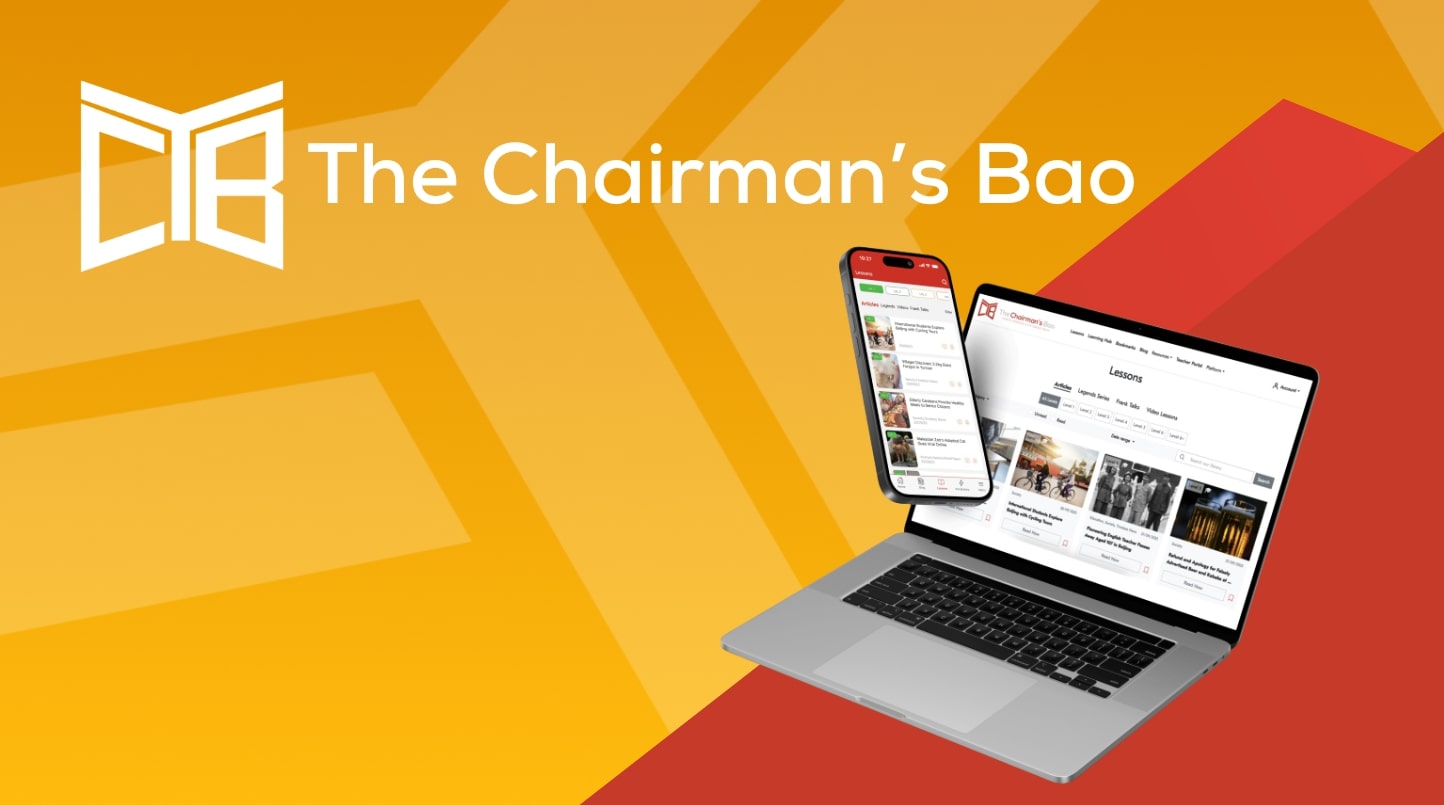
Website profiles · Technology insights · Alternatives

thechairmansbao.com

Learn Chinese online with the world's leading Mandarin news-based HSK-graded reader for students and teachers. Across Website, iOS and Android apps.

Paid content
Visit website
Profile views 13 Outbound visits 2 Normal
The Chairman's Bao Full homepage screenshot

At a glance

Category
News
Language
English
Paid-content signal
Paid contentObserved
Registered
2014
Hosting
wcdnga.comInferred
HTTPS certificate trusted
PassedObserved
Last updated

Website review

This review may include AI-generated content and is not individually verified. Domain, certificate and other facts come from the observed data on this page.

What is The Chairman's Bao?

The Chairman's Bao is a Mandarin Chinese reading platform built around authentic news stories that are rewritten and graded to HSK levels. Instead of textbook dialogues, you read real-world reporting adapted to your level, then reinforce it with comprehension exercises. It works through a website plus iOS and Android apps, so you can study on a laptop, tablet or phone.

The Chairman's Bao

What you actually do on it

  • Read graded news: Lessons are sorted from Level 1 to Level 6, with new articles added regularly.
  • Check your understanding: Reading and listening exercises follow each text, testing character recognition and comprehension.
  • Look words up instantly: A one-tap dictionary shows meanings and lets you save words to a personal learning hub.
  • Review vocabulary: Saved words become flashcards for longer-term memorization.
  • Study across devices: Progress carries between desktop, laptop, mobile and tablet.

Who it suits

It fits intermediate and upper-level learners best, because the core value is volume of real reading material at a controlled difficulty. Beginners can use the lower levels, but complete newcomers may still want a structured course for pronunciation and grammar foundations. Teachers get separate materials, which makes it usable for classroom assignments.

How it compares to alternatives

Option Strength Trade-off
The Chairman's Bao Large library of HSK-graded news, dictionary and flashcards in one place News-based reading, so grammar is learned in context rather than taught systematically
Duolingo Gamified habit-building for beginners Limited depth in authentic reading
HelloChinese Structured beginner lessons with speech practice Less emphasis on long-form news reading

A practical next step: open the free sample lessons and read one at your current HSK level, then one level higher. If the higher level is challenging but manageable with the dictionary, the graded system is doing its job for you. If it feels overwhelming, start lower and build reading stamina first.

How does The Chairman's Bao grade lessons by HSK level?

The Chairman's Bao grades its lessons against HSK levels 1 through 6, and you can filter the lesson library by any single level or view all levels together. The grading is tied to the HSK vocabulary and grammar expectations for each band, so a Level 1 lesson is written to be readable with beginner vocabulary, while a Level 6 lesson uses advanced vocabulary and more complex sentence structures. Each lesson is also tagged by topic and type (for example, animals, technology, society, or "timeless news"), which lets you pick content that matches your interests at a level you can actually handle.

In practice, this means the same news story can be adapted into different levels rather than every learner reading identical text. The page evidence shows sample lessons labeled Level 1, Level 2, and Level 3 with distinct articles, and the library spans all six levels. Lessons are described as authentic, news-based, and updated daily, so the grading applies to current news rather than only textbook material.

How to use the levels

  • Find your band: Start with a level where you recognize most characters but still meet some new words. If you understand nearly everything with no effort, move up.
  • Use the filter: The level filter (Level 1–6 or All Levels) is the main tool for controlling difficulty. Pair it with topic tags to keep reading interesting.
  • Check comprehension: Reading and listening exercises are built into each lesson, so you can confirm whether the level is genuinely right for you before moving on.
  • Build vocabulary: The one-tap dictionary and flashcards let you save unfamiliar words from any lesson, which is useful when a higher-level article has just a few unknown terms.

A useful decision rule: if you can read a lesson at your current level without the dictionary for most of it, try the next level for one or two articles per week. If you are looking up more than a handful of words per paragraph, stay at that level and use the saved-word flashcards until it feels comfortable.

Can I use The Chairman's Bao on multiple devices like phone, tablet, and desktop?

Yes. The Chairman's Bao is built as a cross-platform study tool, so you can read and review lessons on a desktop, laptop, phone, or tablet rather than being tied to one screen. The site describes it as an all-in-one Chinese study app with cross-platform integration, and the platform extends across the website plus iOS and Android apps.

What that means in practice

  • Start a lesson on your phone during a commute, then continue the same article on a laptop at home.
  • Use the one-tap dictionary on whichever device you're holding, saving words to your learning hub.
  • Review saved vocabulary with flashcards on a different device later.
  • Keep a daily reading habit without waiting until you're at a computer.

Practical things to check

Cross-platform access is most useful when your progress, saved words, and lesson history follow you between devices. Before committing, confirm two things on your own account: that your saved vocabulary and lesson progress appear on a second device after signing in, and how many devices or simultaneous sessions your plan allows. The site lists Student Plans under a premium model, so device limits, if any, would sit there rather than in the general feature description.

A quick test

Register for the free sample lessons, save a word on your phone, then open the same lesson on a desktop and check whether the word and your reading position are still there. That single test tells you more about real cross-device usefulness than any feature list.

For the free sample lessons, see The Chairman's Bao.

What's included in the premium subscription and how much does it cost?

The premium subscription unlocks the full lesson library and study tools; the exact price depends on the plan you choose, so check the current Student Plans page rather than relying on a figure quoted elsewhere.

What premium covers

  • Full access to the graded reader — the site describes 11,079 lessons across six levels (Level 1–6), with new articles added daily.
  • Authentic news-based lessons — real news stories rewritten and graded by difficulty, rather than textbook dialogues.
  • Reading and listening exercises — comprehension questions attached to each text to check you understood it.
  • One-tap dictionary and flashcards — look up words while reading, save them to a personal learning hub, then review with flashcards.
  • Cross-platform study — desktop, laptop, mobile and tablet, so you can switch devices mid-lesson.

What's free

Sample lessons are available at every level without paying, and you can register for an account to try them. That's the sensible way to test whether the level grading suits you before committing.

Cost

The site lists "Student Plans" and uses premium/paid language, but the page evidence doesn't state an amount. Pricing is likely tiered by subscription length or by student versus teacher access, so the only reliable source is the official plans page: The Chairman's Bao.

How to decide

If you're an intermediate learner who already knows roughly 1,000–2,000 characters, the value is in volume and freshness — daily news keeps vocabulary current in a way static textbooks don't. If you're a beginner, start with the free Level 1 samples; if the gap between your level and the easiest articles feels wide, the subscription won't fix that.

A practical next step: open two sample lessons, one at your estimated level and one a level higher, and time how long each takes. If the higher one is only mildly harder, premium is worth it for the range. If it's overwhelming, stay on samples until it isn't.

How do teachers use The Chairman's Bao in their Chinese language classes?

Teachers use The Chairman's Bao mainly as a ready-made reading library they can assign to a whole class or to individual students, rather than as a standalone course. The site explicitly separates a "For Students" track from "Materials for teachers," and its lessons are graded across HSK levels 1–6, so a teacher can match a text to the level a class is currently working at without writing or rewriting material.

Typical classroom uses

  • Leveled reading assignments. Pick a lesson at the class's HSK level and assign it as homework or silent reading. The same news story exists at different levels, so mixed-ability classes can read the same topic at different difficulties.
  • Listening and comprehension checks. Each lesson includes reading and listening exercises, which teachers can use as a quick in-class check that students actually understood the text rather than just recognised characters.
  • Vocabulary work. The one-tap dictionary lets students look up and save words to their own learning hub, then drill them with flashcards. Teachers can let students build personal word lists and review them before a quiz.
  • Current-events hooks. Because lessons are based on authentic news and new articles are added daily, teachers can tie a lesson to something happening in China that week, which tends to hold attention better than textbook dialogues.
  • Cross-platform continuity. Students can read on a desktop, laptop, tablet or phone, so a teacher can set reading on a school computer and expect students to continue on their own devices.

How teachers actually fit it in

A common pattern is a weekly cycle: assign one graded article, have students read and save unfamiliar vocabulary at home, then use the listening exercise and a short discussion in class. For teachers who want more structure, the site also offers a dedicated "For Teachers" section and a School for Learning Mandarin area, which suggests institutional use is supported alongside individual teacher accounts.

Trade-offs to weigh

Consideration What it means for a class
News-based content Engaging and current, but topics change; a lesson you liked may not fit next term's syllabus
HSK-graded levels Easy to differentiate, but level labels are the site's own grading, so check a sample before assigning
Free sample lessons Good for trialling with a class before committing
Premium plans Full access sits behind student plans; check the current plans page for what a class or school needs

The practical next step is to open a few sample lessons at the level you teach and read one yourself before assigning it. If the vocabulary load and exercise style suit your students, the daily-updated library removes most of the preparation work; if your syllabus is tightly tied to a fixed textbook, treat it as a supplement for reading practice rather than a replacement.

What features help me remember new Chinese characters and vocabulary?

The Chairman's Bao is built around the repetition loop that makes vocabulary stick: you meet words inside a real news story, look them up without leaving the text, save them, then review them later as flashcards. Its own feature list describes a one-tap dictionary with a learning hub and flashcard practice, plus reading and listening exercises tied to each article.

How the pieces work together

  • One-tap dictionary: Look up a word mid-article instead of switching to a separate dictionary app. This keeps you reading rather than breaking flow.
  • Learning hub: Saved words accumulate in one place, so your personal vocabulary list grows out of what you actually read, not a generic word list.
  • Flashcards: The saved words feed into flashcard review, which is the step that moves a word from "I recognized it once" to "I know it."
  • Reading and listening exercises: Comprehension questions after each text force you to confirm you understood the passage, which reinforces the characters you just met.
  • Graded levels (1–6): Articles are sorted by difficulty, so the vocabulary load per text stays near your level rather than overwhelming you.

A practical routine

Read one Level-appropriate article a day. Tap only words you genuinely don't know, save them, and run the flashcards the next morning before reading something new. The news framing matters here: because the topics are current, the same recurring vocabulary (politics, business, technology, society) reappears across articles, giving you natural spaced repetition on top of the flashcard system.

Trade-offs

This is a reading-first method. It strengthens recognition and listening, but it is not a writing or speaking course, so if your goal is production you'll need to pair it with something else. The news-based approach also means vocabulary skews toward journalistic and current-affairs language rather than everyday conversation.

To judge fit, start with the free sample lessons at several levels and see whether the vocabulary density feels comfortable — if you're saving more than a handful of words per paragraph, drop a level.

Related questions

More questions →
What Does It Mean to Be an IB Student? Roles and Expectations Across the Four Programmes

Being an IB student means more than attending a school that offers an International Baccalaureate programme. It means learning through a specific framework that asks you to think critically, communicate clearly, and take responsibility for your own progress. The IB's four programmes — the Primary Years Programme (PYP), Middle Years Programme (MYP), Diploma Programme (DP), and Career-related Programme (CP) — share a common philosophy but place different demands on students at each stage.

This article explains what the IB expects from students, how responsibilities change across the four programmes, and how families can prepare for the transition.

The foundation: the IB learner profile

Across all four programmes, the IB describes ten attributes it hopes students develop. These are usually called the learner profile. Students are encouraged to be:

  • Inquirers — curious and skilled at asking good questions
  • Knowledgeable — exploring ideas across a range of subjects
  • Thinkers — using critical and creative thinking
  • Communicators — expressing ideas confidently in more than one language
  • Principled — acting with integrity and fairness
  • Open-minded — appreciating other perspectives and cultures
  • Caring — showing empathy and respect
  • Risk-takers — approaching uncertainty with courage
  • Balanced — attending to intellectual, physical, and emotional well-being
  • Reflective — assessing their own learning and experience

These attributes are not a checklist to complete. They describe habits and dispositions that teachers look for and that students are expected to demonstrate over time. In practice, they shape how lessons are taught, how projects are assessed, and how students are asked to behave toward one another.

How student responsibilities differ across the four programmes

Each programme has its own structure, age range, and expectations. The table below summarises the main differences.

Programme Typical age range Core expectation of the student Main assessment emphasis
PYP 3–12 Active participation, curiosity, and reflection on learning Teacher observation, portfolios, student-led conferences
MYP 11–16 Connecting subjects to real-world contexts; developing research and self-management skills Criterion-based assessment, personal project, interdisciplinary units
DP 16–19 Independent academic work across six subject groups plus core requirements External exams, coursework, extended essay, theory of knowledge
CP 16–19 Combining academic study with career-related learning and a reflective project Career-related study, DP courses, personal and professional skills

PYP: building the habits of inquiry

In the PYP, the student's main job is to engage. Children are expected to ask questions, work with others, and reflect on what they have learned. The emphasis is on developing curiosity and basic research skills rather than on formal examinations. Students often take part in units of inquiry that connect subjects, and they may lead conferences where they explain their learning to parents.

MYP: making connections and managing yourself

The MYP asks students to go further. They study eight subject groups and are expected to connect what they learn to the world around them. A key responsibility is the personal project, an independent piece of work that students plan, research, and complete over an extended period. This is often the first time students must manage a long-term deadline largely on their own. Service learning also becomes more structured, and students are encouraged to reflect on their role in the community.

DP: depth, independence, and the core

The DP is the most academically demanding of the four programmes. Students typically study six subjects, three at higher level and three at standard level, and complete three core requirements:

  • Theory of knowledge (TOK) — a course that asks how we know what we claim to know
  • The extended essay — an independent research paper of up to 4,000 words
  • Creativity, activity, service (CAS) — a programme of ongoing experiences outside academic study

DP students are expected to manage a heavy workload, meet external examination deadlines, and produce original academic work. Independent study is not optional; it is central to the programme.

CP: academic study with a career focus

The CP is designed for students who want to combine academic courses with career-related learning. Students take at least two DP courses alongside a career-related study programme, and complete a reflective project. They also develop personal and professional skills. The CP suits students who learn best when their studies connect directly to a practical field, while still requiring the critical thinking and communication skills common to all IB programmes.

How assessment and independence change as students progress

One of the clearest patterns across the IB is the shift from teacher-led assessment toward student-led responsibility.

In the PYP, teachers observe and document learning, and students are guided through reflection. In the MYP, students are assessed against published criteria and must increasingly manage their own projects. By the DP and CP, students are preparing for external examinations and independent research, and they are expected to organise their time, seek help when needed, and meet deadlines without constant reminders.

This progression is deliberate. The IB wants students to leave as self-directed learners who can think for themselves.

Common misconceptions about being an IB student

Several myths circulate about the IB. Here are a few clarifications.

  • "IB students must be geniuses." The programmes are demanding, but they are designed for a broad range of students. Effort, curiosity, and organisation matter as much as raw ability.
  • "The IB is only about exams." Assessment includes projects, portfolios, oral work, and service. The DP has external exams, but the core requirements are equally important.
  • "Students must be fluent in a second language before starting." Language learning is part of the IB, and support is usually available. Requirements vary by programme and school.
  • "IB students have no free time." The workload is real, but the learner profile includes balance. Schools generally encourage students to manage their time and well-being.
  • "All IB schools are the same." Schools implement the programmes in different ways, and the range of subjects and support offered can vary.

Preparing for the transition into an IB programme

If you are a student or a parent preparing to enter an IB programme, the following steps can help.

  1. Read the programme guide for your specific programme. The IB publishes curriculum and assessment information for PYP, MYP, DP, and CP. Understanding the structure reduces surprises.
  2. Talk to current students and teachers. Ask about workload, deadlines, and what support is available.
  3. Build organisational habits early. A simple planner, weekly review, and clear study space make a difference, especially in the MYP and DP.
  4. Practise reflection. The IB asks students to think about their own learning. Keeping a short journal or notes on what worked and what did not is useful preparation.
  5. Ask about language and subject choices. Requirements differ by programme and school, so confirm the details with the school directly.
  6. Plan for the core requirements. In the DP, the extended essay, TOK, and CAS take time. Starting early and setting interim deadlines helps.
  7. Use school support. Coordinators, counsellors, and teachers are there to help. Asking for guidance is part of being a successful IB student.

A practical summary

Being an IB student means developing the learner profile attributes while meeting the specific demands of your programme. In the PYP, that means curiosity and participation. In the MYP, it means making connections and managing independent work. In the DP, it means academic depth and completing the core. In the CP, it means combining academic study with career-related learning and reflection.

Across all four, the common thread is responsibility: for your learning, your time, and your contribution to the community around you. Understanding that early makes the transition smoother and the experience more rewarding.

What HSK Levels Does The Chairman's Bao Cover?

The Chairman's Bao grades its lessons across six levels, Level 1 through Level 6, which map to HSK levels. That means a beginner working toward HSK 1 and an advanced learner pushing past HSK 6 can both find material pitched at their range. The site lets you browse or filter lessons by level, and sample lessons at each level are available for free, so you can check the difficulty against your own reading ability before committing.

How the Level System Works

Every lesson on the platform is tagged with one of six levels. The site's lesson browser shows "All Levels" alongside Level 1 through Level 6 as selectable filters, so the grading is built into how content is organized rather than being a rough label.

Level Typical learner stage
Level 1 Beginner, building first characters and simple sentences
Level 2 Elementary, handling short straightforward texts
Level 3 Intermediate, reading longer passages with common vocabulary
Level 4 Upper-intermediate, working with more complex structures
Level 5 Advanced, reading authentic news-style writing
Level 6 Near-native reading, dense or idiomatic material

The exact vocabulary and grammar load at each level isn't spelled out in the site's public description, so treat the table as a general orientation rather than a precise syllabus. The reliable way to place yourself is to open a sample lesson at a given level and read it.

Why the Levels Are Tied to News Content

The lessons are built on authentic news articles rather than textbook dialogues, and new articles are added daily. Because the same real-world source material is rewritten and graded across six levels, a story can appear at a difficulty that suits you regardless of where you sit on the HSK scale. The site describes itself as a news-based graded reader, which is the mechanism behind the leveling: the topic stays current, the language is adjusted.

Checking Your Level Before You Commit

The most practical step is to test yourself against the free samples. The lesson list includes items marked "Sample" at multiple levels, for example:

  • Level 1 — "Chinese Fruit Seller Feeds Durians to Sheep" (tagged Animals, Funny, Sample)
  • Level 2 — "Woman Attends Wedding Only to Find Out She's the Bride" (tagged Funny, Sample, Society, Timeless News)
  • Level 3 — "Chinese Startup Unveils Pet Translator with '95% Accuracy'" (tagged Animals, Sample, Technology, Timeless News)

Read one at the level you think matches you, then try the level above. If you can follow the text with only occasional dictionary lookups, that's your working level. The one-tap dictionary and flashcard saving make it easy to gauge how much unknown vocabulary a lesson throws at you.

Who the Levels Are Built For

The platform states its content serves both students and teachers of Mandarin Chinese, and it runs across website, iOS, and Android apps, so you can study on desktop, laptop, mobile, or tablet. If you're a teacher, the graded levels let you assign reading at the right difficulty for a mixed-ability class.

What to Keep in Mind

  • The six levels correspond to HSK levels, but the site's public description doesn't publish a detailed per-level vocabulary list, so verify fit with a sample.
  • Sample lessons are free; full access to the broader lesson library involves a premium tier, with student plans listed on the site's plans page.
  • Level tags are the fastest filter, but topics (animals, technology, society, and so on) also help you pick something you'll actually want to read.
Is The Chairman's Bao Free to Use?

The Chairman's Bao is not entirely free, but you can start without paying. Registering gives you access to sample lessons, while the full library of news-based, HSK-graded lessons sits behind a Premium subscription. The site describes itself as offering "premium" plans and points to a Student Plans page, though no specific price is stated in the available information.

What You Get for Free

Based on the site's own description, free access centers on samples:

  • Registration — Creating an account unlocks sample lessons.
  • Sample lessons across all levels — The lesson browser shows entries tagged "Sample" at Level 1, Level 2, and Level 3 (and the level filter runs from Level 1 through Level 6).
  • A look at the format — Samples let you test the core reading experience before committing.

The homepage includes a "Register Now And Access Our Sample Lessons Now for Free" prompt, confirming that free access is real but limited to samples rather than the full catalog.

What Premium Adds

The platform frames its paid tier as the way to reach the complete offering:

  • The full lesson library — The site advertises 11,079 lessons, with new articles added daily. Samples are a small slice of that total.
  • Reading and listening exercises — Comprehension exercises tied to each text.
  • One-tap dictionary and flashcards — Look up words, save them to a learning hub, and review with flashcards.
  • Cross-platform study — Access on desktop, laptop, mobile, or tablet via website, iOS, and Android apps.

The homepage shows "Become Premium" calls to action for both students and teachers, which indicates the paid tier is the intended path for regular study.

How to Decide

Your situation Reasonable starting point
Curious whether the news-based format suits you Register free and work through sample lessons
Studying regularly and need fresh material daily Premium, since samples won't sustain ongoing reading
Teacher sourcing classroom materials Check the teacher-facing Premium option
Budget-sensitive and unsure Compare sample lessons against your needs before subscribing

Checking the Actual Price

No price is given in the information available here. To see current costs and plan tiers, go to the Student Plans page at thechairmansbao.com/plans/. Treat any figure you see there as the authoritative one, since pricing can change.

A Practical Way to Test It

A sensible approach: register, pick one sample at your HSK level, and complete it end to end — reading, listening exercise, dictionary lookup, and flashcard save. If that workflow fits how you study, Premium is the logical next step. If the samples feel too thin or the level tagging doesn't match your ability, you've learned that before spending anything.

What Is The Chairman's Bao?

The Chairman's Bao (thechairmansbao.com) is a news-based graded reader for Mandarin Chinese learners. It turns authentic news articles into lessons graded by HSK level, so you read real-world Chinese at a difficulty you can actually handle. It is aimed at students who want daily reading practice beyond textbook dialogues, and at teachers who want ready-made materials for class. You can use it on the website, iOS, and Android apps, and you can try sample lessons for free before deciding whether to pay for a plan.

How the graded reader works

Each lesson starts from a real news story and is rewritten or leveled to match one of six HSK bands. The site lists lessons under Level 1 through Level 6, so you pick the band that matches your current reading ability rather than guessing.

The catalog is large and refreshed continuously. The site reports 11,079 lessons and says new articles are added daily, which matters if reading the same few texts repeatedly is what usually kills your study habit.

A typical lesson page combines several tools:

  • The graded article itself — your main reading input.
  • Reading and listening exercises — comprehension questions that check whether you actually understood the text, not just recognized characters.
  • One-tap dictionary — look up a word's meaning while reading and save it to your learning hub.
  • Flashcards — review saved words for longer-term memorization.

The listening component is worth noting: many learners can read a character but freeze when they hear it. Pairing the same text with audio exercises targets that gap directly.

What the levels mean for you

The HSK grading is the main decision tool. Use it like this:

Your situation Where to start
You know basic characters and simple sentences Level 1–2
You can read short passages but tire quickly Level 3
You read comfortably but want real news vocabulary Level 4–5
You want near-authentic news with light support Level 6

If a level feels too easy, move up; if you are looking up more than a few words per sentence, move down. The point of a graded reader is to keep you in the zone where you understand most of the text.

Cross-platform study

The platform runs across desktop, laptop, mobile, and tablet, with dedicated iOS and Android apps. The practical benefit is continuity: you can read a lesson on your phone during a commute and review the same saved vocabulary on a laptop later. The site frames this as "never miss another study session," and the cross-platform integration is listed as a core feature rather than an add-on.

Free samples vs. paid plans

You can register and access sample lessons for free, and the sample lessons are marked across all six levels, so you can test the difficulty range before committing. The site also references premium access and links to Student Plans, which indicates that full access sits behind a paid tier. The available information does not specify prices, so check the plans page directly for current terms.

A sensible approach: work through a few free samples at your estimated level, confirm the format suits how you like to study, then decide on a plan.

Who it suits — and who it doesn't

Good fit if you:

  • Want to read real news rather than textbook content.
  • Need material graded to your exact level so you are not overwhelmed.
  • Study across multiple devices and want your vocabulary to follow you.
  • Are a teacher looking for current, leveled reading materials.

Probably not the right tool if you:

  • Are an absolute beginner with no character recognition — you would need a foundation first.
  • Want a structured course with grammar instruction; this is a reading and listening practice platform, not a full curriculum.
  • Prefer free resources only and are unwilling to pay for full access.

Getting started

  1. Go to thechairmansbao.com and register.
  2. Open the sample lessons and try one at your estimated HSK level.
  3. Adjust up or down until the text feels challenging but readable.
  4. Use the one-tap dictionary as you read, and save unfamiliar words.
  5. Complete the reading and listening exercises to confirm comprehension.
  6. Review saved words with flashcards.
  7. If the format works for you, compare Student Plans for full access.

The core idea is simple: consistent daily reading of level-appropriate real Chinese, with built-in tools to catch and retain what you don't yet know.

How Can Teachers Use The Chairman's Bao in Their Classes?

Teachers can use The Chairman's Bao as a ready-made source of HSK-graded, news-based reading and listening material, assign it across desktop and mobile devices, and draw on a dedicated "For Teachers" section plus blog for supporting resources. The site describes itself as a news-based graded reader with 11,079 lessons, new articles added daily, and a "For Teachers" area alongside its student-facing content. That combination makes it most useful when you want current, levelled texts rather than a fixed textbook unit.

What the platform gives you to work with

The site's own feature list maps closely onto classroom needs:

  • Authentic news-based lessons — thousands of articles already published, with new ones added daily, so reading material doesn't run out.
  • Reading and listening exercises — intended to strengthen character recognition and confirm comprehension of each text.
  • One-tap dictionary — look up meaning and save words to a learning hub, with flashcards for longer-term memorisation.
  • Cross-platform study — desktop, laptop, mobile, or tablet, so students can read on whatever device they have.
  • Levels 1–6 — sample lessons are filterable by level, which gives you a rough placement tool when matching a class to a text.

The homepage also lists a "For Teachers" section, a blog, a platform FAQ, and a tutorial video, so you are not relying on the lesson content alone.

Matching lessons to your class level

The level filter (Level 1 through Level 6) is the main lever for differentiation. A practical workflow:

  1. Open the sample lessons and filter to the level closest to your class.
  2. Read the article yourself first and check the topic tags shown on each card (for example Animals, Technology, Society, Funny, Timeless News).
  3. Decide whether the text works as a whole-class read, a homework assignment, or an extension task for stronger students.
  4. Use the level filter again to pull a second text one level up or down for students who need a different challenge.

Because the site labels samples by level and topic, you can build a small themed set — several articles on one subject at different levels — without hunting through unrelated material.

Using the exercises in class

The reading and listening exercises are the part most directly transferable to a lesson plan. Two common patterns:

  • Pre-class: assign the article and its exercises as homework, so class time is spent on discussion and vocabulary rather than first-pass reading.
  • In-class: play the listening component while students follow the text, then use the comprehension exercises as a quick check before moving to pair or group discussion.

The one-tap dictionary and flashcard saving mean students can build their own word lists from the article you set, which keeps vocabulary work tied to the text rather than to a separate list.

Cross-platform access and assigning work

Because the platform runs on desktop, laptop, mobile, and tablet, you can set reading on whatever device students actually use, and they can continue the same lesson elsewhere. The site presents this as an all-in-one study app intended for daily reading, so a realistic assignment is a short article plus its exercises on a regular schedule rather than a large one-off block.

If your school or department wants to go further, the site lists a "School for Learning Mandarin" entry and a "For Teachers" section — worth checking directly for institutional options, since the available page evidence does not spell out what those include.

What to check before committing

  • Pricing: the site references "premium" and links to Student Plans, so some content or features sit behind a paid tier. The evidence here does not state exact prices or what the free sample access covers beyond sample lessons — confirm on the plans page before planning a term around it.
  • Account requirements: registration is offered on the site, but the evidence does not specify what a free account unlocks versus a premium one.
  • Level accuracy: treat the Level 1–6 labels as a starting point and preview any text you assign, since a news article's difficulty depends on topic vocabulary as well as level.

For a teacher who wants current, levelled Chinese reading with built-in comprehension checks and device flexibility, the platform's teacher-facing resources and daily-updated lesson library are the main reasons to try it. Start with the free sample lessons at your class's level, run one article through the pre-class/in-class pattern above, and judge from how students handle the exercises whether to build it into your regular rotation.

Website Overview

Identifiable technologies and additional version or configuration signals make the service easier to fingerprint, which may help targeted scanners narrow their checks. An established domain and managed infrastructure suggest continuity of operations and may support dependable delivery, although neither guarantees service quality.

Domain and Registration

Registered in 2014, this domain has about 12 years of history. That suggests continuity, although ownership and purpose may have changed. Transfer-protection status is present, helping reduce the risk of unauthorized domain transfers. The domain uses the common .com extension, which is not an independent safety signal.

DNS and Email

The lowest TTL is 60 seconds, supporting rapid record changes at the cost of more frequent lookups. Nameservers are provided by desec.io, indicating managed DNS hosting. MX records point to the Microsoft 365 email service. DNSSEC is enabled, allowing validating resolvers to authenticate signed DNS data. SPF and DMARC are configured. DKIM status is unknown.

TLS and Certificates

The certificate issuer is Sectigo Limited, a commercial certificate authority. The certificate uses an RSA 4096-bit public key, offering broad client compatibility. The server supplied a complete certificate chain. No organization name is present in the certificate; the available fields are consistent with domain validation. The certificate is valid for about 198 days in total, with 101 days remaining.

HTTP and Browser Security

The Server header exposes the software version: PWS/8.3.1.0.8. This makes version-targeted checks easier, but is not proof of an exploitable vulnerability. The response lacks these common security headers: CSP. No X-Powered-By header was found, reducing one common source of backend fingerprinting information. The via response header indicates a CDN or caching proxy in the delivery path. No obvious internal addresses or debug information were found in the headers.

Technology Stack Analysis

The public page identifies WordPress 6.6.1, jQuery, Bootstrap, Google Tag Manager, Google Analytics, with exact versions exposed for 1 technologies. These details can narrow vulnerability checks, although exposure alone is not a vulnerability.

Search and Social Sharing

The Generator tag identifies WordPress 6.6.1, making the publishing system easier to fingerprint. The title has 59 characters, within a common display range. A meta description is present, with 148 characters. The observed directives allow indexing and link following. A viewport declaration is present, providing a basis for mobile layout.

Hosting and Email

DNSdesec.io
Hostingwcdnga.com
EmailMicrosoft 365
Approximate IP geolocation (inferred; a CDN or proxy may differ from the origin server) United States flagAshburn, Virginia, United States Inferred 138.113.158.123

Registration details

RDAP / WHOIS

RegistrareNom, LLC
Registered2014-04-17
Expires2031-04-17
Domain statusclient transfer prohibited
Nameserversns1.desec.io、ns2.desec.org
DNSSECsigned

DNS records

DNS

TypeNameValueTTLPriority
Awww.thechairmansbao.com.wcdnga.com138.113.158.12360—
Awww.thechairmansbao.com.wcdnga.com157.185.163.15860—
MXthechairmansbao.comthechairmansbao-com.mail.protection.outlook.com36000
NSthechairmansbao.comns1.desec.io3600—
NSthechairmansbao.comns2.desec.org3600—
TXTthechairmansbao.comMS=ms328664063600—
TXTthechairmansbao.comamazonses:JFzrfV7lAU9wwZYkvZpTkcmAusrXZloA88mXMiucesg=3600—
TXTthechairmansbao.comgoogle-site-verification=rYO-7S2mqCcF2SMSUC626SX60OsefbcFPMWlBCEWp-w3600—
TXTthechairmansbao.comv=spf1 ip4:103.225.64.178 ip4:103.225.64.172 include:spf.braintreegateway.com include:spf.protection.outlook.com include:servers.mcsv.net ~all3600—
CNAMEwww.thechairmansbao.comwww.thechairmansbao.com.wcdnga.com3600—
DSthechairmansbao.com14758 13 2 5b3b3a92719a48e774ce5817cd1b53f8079da86f1f669c22482b70b241e12ac786400—
DMARC_dmarc.thechairmansbao.comv=DMARC1; p=quarantine; rua=mailto:[email protected],mailto:[email protected]; ruf=mailto:[email protected],mailto:[email protected]; rf=afrf; sp=none; pct=100; ri=864003600—

TLS and certificates

TLS / SSL

AssessmentNormal configuration
Supported protocolsTLSv1.2、TLSv1.3
Negotiated protocolTLSv1.3
Certificate subjectwww.thechairmansbao.com
IssuerSectigo Limited
Valid until2027-01-13T23:59 · Remaining when checked: 101 days
Verification detailsCertificate trust: Passed · Hostname match: Passed

HTTP response headers

HTTP

HeaderValue
content-typetext/html; charset=UTF-8
cache-controlno-cache, must-revalidate
serverPWS/8.3.1.0.8
strict-transport-securitymax-age=5; includeSubDomains
x-frame-optionsSAMEORIGIN
x-content-type-optionsnosniff
referrer-policystrict-origin-when-cross-origin
permissions-policygeolocation=(self), payment=(self)

Identified technologies

WordPress 6.6.1jQueryBootstrapGoogle Tag ManagerGoogle Analytics

Pages, Search and Sharing

Meta descriptionLearn Chinese online with the world's leading Mandarin news-based HSK-graded reader for students and teachers. Across Website, iOS and Android apps.
Canonical URLhttps://www.thechairmansbao.com/
LanguageEnglish (default)
Twitter CardNot detected
All bots 1 allowed · 27 disallowed
  • Allow/
  • Disallow/?blackhole
  • Disallow/?test=*
  • Disallow/cart/
  • Disallow/my-words/
  • Disallow/student-complete-profile/
  • Disallow/home/
  • Disallow/page/*
  • Disallow/institution-home/*
  • Disallow/institution-error/*
  • Disallow/student-login/*
  • Disallow/category/*
  • Disallow/exam_category/*
  • Disallow/beta/*
  • Disallow/learning-hub/*
  • Disallow/topic/*
  • Disallow/topics/*
  • Disallow/lessons/*
  • Disallow/videos/*
  • Disallow/?s=*
  • Disallow/teacher/*
  • Disallow/sheet/*
  • Disallow/wcu-statement/*
  • Disallow/login/*
  • Disallow/wp-api/*
  • Disallow/sign-in/*
  • Disallow/wp-admin/*
  • Disallow/*.pdf$

User reviews (0)

  • No reviews yet.