
 简体中文
简体中文 English
Website review
This review may include AI-generated content and is not individually verified. Domain, certificate and other facts come from the observed data on this page.
What is TheChessDirectory?
TheChessDirectory is a curated directory of chess websites, described as collecting hundreds of sites for learning about and playing chess, including resources in multiple languages. Rather than teaching chess itself or hosting games, it functions as an index: its value lies in pointing you toward other places to play, study and follow the game.
Who it suits
- Beginners who don't yet know which chess sites are worth their time and want a starting shortlist rather than search-engine results.
- Intermediate players looking to branch out from a single platform into tactics trainers, opening databases, endgame material or communities.
- Non-English speakers, since the directory explicitly aims to cover sites in any language — useful when most chess content you encounter is English-only.
- Coaches and club organisers assembling a resource list for students or members.
What to expect from a directory like this
A directory is only as good as its upkeep. When you use one, check how entries are organised (by skill level, language, or type of resource), whether descriptions explain what each site actually offers, and whether links still resolve. A short, well-annotated list is more useful than a long, stale one.
How to use it
Pick one goal at a time — say, daily tactics practice or finding opponents at your level — and choose two or three sites from the relevant category to try for a week. If you want a known reference point to compare against while browsing, established destinations include Lichess for free play and study tools, Chess.com for play, lessons and community, and ChessGames.com for historical games. Treat the directory as a discovery layer on top of those, not a replacement for them.
How can I use TheChessDirectory to find chess websites in my language?
TheChessDirectory is a curated index of chess sites rather than a search engine, so use it the way you would use a well-kept bookmark list: browse by category, then confirm the language of each site you open. Its stated scope is hundreds of chess sites for learning and playing, in any language, which means language is treated as a property of the individual sites rather than as a filter you can count on.
A practical way to work through it
- Start from the directory's category or topic groupings (learning, playing, resources) instead of scanning the whole list.
- Open promising entries in a new tab and look at the site's own language switcher or homepage text.
- Note the ones that serve your language, then bookmark them outside the directory so you build a personal shortlist.
- Check whether the site offers your language for the parts you actually need — lessons, playing interface, or community forums often differ.
What to expect, and where it falls short
| Your situation | How the directory helps | The trade-off |
|---|---|---|
| You read English comfortably | Broad choice, quick browsing | Little added value over a normal search |
| You need another language | You may discover smaller regional sites you would not have found | Language is not a reliable filter, so you verify each site yourself |
| You want one good site, fast | Curated entries reduce noise | You still compare several before choosing |
If you need a large, well-known alternative to cross-check, Lichess and Chess.com both offer multiple interface languages, which makes them useful baselines when judging whether a smaller site's translation is complete.
A concrete scenario
Suppose you want to play blitz and read tactics explanations in Polish. Browse the directory's playing and learning sections, open each candidate, and check two things: whether the board interface and menus are in Polish, and whether the instructional content is translated or only the navigation. A site with a translated menu but English lessons will frustrate you within a week.
As a decision rule: pick a site only when the language you need covers the feature you will use most. If the directory entry is ambiguous, treat that as a reason to check the site directly before committing.
What are some recommended websites for learning chess from beginner to advanced?
A structured path works better than a single site: use one resource for rules and basic tactics, another for playing real games, and a third for serious study once you plateau. TheChessDirectory is a directory that catalogs hundreds of chess sites across languages, which makes it useful as a starting map rather than a course itself.
A practical progression
- Beginner: Learn how the pieces move, then drill basic mates and tactics. Interactive puzzle trainers beat passive video watching because you get immediate feedback on blunders.
- Intermediate: Play longer time controls (15+10 or classical) so you actually calculate. Review every loss with an engine, but write down your own reasoning first.
- Advanced: Study openings as plans, not memorized lines; work through annotated master games; and analyze your own games deeply before checking engine suggestions.
Where each kind of site fits
| Stage | What to use | Why |
|---|---|---|
| Beginner | Puzzle trainers, rule explainers | Fast feedback, low cost of mistakes |
| Intermediate | Play servers with rating pools | Real opponents at your level, post-game review |
| Advanced | Game databases, opening explorers, endgame trainers | Depth, searchable master games, targeted weaknesses |
Concrete scenario
A club player stuck around 1400 typically has two gaps: tactical vision and endgame technique. A week of 20 minutes of puzzles daily plus two studied rook-and-pawn endgames often moves the needle more than adding a fourth opening to their repertoire.
Next step
Browse TheChessDirectory to find a play server, a puzzle trainer, and a game database in your language, then commit to one of each for a month before adding more. Chess.com and Lichess are the most widely used play-and-study platforms, and Chess Tempo is a common choice for dedicated tactics and endgame training.
Where can I find platforms to play online chess with other players?
You can find multiplayer chess platforms through curated directories such as TheChessDirectory, which collects hundreds of chess sites for learning and playing across multiple languages. A directory is most useful when you want to compare options before committing to one platform, rather than relying on a single recommendation.
What to weigh when choosing a platform
| Priority | What to look for | Trade-off |
|---|---|---|
| Quick casual games | Large active player base, fast matchmaking | Skill matching can feel uneven at peak hours |
| Improvement | Post-game analysis, puzzles, rating history | Extra tools often sit behind a paid tier |
| Playing friends | Private game links, custom time controls | Fewer opponents if you avoid public lobbies |
| Tournaments | Scheduled events, club or arena formats | Fixed start times require planning |
A practical starting point
If you are new, pick one platform with a broad player base so you rarely wait for an opponent, and play longer time controls (10–15 minutes per side) while you learn. If you already play seriously, choose a site with strong analysis tools and a rating system that matches the one your local club uses.
Directory listings are a starting point, not a verdict: open two or three candidates, check whether they support your language and device, then create a free account on the one that fits.
How do I choose the best chess website for my skill level and goals?
The right chess site depends on whether you want to learn, play, or study seriously. Use TheChessDirectory to shortlist candidates by category, then test each against your actual goal rather than its reputation.
Match the site to your goal
- Absolute beginner: Look for rules explanations, piece-movement drills, and slow games against weak opponents or puzzles. Avoid sites that drop you straight into fast time controls.
- Improving club player: Prioritise tactics trainers, annotated games, and opening explorers. A site that only offers casual play will not move your rating much.
- Competitive player: You need long time controls, rating pools, and analysis tools. Tournament calendars and federation links matter here.
- Casual player: Fast games, variants, and a friendly interface beat deep study features you will never open.
Decide with a two-week test
Pick two sites and use only those for fourteen days, logging what you actually did. If you spent most of your time on puzzles, keep the puzzle site; if you kept playing blitz, admit that and choose the better blitz platform. This beats reading feature lists.
Practical comparison
| Goal | What to check | Common trade-off |
|---|---|---|
| Learning rules | Free lessons, no signup wall | Limited playing strength |
| Tactics | Puzzle volume, spaced repetition | Fewer social features |
| Serious play | Long time controls, anti-cheating | Smaller player pool |
| Openings | Database depth, engine integration | Paywalls on recent games |
TheChessDirectory itself is a directory rather than a playing or learning platform, so treat it as a starting point. For structured lessons, Chess.com and Lichess both cover beginners through advanced players, and Lichess keeps its core features free. For official ratings, tournaments, and rules, go to FIDE.
What are the most popular or highly rated chess websites listed in the directory?
TheChessDirectory is a curated index rather than a rating service, so it does not publish popularity rankings or star scores. Its value is in grouping chess sites by purpose and language, which means "most popular" is best answered by matching a site to what you actually want to do.
Useful categories to browse
- Play and compete — servers for live games, blitz, and tournaments.
- Learn and improve — tactics trainers, opening explorers, and instructional content.
- Reference and data — game databases, player ratings, and historical archives.
- Community and news — forums, blogs, and coverage of elite events.
Well-known sites you will typically find in such a directory
| Site | Best for | Trade-off |
|---|---|---|
| Chess.com | All-in-one play, lessons, puzzles | Heavy interface; some features sit behind a subscription |
| Lichess | Free play, analysis, study tools | Fewer structured courses than commercial rivals |
| Chess24 | Live commentary and elite tournament coverage | Merged into Chess.com, so the experience has shifted |
| FIDE | Official ratings, regulations, event results | Reference material, not a playing or training platform |
| Chessgames.com | Historical game database and player profiles | Dated design; limited interactive coaching |
How to choose
Start from your goal, not from a popularity list. If you want daily games and structured lessons, a large commercial platform fits. If cost or openness matters, a free, open-source server is the stronger pick. If you are researching openings or past games, a database beats a playing site.
A practical next step: open TheChessDirectory, pick the category that matches your goal, and shortlist two or three sites. Try each for a week on the same task — solving tactics, playing a few games, or looking up one opening — and keep the one that fits your routine.
 Namecheap
 Google LLC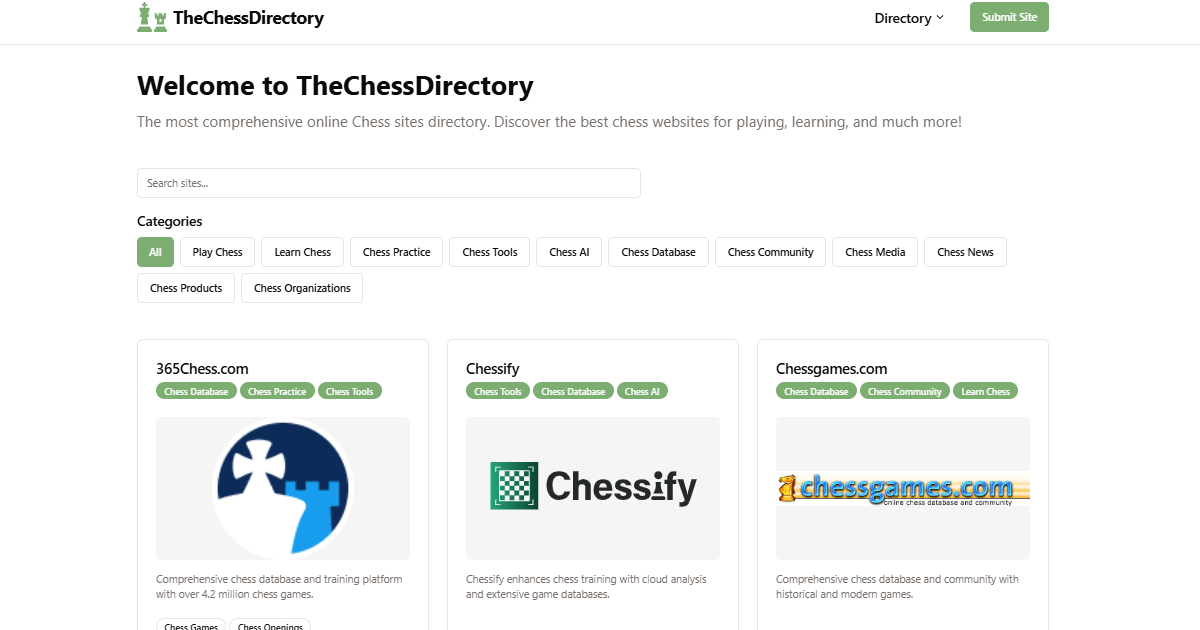

User reviews (0)