
 简体中文
 English
Website review
This review may include AI-generated content and is not individually verified. Domain, certificate and other facts come from the observed data on this page.
What is Truncate?
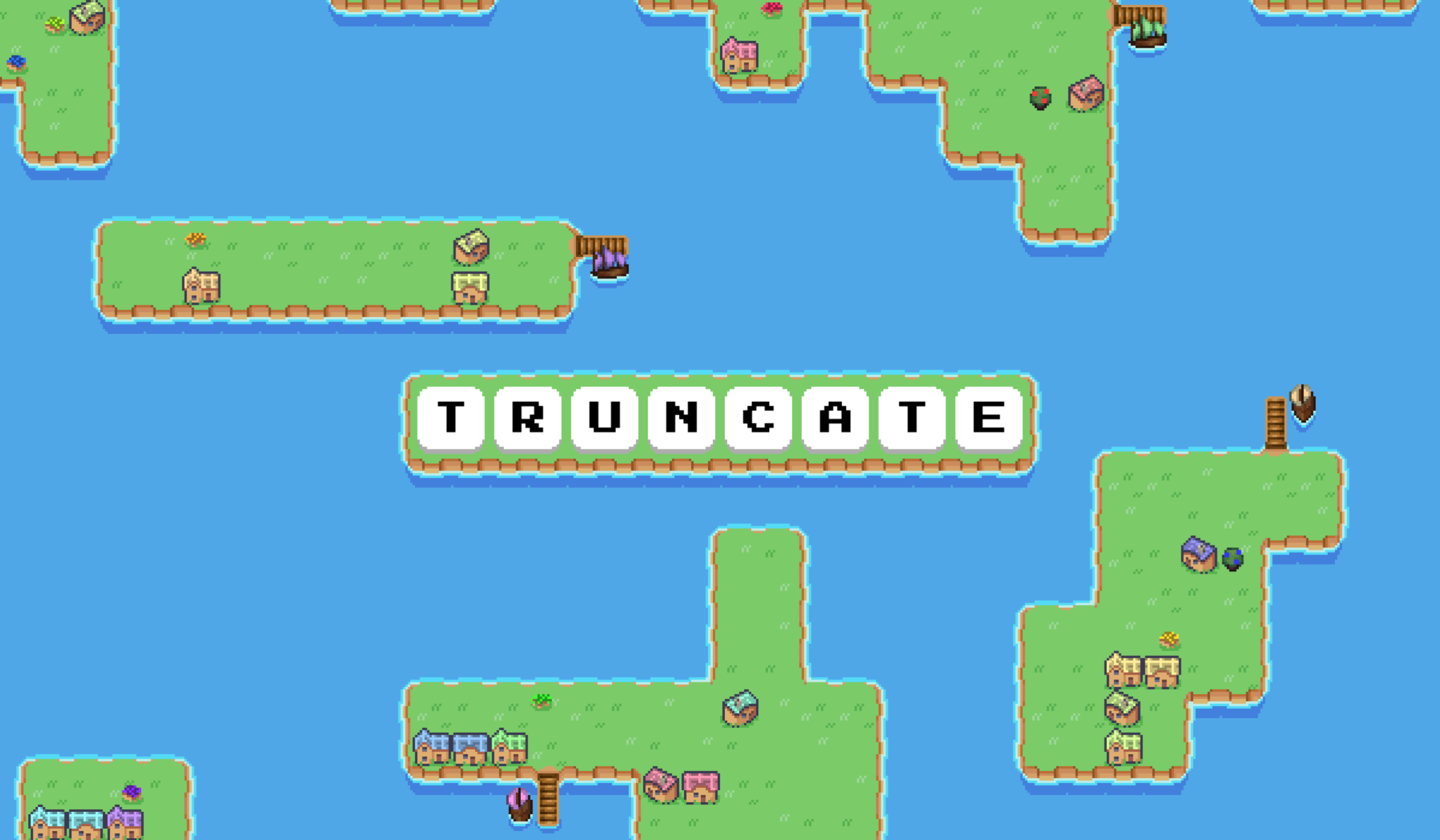
Truncate is a word-based strategy game in which players spell words to cut off an opponent and capture their town. It was created by Liam Bigelow and Blake McAlevey-Scurr, and both its client and server are published as open-source code. Its sprites are also released for reuse under a CC BY-SA 4.0 licence.
The design sits at the intersection of two audiences. Word-game players get vocabulary-driven play rather than letter-tile luck alone; strategy players get spatial conflict, since the goal is to sever and seize territory rather than simply score points. The credited word data—including SCOWL, a Wordnik list and Wiktionary-derived data—suggests a broad dictionary, which matters most for players who dislike being told a reasonable word is invalid.
For a concrete test, play one match and watch whether the tension comes from finding words or from deciding where to place them. If the placement decisions feel as consequential as the spelling, it will suit you; if you only want word-finding, a simpler word game may fit better. The open-source code and permissively licensed assets also make it worth a look for developers curious how a small multiplayer game is structured. More at Truncate.
How does Truncate's word-based strategy gameplay work?
Truncate is a word game played as a territorial contest: you spell words to cut off your opponent and take over their town, rather than simply scoring points for long or rare words. The strategy layer comes from where your words land on the board, since the aim is to sever and claim space, so a modest word placed well can matter more than an impressive one placed carelessly. The site describes it as a word-based strategy game created by Liam Bigelow and Blake McAlevey-Scurr, with both the client and server published as open-source code.
What that means in practice
Think of it less like a crossword and more like a map game where vocabulary is your move budget. Each turn you weigh two things: the word you can actually find, and the shape of the territory that word lets you threaten or defend. Players who enjoy Scrabble-style word finding but want positional pressure—blocking, encircling, expanding—are the natural audience. Players who want pure anagram speed or dictionary trivia may find the territorial thinking slower and more deliberate than they expect.
A concrete scenario: you have a strong seven-letter word available, but it only extends your own area, while a short word would pinch off a chunk of the opponent's town. The strategic read is usually to take the cut, because denying territory compounds over later turns in a way that a high-value word does not.
Trade-offs to weigh
- Word skill versus spatial skill: strong spellers get an advantage, but board reading decides close games.
- Short words versus long words: longer words may cover more ground, but short words are easier to place precisely for cuts.
- Open source: the code is public, which suits players curious about how the game works or who want to run or study it; it matters less if you just want to play.
If you want to judge whether it fits you, play a session focusing only on where your words cut space, ignoring word length—that single constraint reveals quickly whether the territorial layer appeals to you.
Can I play Truncate for free, and where can I get it?
Yes. Truncate is free to play, and its client and server code is open source, published by its creators on GitHub under the TruncateGame/Truncate project. The page also notes that the game's sprites are released under a CC BY-SA 4.0 license, so the visual assets can be reused under that license.
Where to get it
- Main source: the official project repository on GitHub (TruncateGame/Truncate), where both client and server code are available.
- Official site: Truncate is the project's own page and the safest starting point for links and credits.
What "free" covers here
The game itself costs nothing to play. Because the code is open source, you can also inspect it, run your own copy, or build on it, subject to the licenses attached to the code and assets. The sprites carry a share-alike license, so if you reuse or adapt them, your version must be shared under the same terms.
Practical next step
If you just want to play, go to the official site first and follow its link to the GitHub repository. If you want to host a match or modify the game, download the client and server from the repository and check the license files before redistributing anything.
Is Truncate open source, and what license applies to its code and sprites?
Yes. Truncate is open source: both its client and server are published as open-source code on GitHub under the TruncateGame/Truncate repository. The sprites are released separately under a CC BY-SA 4.0 license, so reusing the artwork carries attribution and share-alike obligations even though the code and art are distributed together.
What this means in practice
| Asset | Status | Practical implication |
|---|---|---|
| Client and server code | Open source, available in the project's GitHub repository | You can inspect, run or build on the code; check the repository for the specific code license terms before redistributing |
| Sprites | CC BY-SA 4.0 | Credit the creators and license any adaptations under the same terms |
A concrete case: a hobbyist wanting to build a word-game variant could study the client/server structure, but if they reuse the sprite art in their own release, they must attribute it and keep derivative artwork under CC BY-SA 4.0. Someone only running a private copy has little to worry about beyond following the code license.
As a next step, open the TruncateGame/Truncate repository and read its license file, since the page credits third-party components (such as the egui library under MIT and word lists under MIT-like and CC BY-SA terms) whose terms may also apply to parts of the project. The site itself is at Truncate.
What word list does Truncate use to validate words?
Truncate draws its word list from several open sources rather than a single dictionary. According to the page's credits, the word data comes from the SCOWL Wordlist (by Kevin Atkinson, under an MIT-like license), the Wordnik Wordlist (under MIT), Wiktionary (under CC BY-SA 3.0), and Wiktextract, which makes Wiktionary machine-readable (by Tatu Ylonen / Kaikki.org, under CC BY-SA 3.0).
In practice, this means valid words are not defined by one authority like a Scrabble dictionary. If you are checking whether an unusual word counts, expect the answer to reflect a blend of a curated word list (SCOWL), a broad lexical source (Wordnik), and Wiktionary-derived data. That combination tends to be permissive with real but uncommon words, which suits a strategy game where players want to spell creatively. The trade-off is that edge cases—very new slang or obscure dialect terms—may or may not be accepted depending on which source covers them.
If exact word validation matters to you, the most reliable next step is to check the open-source repository linked from the site (TruncateGame/Truncate on GitHub), where the specific word data files and any filtering rules would be visible.
How can I contribute art, audio, or code to Truncate?
Truncate is explicitly open to outside contributions: its client and server are published as open-source code, and the credits page thanks contributing artists, audio creators and font makers by name. The most reliable route is the project's GitHub repository (TruncateGame/Truncate), where you can open issues or pull requests and see how the code is organised.
Where different skills fit
- Code: The client and server are both open source. Check the repository's issues and contribution guidance before starting, and keep changes focused so they are easy to review.
- Art: Sprites are credited to named artists and released under a CC BY-SA 4.0 licence. If you contribute art, expect it to be shared under the same terms, and confirm the intended licence with the maintainers first.
- Audio: Existing sound assets are credited individually with their licences (for example, a CC0 1.0 sound effect). New audio should come with clear licence information so it can be credited the same way.
- Fonts and word data: The credits list third-party fonts and word lists under their own licences. Contributions here are really about respecting those licences rather than adding new assets.
A practical next step
Before writing code or drawing sprites, open an issue describing what you want to add and why. For art or audio, a short sample plus the licence you can offer is usually enough for maintainers to say whether it fits. If you want to see how a small open-source game project presents its credits and licensing, the Truncate page itself is a useful model: Truncate.
 Namecheap

User reviews (0)