Website profiles · Technology insights · Alternatives

wavian.com

Wavian jerry cans from the authorized US distributor. The original NATO steel fuel can — fully welded recessed seams, made in Latvia. Free shipping over $150.

Paid content
Visit website
Profile views 0 Outbound visits 0 Normal
Wavian USA Full homepage screenshot

At a glance

Category
Other
Language
English
Paid-content signal
Paid contentObserved
Registered
1999
Hosting
CloudflareInferred
HTTPS certificate trusted
PassedObserved
Last updated

Website review

This review may include AI-generated content and is not individually verified. Domain, certificate and other facts come from the observed data on this page.

What is a Wavian jerry can?

A Wavian jerry can is a steel fuel container built to the original NATO jerry can design: a cold-rolled steel body with fully welded, recessed seams and a cam-lever closure using a Viton gasket, made in Latvia. Wavian USA presents it as the authorized US distributor of that original can, with a design lineage the site traces to 1937.

What the design means in practice

The features listed on Wavian USA matter most in situations where a plastic can would fail or degrade:

  • Welded, recessed seams instead of crimped metal — the site specifically contrasts this with cheaper knockoff cans, and says the seams don't leak under pressure.
  • Heavier-gauge steel body that the site says holds its shape after a drop rather than denting in transit.
  • Cam-lever closure with a Viton gasket, described as vapor-tight and able to survive repeated cold and heat cycles.
  • NATO-standard testing for pressure, drop and vibration across the range.

The range and who each size suits

Product Stated capacity/role Typical user
20L Jerry Can Flagship, five colors, full NATO spec Overlanders and fleets needing maximum range per can
10L Jerry Can Same construction, half the volume Motorcyclists, small vehicles, or anyone who can't lift a full 20L can comfortably
22L Water Can Potable-safe, made in Australia Drinking water storage on trips — a different job from fuel
Spare Spout The same spout that ships with each can Replacing a lost or damaged spout
Holders and racks Vehicle mounting Keeping cans secured rather than loose in a bed or trunk

The site frames the audience concretely: overlanders, ranches, off-grid installers and first-response fleets — "wherever fuel needs to travel, or wait." That last word is the useful distinction. A steel NATO can is as much for storing fuel safely at a cabin or job site as for carrying it on a roof rack.

Trade-offs to weigh

Steel brings durability and a proven sealing design, but it is heavier than plastic when empty and, being a fuel can, is not potable-safe — hence the separate water can. A 20L can is also awkward to pour and lift when full; the 10L exists for exactly that reason.

Next step: decide by volume and handling. If one person must lift and pour it repeatedly, the 10L is the practical choice; if range or bulk storage is the priority, the 20L is the flagship. If the need is drinking water rather than fuel, look at the water can instead — it is a different product with a different safety requirement.

How does a Wavian steel jerry can differ from plastic fuel cans?

A Wavian steel jerry can differs from plastic fuel cans mainly in construction, sealing method and durability. According to Wavian USA's own product page, the cans use a cold-rolled steel body with fully welded, recessed seams, a positive-lock cam-lever closure with a Viton gasket, and a vapor-tight seal rated to NATO standards and tested for pressure, drop and vibration. Plastic cans typically rely on molded seams and a simpler screw or push-in cap, which is lighter and cheaper but generally less rigid and less resistant to heat and long-term vapor loss.

Practical differences for a buyer

Aspect Wavian steel can (per Wavian USA) Typical plastic can
Body Cold-rolled steel, heavier gauge Molded plastic, lighter
Seams Fully welded and recessed Molded or crimped
Closure Cam-lever with Viton gasket Screw cap or push spout
Durability Holds shape after a drop, per the page Can crack or deform
Weight Heavier when empty Lighter to carry
Best for Vehicle-mounted, long storage, cold/heat cycles Short trips, occasional use, tight budgets

The trade-off is weight and cost versus longevity. A steel can is heavier to lift and generally pricier, but it suits overlanders, ranches, off-grid installers and response fleets—audiences Wavian names—because it can be rack-mounted and left in a vehicle through temperature swings. A plastic can is easier for a homeowner topping up a mower or storing a small reserve.

If you are choosing, decide by how the can will travel: rack-mounted and stored long-term favors steel; carried by hand occasionally favors plastic. Wavian's page also lists a 10L steel can, a potable-water can and spare spouts, so capacity and color can be matched to a fleet. See Wavian USA for the full range.

Which Wavian jerry can size should I choose for my vehicle or fuel storage needs?

Choose the 20L can if you need the standard, most versatile capacity for vehicle trips or general fuel storage; choose the 10L if space, weight or handling matter more than volume. Both are built to the same NATO specification and construction, so the decision is about capacity and use, not quality.

How to decide

Your situation Better fit Why
Overlanding, long trips, carrying fuel for a vehicle 20L Standard NATO capacity; fewer cans for the same volume
Filling small equipment, mixing fuel, or carrying by hand 10L Half the volume means less weight per lift
Tight storage in a trunk, bed or rack 10L Smaller footprint and easier to stow
Fixed storage or a fleet where cans are swapped 20L More fuel per can and a common standard size
One can for occasional backup 20L Covers more range per can with the same fittings

A full 20L can of petrol is heavy enough that lifting and pouring need care; the 10L is the practical choice if you will handle it often or pour into small tanks. If you plan to mount cans on a rack or in holders, check that the holder suits the can size before buying.

Both cans use the same spout, so a spare spout is a sensible add-on whichever size you pick. For water rather than fuel, Wavian lists a separate potable-safe water can, which is a different product from the fuel cans.

Next step: estimate your longest trip between fuel stops and how many litres you actually need as reserve, then pick the smallest can count that covers it. If you are undecided, the 20L is the safer default for vehicle use, with a 10L added later for handling convenience. See the range at Wavian USA.

Are Wavian jerry cans legal and safe for carrying and storing gasoline?

Wavian's page presents its cans as built to NATO specification, with safety features that matter for gasoline: fully welded recessed seams (not crimped), cold-rolled steel, and a cam-lever closure with a Viton gasket for a vapor-tight seal. The page also states each can is tested for pressure, drop and vibration. Those are the design and testing claims to weigh; they describe the product's construction, not a legal certification.

Legality depends on where and how you use it

"Legal" has two separate parts, and Wavian's page does not settle either:

  • Transport rules vary by country and sometimes by state or province. Many jurisdictions restrict how much fuel you can carry in portable containers, require approved container types, and ban carrying cans inside a passenger cabin. Check your local transport authority before relying on any can for road travel.
  • Storage rules usually concern where fuel is kept (ventilated, away from ignition sources, not in living spaces) and how much. These are typically about your premises, not the can brand.

A can marketed as NATO-spec is a strong signal of robust construction, but it is not the same as a certification for your jurisdiction. Treat "legal" as a local question to verify.

Safety in practice

The features the page highlights — welded seams, a positive-lock cam closure, a vapor-tight gasket — address the main risks with gasoline: leaks and vapor escape. Steel also resists permeation better than many plastics. The trade-offs:

  • Weight and handling: a full steel can is heavy; plan for lifting and pouring, and use a proper spout.
  • Pressure and heat: sealed cans build pressure with temperature swings; vent and open carefully, away from ignition sources.
  • Rust: steel needs care if stored damp or long-term.

For a concrete scenario: an overlander carrying spare fuel on a rack benefits from the sealed, durable construction, but still needs to confirm the vehicle-mount and quantity rules for each region crossed.

Next step

Before buying, check your national or local transport and fire-safety guidance for portable fuel containers — quantity limits, approved types and where cans may be carried. Then compare that against the can's stated spec on Wavian USA. If your use is stationary storage, prioritize ventilation and safe siting over brand; if it is vehicle travel, confirm the transport limits first.

How do I mount a Wavian jerry can to my vehicle with holders and racks?

Wavian sells holders and racks as a mounting option, but the page doesn't detail specific mounting hardware or installation steps, so treat the general guidance below as practical advice rather than a description of this product's mounting system.

What to decide first

  • Carrier type: A dedicated jerry-can holder (often a tray or cradle with a strap or clamp) keeps the can upright and secure. A roof rack or rear-rack mount works when you need the can outside the cabin; a bumper or swing-out carrier suits frequent access.
  • Can size: The 20L and 10L steel cans share construction, so pick the holder sized for the can you carry. A 10L can in a 20L cradle will rattle.
  • Orientation: Store the can upright with the spout up. The cam-lever closure and gasket are designed to seal, but a can lying on its side puts sustained pressure on the seal.

Practical mounting steps

  1. Fit the holder to a solid mounting point — rack crossbars, a reinforced bumper, or a purpose-built bracket — using the holder's own fasteners. Avoid sheet metal or plastic trim.
  2. Set the can in the cradle and confirm it sits flat, with the spout accessible without removing the can.
  3. Secure it with the holder's strap or clamp so it can't shift forward, back, or sideways under braking and cornering.
  4. Check clearance: the can shouldn't contact the body, exhaust, or moving suspension parts.
  5. Re-check tension after the first trip; steel cans are heavy when full and vibration loosens fittings.

Trade-offs

  • Roof mounting keeps fuel smell out of the cabin but raises the center of gravity and makes lifting a full 20L can awkward.
  • Rear or bumper mounting is easier to reach but exposes the can to road spray and rear impacts.
  • Inside the vehicle is simplest for occasional use but risks fumes and blocks cargo space.

For the holder and rack options themselves, check Wavian USA directly, since the page lists holders and racks without specifications. As a next step, measure your rack or bumper mounting points and confirm the holder's footprint matches your chosen can before ordering.

When should I use the 22L water can instead of a fuel can?

Use the 22L water can whenever the liquid is meant for drinking, cooking or washing—never put potable water in a can that has held fuel. Wavian lists the 22L as potable-safe and made in Australia, while the 20L and 10L steel cans are fuel containers built to NATO spec. The distinction is about what the container is designed to carry, not just capacity.

Quick comparison

Need 22L water can 20L / 10L fuel cans
Drinking, cooking, washing Yes—potable-safe No
Fuel for vehicles or equipment No Yes—NATO-spec steel
Camping with a family or group Good for bulk water Not for water
Vehicle fuel reserve Not appropriate Yes, including 10L for compact setups

A concrete scenario: a campervan trip with four people and a camp stove. Carry the 22L water can for washing up and drinking water, and keep a separate 20L fuel can for the vehicle. Don't try to make one can do both jobs; once a can has held fuel, it shouldn't be used for drinking water.

Decision criterion

Ask what the liquid is for. If it goes into a person or a cooking pot, choose the water can. If it goes into an engine, generator or stove fuel tank, choose a fuel can. Capacity is secondary—the 10L fuel can covers smaller vehicles, while the 22L water can suits group water needs.

For the full range and construction details, see Wavian USA.

Related questions

More questions →
What Is Wavian USA and What Does the Site Sell?

Wavian USA (wavian.com) is the authorized U.S. distributor of Wavian jerry cans — the original NATO-specification steel fuel can. The site sells those cans directly to U.S. buyers, along with a small set of related accessories. If you are looking for the Latvian-made steel can rather than a plastic or crimped-seam imitation, this is the distributor's own storefront.

What the site sells

The catalog is deliberately narrow: a few can sizes, a water variant, and the parts that go with them.

Product Capacity What it is Listed price
20L Jerry Can 20 liters Flagship fuel can, full NATO spec, five colors $119.99
10L Jerry Can 10 liters Same construction, half the volume $109.99
22L Water Can 22 liters Potable-safe water can, made in Australia $54.99
Spare Spout — The same spout that ships in the box $29.99

The page also points to holders and racks for mounting a can to a vehicle, though those are presented as a category rather than a priced item in the material reviewed.

What makes these cans different

The site's central claim is construction quality, and it is specific enough to check against a can you already own:

  • Cold-rolled steel body — heavier gauge than commodity cans, so it holds shape after a drop instead of denting in transit.
  • Fully welded, recessed seams — the alternative, crimped metal, is what the site calls out in cheap knockoff cans. Welded seams are the reason it does not leak under pressure.
  • Cam-lever closure with a Viton gasket — a positive-lock handle that stays vapor-tight through cold and heat cycles.
  • Made in Latvia to NATO spec — each can is described as tested for pressure, drop, and vibration.

The site frames the use case simply: steel goes where plastic won't. It names overlanders, ranches, off-grid installers, and first-response fleets as the people who carry it.

Who this site is for

Buy it here if you want the original NATO-pattern steel can and care about seam construction and a sealed closure — for vehicle-mounted fuel, remote fuel storage, or fleet use. The 10L is the same build in half the volume if space is tight; the 22L water can is a separate product for potable water, not fuel.

Two practical notes before ordering: the site advertises free shipping over $150, so a single 20L can falls just under that threshold while a 20L plus a spare spout clears it. And the spare spout listing matters — it is the same part that ships in the box, so it is a replacement, not an upgrade.

How Are Wavian Jerry Cans Built Differently from Cheap Knockoff Cans?

Wavian jerry cans differ from cheap knockoffs in four build details: a cold-rolled steel body in a heavier gauge than commodity cans, fully welded recessed seams instead of crimped metal, a cam-lever closure with a Viton gasket for a vapor-tight seal, and NATO-standard testing for pressure, drop, and vibration. These differences matter most if you plan to carry fuel off-road, store it through temperature swings, or keep cans in service for years rather than one season.

The four construction differences

1. Steel body and gauge

Wavian uses a cold-rolled steel body that the company describes as heavier gauge than commodity cans. The practical effect stated on the site is shape retention: the can holds its form after a drop and resists denting in transit. A dented can is more than cosmetic — deformation around the closure or seams is where leaks tend to start.

2. Seams: welded and recessed vs. crimped

This is the clearest structural split. Wavian cans use fully welded, recessed seams. Cheap knockoffs typically use crimped metal, where edges are folded and pressed together rather than fused. The site's claim is that the welded, recessed construction means no leaks at pressure. Recessed seams also sit protected below the can's outer surface, so they are less exposed to abrasion when the can slides or rests against a rack.

3. Closure and gasket

Wavian uses a positive-lock cam handle with a Viton gasket, described as a vapor-tight seal that survives cold and heat cycles. A cam-lever closure lets you seat the lid with a consistent action rather than relying on how hard you tighten a cap. The gasket material matters because fuel cans often sit through freezing nights and hot afternoons; a seal that hardens or shrinks in those cycles is a common failure point on inexpensive cans.

4. Testing to NATO specification

Every Wavian can is rated to NATO standards and tested for pressure, drop, and vibration. Those three tests map directly onto real use: pressure (seal integrity and vapor containment), drop (body and seam strength), and vibration (what a can experiences mounted on a vehicle over washboard roads).

Side-by-side comparison

Dimension Wavian jerry can Typical cheap knockoff
Body material Cold-rolled steel, heavier gauge than commodity cans Commodity steel, often thinner
Seams Fully welded, recessed Crimped metal
Closure Cam-lever with Viton gasket Often a simple screw cap or basic cam
Seal behavior Vapor-tight through cold and heat cycles Not specified; common weak point
Testing Pressure, drop, vibration to NATO spec Usually unspecified
Origin Made in Latvia Varies

Where the differences actually show up

The site frames the use case as "steel goes where plastic won't," naming overlanders, ranches, off-grid installers, and first-response fleets — situations where fuel needs to travel or wait. For example, a can strapped to a roof rack for a multi-day trip gets vibration, sun, and cold nights in sequence; that is exactly the combination the welded seams, cam closure, and Viton gasket are built for. A can that only shuttles between a garage and a mower sees far less stress, and the gap between a Wavian and a knockoff will be less visible.

Choosing between them

  • Choose Wavian if the can will be vehicle-mounted, stored long-term, exposed to temperature cycling, or used where a leak is a real problem.
  • A knockoff may be adequate for light, short-term, stationary use where the can is emptied quickly and not left sealed under pressure.
  • Check the seams first on any can you consider: welded and recessed versus crimped is the single easiest visual tell, and it is the difference the manufacturer ties most directly to leak performance.

Practical notes before buying

Wavian sells the 20L can in five colors at $119.99 and the 10L at $109.99, both to the same NATO specification. A spare spout is $29.99, and the site lists holders and racks for mounting to a vehicle. Shipping is free over $150. The site does not state whether checkout requires an account, so treat login requirements as unconfirmed until you reach the checkout page.

Which Wavian Can Should I Choose: 20L, 10L, or the 22L Water Can?

Choose the 20L jerry can if you need maximum fuel capacity and want the flagship NATO-spec can in one of five colors ($119.99). Choose the 10L if you want the same steel construction in a more compact size for tighter storage or lighter loads ($109.99). Choose the 22L water can only if you need potable water, not fuel — it is a different product made in Australia ($54.99). All three share the same brand promise, but they are not interchangeable in use.

The three cans at a glance

Can Capacity Purpose Construction / origin Price
20L Jerry Can 20 liters Fuel Cold-rolled steel, fully welded recessed seams, made in Latvia to NATO spec; five colors $119.99
10L Jerry Can 10 liters Fuel Same construction and NATO spec, half the volume $109.99
22L Water Can 22 liters Potable water Made in Australia; potable-safe $54.99

The site states that every Wavian jerry can is built to the same NATO specification, and that each can is rated to NATO standards and tested for pressure, drop, and vibration. The 20L and 10L differ in capacity, not in build quality.

When the 20L is the right pick

The 20L is the flagship: five colors, full NATO spec, and the can the brand leads with. It suits overlanders, ranches, off-grid installers, and first-response fleets — the use cases the site names for carrying or storing fuel where it needs to travel or wait.

Pick the 20L when:

  • You want the most fuel per can and can handle a full-size can.
  • You want color choice to match a vehicle or fleet.
  • You are standardizing on one can size across multiple vehicles or crews.

When the 10L makes more sense

The 10L is described as "same spec, half the volume." That makes it the choice when space or weight is the constraint rather than total capacity.

Pick the 10L when:

  • Storage space is tight (smaller vehicle compartments, packed rigs).
  • You want a lighter can to lift and pour.
  • You plan to carry several cans and prefer smaller units over one large one.

Note the price gap is small — $109.99 versus $119.99 — so the decision should be driven by size and handling, not by saving money.

Why the 22L water can is a separate decision

The 22L water can is potable-safe and made in Australia. It is for drinking water, not fuel, so it does not compete with the jerry cans — it complements them. If your trip needs both fuel and water, the 22L is the water side of that pair. Do not treat it as a cheaper substitute for a fuel can.

What the steel construction means for your choice

All Wavian jerry cans use cold-rolled steel with fully welded, recessed seams — the site contrasts this with "crimped metal like cheap knockoff cans" — plus a cam-lever closure with a Viton gasket for a vapor-tight seal that survives cold and heat cycles. Because the 10L and 20L share this construction, you are not trading down in durability by choosing the smaller can. The site also notes the steel body is heavier gauge than commodity cans and holds shape after a drop.

Accessories worth adding at the same time

  • Spare spout ($29.99): the same spout that ships in the box. Worth adding if you want a backup or a second spout for a multi-can setup.
  • Holders and racks: the site lists mounting options to attach a can to the vehicle. If you are buying for a rig, plan the mount alongside the can.

A quick way to decide

  1. Is the liquid fuel? If no, go to the 22L water can.
  2. If fuel: do you need maximum capacity and color choice? Take the 20L.
  3. If fuel but space or weight is tight: take the 10L — same spec, half the volume.
  4. Add a spare spout and a mount if you are outfitting a vehicle.

Shipping is free over $150 per the site; a single 20L or 10L can falls below that threshold, while a can plus a spare spout or a multi-can order may cross it.

Who Uses Wavian Jerry Cans and in What Situations?

Wavian jerry cans are used by overlanders, ranches, off-grid installers, and first-response fleets — anyone who needs fuel to travel long distances or sit in storage for extended periods. The common thread is a steel can that holds up where plastic won't: cold-rolled steel bodies, fully welded recessed seams, and a cam-lever closure with a Viton gasket, all built to NATO specification and made in Latvia. If your fuel has to leave the paved road or wait months between uses, that construction is the reason to pick Wavian.

The four user groups the site names

Wavian's own product page lists the audiences directly: "Overlanders, ranches, off-grid installers, first-response fleets." Each maps to a different job for the can.

Overlanders

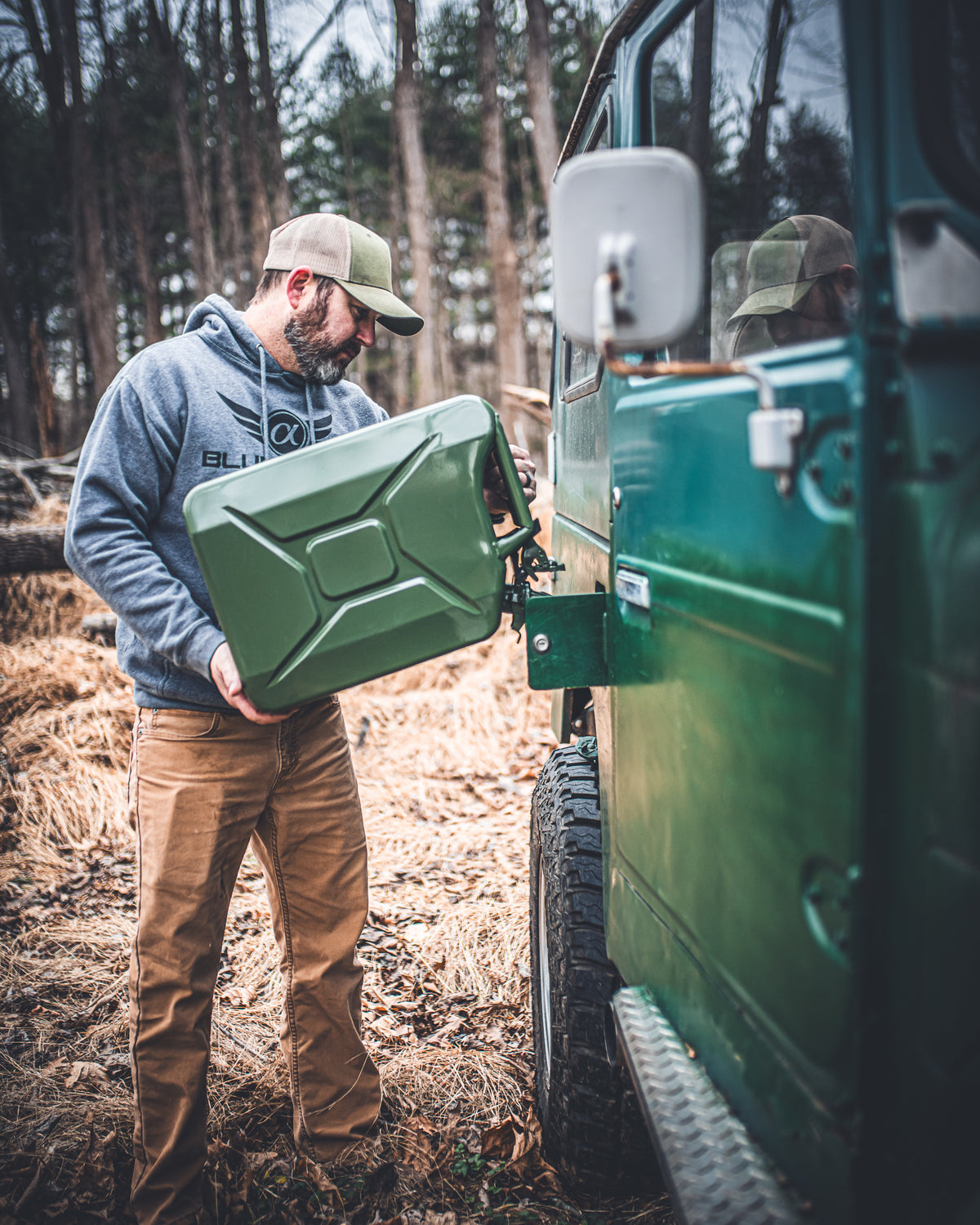
Fuel range is the constraint on remote routes. A 20L can extends distance between fill-ups and mounts to the vehicle via holders and racks. The site's "In the wild" section shows real owner rigs and trips pulled from Instagram (@wavianusa), which is the closest thing to field evidence on the page — actual vehicles, actual loads, actual destinations.

Ranches

Fuel for equipment often has to be carried to where the work is, not the other way around. A steel can that "holds shape after a drop, doesn't dent in transit" matters when it rides in a truck bed or on an ATV across rough ground.

Off-grid installers

Generators, pumps, and remote power equipment need fuel delivered and stored on site. Storage is the hard part here — the cam-lever closure with a Viton gasket is described as a vapor-tight seal that "survives cold and heat cycles," which is what long-term sitting demands.

First-response fleets

Fleets need standardized equipment. Every Wavian can is built to the same NATO specification, so capacity and color are the only variables — the construction doesn't change between sizes.

The situations where steel earns its place

The page's framing is "Steel goes where plastic won't," and the situations it implies are specific:

  • Fuel needs to travel. Long routes, remote access, vehicle-mounted carry.
  • Fuel needs to wait. Seasonal equipment, standby generators, reserve supply.
  • The can gets handled hard. Drops, vibration, loading and unloading — the page states every can is tested for pressure, drop, and vibration to NATO standards.
  • Temperature swings. The Viton gasket seal is rated to survive cold and heat cycles, which is the failure point on lesser cans.

If your use is filling a lawnmower from a can that lives in a garage, none of this is necessary. The case for Wavian is distance, storage duration, and rough handling.

Matching the can to the situation

The range is built to one spec, so the choice is about volume and purpose:

Can Capacity Price Best fit
20L Jerry Can 20L, five colors $119.99 Flagship choice for overlanding and fleet use
10L Jerry Can 10L, same construction $109.99 Compact carry where full volume isn't needed
22L Water Can 22L, potable-safe, made in Australia $54.99 Drinking water, not fuel
Spare Spout — $29.99 Replacement for the spout that ships in the box

Two practical notes from the page: the 10L carries the same NATO spec at half the volume, and the water can is a separate product made in Australia rather than Latvia — it's for potable water, so don't treat it as a fuel can variant.

What to check before buying

  • Mounting. The site points to holders and racks for vehicle mounting; confirm your rig's fit before ordering the 20L.
  • Shipping. Free shipping applies over $150, so a single 10L can ($109.99) falls below that threshold while a 20L ($119.99) is close — a spout or second can pushes an order over.
  • Spout supply. Every can ships with a spout, and the $29.99 spare is the same part — worth adding if you run multiple cans or expect to lose one.

If your fuel stays close to home and moves by hand, a plastic can is cheaper and adequate. If it travels far, sits long, or gets dropped, the welded steel construction and vapor-tight closure are the reasons Wavian's owners are overlanders, ranches, installers, and response fleets rather than driveway users.

Why Choose a Steel Wavian Jerry Can Over a Plastic Fuel Can?

Choose a steel Wavian jerry can when fuel has to survive rough handling, long storage, or repeated pressure and temperature swings — off-road trips, ranch and fleet use, or off-grid fuel storage. Its cold-rolled steel body, fully welded recessed seams, and cam-lever closure with a Viton gasket are built to hold shape and seal tight where a plastic can may dent, crack, or vent vapor. Choose plastic instead only if you need the lowest weight and cost and your fuel stays in light, short-term use.

The construction differences that matter

Wavian describes every can as built to NATO specification and made in Latvia, with these features:

Feature What it means in practice
Cold-rolled steel body Heavier gauge than commodity cans; the site says it holds shape after a drop and doesn't dent in transit
Fully welded, recessed seams No crimped metal like cheap knockoff cans; the site states no leaks at pressure
Cam-lever closure with Viton gasket Vapor-tight seal that the site says survives cold and heat cycles
NATO-standard testing Each can is tested for pressure, drop, and vibration

Plastic cans are lighter and usually cheaper, but they rely on molded seams and a plastic or rubber seal. Under load, sunlight, and temperature cycling, those are the parts most likely to deform or wear. Steel with welded seams removes the seam as a weak point.

Where steel earns its place

The site names the users it builds for: overlanders, ranches, off-grid installers, and first-response fleets — "wherever fuel needs to travel — or wait." The phrase "steel goes where plastic won't" points to the real decision: fuel that is carried on a rack, dropped, stacked, or stored for long periods benefits from a rigid body and a pressure-tested seal. If your can lives in a garage and gets filled monthly for a lawnmower, a plastic can is adequate and lighter.

Sizes and current listed prices

The Wavian range shares the same NATO specification; you choose capacity and color:

  • 20L Jerry Can — five colors, full NATO spec, listed at $119.99
  • 10L Jerry Can — same construction, half the volume, listed at $109.99
  • 22L Water Can — potable-safe, made in Australia, listed at $54.99
  • Spare Spout — the same spout that ships in the box, listed at $29.99

The site also lists holders and racks for mounting a can to a vehicle, and states free shipping over $150. Confirm current prices and shipping at checkout, since listings can change.

How to decide

  1. Match the can to the job. Carried on a vehicle, dropped, or stored long-term: steel 20L or 10L. Light, occasional use: plastic is lighter and cheaper.
  2. Pick capacity by space and weight. The 10L uses the same construction at half the volume — useful where a 20L is too tall or too heavy when full.
  3. Plan the mount. If the can rides outside the vehicle, add a holder or rack rather than strapping it loose.
  4. Keep the spout. The spare spout is the same part that ships with every can, so a lost or damaged spout doesn't sideline the can.
  5. Verify before ordering. Check the product page for color availability, the shipping threshold, and the final price at checkout.

The trade-off is straightforward: steel costs more and weighs more, and in exchange you get a rigid, welded, pressure-tested can that the manufacturer says holds its shape and seals through cold and heat cycles.

Website Overview

An established domain and managed infrastructure suggest continuity of operations and may support dependable delivery, although neither guarantees service quality. Page metadata, canonical configuration and social previews work together to provide more consistent search and sharing presentation.

Domain and Registration

Registered in 1999, this domain has about 27 years of history. That suggests continuity, although ownership and purpose may have changed. Transfer-protection status is present, helping reduce the risk of unauthorized domain transfers. The registrar is Cloudflare, Inc., a widely used domain service provider. The domain uses the common .com extension, which is not an independent safety signal.

DNS and Email

Nameservers are provided by Cloudflare, indicating managed DNS hosting. No CNAME was found; the observed records resolve directly to addresses. No MX record was found. A conventional explicit inbound-mail route is not configured. TXT records include verification markers for Google. Such markers may also remain after a service stops being used. DNSSEC signatures were not detected, so this additional DNS authenticity protection is not confirmed.

TLS and Certificates

The public key uses EC with 256 bits. The server supplied a complete certificate chain. No organization name is present in the certificate; the available fields are consistent with domain validation. The certificate was issued by Let's Encrypt, commonly associated with automated certificate services. The certificate's total validity is about 89 days, consistent with a short renewal cycle.

HTTP and Browser Security

The response lacks these common security headers: Referrer-Policy, Permissions-Policy. No X-Powered-By header was found, reducing one common source of backend fingerprinting information. The cf-ray response header indicates a CDN or caching proxy in the delivery path. No obvious internal addresses or debug information were found in the headers. The Server header identifies cloudflare without an exact version.

Technology Stack Analysis

The public page identifies Shopify, Cloudflare without precise versions, leaving fewer clues for version-specific scanning.

Search and Social Sharing

Twitter Card metadata is configured. JSON-LD includes Organization data, helping describe the organization as an entity. The title has 59 characters, within a common display range. A meta description is present, with 158 characters. The observed directives allow indexing and link following.

Hosting and Email

DNSCloudflare
HostingCloudflare
EmailUnknown
Approximate IP geolocation (inferred; a CDN or proxy may differ from the origin server) Canada flagOttawa, Ontario, Canada Inferred 23.227.38.65

Registration details

RDAP / WHOIS

RegistrarCloudflare, Inc.
Registered1999-06-02
Expires2028-07-01
Domain statusclient transfer prohibited
Nameserversjacqueline.ns.cloudflare.com、kyree.ns.cloudflare.com
DNSSECunsigned

DNS records

DNS

TypeNameValueTTLPriority
Awavian.com23.227.38.65300—
NSwavian.comjacqueline.ns.cloudflare.com86400—
NSwavian.comkyree.ns.cloudflare.com86400—
TXTwavian.comgoogle-site-verification=zWFugedTfP50EM7CWjEwLV9235cDJF1homxQGlbAEDc3600—

TLS and certificates

TLS / SSL

AssessmentNormal configuration
Supported protocolsTLSv1.2、TLSv1.3
Negotiated protocolTLSv1.3
Certificate subjectwavian.com
IssuerLet's Encrypt
Valid until2026-12-10T15:26 · Remaining when checked: 41 days
Verification detailsCertificate trust: Passed · Hostname match: Passed

HTTP response headers

HTTP

HeaderValue
content-typetext/html; charset=utf-8
content-languageen-US
cache-controlprivate, max-age=0, must-revalidate
servercloudflare
strict-transport-securitymax-age=7889238
content-security-policyblock-all-mixed-content; frame-ancestors 'none'; upgrade-insecure-requests;
x-frame-optionsDENY
x-content-type-optionsnosniff
set-cookieRedacted

Identified technologies

ShopifyCloudflare

Pages, Search and Sharing

Meta descriptionWavian jerry cans from the authorized US distributor. The original NATO steel fuel can — fully welded recessed seams, made in Latvia. Free shipping over $150.
Canonical URLhttps://wavian.com/
LanguageEnglish (default)
Twitter Cardsummary_large_image
All bots 23 allowed · 41 disallowed
  • Allow/
  • Allow/products/account
  • Allow/products/orders
  • Allow/products/checkout
  • Allow/*/products/account
  • Allow/*/products/orders
  • Allow/*/products/checkout
  • Allow/collections/account
  • Allow/collections/orders
  • Allow/collections/checkout
  • Allow/*/collections/account
  • Allow/*/collections/orders
  • Allow/*/collections/checkout
  • Allow/pages/checkout
  • Allow/*/pages/checkout
  • Allow/blogs/*account
  • Allow/blogs/*orders
  • Allow/blogs/*checkout
  • Allow/*/blogs/*account
  • Allow/*/blogs/*orders
  • Allow/*/blogs/*checkout
  • Allow/account/login
  • Allow/*/account/login
  • Disallow/admin
  • Disallow/cart/
  • Disallow/*/cart/
  • Disallow/checkout
  • Disallow/*/checkout
  • Disallow/checkouts/
  • Disallow/*/checkouts/
  • Disallow/orders
  • Disallow/*/orders
  • Disallow/account
  • Disallow/*/account
  • Disallow/67418619991
  • Disallow/cdn/wpm/*.js
  • Disallow/services
  • Disallow/sf_*
  • Disallow/.well-known/shopify/monorail
  • Disallow/cart.js
  • Disallow/*/cart.js
  • Disallow/recommendations/products
  • Disallow/*/recommendations/products
  • Disallow/collections/*sort_by*
  • Disallow/*/collections/*sort_by*
  • Disallow/collections/*+*
  • Disallow/collections/*%2B*
  • Disallow/collections/*%2b*
  • Disallow/*/collections/*+*
  • Disallow/*/collections/*%2B*
  • Disallow/*/collections/*%2b*
  • Disallow/collections/*filter*&*filter*
  • Disallow/*/collections/*filter*&*filter*
  • Disallow/blogs/*+*
  • Disallow/blogs/*%2B*
  • Disallow/blogs/*%2b*
  • Disallow/*/blogs/*+*
  • Disallow/*/blogs/*%2B*
  • Disallow/*/blogs/*%2b*
  • Disallow/*?*ls=*&ls=*
  • Disallow/*?*ls%3*ls%3*
  • Disallow/*?*oseid=*
  • Disallow/*?*preview_theme_id=*
  • Disallow/*?*preview_script_id=*
adsbot-google 12 allowed · 10 disallowed
  • Allow/products/
  • Allow/*/products/
  • Allow/collections/
  • Allow/*/collections/
  • Allow/pages/
  • Allow/*/pages/
  • Allow/blogs/
  • Allow/*/blogs/
  • Allow/pages/checkout
  • Allow/*/pages/checkout
  • Allow/blogs/*checkout
  • Allow/*/blogs/*checkout
  • Disallow/checkout
  • Disallow/*/checkout
  • Disallow/checkouts/
  • Disallow/*/checkouts/
  • Disallow/orders
  • Disallow/*/orders
  • Disallow/services
  • Disallow/sf_*
  • Disallow/67418619991
  • Disallow/cdn/wpm/*.js

User reviews (0)

  • No reviews yet.