
 简体中文
简体中文 English
Website review
This review may include AI-generated content and is not individually verified. Domain, certificate and other facts come from the observed data on this page.
What is Working Solutions?
Working Solutions is a business process outsourcing (BPO) provider focused on contact center and customer experience (CX) services. Rather than running a traditional brick-and-mortar call center, it operates a virtual network of independent agents and pairs that human capacity with AI-assisted tools — what the company describes as "AI + IA" (artificial intelligence plus intelligent automation). Its stated aim is to help brands scale support up and down, improve CX, and lower cost per contact, including reducing handle times.
What it actually offers
- Outsourced customer service and contact center operations — handling inbound and outbound customer interactions on a brand's behalf.
- Scalable staffing — flexing agent capacity to match demand, which matters most during predictable volume spikes.
- AI plus human agents — automation for routine or high-volume contacts, with people handling the empathetic or complex parts.
- CX and operational expertise — process design and management layered on top of the staffing.
Who it suits
The clearest fit is a mid-size to large organization with volatile contact volumes: seasonal retail peaks, insurance or benefits open enrollment, product launches, or billing cycles. The page specifically highlights maintaining member experience and service levels during open enrollment spikes — a scenario where a fixed in-house team is either overstaffed in quiet months or overwhelmed in busy ones. Smaller businesses with steady, low-volume support needs will usually find a BPO of this type hard to justify against an in-house team or a simpler answering service.
The trade-offs to weigh
| Consideration | What outsourcing to a virtual network buys you | What it costs you |
|---|---|---|
| Flexibility | Fast ramp-up and down for spikes | Less direct control over daily scheduling |
| Cost | Variable cost instead of fixed headcount | Per-contact or per-hour pricing can exceed in-house at stable, high volume |
| Talent | Access to a distributed agent pool | Brand immersion and product depth take longer to build |
| Technology | AI and automation bundled in | Integration work with your CRM and systems |
A useful next step
Before contacting any BPO, write down three numbers: your average monthly contact volume, your peak-to-trough ratio, and your current cost per contact. If the peak-to-trough ratio is high — say 3x or more — outsourcing is likely worth pricing out; if volumes are flat, an in-house team usually wins on cost and control. Then ask specifically how onboarding, quality monitoring, and data security work, since those are where virtual-agent models most often disappoint.
For context on the wider category, see Working Solutions for the company's own description of its services, and compare against established BPO operators such as Teleperformance or Concentrix if you are evaluating multiple vendors.
How does Working Solutions compare to hiring in-house customer service agents for my business?
Working Solutions is a contact center outsourcing provider, so the comparison is really "outsourced virtual agent network" versus "your own employed support team." The page positions its offer around scalability, cost reduction, and a mix of AI plus human agents, with a virtual agent network and claimed reductions in handle times. For a business weighing this choice, the deciding factors are usually volume variability, how much control you want over hiring and culture, and whether you can absorb fixed payroll.
H3 Where each model tends to win
| Factor | Working Solutions (outsourced) | In-house team |
|---|---|---|
| Ramp speed | Faster to add or remove agents because the provider recruits from its existing network | Hiring, onboarding and training take weeks per cohort |
| Cost structure | Variable, usage- or seat-based; easier to flex down in slow periods | Fixed salaries, benefits, equipment, management overhead |
| Control | You set scripts, SLAs and brand guidelines, but day-to-day management sits with the provider | Direct control over hiring, coaching, culture and escalation |
| Coverage | Typically easier to staff evenings, weekends and peaks | Requires shift planning or paying premiums |
| Institutional knowledge | Knowledge stays with the provider's agents and account team | Knowledge accumulates inside your company |
H3 A practical scenario
Suppose you run an e-commerce or membership business with a predictable baseline but sharp seasonal spikes — open enrollment, holiday sales, a product launch. In-house staff handle the baseline well and know your products deeply, but you would need to hire and train temporary agents for a six-week surge, then either let them go or carry the cost. An outsourced network is designed for exactly that shape of demand. The trade-off is that surge agents may be less fluent in your niche, so your onboarding materials and quality monitoring have to do more work.
H3 Decision criteria
- Choose outsourcing when demand is volatile, you need coverage outside business hours, or support is not a core competency you want to build.
- Stay in-house when the interaction requires deep product or technical expertise, when the customer relationship itself is the product, or when data sensitivity makes third-party access difficult.
- Consider a hybrid: keep a small in-house core for escalations and complex cases, and route routine or overflow contacts to the outsourced partner.
H3 Next step
Before committing, ask any provider — Working Solutions included — for the specifics that determine fit: how agents are recruited and trained for your industry, how quality is measured, what the minimum commitment and ramp timeline look like, and how they handle data security and compliance. Then run a small pilot on one contact type and compare handle time, first-contact resolution and customer satisfaction against your in-house baseline. For broader context on the outsourced model, see Working Solutions and, if you want to benchmark alternatives, TTEC and Teleperformance operate in the same space.
What types of companies or industries benefit most from Working Solutions' contact center outsourcing?
Working Solutions suits organizations that need flexible, at-scale customer contact capacity rather than a fixed in-house call center. Its model combines a virtual agent network with AI plus human support, so the best fit is a company whose contact volume rises and falls sharply, or whose internal team cannot cover peaks without overhiring.
Likely best-fit organizations
- E-commerce and retail brands handling seasonal spikes, promotions, and post-purchase questions such as order status, returns, and exchanges.
- Healthcare and insurance organizations that face enrollment-driven surges, as the page specifically cites maintaining member experience and service levels during open enrollment volume spikes.
- Financial services and fintech companies with regulated, trust-sensitive interactions where empathy and accuracy matter as much as speed.
- SaaS and technology businesses needing tiered support that can scale with user growth without building a large internal team.
- Travel and hospitality companies with weather, holiday, and disruption-driven contact surges.
- Utilities, telecom, and subscription services with recurring billing, outage, and retention conversations.
When it may not be the right fit
- Very small operations with steady, low contact volume may find outsourced scale unnecessary.
- Companies whose entire value proposition depends on in-person or highly specialized expert support may prefer to keep that function in-house.
- Organizations unwilling to integrate AI-assisted workflows should weigh whether the model's efficiency gains still apply.
A practical next step
Map your last 12 months of contact volume by week and channel. If the peaks are more than roughly 20–30% above your baseline, or if hiring and training lag behind demand, an outsourced flexible model is worth evaluating. Ask providers how they ramp during your specific peak and how they measure handle time, resolution, and customer satisfaction. You can review the company's own description at Working Solutions. For broader comparison, the official sites of TTEC and Concentrix describe alternative enterprise BPO models.
How does Working Solutions integrate AI with human agents to improve customer experience?
Working Solutions combines AI with a virtual network of human agents rather than replacing agents outright. Its model is contact center outsourcing: brands hand over some or all of their customer service, and Working Solutions routes work between automation and people depending on the task. The stated goal is to improve contact center operations and ROI while keeping interactions empathetic.
The division of labor is the core idea:
- AI handles the repetitive layer. Routine, high-volume contacts such as simple status questions or basic triage can be automated, which reduces the load on human agents.
- Human agents handle the judgment layer. Complex, emotional or high-value conversations go to people, which is where empathy and problem-solving matter most.
- The network scales elastically. Working Solutions uses a distributed agent model, so capacity can rise and fall with demand rather than being fixed to a single site.
A concrete example from the page is open enrollment. When member contact volume spikes, the AI-plus-human mix is meant to hold service levels steady without a permanent staffing increase. That is the practical trade-off: you get flexibility and potentially lower cost per contact, but you give up some direct control over who handles your customers and you depend on the provider's routing quality.
If you are evaluating this approach, ask two questions before a demo: which contact types will be automated versus escalated, and how the provider measures resolution quality, not just handle time. Those answers will tell you whether the AI is genuinely assisting agents or simply deflecting customers.
What is the process for scaling customer support up or down during peak seasons with Working Solutions?
Working Solutions scales contact center staffing by combining a virtual, work-from-home agent network with AI + IA (intelligent automation) tooling, so capacity can be added or reduced as contact volumes change. From the page evidence, the emphasis is on flexible, empathetic BPO services that are "proven to reduce handle times," with the company positioning itself around scalability, enhanced CX and cost reduction for enterprise clients.
How the scaling model works in practice
H3 What the page indicates
- A virtual agent network rather than a fixed brick-and-mortar site, which is the structural reason rapid up/down scaling is possible.
- AI + IA solutions layered with human agents, aimed at improving contact center operations and ROI.
- An explicit use case: maintaining member experience and service levels during open enrollment volume spikes.
- A "How It Works" section on the page, which is where the specific onboarding and ramp steps would be detailed.
H3 A realistic scaling scenario A health insurer or benefits provider faces a predictable but steep surge during open enrollment. A typical approach with a model like this would be to forecast volume by week, pre-onboard a pool of trained agents before the surge, route routine inquiries to automation, and reserve human agents for complex or sensitive contacts. After the peak, capacity is dialed back down, avoiding the cost of idle full-time staff.
| Scaling direction | Practical mechanism | Main trade-off |
|---|---|---|
| Up | Add virtual agents from a distributed network; lean on AI for routine volume | Ramp time for training and quality calibration |
| Down | Reduce agent hours or assignments after peak | Retaining trained agents for the next cycle |
Next step Ask Working Solutions directly for their ramp timeline, minimum volume commitments, and how training and quality monitoring are handled during a surge. If you are comparing providers, also look at TTEC and Concentrix, which offer similar outsourced CX models, and check each one's stated onboarding lead time.
How does Working Solutions ensure data security and compliance for outsourced customer service?
Working Solutions addresses security and compliance primarily through its operating model: it uses a virtual, work-from-home agent network rather than large brick-and-mortar centers, and pairs human agents with AI and intelligent automation ("AI + IA"). The page evidence emphasizes enterprise CX delivery, scalability, and ROI rather than publishing a detailed security certification list, so treat any specific framework claims as things to verify directly with the vendor.
What the model implies for security
- Distributed agents: A virtual network removes some physical site risks but shifts the burden to identity verification, device standards, background screening, and secure remote access. These are the controls to ask about.
- AI + human handling: Automation can reduce how much sensitive data humans touch, but it also creates new questions about where data is processed, what is logged, and how models are governed.
- Enterprise clientele: The page cites 25+ years and top brands, which suggests experience with enterprise procurement and compliance reviews—not proof of any specific certification.
Questions that actually determine fit
| Area | Ask Working Solutions | Why it matters |
|---|---|---|
| Certifications | SOC 2 Type II, PCI DSS, HIPAA, ISO 27001, GDPR/CCPA posture | Confirms independent audit, not just policy claims |
| Agent screening | Background checks, identity proofing, device and network requirements | Remote agents are the main control point |
| Data handling | Encryption in transit/at rest, data residency, retention and deletion | Affects regulated and cross-border work |
| AI governance | Which AI tools, training data use, human review, audit logs | Prevents uncontrolled data exposure |
| Incident response | Breach notification timelines, SLAs, right to audit | Defines recourse if something goes wrong |
Practical next step: before a demo, send a security questionnaire and request the latest audit reports under NDA, then map the answers to your own regulatory obligations (for example, HIPAA for healthcare or PCI DSS for payments). If your industry is highly regulated, compare against providers that publish certifications openly, such as Teleperformance or Concentrix, and use their disclosures as a benchmark for what Working Solutions should provide.
 Azure DNS
 Cloudflare
 Microsoft 365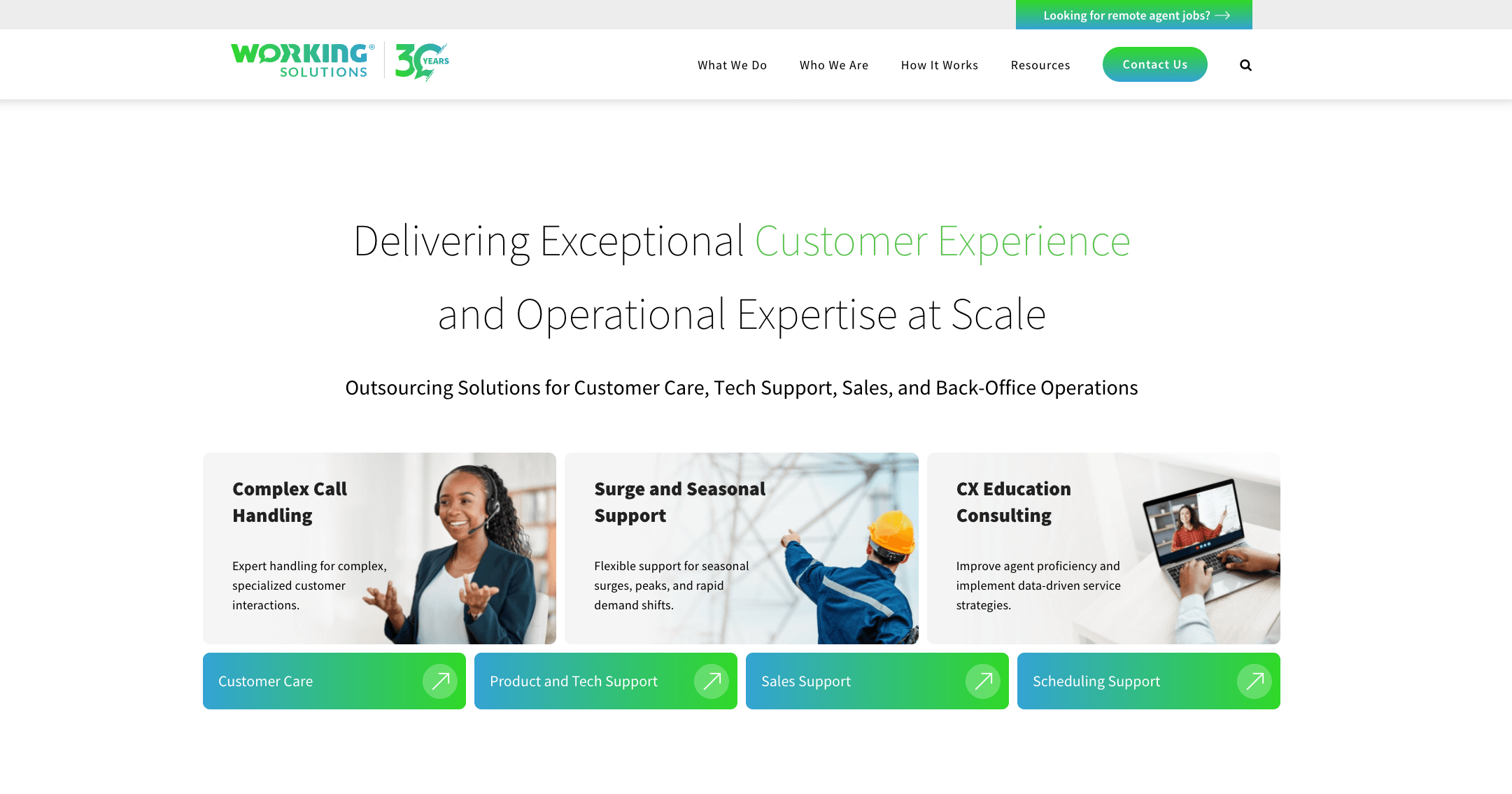

User reviews (0)