
 zabbix.com
 Paid content
 Multilingual
Categories: Business Services
Zabbix is an enterprise-class, open-source monitoring solution that makes network and application monitoring simple.
 Visit website
 Updated: 2026-09-27 00:24
Language: English (default)
Updated: 2026-09-27 00:24
Language: English (default)
 Access: Normal
 Profile views 0
 Outbound visits 0
Related questions
More questions →Does Aldersgate United Methodist Church Have a Mobile App?
As of the information available on the church's website, Aldersgate United Methodist Church in Wichita, Kansas does not advertise a dedicated mobile app. The site presents itself as the primary online hub for the congregation, with its mission of "Making Disciples of Jesus Christ for the Transformation of the World" front and center. If a mobile app exists, it is not prominently featured on the homepage. The most reliable way to confirm is to contact the church office directly or check the website for any new announcements.
That said, "no app advertised" is not the same as "no app at all." Churches sometimes launch apps quietly, link them only in weekly bulletins, or roll them out through a congregation-wide email. This article explains what a church mobile app usually includes, how to verify whether Aldersgate has one, and how to stay connected in the meantime.
What a Church Mobile App Typically Offers
Most church apps are built around a handful of core functions. If Aldersgate launches or already operates one, you can reasonably expect some combination of the following:
- Sermons and worship — audio or video of past services, sometimes with notes or discussion questions.
- Events calendar — worship times, Bible studies, youth group meetings, outreach days, and seasonal services.
- Giving — online donations via credit card, debit card, or bank transfer, often with recurring gift options.
- Prayer requests — a form or feed where members can submit and pray for needs.
- Groups and ministries — sign-ups, rosters, and communication for small groups, choirs, or volunteer teams.
- Push notifications — reminders for services, weather cancellations, or special announcements.
- Connection cards — a digital way for first-time visitors to share contact information.
Not every app includes all of these. Some churches use a general-purpose platform that bundles them together; others rely on separate tools for giving and communication.
How to Check Whether Aldersgate Has an App
Because app availability changes and the website may not always reflect the latest tools, verify through more than one channel:
- Search the website. Look for a menu item labeled "App," "Mobile," "Connect," or "Media." Check the footer, too, since app links are sometimes placed there.
- Search your phone's app store. Try terms like "Aldersgate United Methodist," "Aldersgate Wichita," or "Aldersgate Church." Be careful to match the correct city and denomination, since other churches share the Aldersgate name.
- Call or email the church office. This is the fastest way to get a definitive answer. Ask specifically: "Do we have a mobile app, and if so, what is it called and where do I download it?"
- Ask an usher or greeter on Sunday. They often know about new tools before they appear online.
- Check the weekly bulletin or newsletter. App launches are frequently announced there first.
If you find an app, confirm it is officially affiliated with the church before entering any personal or payment information.
If There Is No App: Other Ways to Stay Connected
A dedicated app is convenient, but it is not the only way to remain plugged into church life. These alternatives cover most of what an app would do:
| Need | Alternative |
|---|---|
| Worship times and location | Church website homepage |
| Sermons | Website media page, podcast, or social media |
| Events | Website calendar, bulletin, or email newsletter |
| Giving | Online giving link on the website, or giving during service |
| Prayer requests | Email, phone call, or prayer chain |
| Announcements | Email newsletter, social media, or Sunday bulletin |
For a first-time visitor, the simplest starting point is the website's contact page: send a message introducing yourself and ask how the church prefers to communicate. For a long-time member, the church office can add you to the email list or connect you with the right ministry leader.
A Practical Checklist for Getting Connected
Use this sequence whether or not an app exists:
- Visit the church website and note the worship times and address.
- Find the "Contact" or "About" page and save the office phone number and email.
- Sign up for the email newsletter if a sign-up form is available.
- Follow the church on any social media accounts linked from the site.
- Ask the office directly about a mobile app, online giving, and prayer request channels.
- If an app is confirmed, download it, create an account, and enable notifications for the updates you want.
A Note on Accuracy
App availability, features, and download links can change at any time, and a website may lag behind those changes. Nothing in this article should be treated as a guarantee that Aldersgate United Methodist Church does or does not currently offer an app. Treat the church office as the authoritative source, and confirm details before relying on any tool for giving or personal information.
If you are a member or visitor hoping for an app, it is also reasonable to ask the church whether one is planned. Congregations often gauge interest before investing in a new platform, and a simple question can move the conversation forward.
What Are Open-Source UI Element Libraries and How Do They Differ From UI Frameworks?
An open-source UI element library is a collection of individual, ready-made interface pieces—buttons, cards, inputs, toggles, loaders—that you copy into your own project and adapt. A UI framework, by contrast, is a structured system of components, conventions, and often a theming layer that governs how your whole interface is built. The practical difference: an element library gives you a snippet; a framework gives you a way of working. If you need a polished button in ten minutes, reach for the element library. If you're building a 40-screen product with a team, you probably want the framework.
What "open-source UI element library" actually means
The term gets used loosely, so it helps to separate the parts:
- Open-source: the code is publicly available, and the license tells you what you may do with it—copy, modify, redistribute, or use commercially.
- UI element: a single, self-contained piece of interface, usually small enough to read in one sitting. A button with hover states, a pricing card, a search field.
- Library: a browsable, searchable collection of those elements, typically contributed by many different people.
On a site like Uiverse, elements are shared by a community and written in plain CSS or Tailwind. You find one you like, copy the markup and styles, paste them into your project, and adjust colors, spacing, and text to fit. There's no package to install and no build step required—which is exactly the appeal, and also the source of most of the confusion.
Element library vs. UI framework: the core differences
| Dimension | Open-source UI element library | UI framework / design system |
|---|---|---|
| Unit of reuse | A single snippet you copy | A component you import or call |
| Installation | None; paste into your code | Package install, config, sometimes a provider |
| Consistency | Depends on you; each element may look different | Enforced by shared tokens and APIs |
| Theming | Manual edits per element | Central theme/config file |
| Updates | You own the copy; no upstream updates | Version bumps bring fixes and changes |
| Accessibility | Varies per contributor; must be checked | Usually tested and documented |
| Best for | Prototypes, landing pages, small sites, one-off needs | Multi-page apps, teams, long-lived products |
| Learning curve | Low—read the CSS | Higher—learn the API and conventions |
The table isn't a verdict. It's a map of trade-offs. Element libraries win on speed and freedom; frameworks win on consistency and maintenance.
Licensing and attribution: what to check before you paste
This is where people get into trouble, and it's worth slowing down for.
- Find the license. Every element or collection should state one. Common open-source licenses include MIT, Apache-2.0, and BSD. Some projects use copyleft licenses like GPL, which can impose obligations if you redistribute your code.
- Understand what the license permits. MIT and Apache-2.0 are permissive: you can typically use the code in commercial and closed-source projects. Copyleft licenses may require you to release derivative source under the same terms.
- Check attribution requirements. Permissive licenses usually require you to keep the copyright notice and license text somewhere in your project. That's a real obligation, not a formality.
- Look for per-element terms. On community sites, the site's overall terms and the individual contributor's stated wishes may differ. If a contributor asks for credit, honor it.
- When in doubt, ask or avoid. If a snippet has no license at all, you don't have clear permission to reuse it. Treat "no license" as "not open source," even if the code is publicly visible.
This article is general information, not legal advice. For commercial products with real exposure, have someone qualified review the licenses you're relying on.
How to use a community element in your project: a practical workflow
Here's a repeatable process that avoids most of the usual mess.
1. Start from a real need, not a browsing session
Decide what you need first—"a compact primary button with a loading state"—then search. Browsing aimlessly produces a pile of pretty snippets that don't fit together.
2. Copy the smallest version that works
Take the markup and the styles. Strip anything you don't need: demo wrappers, extra animations, decorative layers. Less code means fewer surprises.
3. Convert it to your conventions
If your project uses design tokens or CSS variables, replace hard-coded values:
/* Before: hard-coded */
.button { background: #4f46e5; border-radius: 8px; }

/* After: token-based */
.button { background: var(--color-primary); border-radius: var(--radius-md); }
This one step is what keeps a copied element from looking like a foreign object in your UI.
4. Check accessibility before you ship
Community elements vary widely here. Verify at minimum:
- Keyboard focus is visible and the element is reachable by Tab.
- Color contrast meets WCAG AA (4.5:1 for normal text).
- Interactive elements use semantic HTML (
<button>, not a clickable<div>). - Form inputs have associated labels.
- Motion respects
prefers-reduced-motion.
5. Test in context
Paste it into a real page with real content. Long labels, small screens, and dark mode break more copied elements than anything else.
6. Note where it came from
Keep a short comment or an internal credits file: source, license, date. Future you—and your legal reviewer—will be grateful.
Where element libraries genuinely shine
- Prototypes and demos: you need something clickable today, not a design system.
- Landing pages and marketing sites: a handful of distinctive elements, each custom.
- Filling gaps: your framework lacks one specific component, and you don't want to build it from scratch.
- Learning: reading well-made CSS is one of the fastest ways to improve.
- Small projects: a personal site doesn't need a theming architecture.
Where they fall short
- Consistency at scale: ten elements from ten contributors rarely look like one product.
- Maintenance: you own every copy. When your design changes, you edit each one.
- Accessibility debt: you inherit whatever the contributor did or didn't do.
- No upstream fixes: a bug fixed in the original won't reach your copy.
- Integration friction: different naming conventions, different units, different assumptions about resets.
When to choose which
Choose an element library when the scope is small, the timeline is short, or you need a few distinctive pieces rather than a whole system.
Choose a framework or design system when multiple people build multiple screens over months, when consistency is a product requirement, or when accessibility and theming need to be guaranteed rather than checked.
A hybrid works well for many teams: adopt a framework for the structural components—forms, navigation, layout—and borrow individual elements for the places where you want personality. Just route every borrowed element through the same token and accessibility checks, so it lands as part of your system rather than beside it.
The short version: open-source UI element libraries are a fast, flexible way to get good-looking interface pieces into a project. They are not a substitute for a design system, and the license and accessibility details are the part worth reading carefully.
Website Overview
An established domain and managed infrastructure suggest continuity of operations and may support dependable delivery, although neither guarantees service quality.
Domain and Registration
Registered in 2002, this domain has about 24 years of history. That suggests continuity, although ownership and purpose may have changed. Transfer-protection status is present, helping reduce the risk of unauthorized domain transfers. The registrar is Cloudflare, Inc., a widely used domain service provider. The domain uses the common .com extension, which is not an independent safety signal.
DNS and Email
Nameservers are provided by Cloudflare, indicating managed DNS hosting. MX records point to the Microsoft 365 email service. CAA records restrict which certificate authorities are authorized to issue certificates. No CNAME was found; the observed records resolve directly to addresses. SPF and DMARC are configured. DKIM status is unknown.
TLS and Certificates
The public key uses EC with 256 bits. The server supplied a complete certificate chain. No organization name is present in the certificate; the available fields are consistent with domain validation. The certificate was issued within the Google Trust Services cloud or CDN ecosystem. The certificate's total validity is about 90 days, consistent with a short renewal cycle.
HTTP and Browser Security
The response lacks these common security headers: Permissions-Policy. CORS permits any origin to read this response. This is common for public resources; sensitive responses need narrower handling. No X-Powered-By header was found, reducing one common source of backend fingerprinting information. The cf-ray response header indicates a CDN or caching proxy in the delivery path. No obvious internal addresses or debug information were found in the headers.
Technology Stack Analysis
The public page identifies Google Tag Manager, Cloudflare without precise versions, leaving fewer clues for version-specific scanning.
Search and Social Sharing
Open Graph is partially configured; og:description is missing. The page declares 8 language or regional alternatives using hreflang. The title has 63 characters, within a common display range. A meta description is present, with 116 characters. The observed directives allow indexing and link following.
 Hosting and Email
 Cloudflare
 Hosting
 Microsoft 365
 Location
 unknown
104.26.6.148
Location
Location unknown
104.26.6.148
 Pages, Search and Sharing
| Meta description | Zabbix is an enterprise-class, open-source monitoring solution that makes network and application monitoring simple. |
|---|---|
| Canonical URL | https://www.zabbix.com/index |
| Language | English (default) · Multilingual |
| Twitter Card | Not detected |
Social Sharing Preview
7 fields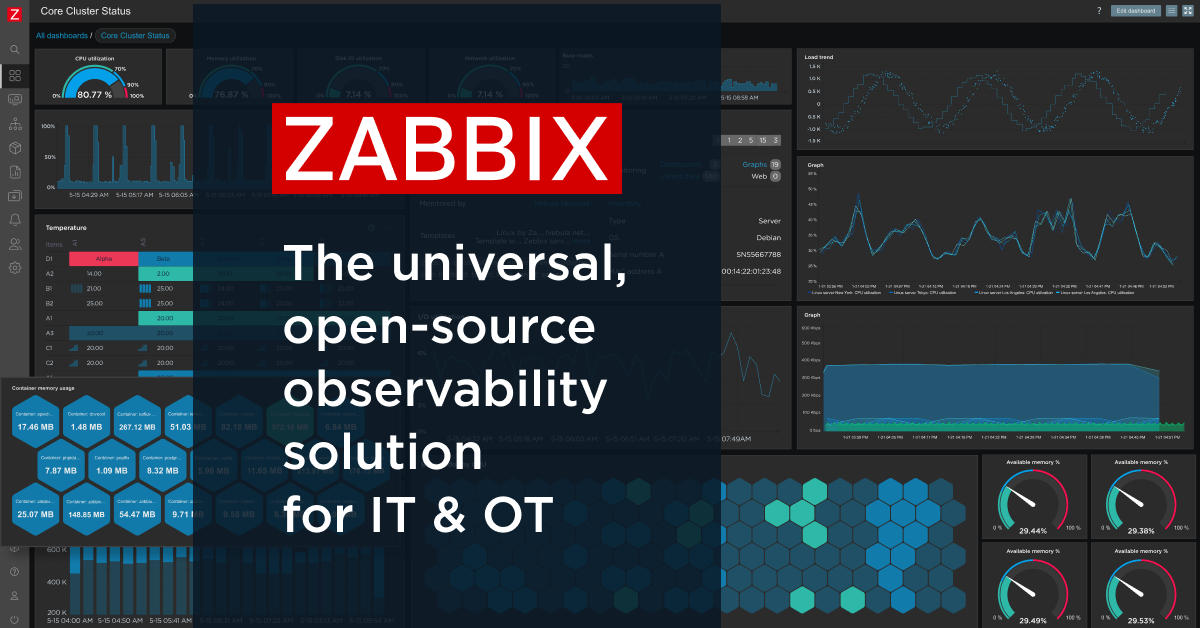
Sharing metadata
| og:url | https://www.zabbix.com/index |
|---|---|
| og:type | website |
| og:image | https://assets.zabbix.com/img/banners/og/index_1200x628.png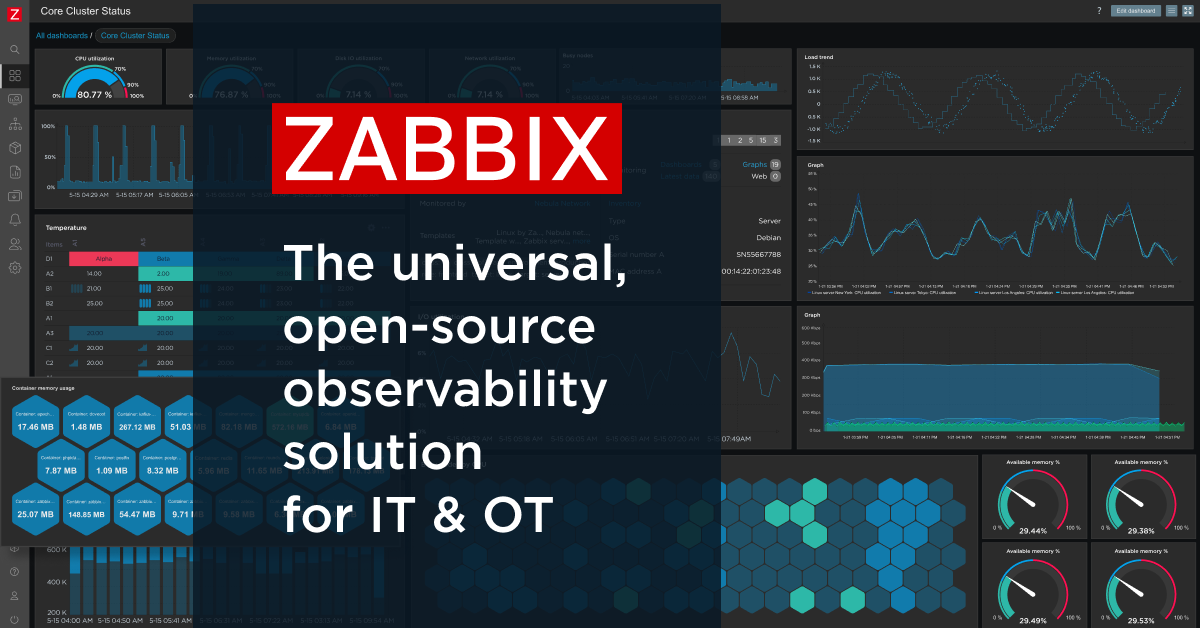 |
| og:title | Zabbix: The enterprise-class open source observability solution |
| og:image:type | image/jpg |
| og:image:width | 1200 |
| og:image:height | 630 |
robots.txt (opens in a new tab)
7 rulesAll bots 0 allowed · 7 disallowed

 All bots

/partners//customers//forum/special/visitor-messages/forum/member//trainers//package/documentation/*/search
No matching rules.
Sitemaps
1 Registration details RDAP / WHOIS
| Registrar | Cloudflare, Inc. |
|---|---|
| Registered | 2002-01-25 |
| Expires | 2027-01-25 |
| Domain status | client transfer prohibited |
| Nameservers | ines.ns.cloudflare.com、paul.ns.cloudflare.com |
| DNSSEC | unsigned |
 DNS records
| Type | Name | Value | TTL | Priority |
|---|---|---|---|---|
| A | www.zabbix.com | 104.26.6.148 | 300 | — |
| A | www.zabbix.com | 104.26.7.148 | 300 | — |
| A | www.zabbix.com | 172.67.69.4 | 300 | — |
| AAAA | www.zabbix.com | 2606:4700:20::681a:694 | 300 | — |
| AAAA | www.zabbix.com | 2606:4700:20::681a:794 | 300 | — |
| AAAA | www.zabbix.com | 2606:4700:20::ac43:4504 | 300 | — |
| MX | zabbix.com | zabbix-com.mail.protection.outlook.com | 300 | 0 |
| NS | zabbix.com | ines.ns.cloudflare.com | 86400 | — |
| NS | zabbix.com | paul.ns.cloudflare.com | 86400 | — |
| TXT | zabbix.com | MS=0F064347AE3FC168815E363F20BF1D19D4FAD991 | 300 | — |
| TXT | zabbix.com | MS=ms59937689 | 300 | — |
| TXT | zabbix.com | anthropic-domain-verification-hvz0yy=aHvm3JqTOET0wYhxWhPg6CRiB | 300 | — |
| TXT | zabbix.com | apple-domain-verification=JrEbzBRT2IysCxNj | 300 | — |
| TXT | zabbix.com | google-site-verification=8UYiyJcfMPtcB_5m9GRsiL6d7y31pB2zLbfOgDiJNTQ | 300 | — |
| TXT | zabbix.com | google-site-verification=DHZBN2lMU-LRY957ew3K7n91V3SGZOXRQ3vSjC4sVKM | 300 | — |
| TXT | zabbix.com | h1-domain-verification=7A4meJBiG8RXdxrfEeu9JdrKXj3YGck5nZGySfjba7ic1qUA | 300 | — |
| TXT | zabbix.com | lw=682ec1d7bfe7091b28241fa1 | 300 | — |
| TXT | zabbix.com | sending_domain1068182=54fd5eec6a9dc8f51f362cfec814d34877adbccdf9b49c7d53ac989c5cbe860c | 300 | — |
| TXT | zabbix.com | v=spf1 mx ip4:80.232.239.26 ip4:195.122.9.66 ip4:195.122.9.71 ip4:195.122.9.72 ip4:195.122.13.66 include:spf.protection.outlook.com include:spf.mandrillapp.com include:_spf.salesforce.com include:mailgun.org -all | 300 | — |
| CAA | zabbix.com | 0 iodef "mailto:[email protected]" | 300 | — |
| CAA | zabbix.com | 0 issue "amazon.com" | 300 | — |
| CAA | zabbix.com | 0 issue "comodoca.com" | 300 | — |
| CAA | zabbix.com | 0 issue "digicert.com; cansignhttpexchanges=yes" | 300 | — |
| CAA | zabbix.com | 0 issue "letsencrypt.org" | 300 | — |
| CAA | zabbix.com | 0 issue "pki.goog; cansignhttpexchanges=yes" | 300 | — |
| CAA | zabbix.com | 0 issue "sectigo.com" | 300 | — |
| CAA | zabbix.com | 0 issue "ssl.com" | 300 | — |
| CAA | zabbix.com | 0 issuewild "comodoca.com" | 300 | — |
| CAA | zabbix.com | 0 issuewild "digicert.com; cansignhttpexchanges=yes" | 300 | — |
| CAA | zabbix.com | 0 issuewild "letsencrypt.org" | 300 | — |
| CAA | zabbix.com | 0 issuewild "pki.goog; cansignhttpexchanges=yes" | 300 | — |
| CAA | zabbix.com | 0 issuewild "sectigo.com" | 300 | — |
| CAA | zabbix.com | 0 issuewild "ssl.com" | 300 | — |
| DMARC | _dmarc.zabbix.com | v=DMARC1; p=reject; rua=mailto:[email protected]; ruf=mailto:[email protected]; fo=1; adkim=r; aspf=r | 300 | — |
 TLS and certificates
| Assessment | Normal configuration |
|---|---|
| Supported protocols | TLSv1.2、TLSv1.3 |
| Negotiated protocol | TLSv1.3 |
| Certificate subject | zabbix.com |
| Issuer | Google Trust Services |
| Valid until | 2026-12-03T20:58 · Remaining when checked: 67 days |
| Verification details | Certificate trust: Passed · Hostname match: Passed |
 HTTP response headers
| Header | Value |
|---|---|
| content-type | text/html |
| server | cloudflare |
| strict-transport-security | max-age=31536000; includeSubDomains |
| content-security-policy | frame-ancestors 'self' *.zabbix.com https://challenges.cloudflare.com |
| x-frame-options | SAMEORIGIN |
| x-content-type-options | nosniff |
| referrer-policy | strict-origin |
| access-control-allow-origin | * |
| set-cookie | Redacted |
 Identified technologies
User reviews (0)