
 简体中文
简体中文 English
bewelcome.org
Join BeWelcome, the largest free hospitality community. Stay with locals, host travellers in your home, meet people, make new friends all over the world and share authentic travel experiences.
At a glance
- Category
- Social & Community
- Language
- English
- Paid-content signal
- No paid content foundObserved
- Registered
- 2006
- Hosting
- Hetzner Online GmbHInferred
- HTTPS certificate trusted
- PassedObserved
- Last updated
Related questions
More questions →How Does Free Accommodation Through Hospitality Exchange Work?
Free accommodation through hospitality exchange works by reciprocity rather than payment: members of a network like BeWelcome offer a spare bed, couch, or room to other members at no charge, and in return they can stay with members elsewhere. It suits travelers who are flexible on timing and comfort, willing to communicate before arrival, and ready to host or otherwise contribute to the community. BeWelcome describes itself as "the largest free hospitality community," with 288,397 members across 219 countries and 315 languages, so the model is well established — but it depends on trust signals and clear expectations, not on a booking transaction.
The core mechanism
Hospitality exchange replaces the payment step with a member-to-member arrangement. There is no nightly rate and no booking platform taking a cut; instead, the network provides profiles, messaging, references, and search tools so hosts and guests can find each other.
On BeWelcome, the site frames this around four activities:
- Meet — get to know people online through the website or in real life
- Travel — organise a journey and meet people along the way
- Host — open your home using the platform's tools
- Share — exchange experiences, moments, and knowledge, and welcome guests "if we can"
The phrase "if we can" matters. Hosting is voluntary and conditional, so availability is a personal decision each member makes, not a guaranteed inventory.
How trust and safety are built
Because no money changes hands, trust comes from accumulated signals rather than payment protection. BeWelcome's statistics list 55,928 positive comments — member references that function as the reputation layer of the network.
When evaluating a potential host or guest, look at:
| Signal | What it tells you |
|---|---|
| Profile completeness | How much the person has invested in the community |
| Positive comments | Past experiences reported by other members |
| Activity on the site | Whether the account is currently in use |
| Communication before arrival | Whether expectations are being discussed clearly |
A profile with many positive comments and recent activity is a stronger signal than a new or empty one. This is a general principle of hospitality exchange, not a guarantee — always read the actual comments rather than just counting them.
As a guest: requesting and staying
The practical sequence is the same across most hospitality networks:
- Create a complete profile. State who you are, why you're traveling, and what you're like as a guest. Hosts screen requests partly on this.
- Search for hosts in your destination. BeWelcome's stated purpose is to "find hosts and guests everywhere in the world," so search by location and read profiles before writing.
- Send a personal request. Explain your dates, how many people you are, and why you picked this host. Generic copy-paste requests are usually ignored.
- Agree on expectations before you arrive. Confirm arrival and departure times, whether you get a key, meals, house rules, and how much interaction the host wants.
- Confirm and show up. If your plans change, tell the host immediately — a no-show damages your reputation in a network built on comments.
- Leave a reference afterward. This is how the system stays useful for the next traveler.
As a host: setting availability and screening
Hosting works in reverse:
- Decide what you can offer. A couch, a spare room, or just a coffee and a tour — BeWelcome explicitly includes "show them around" as a form of hospitality, not only overnight stays.
- Set your availability. Indicate when you can host so you aren't fielding requests during periods you can't accept.
- Screen requests. Read the guest's profile and comments, and ask questions if something is unclear.
- State your house rules up front. Quiet hours, smoking, pets, maximum stay, and how much time you want to spend together.
- Leave a reference after the stay. Honest references keep the comment system meaningful.
Common limits and etiquette
Free accommodation is not the same as a free hotel. Expect these constraints:
- Availability is not guaranteed. A host may be busy, traveling, or simply not taking guests. "If we can" is the operative condition.
- Comfort varies widely. You may get a couch, a shared room, or a mattress on the floor.
- Reciprocity is expected over time. The community works when members both host and travel, or otherwise contribute.
- Communication failures are the most common problem. Most bad experiences trace back to unclear arrival times, unstated expectations, or a guest treating the host as a service.
- Cancellations happen. Have a backup plan, especially for the first night in a new city.
When something goes wrong
If a host doesn't respond, widen your search and send more requests rather than waiting on one. If plans change, message immediately — silence is what damages your standing. If a stay feels unsafe, leave and report it through the platform's channels; the comment and reference system exists precisely so that patterns of behaviour become visible to other members.
BeWelcome's own framing is the clearest summary of the model: "We believe that sharing creates a better world. You can let people stay over or show them around. It's easy and it's called hospitality." Free accommodation works when both sides treat it as an exchange between people, not a transaction between a customer and a provider.
What Is BeWelcome and How Does Its Free Hospitality Exchange Work?
BeWelcome is a free hospitality exchange community where members host travelers in their homes or stay with locals, with no money exchanged for the accommodation itself. It suits travelers who want to meet people rather than book a room, and hosts who are willing to share a spare bed, couch, or just their time showing someone around. Joining is free, and the platform describes itself as the largest free hospitality community, with members in 219 countries.
How the exchange works
The core loop is simple: create a profile, find people in the place you want to go (or who want to come to you), message them, and agree on a stay directly between the two of you. BeWelcome does not act as a booking engine — there is no reservation system, no payment, and no inventory of rooms. It provides the profiles, search tools, and messaging so members can arrange things themselves.
According to the site, members can take part in four broad ways:
- Meet — get to know people online through the website or in real life.
- Travel — organize a journey and meet people along the way, whether across the world or in the next town over.
- Host — offer a place to stay, using the platform's tools to make sharing easy.
- Share — exchange experiences, moments, and knowledge, and welcome guests at home when you can.
A key point: hosting does not always mean providing a bed. The site explicitly frames hospitality as either letting people stay over or showing them around. So a member with no spare room can still participate as a host in the "show you around" sense.
What the numbers say
The homepage lists these statistics:
| Statistic | Figure |
|---|---|
| Members | 288,397 |
| Countries | 219 |
| Languages | 315 |
| Positive comments | 55,928 |
| Activities | 4,834 |
These figures give a rough sense of scale and geographic reach. The member count is in the hundreds of thousands, and the country and language counts suggest you can find hosts and guests across most of the world. The "positive comments" number reflects the reference/feedback culture — members leaving comments about their experiences with each other, which is one of the main signals you use when deciding whether to contact someone.
Who it's for
BeWelcome fits you if:
- You want free accommodation as part of a trip and are comfortable staying with a stranger who has been vetted only by profile information and member comments.
- You want to host and meet travelers, whether by offering a place to sleep or by showing people around your area.
- You're motivated by intercultural understanding and meeting people, not just by cutting accommodation costs.
- You're willing to put in the work of building a profile, reading others' profiles carefully, and messaging back and forth before a stay.
It fits you less well if you want guaranteed, instant, or standardized accommodation, or if you're not comfortable with the uncertainty that comes from person-to-person arrangements.
How it differs from paid booking sites and other networks
The main distinction is the money question. On BeWelcome, no money changes hands for the accommodation. That separates it from paid booking platforms, where you pay for a room, and it's also a stated difference from some other hospitality networks that charge membership or booking fees. BeWelcome presents itself as nonprofit and free to join.
The practical consequence: because nothing is paid, nothing is guaranteed. A host can decline, a stay can fall through, and the quality of a couch varies enormously. What replaces the guarantee is the social layer — profiles, references, and comments — plus your own judgment before you commit.
Before you join: practical safety steps
The platform's emphasis on meeting people means the responsibility for a good, safe experience sits largely with you. Reasonable practices:
- Read profiles and comments carefully. Look at how long someone has been a member, how complete their profile is, and what past guests or hosts have written. The "positive comments" count on the site reflects this reference system.
- Message in advance. Don't show up on a doorstep. Exchange enough messages to confirm dates, what's actually offered (a bed? a couch? just a tour?), and house expectations.
- Set clear expectations with your host or guest. Agree on arrival and departure times, how long you'll stay, whether meals are shared, and any house rules.
- Have a backup plan. Since stays are arranged between individuals and can fall through, know where else you could stay.
- Trust your judgment. If a profile or conversation feels off, you're free to decline or move on.
Getting started
To join, you sign up from the homepage (there's a "Sign up" link next to the login form), create a profile, and then browse hosts and guests by location. From there you message people directly to arrange a stay or an offer to host. Logging in later uses your username or email plus a password, with a "stay logged in" option.
The site's own framing sums up the intent: "We believe that sharing creates a better world. You can let people stay over or show them around. It's easy and it's called hospitality." If that model matches how you like to travel, the free membership and global reach make it worth trying.
Couchsurfing vs BeWelcome: Which Free Hospitality Exchange Should You Use?
Choose Couchsurfing if you want the largest possible pool of hosts and guests and don't mind a commercial platform. Choose BeWelcome if you want a free, volunteer-run, nonprofit community and are willing to trade some reach for a non-commercial model. The two platforms solve the same problem — finding free stays with locals and hosting travelers — but they differ in ownership, cost structure, and scale.
The core difference: commercial vs. nonprofit
Couchsurfing is a well-known commercial hospitality network. BeWelcome describes itself as "the largest free hospitality community" and is built around member-driven, nonprofit hospitality exchange.
That distinction shapes almost everything else:
| Dimension | Couchsurfing | BeWelcome |
|---|---|---|
| Ownership model | Commercial company | Volunteer-run, nonprofit community |
| Cost to use | Has historically introduced paid verification and access limits | Positioned as free hospitality exchange |
| Governance | Corporate decisions | Member-driven community |
| Primary focus | Large-scale hosting and meeting travelers | Intercultural understanding and sharing |
If your main concern is avoiding payments and corporate control, BeWelcome's model is the clearer fit. If your main concern is finding a host quickly in a specific city, scale matters more.
Reach: how many hosts and guests can you actually find?
BeWelcome publishes its own statistics on its homepage:
- 288,397 members (the site also cites 230,000+ in its join prompt)
- 219 countries
- 315 languages
- 55,928 positive comments
- 4,834 activities
Couchsurfing's user base is generally larger and more widely recognized, which usually translates into more available hosts in major cities and tourist hubs. BeWelcome's 288,000+ members across 219 countries is substantial, but spread across the globe it means thinner coverage in some locations.
Practical rule: if you're traveling to a major city and want the best odds of finding a host, Couchsurfing's larger base helps. If you're hosting and want to reach a community that explicitly values cultural exchange over scale, BeWelcome's numbers are still meaningful.
What BeWelcome actually offers
From its own description, BeWelcome is organized around four activities:
- Meet — get to know people online through the website or in real life
- Travel — organize a journey and meet people along the way
- Host — open your home to travelers, with tools designed to make sharing easy
- Share — exchange experiences, moments, and knowledge, and welcome guests when you can
The site frames this as "hospitality exchange" rather than a booking service: "You can let people stay over or show them around. It's easy and it's called hospitality."
How to decide
Pick Couchsurfing if:
- You want maximum host availability, especially in popular destinations
- You're comfortable with a commercial platform and any fees or verification it requires
- You value a large, familiar brand and broad name recognition
Pick BeWelcome if:
- You want a free, nonprofit, volunteer-run community
- You care about member-driven governance and a non-commercial ethos
- You're hosting and want to connect with travelers who prioritize cultural exchange
- You're willing to accept thinner coverage in some regions in exchange for the community model
Consider using both. Nothing prevents you from maintaining a profile on each — many hospitality exchange participants do — and choosing whichever has an active host in your destination.
A note on cost and access
BeWelcome's own materials describe it as "the largest free hospitality community," which is the basis for treating it as free to join and use. For Couchsurfing, this comparison does not have verified current pricing details, so check its site directly for any fees, verification requirements, or access limits before committing. Don't assume either platform is free or paid beyond what each one states.
Bottom line
The choice comes down to what you value more: reach (Couchsurfing's larger, commercial network) or model (BeWelcome's free, nonprofit, member-driven community). If free access and non-commercial governance are non-negotiable for you, BeWelcome is the direct answer. If finding a host fast in a specific city is the priority, Couchsurfing's scale is the advantage — provided you accept its commercial terms.
How Does Hospitality Exchange Build Intercultural Understanding?
Hospitality exchange builds intercultural understanding by putting you inside everyday life in another culture rather than in front of it. Instead of staying in a hotel and visiting sights, you stay with a local host, share meals and routines, and talk about ordinary things — which is where stereotypes tend to break down. On BeWelcome, a free hospitality community, this happens through member profiles, messages, and stays arranged directly between hosts and guests. It suits travellers who want contact with locals and hosts who want to open their home to the world; it is not a booking service, and it depends on mutual effort rather than a transaction.
What "intercultural understanding" actually means here
In hospitality exchange, intercultural understanding is not a lecture or a guided tour. It is the accumulated result of small, ordinary interactions:
- Living alongside someone — seeing how they cook, shop, commute, and spend an evening.
- Talking about daily life — work, family, food, money, holidays, and what people worry about.
- Explaining your own normal — answering "why do people in your country do X?" forces you to notice your own assumptions.
- Correcting each other gently — misunderstandings get discussed in person instead of left to guesswork.
The key difference from sightseeing is reciprocity. You are not only observing a culture; you are also being observed, and you are expected to contribute to the household rhythm while you are there.
How BeWelcome connects you across countries and languages
BeWelcome describes itself as "the largest free hospitality community" and reports a membership spanning many countries and languages. Its own statistics page lists figures such as 288,397 members, 219 countries, 315 languages, and 55,928 positive comments. Those numbers matter for intercultural understanding because they represent the pool of people you can actually reach.
The platform's own framing of what it offers maps closely onto this goal:
| BeWelcome feature | What it enables |
|---|---|
| Meet | Getting to know people online through the website, or meeting them in real life |
| Travel | Organising a journey and meeting people along the way |
| Host | Tools and features for sharing your home and meeting guests |
| Share | Exchanging experiences, moments, and knowledge, and welcoming guests when you can |
In practice, you create a profile, describe yourself and your home or travel plans, search for hosts or guests in a place, and message people directly to arrange a stay. Language is part of the exchange: the site's language count reflects a membership that does not all share one mother tongue, so conversations often happen in a second language for at least one person.
What participants actually gain
The gains are concrete rather than abstract:
- Language practice — speaking with someone who lives in the language, in ordinary situations rather than classroom exercises.
- A local way of life — where people eat, when they sleep, how they treat guests, what they find funny or rude.
- Fewer stereotypes — generalisations about a nationality or religion get tested against one specific person you now know.
- A network that persists — the "positive comments" on profiles are references left by past hosts and guests, so trust accumulates across the community.
- Reciprocity in both directions — as a host, you also learn how your own habits look to a visitor.
Practical ways to make a stay genuinely intercultural
Whether you are hosting or staying, the understanding comes from what you do together, not from the fact of sharing an address.
As a guest:
- Ask about daily routines and join them where you are welcome — cooking, shopping, a walk, a family meal.
- Offer something back: cook a dish from home, help with chores, share music or photos.
- Ask questions about things you notice instead of assuming you already know the answer.
- Be explicit about your own expectations for arrival, departure, and alone time.
As a host:
- Explain house rules and local customs plainly; do not assume a guest will infer them.
- Invite your guest into ordinary activities rather than treating the stay as a service.
- Ask your guest about their home country — the exchange should run both ways.
- Leave room for the guest to have time alone; constant contact is not the same as understanding.
Expectations and boundaries before you join
Hospitality exchange works on reciprocity and trust, not payment. BeWelcome describes itself as a free hospitality community, and the arrangement is mutual: hosts offer a place to stay or show someone around, and guests participate in the exchange. A few things to keep in mind:
- It is not a hotel. There is no guaranteed standard of accommodation, and no service obligation on the host.
- Trust is built through communication. Profiles, messages, and references are how you judge whether a stay will work; read them before committing.
- Cultural friction is normal. Differences in punctuality, personal space, food, religion, or cleanliness can surface. The useful response is to raise it directly and calmly rather than silently resent it.
- Either side can decline. Not every match works, and declining or ending a stay is part of keeping the exchange healthy.
- Be clear about limits. If you have constraints — dietary needs, work hours, a no-smoking home, limited space — state them early so the other person can decide with full information.
The understanding that hospitality exchange produces is slow and specific: it comes from one household, one conversation, and one shared meal at a time. If you want that kind of contact rather than a packaged trip, joining a community like BeWelcome and starting with a short, well-communicated stay is the most direct way to begin.
What Is Hospitality Exchange and How Does It Work?
Hospitality exchange is a form of travel where members of a community host each other for free, usually in their homes, and the "exchange" is social rather than financial: guests get a place to stay and local company, hosts get to meet people from elsewhere and share their own corner of the world. It suits travellers who are comfortable with a stranger's spare room or couch, who value conversation over hotel service, and who are willing to reciprocate by hosting or at least by being a considerate guest. BeWelcome, a community that describes itself as "the largest free hospitality community," is one example of a network built around this idea.
The core idea: free stays, human exchange
In a hospitality exchange network, no money changes hands for accommodation. BeWelcome's own framing is that "sharing creates a better world" and that members "share experiences, moments, knowledge and we welcome guests in our homes, if we can." The phrase "if we can" matters — hosting is voluntary and situational, not a guaranteed service. The exchange is not a transaction you book and confirm like a hotel room; it is an arrangement two people agree to.
This distinguishes it from:
- Paid accommodation (hotels, hostels, short-term rentals), where the relationship is commercial and the host has a service obligation.
- House-sitting, where the primary purpose is usually care of a property or pets, often with defined duties.
- Hospitality exchange, where the primary purpose is meeting people and sharing daily life, with the stay itself free.
How it works in practice
The mechanics are similar across most networks, including BeWelcome:
- Join and build a profile. You create an account and describe who you are, where you live, and what you're interested in. BeWelcome's site is organised around four verbs — meet, travel, host, share — which map to the main things members do.
- Find hosts or guests. You search for members in a destination (or browse people who want to visit your area). BeWelcome states you can "find hosts and guests everywhere in the world."
- Send a request. You write to a potential host explaining who you are, your dates, and why you'd like to stay. A good request is specific and personal, not a copy-paste blast.
- Arrange the details. Once a host agrees, you settle arrival time, length of stay, house rules, and what you'll do about meals and keys.
- Stay and interact. The point is the shared time — a meal, a walk, a conversation — not just a bed.
- Leave a reference. After the stay, both sides typically write comments about each other.
Trust: profiles, references, and comments
Because there is no payment and no formal contract, trust is carried by the community's own signals. BeWelcome's homepage highlights "55928 positive comments" as a statistic, which shows how central member feedback is to how the network functions.
When you evaluate a potential host or guest, look at:
- Profile completeness — how much the person has written about themselves.
- References and comments — what previous hosts or guests said, and whether the accounts leaving them look genuine.
- Verification or vouching — some networks let existing members vouch for new ones; check what a given platform offers.
- Communication style — how they respond, and whether their expectations match yours.
A profile with no references isn't automatically a red flag — everyone starts somewhere — but it means you're relying more on conversation and your own judgement.
What hosts and guests typically expect
Expectations vary by person, so the practical rule is: ask, and state your own. Common ground includes:
| Dimension | Typical guest expectation | Typical host expectation |
|---|---|---|
| Cost | Free accommodation | No payment for the stay |
| Time | Some shared time, not constant company | Guest is independent during the day |
| Space | A couch, spare room, or shared area | Guest respects house rules and quiet hours |
| Contribution | Conversation, maybe cooking or a small gift | Cleanliness, communication, no surprises |
| Duration | A few nights, agreed in advance | Clear arrival and departure dates |
The "cultural exchange" element is the reason many people do this. BeWelcome describes itself as being about "intercultural understanding" and about meeting others "online through the website or meet them in real life."
Scale of the community
BeWelcome publishes these figures on its site:
- 288,397 members
- 219 countries
- 315 languages
- 55,928 positive comments
- 4,834 activities
These numbers give a sense of reach, but they don't tell you how many hosts are active in a specific city on specific dates. Availability is always local and time-dependent.
How to get started
- Pick a network and read its rules. BeWelcome's sign-up is free to join; the site presents membership as joining a community rather than buying a service.
- Complete your profile properly. Write enough that a stranger can decide whether they'd enjoy hosting you.
- Start small. A first stay of one or two nights, or hosting someone briefly, is easier to manage than a long arrangement.
- Communicate before committing. Confirm dates, house rules, and what's shared (meals, transport, keys).
- Be a good guest or host. Clean up, communicate changes early, and don't overstay a welcome.
- Leave honest references. Your feedback is what makes the system work for the next person.
Common pitfalls
- Treating it like a booking site. Hosts can decline or cancel; always have a backup plan.
- Vague requests. "Hi, can I stay?" rarely works. Say who you are and why you're writing to that person.
- Assuming free means no obligations. The obligation is social: respect, communication, and reciprocity.
- Ignoring safety basics. Meet in public if unsure, tell someone your plans, and trust your instincts about a profile or conversation.
Hospitality exchange works because enough people are willing to open a door and enough travellers are willing to be good guests. If that trade appeals to you, joining a community like BeWelcome and filling out a real profile is the first step.
Website Overview
Identifiable technologies and additional version or configuration signals make the service easier to fingerprint, which may help targeted scanners narrow their checks. An established domain and managed infrastructure suggest continuity of operations and may support dependable delivery, although neither guarantees service quality.
Domain and Registration
Registered in 2006, this domain has about 19 years of history. That suggests continuity, although ownership and purpose may have changed. Transfer-protection status is present, helping reduce the risk of unauthorized domain transfers. The domain uses the common .org extension, which is not an independent safety signal.
DNS and Email
Nameservers are provided by hetzner.de, indicating managed DNS hosting. MX records point to the bewelcome.org email service. CAA records restrict which certificate authorities are authorized to issue certificates. No CNAME was found; the observed records resolve directly to addresses. SPF and DMARC are configured. DKIM status is unknown.
TLS and Certificates
The certificate uses an RSA 4096-bit public key, offering broad client compatibility. The server supplied a complete certificate chain. No organization name is present in the certificate; the available fields are consistent with domain validation. The certificate was issued by Let's Encrypt, commonly associated with automated certificate services. The certificate's total validity is about 89 days, consistent with a short renewal cycle.
HTTP and Browser Security
The Server header exposes the software version: nginx/1.30.4. This makes version-targeted checks easier, but is not proof of an exploitable vulnerability. X-Powered-By exposes backend information: PHP/8.3.33. The response lacks these common security headers: CSP, Permissions-Policy. No obvious internal addresses or debug information were found in the headers. Cookie security attributes are unknown.
Technology Stack Analysis
The public page identifies nginx 1.30.4, PHP, with exact versions exposed for 1 technologies. These details can narrow vulnerability checks, although exposure alone is not a vulnerability.
Search and Social Sharing
The meta description has 192 characters and may be shortened in search results. No homepage canonical URL was detected. If duplicate URLs exist, consolidation may be less explicit. Twitter Card metadata is configured. The title has 61 characters, within a common display range. The observed directives allow indexing and link following.
Hosting and Email
 hetzner.de
 Germany
Inferred
204.168.156.192
Germany
Inferred
204.168.156.192
Registration details
| Registrar | OVH sas |
|---|---|
| Registered | 2006-11-25 |
| Expires | 2028-11-25 |
| Domain status | client delete prohibited、client transfer prohibited |
| Nameservers | helium.ns.hetzner.de、hydrogen.ns.hetzner.com、oxygen.ns.hetzner.com |
| DNSSEC | unsigned |
DNS records
| Type | Name | Value | TTL | Priority |
|---|---|---|---|---|
| A | bewelcome.org | 204.168.156.192 | 300 | — |
| AAAA | bewelcome.org | 2a01:4f9:c012:af96::1 | 300 | — |
| MX | bewelcome.org | mail01.bewelcome.org | 300 | 5 |
| NS | bewelcome.org | helium.ns.hetzner.de | 86400 | — |
| NS | bewelcome.org | hydrogen.ns.hetzner.com | 86400 | — |
| NS | bewelcome.org | oxygen.ns.hetzner.com | 86400 | — |
| TXT | bewelcome.org | v=spf1 ip4:65.108.213.241 ip6:2a01:4f9:c010:9fc2::1 ip4:135.181.109.25 -all | 300 | — |
| CAA | bewelcome.org | 0 iodef "mailto:[email protected]" | 300 | — |
| CAA | bewelcome.org | 0 issue "letsencrypt.org" | 300 | — |
| DMARC | _dmarc.bewelcome.org | v=DMARC1; p=reject; rua=mailto:[email protected],mailto:[email protected]; ruf=mailto:[email protected]; rf=afrf; sp=reject; fo=0:1:d:s; adkim=r; aspf=r | 300 | — |
TLS and certificates
HTTP response headers
| Header | Value |
|---|---|
| content-type | text/html; charset=UTF-8 |
| cache-control | max-age=0, must-revalidate, private |
| server | nginx/1.30.4 |
| strict-transport-security | max-age=31536000; includeSubDomains; preload |
| x-frame-options | DENY |
| x-content-type-options | nosniff |
| referrer-policy | no-referrer, strict-origin-when-cross-origin |
| set-cookie | Redacted |
Identified technologies
Pages, Search and Sharing
| Meta description | Join BeWelcome, the largest free hospitality community. Stay with locals, host travellers in your home, meet people, make new friends all over the world and share authentic travel experiences. |
|---|---|
| Canonical URL | Not detected |
| Language | English (default) |
| Twitter Card | summary_large_image |
Social Sharing Preview
13 fields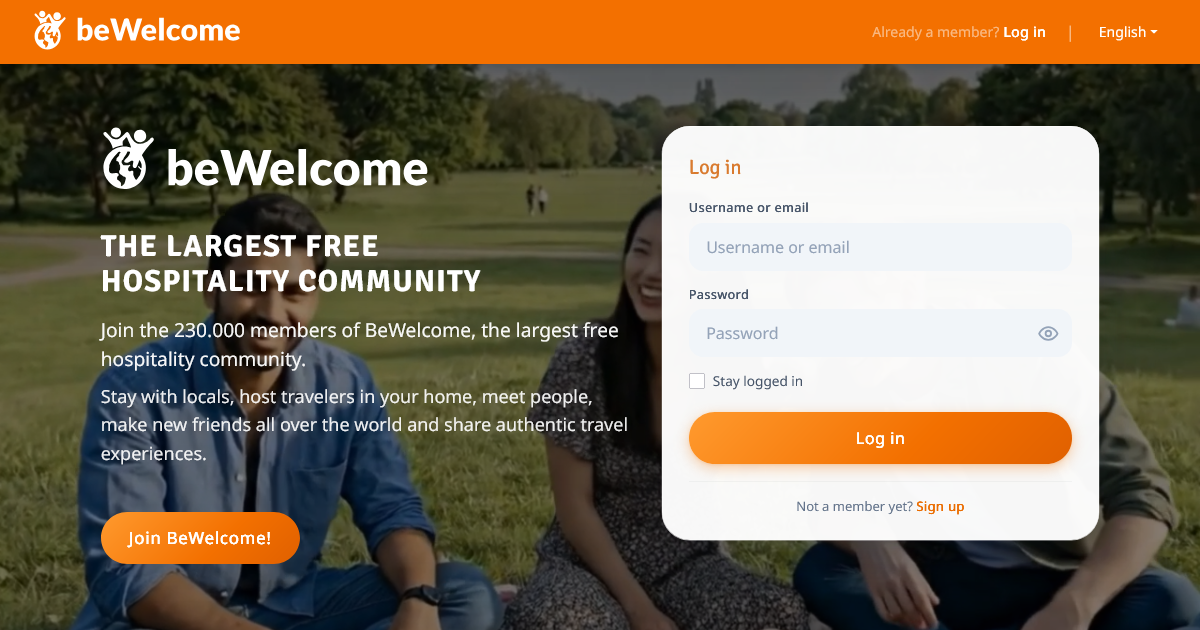

robots.txt (opens in a new tab)
0 rulesAll bots 0 allowed · 0 disallowed
- Interval
Crawl delay 10 seconds
No matching rules.
Sitemaps
1Recent Updates
- Website images
- Screenshots
- Network details
- Website Technologies
- Pages and Search Information
- HTTP Response Information
- TLS and certificates
- DNS Information
- Domain Registration
- Website profile
- Website Description
- Website Name
- Website profile
- Website Description
- Website Name
User reviews (0)